
Crabbing: Wool Yarn Setting

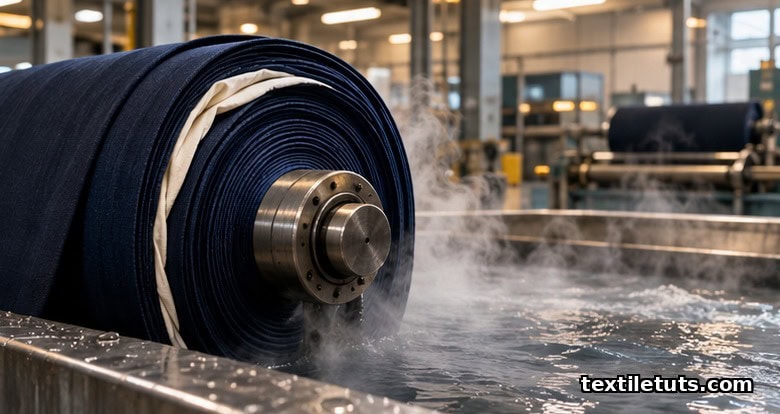
Crabbing is a hot-water wool finishing process in which tightly wound fabric rolls are immersed in water at 95 to 100°C for 10 to 30 minutes to permanently set yarn twist and lock the weave geometry of worsted wool cloth.
The process is most commonly applied to wool gabardines, twills, and other warp-faced worsted constructions where the weave structure must remain dimensionally stable through subsequent scouring, dyeing, and finishing. Crabbing is the first setting step in the worsted finishing sequence, and it predates every wet chemistry process that follows it.
In the sections below, we walk through what crabbing does to wool fiber and yarn, how a mill actually runs the process, where crabbing sits relative to decatizing and other setting treatments, and how to prevent the most common crabbing defects on a worsted finishing range.
What Crabbing Does to Wool Yarn and Fabric
Crabbing relies on the hygroplastic behavior of wool keratin, the same fiber-chemistry mechanism exploited in decatizing and yarn setting. When wool fibers absorb moisture above roughly 80°C, the hydrogen bonds in the keratin matrix break and reform as the fabric dries under tension. The fabric is, in effect, “frozen” in its current geometry. Crabbing uses direct hot-water immersion on a wound roll, without the steam pressure and longer dwell times of decatizing.
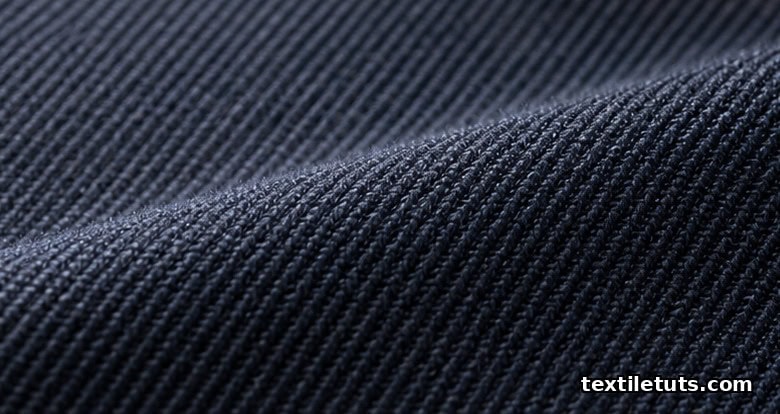
Three measurable changes occur during crabbing:
- Yarn twist is permanently set, so warp ends will not unravel or migrate during subsequent wet processing.
- Inter-yarn crimp in the weave is locked in, which reduces the fabric’s tendency to shrink, skew, or lose its crisp diagonal line.
- Surface hairiness is flattened, producing a clearer weave appearance and a firmer, more compact handle.
These changes are why wool gabardine keeps its sharp twill line, why a worsted suit fabric keeps its pressed appearance after steam finishing, and why a piece-dyed worsted accepts dye evenly across the face of the cloth.
The Crabbing Process, Step by Step
Industrial crabbing is performed on a crabbing machine (sometimes called a crabbing range or a crabbing pit). The fabric is first passed through a hot-water saturator at 90 to 95°C to pre-wet the fibers evenly, then wound under controlled tension onto a perforated or solid steel roller, the crabbing roller or beam. A cotton or jute “head cloth” is typically interleaved between the fabric layers so the roll can be unwound cleanly after the hot-water soak.
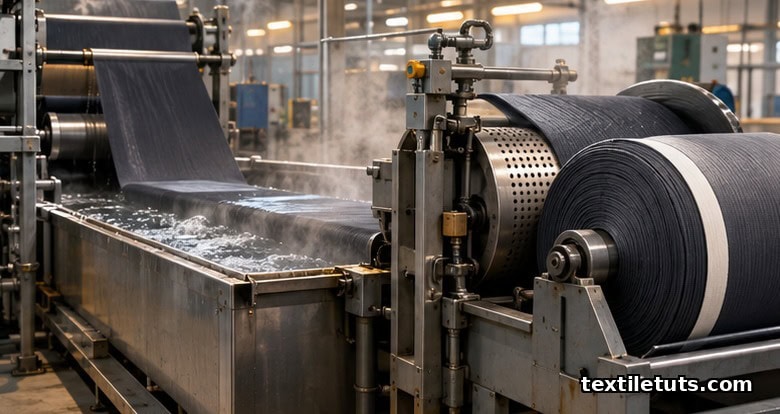
The wound roll is then immersed in a tank of near-boiling water (typically 95 to 100°C, held within ±2°C of target) for a dwell time of 10 to 30 minutes, depending on fabric weight and weave density. After the hot-water soak, the roll is removed and either cooled rapidly with a cold-water spray or allowed to cool naturally while still wound. Cooling while still wound is what fixes the yarns in their set position, so the roll is not unwound until its surface temperature drops below roughly 40°C.
Two machine variants exist:
- Roller crabbing (the classical Bradford method) — the fabric is wound onto a large steel roller with an interleaving head cloth, and the entire roll is submerged in a hot-water pit. Roller crabbing produces the most permanent set because the wound layers press against each other and hold the yarns in place during cooling.
- Belt or open-width crabbing — used on lighter fabrics, where the cloth is carried through a hot-water trough in open width, then wound hot onto a roll. Open-width crabbing is faster but produces a softer, less rigid set, and is reserved for lightweight worsteds where extreme dimensional stability is not required.
Roller crabbing remains the standard for worsted suitings, gabardines, and uniform cloths because the additional pressure on the wound layers produces a more durable set.
Why Crabbing Comes Before Other Finishing Steps
Crabbing is performed first in the wool finishing sequence because it stabilizes the fabric before any wet chemistry is applied. If a worsted gabardine were scoured, dyed, or carbonized before crabbing, the warp ends could migrate and the weave could skew, producing a fabric that loses its crisp diagonal line and its sharp appearance. Crabbing gives the rest of the finishing sequence a stable substrate to operate on.
A typical worsted finishing sequence runs: crabbing, scouring, milling (if a soft finish is required), piece dyeing, drying, decatizing, pressing, cropping, and final inspection. Crabbing sits between the greige (loom-state) cloth and the first wet chemistry, so every downstream process operates on a fabric whose weave geometry is already locked in. For pure worsteds that will be piece-dyed, crabbing also flattens the warp floats so dye uptake is uniform across the face of the cloth.
Crabbing vs Decatizing: How They Differ
Crabbing and decatizing are both wool setting processes, but they serve different purposes and use different mechanisms. Crabbing uses direct hot-water immersion on a wound roll; decatizing uses saturated steam on a wound roll wrapped in a cotton cover. The two processes are complementary rather than redundant, and a typical worsted suiting is crabbed first and decatized later in the finishing sequence.
| Property | Crabbing | Decatizing |
|---|---|---|
| Heat medium | Hot water, 95 to 100°C | Saturated steam, 100 to 130°C |
| Form of fabric | Wound roll under water | Wound roll with cotton wrapper, in steam |
| Primary effect | Sets warp twist and locks weave geometry | Sets fabric flatness, finish, and luster |
| Position in sequence | First, after greige inspection | Late, after dyeing and drying |
| Typical dwell time | 10 to 30 minutes | 3 to 10 minutes (batch) or seconds (continuous) |
| Equipment | Crabbing pit with circulating hot water | Batch decatizer (KD) or continuous decatizing stenter |
Crabbing sets the geometry. Decatizing sets the surface finish. A mill that skipped crabbing on a gabardine would see the diagonal line drift during dyeing; a mill that skipped decatizing would see a soft, lifeless surface on the finished cloth.
Common Crabbing Defects and How Mills Prevent Them
The most common crabbing defect is uneven setting, which appears as patches of unstable weave that distort during subsequent wet processing. Causes include uneven winding tension, insufficient dwell time, or water that is not at uniform temperature throughout the tank. Mills prevent uneven setting by maintaining a constant winding tension (typically 8 to 15 N/cm of fabric width), using a circulating hot-water system to hold the bath within ±2°C of target, and verifying the roll’s core temperature with a probe before removing the roll from the tank.
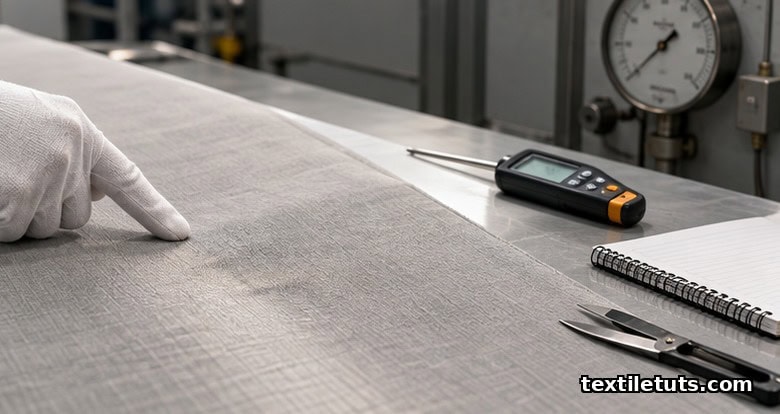
Other recurring defects include:
- Yellowing — caused by prolonged exposure at the upper temperature limit, especially on white or pale-shade cloths. Mills cap the dwell time and lower the bath to 90°C for whites and pale shades.
- Surface marks from the head cloth — minimised by using a clean cotton wrapper for each batch and inspecting the wrapper before winding.
- Excessive stiffness — caused by over-setting or insufficient cooling. The roll must cool below 40°C before it is unwound, or the set will relax back out of position.
- Edge marks and roll creases — caused by uneven cooling on a roll that is unwound too hot, or by a roll that has been stacked before cooling is complete.
Standard QC tests (pH of aqueous extract per ISO 4918, dimensional stability per AATCC TM 8, and similar protocols in the mill’s ISO/ASTM quality plan) are run on the crabbed cloth before it moves to scouring and dyeing.
Frequently Asked Questions
What temperature is used for crabbing wool?
Crabbing is performed at 95 to 100°C in near-boiling water. White and pale-shade fabrics are typically crabbed at the lower end (90 to 95°C) to prevent yellowing, while darker worsteds and gabardines can be crabbed at the full 100°C for a more permanent set. The bath temperature is held within ±2°C of target throughout the dwell time using a circulating hot-water system.
Is crabbing the same as setting?
No. Crabbing is one specific setting process; “setting” is the general term for any process that stabilizes wool fabric geometry. Decatizing, blowing, and crabbing are all setting processes, but only crabbing uses direct hot-water immersion on a wound roll. The Woolmark Company’s technical bulletins treat crabbing and decatizing as distinct processes that complement each other in a worsted finishing sequence.
Which fabrics need crabbing?
Worsted wool gabardines, twills, and serge fabrics benefit most from crabbing because their warp-faced weave structures are most sensitive to distortion in wet processing. Woolen fabrics with a soft, raised finish are typically not crabbed, because the process would flatten the raised surface. Lightweight worsteds may use open-width crabbing or skip crabbing altogether in favor of a single decatizing pass at the end of finishing.
Can crabbing be done on wool yarn rather than fabric?
Crabbing is almost always performed on woven fabric, not on loose yarn. Loose yarn setting is called yarn setting or twist setting, and is performed on a different machine (a yarn-setting autoclave or a continuous steam setter). The mechanism is the same — heat and moisture relax and reset the keratin hydrogen bonds — but the equipment and processing conditions differ enough that yarn setting is treated as a separate process in mill planning.
What is the dwell time for crabbing?
Typical industrial crabbing dwell times range from 10 to 30 minutes, depending on fabric weight, weave density, and the desired degree of set. A 200 g/m² wool gabardine typically runs 15 minutes; a heavier 400 g/m² overcoating may run 25 to 30 minutes. The Woolmark Company recommends a minimum of 10 minutes for any worsted construction to ensure uniform heat penetration through the wound roll.
References
- International Organization for Standardization. ISO 4918:2016 — Textiles — Determination of pH of aqueous extract. iso.org — Standard test method referenced in wool finishing QC for crabbed cloth.
- ASTM International. ASTM D461 — Standard Test Methods for Felt. astm.org — Standard referenced for wool felt and wool fabric dimensional stability testing.
- American Association of Textile Chemists and Colorists. AATCC TM 8 — Colorfastness to Crocking: AATCC Crockmeter Method. aatcc.org — AATCC test method cited in worsted finishing QC after crabbing and dyeing.
- The Woolmark Company. Wool Processing: Worsted Yarn to Finished Fabric (technical bulletin). wool.com — Industry reference describing crabbing and decatizing in the worsted finishing sequence.
- ResearchGate. Permanent Setting of Wool Keratin by Hot-Water Treatment (review article). researchgate.net — Peer-reviewed review of wool setting processes including hot-water crabbing.
- ScienceDirect. Wool: Science and Technology — Chapter on Wool Finishing. sciencedirect.com — Reference text covering wool setting mechanisms including hot-water crabbing and steam decatizing.
- MDPI. Textiles — Special issue on wool and keratin fiber processing (open-access journal). mdpi.com — Peer-reviewed source for keratin hydrogen-bond behavior under hot-water treatment.
This article is the working reference for crabbing wool yarn setting. Editorial by Shahrukh Islam, TextileTuts. Sources: ISO, ASTM, AATCC, The Woolmark Company, ResearchGate, ScienceDirect, and MDPI as cited.


