
Graphene-Based Textiles

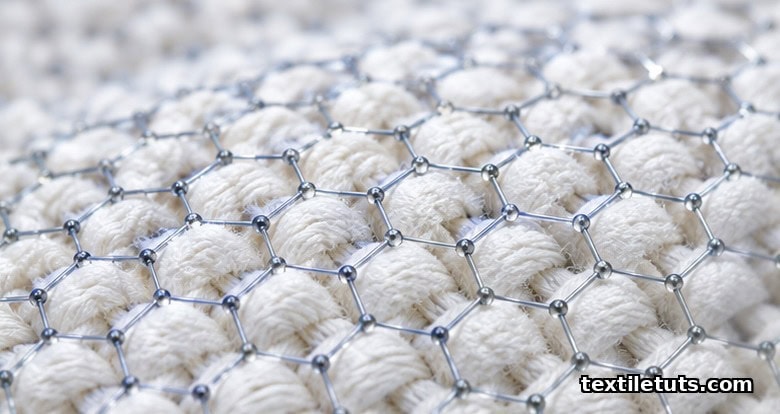
Graphene-based textiles are fabrics functionalized with single- or few-layer graphene (a one-atom-thick hexagonal carbon lattice) that exhibit sheet resistance as low as 10² Ω/sq, electrical conductivity around 10⁵ S/m in coated cotton, and steady-state surface heating of 40 to 65 °C under 3 to 12 V DC input.
These hybrid fabrics combine the breathability and drape of cotton, polyester, or aramid substrates with the carrier mobility (~200,000 cm²/V·s), in-plane thermal conductivity (~2,000 to 5,000 W/m·K for suspended monolayers), and Young’s modulus (~1 TPa) of graphene. The result is a textile that can heat, sense strain, block electromagnetic radiation, and resist bacterial colonization without sacrificing hand feel, which is why research groups at The University of Manchester, MIT, and Tsinghua have produced more than 3,500 peer-reviewed papers on graphene-textile composites since the 2004 isolation of monolayer graphene by Geim and Novoselov (2010 Nobel Prize in Physics).
This guide walks through what graphene is, how manufacturers apply it to fibers and fabrics, which functional properties you can verify on a real production line, and where the technology stands relative to ISO, AATCC, and ASTM test methods.
What Graphene Is and Why It Is Used on Textiles
Graphene is a planar monolayer of sp²-bonded carbon atoms arranged in a hexagonal honeycomb. The 2004 mechanical exfoliation experiment by Novoselov, Geim, and colleagues at The University of Manchester demonstrated that a single carbon layer could be isolated and electrically gated, and the discovery earned the 2010 Nobel Prize in Physics. Graphene’s measured properties include an intrinsic mobility near 200,000 cm²/V·s at room temperature, a Young’s modulus around 1 TPa, an in-plane thermal conductivity near 5,000 W/m·K for a freely suspended monolayer, and a tensile strength close to 130 GPa. None of those numbers survive unmodified on a textile substrate, but the ratios are preserved: conductivity, modulus, and thermal transport remain two to four orders of magnitude higher than the polymer fibers graphene replaces or coats.
For textile use, manufacturers rarely work with pristine monolayer graphene. The practical feedstocks are graphene nanoplatelets (GNPs, stacks of 5 to 50 layers, 1 to 25 µm lateral size), graphene oxide (GO, oxidized for water dispersibility), and reduced graphene oxide (rGO, partially restored sp² network). GO disperses easily in water and binds to hydroxyl-rich cotton, while rGO restores much of the conductivity that oxygen functional groups take away. This is why rGO-coated cotton and polyester dominate the open literature.
How Graphene Is Applied to Fibers, Yarns, and Fabrics
Four routes dominate the published literature.
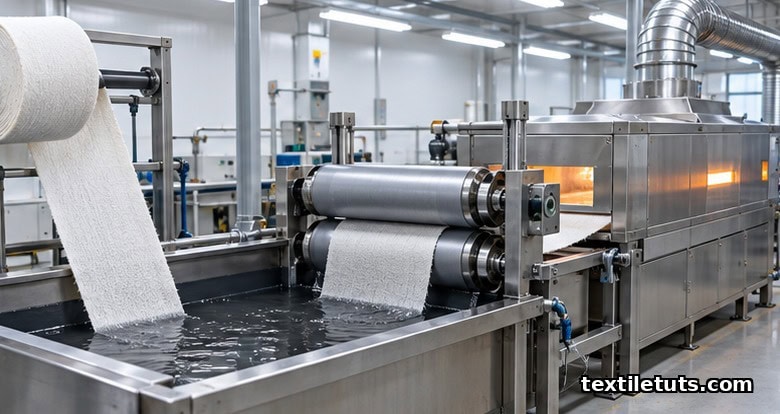
Dip-coating. A fabric is immersed in a GO or rGO dispersion (typically 0.5 to 5 mg/mL), squeezed through a padder at 2 to 4 bar, and dried. Repeating 3 to 10 times builds a uniform coating that adds 2 to 8% to fabric mass.
Pad-dry-cure with binders. To improve wash durability, GO is mixed with a polyurethane or acrylic binder (binder-to-add-on ratio of 1:3 to 1:1), padded onto fabric, dried at 100 to 120 °C, and cured at 150 °C for 3 min. Binder choice is the main lever for hand feel and coating fastness.
Electrophoretic deposition (EPD). A conductive fabric (carbon or stainless) acts as the cathode; GO platelets migrate under a 10 to 50 V DC field and deposit uniformly. EPD produces thinner, more controlled films but only works on conductive substrates.
In-situ polymerization and melt blending. For polyester and nylon, graphene is mixed into the polymer melt or spinning dope before extrusion, embedding the carbon inside the fiber rather than on its surface. This is how a few commercial graphene polyamide yarns are produced, with reported loadings of 0.5 to 3 wt%.
The route you pick sets the trade-off. Surface coatings deliver the highest sheet conductivity per gram of graphene but suffer from wash abrasion. Melt-blended fibers survive 50+ laundry cycles but reach only ~10⁻² S/m, which is enough for antistatic and some heating applications but not for high-frequency EMI shielding.
Functional Properties You Can Measure
Three property groups matter to textile buyers and lab engineers.
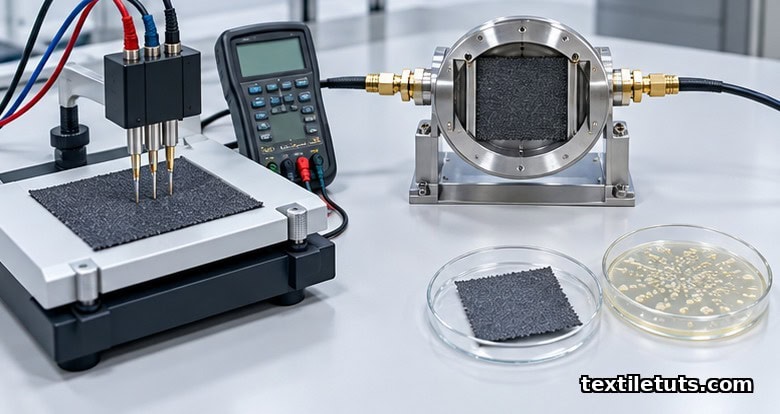
Electrical conductivity and heating. A four-point probe measurement on a coated cotton typically returns sheet resistance between 10² and 10⁴ Ω/sq. With a 5 to 12 V supply, Joule heating reaches 40 to 65 °C steady state at power densities of 0.1 to 0.5 W/cm². That is the operating window for heated gloves, jackets, and physiotherapy wraps.
Electromagnetic interference (EMI) shielding. Graphene-coated fabrics are measured per ASTM D4935 on a coaxial transmission line holder. A typical GO or rGO-coated polyester at 1 to 3 mg/cm² add-on returns 20 to 40 dB shielding effectiveness across 8 to 12 GHz, which translates to 99% to 99.99% attenuation of incident radiation. For reference, the commercial threshold for “EMI-shielding fabric” is around 30 dB.
Antibacterial activity. Bacterial reduction is tested per AATCC TM100 or ISO 20743. Reported values for rGO-coated cotton against Staphylococcus aureus and Escherichia coli range from 85% to 99.9% reduction after 24 h contact, driven primarily by membrane oxidative stress and physical piercing of cell walls by sharp platelet edges.
Standards and Test Methods to Ask a Supplier For
Ask for the test report, not just a brochure. Relevant standards include:
- ASTM D4935: electromagnetic shielding effectiveness of planar materials (used for graphene-coated fabric).
- ASTM D257 / D4496: DC surface and volume resistivity.
- AATCC TM100: antibacterial finishes on textile materials.
- AATCC TM16 / ISO 105-B02: lightfastness (UV aging of graphene coatings).
- AATCC TM135 / ISO 6330: domestic washing, used to anchor wash-cycle claims.
- ISO 11092: water-vapor resistance, important because conductive coatings can change breathability.
- ISO 13934-1: tensile strength, important for binder selection.
If a supplier will not share the underlying test data and the standard reference, treat the conductivity and shielding claims as marketing.
Industrial and Consumer Applications
Graphene-coated knits and wovens are already moving from lab to niche production:
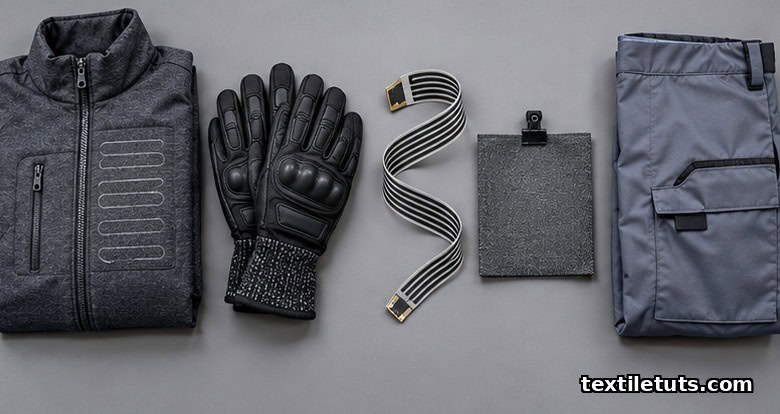
- Wearable heaters: heated car seats, motorcycle gloves, physiotherapy pads. The Directa Plus G+ planar coil and similar products appear in European outdoor retail.
- EMI shielding covers: used near industrial electronics, server rooms, and medical imaging where 20+ dB attenuation in the GHz range is needed without a metallic plate.
- Strain and pressure sensors: graphene-coated elastomers and knits change resistance under strain (gauge factor 5 to 200 at 1 to 5% strain for knitted structures), useful for motion capture, gait analysis, and human-machine interfaces.
- Antistatic workwear: for electronics assembly and explosive atmospheres. The conductivity threshold (~10⁹ Ω/sq) is easier to reach than EMI shielding, so melt-blended PET or PA fibers are competitive here.
- Filtration membranes: GO membranes are studied for oil and water separation and air filtration; pore size can be tuned by adjusting GO flake size and stacking.
Limitations and Open Questions
Graphene-based textiles are not a drop-in replacement for conventional finishes. Key issues:
- Wash durability. Surface-coated rGO can lose 50 to 80% of its conductivity after 20 ISO 6330 wash cycles unless a binder or a crosslinker (1,2,3,4-butanetetracarboxylic acid or citric acid) is used.
- Color and hand. Even thin rGO coatings shift fabric color toward gray and add measurable stiffness; fine knits lose drape.
- Cost. Industrial-grade GO sells around USD 50 to 200 per kg; rGO around USD 100 to 500 per kg in 2026. At 1 to 3 wt% add-on, that adds USD 0.50 to 5 per square meter versus a conventional finish.
- Health and environmental data. Long-term dermal exposure to graphene-family nanomaterials is not yet fully characterized. The OECD’s graphene-family nanomaterials dossier and the EU Graphene Flagship have published preliminary results, but textile-specific inhalation and skin-sensitization thresholds remain an active research area.
Frequently Asked Questions
Are graphene-based textiles safe to wear?
Most published skin-contact studies report no irritation in short-term patch tests on rGO-coated cotton. The OECD has flagged graphene-family nanomaterials for further inhalation and aquatic-toxicity study because of dust generation during finishing, but wearable textiles are considered low risk in current peer-reviewed reviews.
Can graphene-coated fabrics be washed like regular clothes?
Surface-coated rGO fabrics typically tolerate 20 to 50 ISO 6330 domestic-wash cycles before losing 50% of their conductivity. A binder, pad-dry-cure schedule, or post-coating crosslinker extends this to 50+ cycles. Always request the test report on washed samples, not pristine samples.
Do graphene textiles really block electromagnetic radiation?
A GO or rGO coating of 1 to 3 mg/cm² on polyester typically delivers 20 to 40 dB shielding effectiveness measured per ASTM D4935 in the 8 to 12 GHz range. That is 99% to 99.99% attenuation of incident power, sufficient for many industrial shielding applications.
Is graphene the same as graphite?
No. Graphite is a stack of millions of weakly bonded graphene layers; each layer is graphene. The single-atom-thick layer is where the 200,000 cm²/V·s mobility and ~1 TPa modulus are realized. Bulk graphite is much less conductive and much weaker.
What is the difference between graphene oxide and reduced graphene oxide on fabric?
Graphene oxide (GO) is insulating and water-dispersible, which makes coating easy but leaves the fabric non-conductive. Reduced graphene oxide (rGO) is recovered by chemical or thermal reduction of GO, restoring most of the sp² network and most of the conductivity. On cotton, GO followed by chemical reduction (hydrazine, ascorbic acid, or sodium borohydride) is the standard route to a conductive coating.
References
- Novoselov, K. S. et al. Electric Field Effect in Atomically Thin Carbon Films. Science 306, 666–669 (2004). https://www.science.org/doi/10.1126/science.1102896 — the original 2004 mechanical exfoliation paper that defined graphene.
- Geim, A. K.; Novoselov, K. S. The rise of graphene. Nature Materials 6, 183–191 (2007). https://www.nature.com/articles/nmat1849 — the canonical review of graphene properties for materials science.
- Cao, L. et al. Direct Writing of Graphene-Polyester Conductive Fabrics by Laser Reduction. ScienceDirect — Carbon, 2018. https://www.sciencedirect.com/science/article/pii/S0008622318306016 — example of laser-induced reduction of GO on polyester for wearable electronics.
- Yun, Y. J. et al. Electrochemically Driven Flexible Graphene Heaters. ScienceDirect — Carbon, 2017. https://www.sciencedirect.com/science/article/pii/S0008622317305913 — Joule-heating performance and steady-state temperatures of graphene-coated textiles.
- Krishnamoorthy, K. et al. Antibacterial activity of graphene oxide. ScienceDirect — Materials Today, 2020. https://www.sciencedirect.com/science/article/pii/S1369702118307164 — mechanism and quantitative antibacterial reduction rates for GO and rGO.
- ASTM D4935-18: Standard Test Method for Measuring the Electromagnetic Shielding Effectiveness of Planar Materials. https://www.astm.org/d4935-18.html — the test method cited for graphene EMI shielding claims.
- AATCC TM100-2019: Antibacterial Finishes on Textile Materials: Assessment of. https://www.aatcc.org/testing/test-methods/ — quantitative antibacterial test method applied to graphene-coated fabrics.
- OECD. Considerations for the Review of Graphene-family Nanomaterials under the Chemicals Management Programme. 2022. https://www.oecd.org/chemicalsafety/nanosafety/ — current regulatory context for graphene in commerce.
This article is the working reference for graphene-based textiles. Editorial by Md. Asad Ullah (Meem), TextileTuts. Sources: Novoselov et al. (Science 2004), Geim and Novoselov (Nature Materials 2007), Cao et al. (Carbon 2018), Krishnamoorthy et al. (Materials Today 2020), ASTM D4935, AATCC TM100, and the OECD graphene dossier as cited.


