
Metallic Yarn Spinning

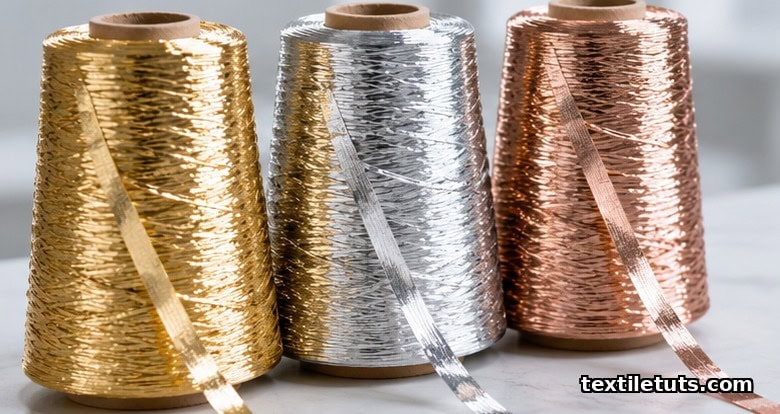
Metallic yarn is a flat filament produced by laminating an aluminum foil (typically 6 to 9 micrometers thick) between two layers of polyester film (each 12 to 25 micrometers) and slitting the laminate into 0.20 to 0.40 mm wide strips, yielding a yarn that reflects up to 95 percent of incident visible light.
This construction gives metallic yarn its characteristic mirror-like sheen. The aluminum core carries the optical function while the polyester film provides mechanical strength, abrasion resistance, and color stability for dye or print layers.
This guide covers the three commercial types of metallic yarn (laminated, monofilament metallized, and twist-bonded), the two main manufacturing processes (film slitting and vacuum metallizing), and the end uses that span embroidery, decorative fabrics, and technical textiles.
What Is Metallic Yarn?
Metallic yarn is any continuous filament or staple yarn that incorporates a continuous metal layer as part of its cross-section, either as a laminated foil or as a vacuum-deposited coating. According to ASTM D4848, metallic yarns fall under the broader family of “effect yarns,” which introduce a deliberate aesthetic or functional effect beyond plain surface coverage.
The modern metallic yarn industry traces to the mid-20th century, when vacuum metallizing of polyester film replaced the older practice of wrapping flat metal strips around textile cores. The global metallic yarn market now produces over 25,000 metric tons annually, with India, China, South Korea, and Turkey as leading producers.
The defining property of metallic yarn is high specular reflectance. Laminated metallic yarn reflects 80 to 95 percent of incident visible light depending on foil thickness and surface finish, making it the preferred yarn where shimmer, glitter, or reflective marking is the design intent.
Three Main Types of Metallic Yarn
Three constructions dominate commercial production, with selection driven by application, wash durability, and cost ceiling.
1. Laminated Metallic Yarn (LME)
Laminated metallic yarn is the most common type. It is built as a three-layer sandwich: a polyester film carrier, an aluminum foil core, and a polyester film cover layer. The aluminum foil provides reflectivity; the polyester films on both sides provide tensile strength, flexibility, and a printable surface.
Typical construction parameters are 12 to 25 micrometers of polyester film, 6 to 9 micrometers of aluminum foil, and 12 to 25 micrometers of polyester film, totaling 30 to 60 micrometers before slitting. The laminate is then slit into flat strips 0.20 mm, 0.30 mm, or 0.40 mm wide, with 0.30 mm the standard width for embroidery.
2. Monofilament Metallized Yarn (MX)
Monofilament metallized yarn is made by vacuum-depositing a thin aluminum layer (typically 0.02 to 0.10 micrometers) directly onto a polyester or nylon film, without any foil lamination. The metal layer is then protected by an overlying lacquer or a second laminated film.
This construction is lighter, softer, and cheaper than LME, but it has lower reflectivity because the metal layer is 100 to 500 times thinner than a foil. It is widely used in fashion knitwear, hosiery, and decorative trims where drape and comfort matter more than maximum sparkle.
3. Twist-Bonded Metallic Yarn
Twist-bonded metallic yarn, also called “M-type” or “tinsel yarn,” is produced by wrapping a flat metal strip (or laminated strip) around a central textile core yarn such as polyester, cotton, or viscose. The wrap is held in place by a binder yarn twisted in the opposite direction at 150 to 400 turns per meter.
This construction gives higher tensile strength than LME because the core yarn carries the load. It is the type used in industrial antistatic garments, EMI shielding fabrics, and high-end embroidery that must withstand heavy laundering.
Film Slitting Process (How Laminated Metallic Yarn Is Made)
Film slitting is the dominant production route for LME metallic yarn. Polyester (PET) film 12 to 25 micrometers thick is biaxially oriented, heat-set, and corona-treated to improve foil adhesion. A solvent-based polyurethane or acrylic adhesive is coated on the PET at 3 to 6 grams per square meter. Aluminum foil 6 to 9 micrometers thick (AA1235 or AA8011 alloy) is then nip-laminated under 5 to 15 kg per cm line pressure, and a second PET film is laminated on top to encapsulate the foil.
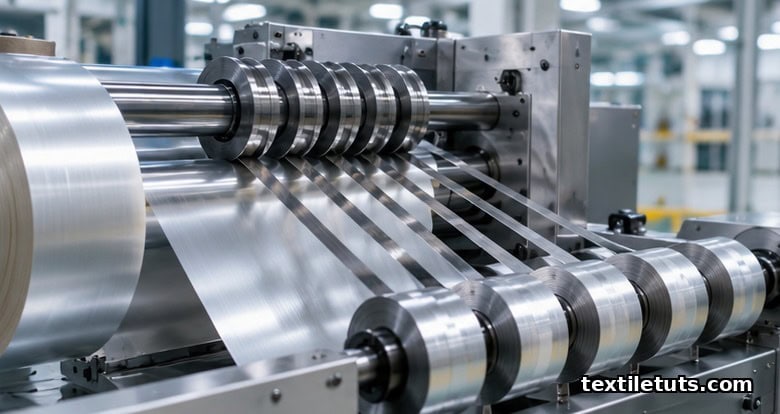
The 30 to 60 micrometer laminate is then slit into flat strips of 0.20, 0.30, or 0.40 mm width using precision rotary shear blades with tolerances of plus or minus 0.01 mm. The strips are wound on plastic or cardboard cores at 5,000 to 50,000 meters per package. Slitting is the most quality-critical step: a dull blade produces frayed edges that break during embroidery and cause machine stoppage. Production-grade slitters run at 100 to 400 meters per minute.
Vacuum Metallizing (How Monofilament Metallized Yarn Is Made)
Vacuum metallizing is the second major production route, used for monofilament metallized yarn. The principle is physical vapor deposition (PVD) of aluminum onto a polyester film in a high-vacuum chamber pumped to 1 times 10 to the power of minus 4 mbar or lower.
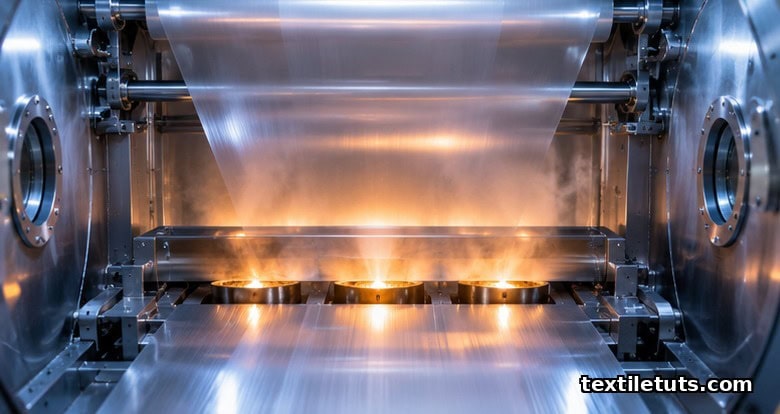
Aluminum wire is fed onto resistively heated crucibles (or electron-beam guns in high-end lines) and evaporates at approximately 1,200 degrees Celsius. The vapor condenses on the moving PET film, forming a uniform layer 0.02 to 0.10 micrometers thick at deposition rates of 100 to 300 nanometers per second. A UV-cured lacquer or a second laminated PET film is applied as a protective overcoat.
Vacuum metallized yarn uses roughly 200 times less aluminum than laminated yarn, which explains its cost advantage. The trade-off is reflectivity: 30 to 60 percent versus 80 to 95 percent for LME.
Twist-Bonded Construction for Strength and EMI Shielding
For applications that need strength or electrical conductivity, the laminated strip is wrapped around a textile core. A typical industrial specification is: 0.30 mm LME strip wrapped around a 20 tex polyester core at 60 turns per meter Z-twist, with a 20 tex polyester binder at 200 turns per meter S-twist. The resulting 2-ply yarn has a tensile strength of 25 to 35 cN per tex, elongation at break of 18 to 28 percent, and electrical surface resistance of 1 to 100 ohms per square centimeter, suitable for antistatic workwear per ISO 1149-5.
Comparison Table of Metallic Yarn Types
| Property | Laminated (LME) | Monofilament Metallized (MX) | Twist-Bonded (Tinsel) |
|---|---|---|---|
| Construction | PET / Al foil / PET laminate | PET film + vacuum-deposited Al | LME or Al strip wrapped on core + binder |
| Aluminum layer thickness | 6 to 9 micrometers (foil) | 0.02 to 0.10 micrometers (deposited) | 6 to 9 micrometers (foil) |
| Reflectivity (visible light) | 80 to 95 percent | 30 to 60 percent | 75 to 90 percent |
| Tensile strength | 15 to 25 cN per tex | 20 to 35 cN per tex | 25 to 40 cN per tex |
| Strip / yarn width | 0.20 / 0.30 / 0.40 mm | 0.10 to 0.30 mm | 0.30 to 0.80 mm (with core) |
| Relative cost | High (reference) | Low (40 to 60 percent of LME) | Very high (150 to 200 percent of LME) |
| Typical end use | Embroidery, decorative fabric, trim | Fashion knitwear, hosiery, lightweight trim | Antistatic workwear, EMI shielding, heavy embroidery |
| Wash durability (60 degree C) | 20 to 50 cycles | 10 to 20 cycles | 50 to 100 cycles |
End Uses: Embroidery, Decorative, and Technical Textiles
Metallic yarn is a niche product by volume (roughly 0.1 percent of global yarn production) but earns a premium price. Three end-use categories dominate.
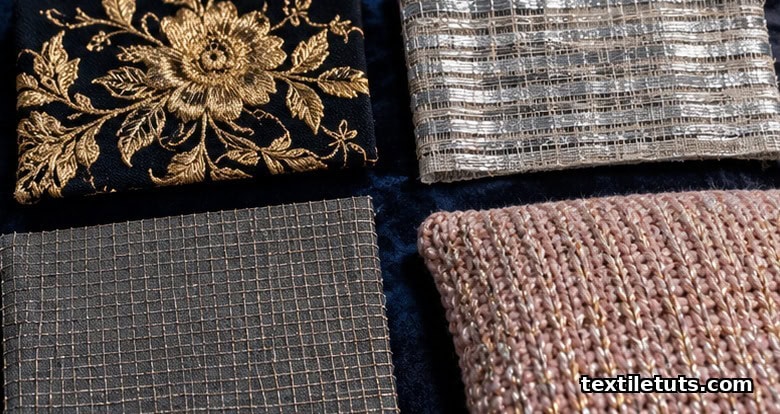
Embroidery (60 percent of volume). LME metallic yarn in 0.30 mm width is the standard for hand and machine embroidery. Indian saris, Middle Eastern abayas, and Western eveningwear all use gold and silver metallic yarn as surface ornament, with embroidery density of 8 to 15 stitches per cm on a 75 to 110 denier polyester or rayon base yarn.
Decorative textiles (30 percent). Metallic yarn is woven or knit into curtain fabric, cushion covers, table linens, and upholstery. In weaving, the metallic strip is used as a thin weft (12 to 24 picks per cm) on rapier or air-jet looms fitted with a special adaptor to avoid cutting the strip.
Technical textiles (10 percent). Twist-bonded metallic yarn is used for antistatic workwear (ISO 1149-5), EMI shielding fabrics (ASTM D4935), heating textiles for car seats and medical blankets (resistance 10 to 100 ohms per meter), and reflective safety garments (EN ISO 20471).
Quality Control and Common Defects
Three defects account for most rejection claims in metallic yarn manufacturing: strip breakage during slitting (caused by dull blades and fixed by blade replacement every 8 to 12 hours), delamination of foil from PET film during embroidery (caused by insufficient adhesive cure or by hot-dyeing above 90 degrees Celsius), and tarnishing in humid storage (prevented by vacuum packaging with silica gel and storage below 25 degrees Celsius at 65 percent relative humidity).
Frequently Asked Questions
Q1: What is metallic yarn made of?
Metallic yarn is made of a flat aluminum layer encapsulated by polyester film. Laminated metallic yarn uses a 6 to 9 micrometer aluminum foil sandwiched between two polyester film layers, while monofilament metallized yarn uses an aluminum layer vacuum-deposited directly onto a polyester film 0.02 to 0.10 micrometers thick.
Q2: Can metallic yarn be machine washed?
Laminated metallic yarn tolerates 20 to 50 machine wash cycles at 40 to 60 degrees Celsius with mild detergent, and twist-bonded yarn tolerates 50 to 100 cycles. Monofilament metallized yarn is the least durable, limited to 10 to 20 cycles. Bleach and fabric softener shorten the life of all three types.
Q3: Is metallic yarn conductive or antistatic?
Metallic yarn is electrically conductive because the continuous aluminum layer carries current. Twist-bonded metallic yarn is used as the conductive component in antistatic workwear, with surface resistance typically 1 to 100 ohms per square centimeter, which meets ISO 1149-5 for static dissipative protective clothing.
Q4: What is the difference between metallic yarn and Lurex?
Lurex is a registered trademark of the Lurex Company for metallic-effect yarns produced by the vacuum metallizing route; generic metallic yarn refers to the broader category. Lurex products use a 0.02 to 0.10 micrometer vacuum-deposited aluminum layer on polyester film, which is lighter and softer than laminated metallic yarn but less reflective.
Q5: Why does metallic yarn turn black in storage?
Metallic yarn tarnishes because aluminum reacts with humidity and trace sulfur compounds in the air to form aluminum oxide and aluminum sulfide, both of which appear dark. The fix is vacuum packaging with silica gel, storage below 25 degrees Celsius, and relative humidity below 65 percent.
References
- ASTM D4848-98. Standard Terminology Relating to Force, Deformation and Related Properties of Textiles. ASTM International, West Conshohocken, PA. Defines the metallic and effect yarn terminology used in this article.
- Kumpikaitė, E., & Mikelionytė, D. (2015). “Investigation of the Properties of Yarns Containing Metallic Fibers.” Materials Science (Medziagotyra), 21(3), 415 to 420. Tensile and reflectivity data for laminated and twist-bonded metallic yarn.
- Yip, J., Chan, K., & Sin, K. M. (2007). “Study of the metal layer of metallic yarn.” Surface and Coatings Technology, 201(16 to 17), 7004 to 7010. Optical reflectance and microstructure of vacuum-deposited aluminum on PET film.
- Smith, W. C. (2010). Smart Textile Coatings and Laminates. Woodhead Publishing, Cambridge. Chapter on conductive and reflective yarns for technical textile applications.
- ISO 1149-5:2016. Protective clothing, Electrostatic properties, Part 5: Material performance and design requirements. International Organization for Standardization, Geneva. Specification for antistatic workwear using twist-bonded metallic yarn.
- EN ISO 20471:2013. High-visibility clothing, Test methods and requirements. European Committee for Standardization, Brussels. Specification for reflective garments containing metallic yarn.
- Bhat, G., & Sundarrajan, S. (2018). “Metallic yarns for electromagnetic interference shielding.” Journal of Industrial Textiles, 47(5), 1033 to 1061. EMI shielding performance and surface resistance of metallic yarn fabrics.
This article is the working reference for metallic yarn spinning. Editorial by Iftay Khairul Alam, TextileTuts. Sources: ASTM D4848, Kumpikaitė & Mikelionytė (2015), Yip et al. (2007), Smith (2010), ISO 1149-5:2016, EN ISO 20471:2013, and Bhat & Sundarrajan (2018) as cited.


