
Glass Fiber Spinning

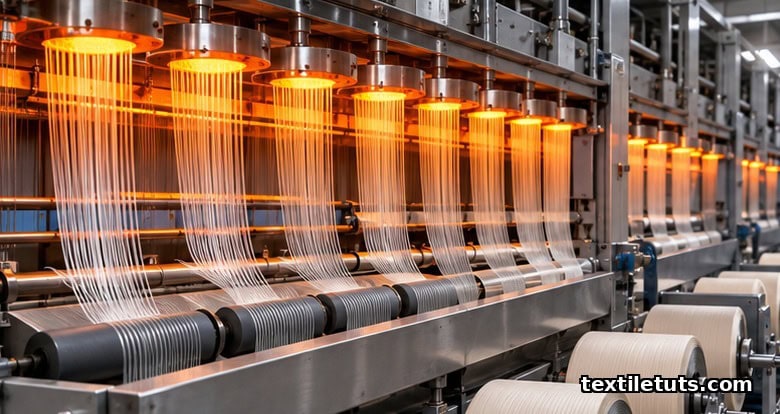
Glass fiber spinning is a continuous filament drawing process in which molten glass at 1,180 to 1,250 degrees Celsius is attenuated through a platinum-rhodium bushing of 200 to 6,000 holes to produce filaments with diameters of 5 to 24 micrometers and a linear density of 1.7 to 73 tex per filament bundle.
Continuous glass filaments are the dominant reinforcement form for composite textiles, with global production reaching 7.6 million tonnes in 2024 across E, S, C, and AR glass chemistries.
This guide covers the four major glass chemistries, the marble and direct-melt drawing routes, filament diameter control, sizing chemistry, and the three largest textile end uses for spun glass fibers.
What Is Glass Fiber Spinning?
Glass fiber spinning is the industrial conversion of molten silicate glass into continuous filaments by mechanical attenuation. Unlike staple fiber spinning of cotton or wool, glass is spun from a fully molten inorganic melt rather than from a polymer solution or dope. The precursor is molten glass held at 1,180 to 1,250 degrees Celsius in a refractory bushing, and filaments form when gravity and a high-speed winding pull a thin stream of melt through each nozzle in the bushing plate.
The most common process is continuous filament drawing. Molten glass issues from the bushing at a flow rate of 0.4 to 1.0 grams per minute per hole, cools to a solid filament in 0.1 to 0.5 milliseconds, and is wound at 1,500 to 4,000 meters per minute onto a forming package. Multiple filaments are gathered into a strand by a sizing applicator that coats each filament with 0.5 to 2.0 percent by mass of a starch-oil or silane-based size, which protects the fiber against abrasion during downstream textile processing.
Glass fibers are inorganic, amorphous, and isotropic, with a density of 2.5 to 2.6 grams per cubic centimeter, depending on the glass chemistry. They do not burn, do not absorb water (moisture regain below 0.1 percent), and lose strength only above 400 degrees Celsius, which is why the bulk of spun glass fiber production goes into fire protection, filtration, and electrical insulation textiles.
The Four Major Glass Fiber Chemistries
The glass composition controls the fiber’s tensile strength, temperature resistance, chemical durability, and cost. Four chemistries dominate commercial production.
E-glass (electrical glass) is the dominant general-purpose reinforcement and accounts for roughly 90 percent of global continuous filament production. Its calcium-alumino-borosilicate composition delivers a tensile strength of 3.4 to 3.8 gigapascals and a softening point near 850 degrees Celsius, with a density of 2.54 grams per cubic centimeter.
S-glass (structural glass) is a magnesium-alumino-silicate composition used where higher tensile strength and temperature resistance are required. Its tensile strength of 4.6 to 4.9 gigapascals is 35 percent higher than E-glass, with a density of 2.49 grams per cubic centimeter. S-glass is more expensive and is used in aerospace, defense, and high-performance composite fabrics.
C-glass (chemical glass) is formulated for acid resistance and is used in chemical filtration fabrics, battery separators, and roofing mats. Its sodium-calcium-borosilicate chemistry tolerates acidic environments where E-glass would degrade, and it carries a slightly higher density of 2.55 grams per cubic centimeter.
AR-glass (alkali-resistant glass) contains at least 16 percent zirconium oxide and is the only glass fiber that resists the alkaline pore water in Portland cement. AR-glass is the standard reinforcement for glass-fiber-reinforced concrete and is spun into alkali-resistant scrim fabrics.
Filament Drawing: From Melt to Package
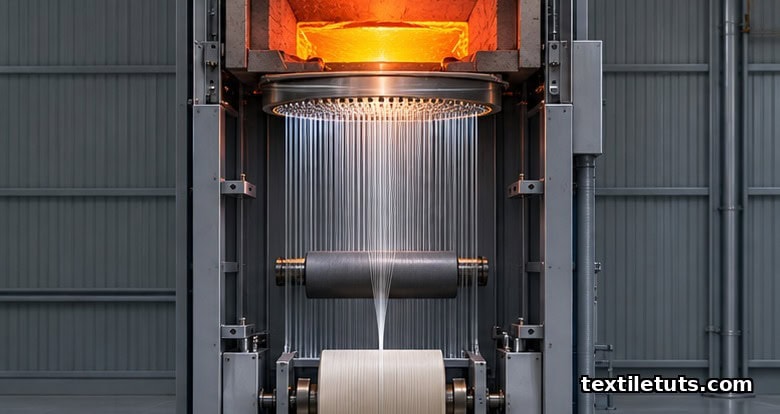
The continuous filament drawing process has seven sequential steps, beginning with raw material batching and ending with a wound package of sized yarn.
Step 1, batching. Silica sand, limestone, kaolin, dolomite, and borax are weighed to the target composition and dry-mixed. Batch tolerances below 0.5 percent are required because small composition shifts change fiber viscosity and tensile strength.
Step 2, melting. Batch is fed into a gas- or electric-fired furnace at 1,400 to 1,600 degrees Celsius. Most modern plants use recuperative or oxy-fuel furnaces that cut natural gas use by 30 to 50 percent relative to older designs.
Step 3, bushing attenuation. Molten glass flows from the forehearth into a platinum-rhodium alloy bushing plate. Bushings contain 200 to 6,000 holes, each 1.0 to 2.5 millimeters in diameter. Filament diameter is set by the combination of bushing hole size, melt viscosity, and drawing speed.
Step 4, cooling and attenuation. Filaments drop 0.5 to 2.5 meters through ambient air and reach a final diameter of 5 to 24 micrometers. The relationship between bushing throughput and winding speed is linear: doubling drawing speed halves filament diameter at constant mass flow.
Step 5, sizing application. Filaments pass across a graphite or ceramic applicator roll that deposits a thin film of size. Starch-oil sizes are used for reinforcement textiles that will be re-sanded and combined with polymer binders. Silane-based sizes are used for composite reinforcement where the fiber will bond directly to a polymer matrix.
Step 6, gathering. Filaments are combined into a strand by a gathering shoe. A typical 1,200-filament strand produces a yarn of 68 to 300 tex, depending on filament diameter.
Step 7, winding. The strand is wound onto a paper or plastic tube at 1,500 to 4,000 meters per minute. Modern winders apply a precision cross-wind package of 4 to 25 kilograms, ready for downstream creeling in weaving, knitting, or nonwoven forming lines.
Filament Diameter, Tex, and Yarn Numbering
Glass fiber yarn is specified by filament diameter and linear density, and both numbers matter for downstream textile performance. Diameter governs the fiber’s flexibility and the fabric’s hand: 5 to 9 micrometer filaments are classed as “fine” and are used in apparel interlinings and battery separators. Standard textile filaments fall between 9 and 17 micrometers. “Coarse” filaments above 17 micrometers are used in rovings and reinforcement mats.
The standard yarn numbering system for continuous glass yarn is tex (grams per 1,000 meters) rather than the English cotton count or metric count used for staple yarns. Common commercial glass yarn tex values are 11, 22, 33, 68, 136, 272, and 300 tex. The tex of a finished yarn is the sum of its filament tex values; a 1,200-filament bundle of 9 micrometer filaments produces a 198 tex strand, which falls between 136 and 272 tex.
A second numbering convention is the yield code (yards per pound), where higher numbers mean finer yarns. Common yield codes are 75 (very coarse), 150, 300, 600, and 1,800 (fine). The conversion is: yield in yards per pound equals 496,000 divided by tex.
Comparison Table: E-Glass vs S-Glass vs C-Glass vs AR-Glass
| Property | E-Glass | S-Glass | C-Glass | AR-Glass |
|---|---|---|---|---|
| Tensile strength (GPa) | 3.4 to 3.8 | 4.6 to 4.9 | 3.1 to 3.4 | 3.2 to 3.6 |
| Density (g/cm3) | 2.54 | 2.49 | 2.55 | 2.68 to 2.78 |
| Softening point (degrees C) | 846 | 1,056 | 750 | 880 |
| Acid resistance | Moderate | Low | High | Low to moderate |
| Alkali resistance | Low | Low | Low | High (zirconia >16%) |
| Typical filament diameter (micrometers) | 5 to 24 | 7 to 13 | 9 to 24 | 10 to 20 |
| Approximate price (USD/kg) | 1.5 to 2.5 | 15 to 25 | 2.5 to 4.0 | 3.5 to 6.0 |
| Primary end use | Reinforcement, electrical | Aerospace, defense | Filtration, roofing | Cement reinforcement |
Textile Applications of Spun Glass Fibers
Three end-use categories account for roughly 80 percent of spun glass fiber textile production.
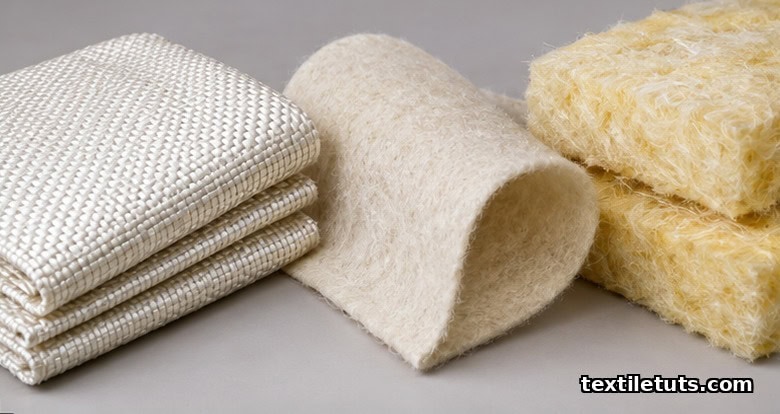
Fire protection textiles. Glass fibers do not burn, do not release toxic gas, and maintain integrity above 400 degrees Celsius, which is why they are the standard substrate for fire blankets, fire curtains, welding blankets, and high-temperature filtration bags. Fire-protective fabrics are woven or needle-punched from E-glass or S-glass filament yarns in fabric weights of 200 to 1,200 grams per square meter, often with a vermiculite or silicone coating to improve heat-shield performance.
Filtration textiles. Needled glass fiber felts and woven glass filter fabrics operate continuously at 260 to 280 degrees Celsius, with peak excursions to 320 degrees Celsius, in cement kiln, metal refining, and waste incineration bag filters. Fine diameter filaments of 5 to 9 micrometers give high collection efficiency for submicron particulates while the inherent moisture resistance keeps filtration efficiency constant in humid flue gas.
Thermal and acoustic insulation. Continuous glass filaments are chopped to 6 to 25 millimeters and formed into nonwoven mats and batts for building, appliance, and pipe insulation. The same fiber chemistry that resists fire also gives a thermal conductivity of 0.030 to 0.040 watts per meter kelvin, which is comparable to mineral wool. Glass fiber insulation batts are bonded with phenol-formaldehyde or acrylic binders at 4 to 12 percent by mass.
Two smaller but fast-growing end uses are printed circuit board substrates, where E-glass woven fabric is impregnated with epoxy resin to form copper-clad laminates, and alkali-resistant scrim fabrics for EIFS (external insulation and finishing systems) where AR-glass is the only viable reinforcement.
Glass Fiber Staple vs Continuous Filament Processing
Glass can be spun into staple fibers as well as continuous filaments, and the choice changes downstream processing. In staple processing, filaments are drawn, gathered, and immediately attenuated by a high-velocity gas jet into 8 to 25 millimeter lengths. These chopped fibers are then carded, needled, or wet-laid into nonwoven fabrics.
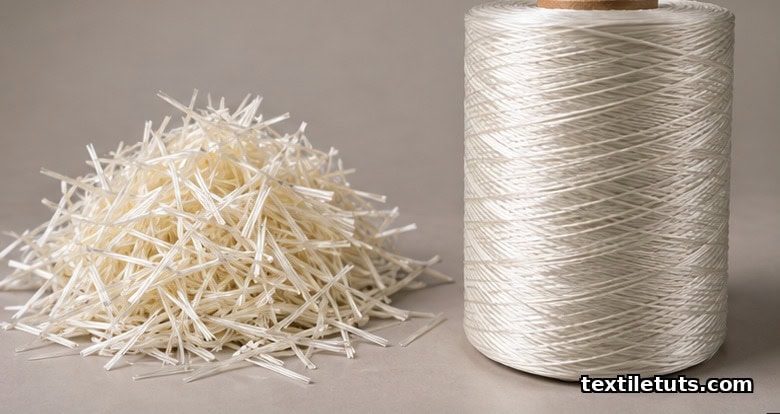
Continuous filament processing, by contrast, winds the strand directly onto a package and feeds weaving, knitting, or braiding lines that require unbroken yarn. Continuous filament yarns give higher mechanical strength because there are no fiber ends to act as stress concentrators, while staple nonwovens give better isotropic strength distribution and lower cost per square meter. Most high-temperature filtration fabrics are needled from staple glass, while most reinforcement fabrics for composites are woven from continuous filament yarn.
Frequently Asked Questions
Q1: What temperature does glass fiber spinning require?
Glass fiber spinning requires the glass melt to be held between 1,180 and 1,250 degrees Celsius in the bushing, with upstream melting furnaces running at 1,400 to 1,600 degrees Celsius. The drawing zone itself is at ambient air temperature, but the melt viscosity must be in the range of 100 to 1,000 poise to attenuate properly.
Q2: What is the difference between E-glass and S-glass fibers?
E-glass is a calcium-alumino-borosilicate composition with a tensile strength of 3.4 to 3.8 gigapascals and a softening point near 846 degrees Celsius, used for most electrical and reinforcement textiles. S-glass is a magnesium-alumino-silicate with 35 percent higher tensile strength at 4.6 to 4.9 gigapascals and a softening point above 1,050 degrees Celsius, used in aerospace and defense fabrics.
Q3: Is glass fiber safe to handle in textiles?
Continuous filament glass fiber textiles are safe to handle in their finished fabric form because the filaments are bound by size and weave structure and cannot release airborne respirable fibers. The hazard is during chopping, grinding, or downstream cutting operations, where proper respiratory protection (P2 or N95 minimum) keeps fiber dust below the 1 fiber per cubic centimeter occupational exposure limit.
Q4: Can glass fiber be dyed or colored?
Glass fiber cannot be dyed by conventional aqueous dyeing because it has no reactive sites and absorbs no water. Pigments are applied by surface coating with an acrylic, silicone, or PTFE binder during fabric finishing. The pigmented coating adds 5 to 15 grams per square meter to fabric weight and gives the same colorfastness as the underlying coating chemistry.
Q5: Why is glass fiber used in printed circuit boards?
Glass fiber woven fabric is the substrate for printed circuit boards because it combines a low coefficient of thermal expansion (5 to 6 parts per million per degree Celsius) with a dielectric constant of 6.2 at 1 megahertz and a tensile strength above 2 gigapascals. No other textile substrate matches all three properties, which is why FR-4 and similar copper-clad laminates use E-glass fabric at 70 to 200 grams per square meter as the reinforcement.
References
- Wallenberger, F.T., Bingham, P.A. Fiberglass and Glass Recycling: Science and Technology. Springer, 2009 — peer-reviewed reference on glass fiber composition, drawing, and properties.
- Akinc, M. et al. Mechanical properties of E-glass and S-glass fiber tows. Journal of Materials Science, Springer, 2015 — tensile strength and elastic modulus data for E and S glass.
- ASTM D578 – Standard Specification for Glass Fiber Strands. ASTM International — diameter, tex, and yield specifications for glass fiber yarn.
- ISO 1888:2006 — Reinforcement yarns — Determination of linear density. International Organization for Standardization — tex and yield methods for glass yarn.
- Jones, F.R. Glass Fibre Reinforcement. In: Handbook of Textile Fibre Structure, Woodhead Publishing (Elsevier), 2009 — fundamentals of glass fiber spinning and composite sizing.
- Berge, B. et al. Chemistry and Properties of Glass for High-Temperature Filtration. Industrial & Engineering Chemistry Research, ACS, 2018 — chemical and thermal resistance data for C-glass filtration fabrics.
- Paul, A. Chemistry of Glasses. 2nd Edition, Springer, 1990 — foundational reference for silicate glass composition and viscosity control.
This article is the working reference for glass fiber spinning chemistry, drawing, and textile applications. Editorial by Iftay Khairul Alam, TextileTuts. Sources: Springer (Wallenberger 2009, Jones 2009, Paul 1990), ASTM D578, ISO 1888:2006, ACS Industrial & Engineering Chemistry Research 2018 as cited.


