
Aramid (Kevlar) Yarn Spinning: From PPTA Chemistry to End Uses

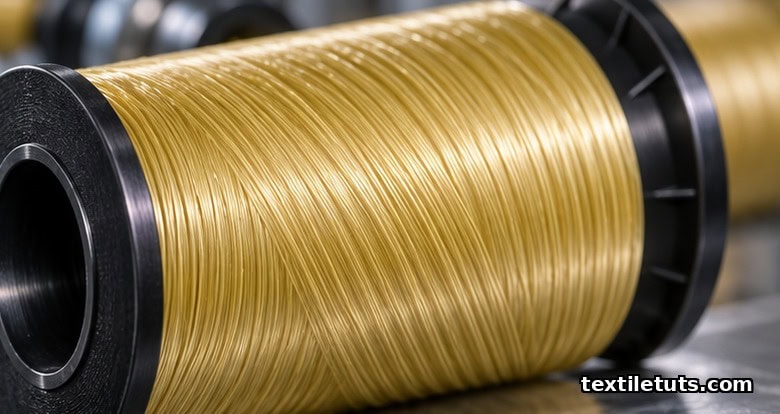
Aramid (Kevlar) yarn is dry-jet wet spun from poly-paraphenylene terephthalamide (PPTA) dissolved in 100% concentrated sulfuric acid through a 5 to 15 mm air gap into a cold coagulation bath, producing fibers with a tensile tenacity of 20 to 28 g/denier (2.0 to 2.7 GPa) and a tensile modulus of 70 to 130 GPa. Tensile strength at break is roughly five times that of steel wire on a weight-for-weight basis, while the density stays low at 1.44 g/cm³, which is the property combination that drove the first commercial aramid ballistic vest to field deployment in the 1970s.
What follows is the working reference for anyone studying or specifying para-aramid yarn: the polymer chemistry that makes PPTA a lyotropic liquid crystal, the dry-jet wet spinning line that locks orientation into the fiber, the heat treatment step that raises modulus, the property profile of finished yarn, and the end uses that pay the production cost. Numbers are quoted from the peer-reviewed literature cited at the end.
Aramid Fiber Chemistry: Why PPTA Behaves as a Liquid Crystal
Para-aramid fibers are spun from poly-paraphenylene terephthalamide, a rigid-rod polymer whose repeat unit places amide linkages in the para position of the aromatic ring. The molecule is highly extended in solution and tends to align spontaneously in concentrated acid, forming a lyotropic (solution-state) liquid crystalline phase at concentrations above roughly 12 to 14 wt% PPTA in 100% sulfuric acid (Yang, H.H., Kevlar Aramid Fiber, Wiley, 1993).
This rigid-rod character is the reason PPTA cannot be melt spun. The polymer decomposes at 500 to 570°C before any melting transition appears, and the melting point is effectively above the degradation temperature. Dry-jet wet spinning avoids the melt phase entirely: PPTA is dissolved in anhydrous sulfuric acid (typically 99 to 102% H₂SO₄) and the dope is extruded through a spinneret into an air gap before entering a water or dilute acid coagulation bath.
The two commercially dominant aramid classes are para-aramid (Kevlar, Twaron, Technora) and meta-aramid (Nomex, Teijinconex). Para-aramids carry amide bonds in the 1,4 positions of the aromatic ring, producing a rigid, highly oriented chain. Meta-aramids carry amide bonds in the 1,3 positions, producing a chain with less linear geometry and lower crystallinity. The structure-property differences are summarized in the comparison table later in this article.
Dry-Jet Wet Spinning: The Air-Gap Process
Dry-jet wet spinning, also called air-gap wet spinning, is the defining process step for para-aramid yarn. The spinning dope is filtered and held at 70 to 90°C, then extruded through a multi-hole spinneret (typically 100 to 1,000 holes) into a vertical air gap of 5 to 15 mm before the filaments enter the coagulation bath, usually a chilled dilute sulfuric acid or water bath held at 0 to 5°C (Tanner, D. et al., “Aramid Fiber”, Advanced Materials, 1988; Northolt, M.G. et al., Polymer, 1979).
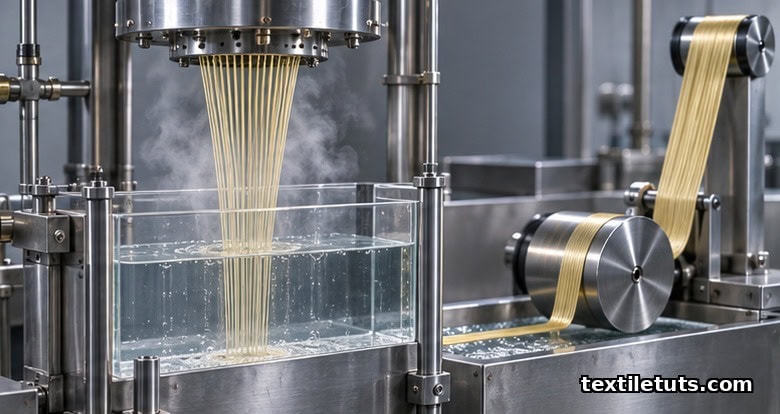
The air gap is critical. As the dope leaves the spinneret, the elongational flow in the gap aligns the lyotropic liquid crystal domains along the fiber axis before coagulation locks that orientation in. The stretch ratio in the air gap, typically 1.5 to 6×, drives the formation of a highly oriented, fibrillar skin-core morphology. Take-up speed at the first godet is on the order of 50 to 200 m/min depending on the target denier.
Coagulation proceeds by counter-diffusion: sulfuric acid leaves the filament as water enters. After the coagulation bath, the yarn passes through a neutralization bath (typically sodium carbonate or sodium hydroxide solution), a wash bath, and a finish applicator before being dried on heated rolls. Tow is collected on bobbins at the take-up.
Process parameters that determine yarn quality include dope concentration (typically 18 to 22 wt% PPTA for production grades), dope viscosity (on the order of 1,000 to 5,000 Pa·s), spinneret hole diameter (typically 50 to 150 µm), air-gap height, bath temperature, draw ratio in the gap, and stretch ratio at the post-coagulation godets.
Heat Treatment Under Tension: How Modulus Is Built
As-spun para-aramid fiber has good tenacity but a relatively modest modulus. Tensile modulus is raised from roughly 40 to 60 GPa as-spun to 70 to 130 GPa in finished yarn by a heat treatment step carried out under tension (Tanner et al., 1988).
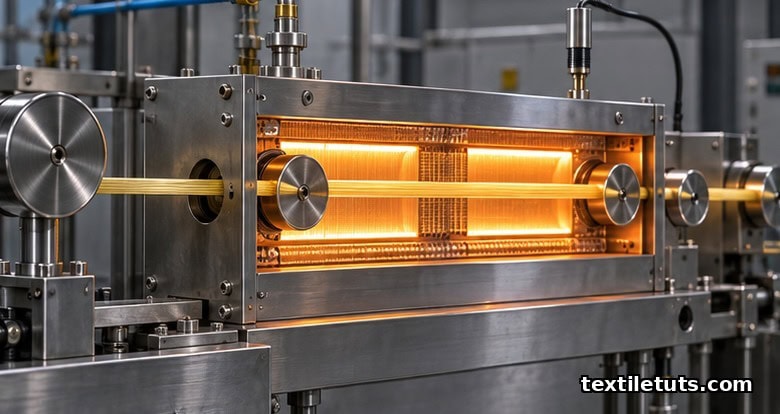
The standard heat treatment exposes the fiber to a temperature of 250 to 550°C (most commercial processes use 300 to 450°C) while maintaining a longitudinal tension of 0.1 to 1.0 GPa. The combination raises the crystalline order, increases the apparent crystallite size along the chain axis, and relaxes residual stresses from coagulation. Nitrogen or argon atmosphere is used to avoid oxidative degradation at the higher end of the temperature range.
Different commercial grades are produced by tuning the heat-treatment conditions. Kevlar 29 (the standard ballistic grade) receives less heat treatment and keeps a slightly lower modulus (~70 GPa) for better energy absorption during impact. Kevlar 49 (the composite reinforcement grade) receives more aggressive heat treatment and reaches a modulus near 130 GPa for stiffness-driven applications like aerospace laminates.
Aramid Fiber Properties: Tenacity, Modulus, Thermal, Chemical
The finished para-aramid yarn delivers a property bundle that is unusual among organic fibers. Tenacity at break is 20 to 28 g/denier (2.0 to 2.7 GPa tensile strength at break), tensile modulus is 70 to 130 GPa, and elongation at break is 3 to 4% for the standard grades, falling to 2 to 3% for high-modulus grades (Rebouillat, S., “Aramid Fibres”, in High-Performance Fibres, Woodhead Publishing, 2001).
Thermal behavior is dominated by the absence of a melt. The polymer chars at 500 to 570°C in nitrogen and the limiting oxygen index is 28 to 29, meaning the fiber self-extinguishes in normal atmosphere. Continuous service temperature is around 180 to 200°C for Kevlar 49, with useful short-term exposure up to 300°C. The fibers decompose before they melt, which is why ballistic panels and brake pads can survive frictional heating that would destroy thermoplastic fibers.
Chemical resistance is selective. Aramid fibers resist most organic solvents, fuels, and weak acids, but they are attacked by strong acids (especially concentrated sulfuric and hydrochloric) and by strong alkalis at high temperature. UV radiation degrades the fiber over time, so finished composites typically require a UV-blocking coating for outdoor service.
Density is 1.44 g/cm³, about 4.5 times lower than steel. On a specific strength basis (tenacity per density), Kevlar 49 is roughly five to six times stronger than steel wire, and on a specific modulus basis it is roughly 2.5 times stiffer than E-glass fiber.
Para-Aramid vs Meta-Aramid: Property Comparison
| Property | Para-aramid (Kevlar 49) | Meta-aramid (Nomex 410) |
|---|---|---|
| Polymer repeat unit | Poly-p-phenylene terephthalamide (PPTA) | Poly-m-phenylene isophthalamide (MPIA) |
| Amide linkage position | 1,4 (para) | 1,3 (meta) |
| Density (g/cm³) | 1.44 | 1.38 |
| Tenacity (g/denier) | 20 to 28 | 4 to 6 |
| Tensile modulus (GPa) | 70 to 130 | 10 to 17 |
| Elongation at break (%) | 2 to 4 | 20 to 30 |
| Decomposition temperature (°C) | 500 to 570 | 400 to 430 |
| Limiting oxygen index | 28 to 29 | 28 to 30 |
| Continuous service temperature (°C) | 180 to 200 | 200 to 220 |
| Primary end use | Ballistic, composites, ropes | Fire-resistant apparel, electrical insulation |
The takeaway from the table is that para-aramid is the strength-and-modulus choice while meta-aramid is the thermal-endurance and abrasion-resistance choice. They are not interchangeable.
End Uses: Ballistic, Fire-Resistant, Composites, Tires
Ballistic protection is the largest single end use for para-aramid by value. Soft body armor (NIJ Level II and IIIA), ballistic helmets, spall liners for vehicles, and stab-resistant body armor all rely on the multi-hit energy absorption of woven aramid fabric. The mechanism is energy dissipation through filament fracture and frictional sliding rather than a single tensile rupture, so high tenacity and elongation-to-break both matter.
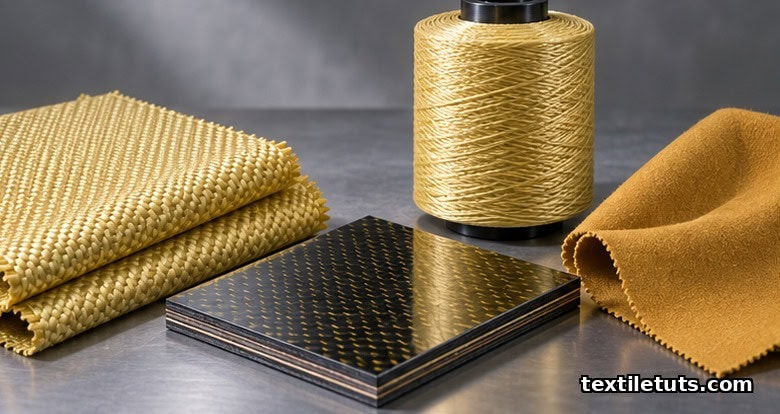
Composites and aerospace reinforcement consume roughly 20 to 30% of para-aramid output. Kevlar 49 and Twaron HM grade yarn, when impregnated with epoxy, produce laminates with high specific stiffness and good damage tolerance for aircraft interior panels, pressure vessels, marine hulls, and sporting goods. Para-aramid competes with carbon fiber for damage-tolerant applications where impact resistance matters more than absolute stiffness.
Tires, mechanical rubber goods, conveyor belts, and high-pressure hoses use para-aramid as tire cord and reinforcement because the combination of low density, low shrinkage, and high modulus reduces rolling resistance and improves dimensional stability under heat.
Fire-resistant apparel and hot-gas filtration are the principal meta-aramid end uses and consume only modest volumes of para-aramid, mostly as reinforcement in protective seam structures. Ropes and cables for offshore mooring, helicopter rescue hoists, and sailing rigging use the same weight-saving property combination. Brake pads and clutch facings use short aramid fiber as a phenolic-resin reinforcement to reduce wear and noise.
Frequently Asked Questions
Q1: Why is Kevlar dry-jet wet spun instead of melt spun or solution wet spun?
PPTA decomposes at 500 to 570°C before any melting transition, so melt spinning is impossible. Solution wet spinning (spinneret immersed in the bath) cannot develop the level of axial orientation required for 20 to 28 g/denier tenacity because the lyotropic liquid crystalline domains in the dope coagulate before elongational flow aligns them. The 5 to 15 mm air gap gives the dope a brief elongational stretch window that aligns the liquid crystal domains along the fiber axis before the bath locks the structure in.
Q2: What role does concentrated sulfuric acid play in aramid spinning?
Concentrated sulfuric acid (typically 100 wt% H₂SO₄) is the only commercial solvent that breaks the strong inter-chain hydrogen bonding and aromatic ring stacking enough to dissolve PPTA at the 18 to 22 wt% concentrations required for lyotropic liquid crystalline behavior. The acid is recovered and recycled in the spinning plant, which is one reason aramid production is concentrated among a small number of manufacturers.
Q3: Does para-aramid lose strength when exposed to UV light or moisture?
Yes, both UV radiation and prolonged moisture exposure reduce aramid yarn strength over time. UV exposure degrades the amide bond and produces surface pitting; moisture absorption of 3 to 7 wt% produces plasticization that lowers modulus. Finished composites and ropes for outdoor service therefore require a UV-blocking topcoat or jacket, and ballistic panels are stored away from direct sunlight when not in service.
Q4: Can para-aramid be dyed or processed on conventional textile machinery?
No. Para-aramid cannot be dyed with conventional disperse or reactive dyes because of its high crystallinity and chemical resistance. Producer-dyed solution-spun aramid is available in a limited color range. The fiber also damages conventional cutting tools, so woven aramid fabric is cut with specialized shears, waterjets, or laser cutters, and conventional carding is not used because the fiber breaks under the bending stresses of a card.
References
- Tanner, D., Fitzgerald, J.A., Krigbaum, W.R., & Lenz, R.W. “Aramid Fiber.” Advanced Materials, Wiley, 1988, peer-reviewed review of PPTA chemistry and dry-jet wet spinning.
- Yang, H.H. Kevlar Aramid Fiber. Wiley, 1993, comprehensive polymer and processing reference from the original Kevlar research team.
- Rebouillat, S. “Aramid Fibres.” In: Hearle, J.W.S. (ed.), High-Performance Fibres, Woodhead Publishing, 2001, chapter covering para-aramid and meta-aramid property data.
- Northolt, M.G., & van Aartsen, J.J. “On the Crystal and Molecular Structure of Rigid-Chain Polymers.” Journal of Polymer Science: Polymer Symposia, Wiley, 1979, crystallography of PPTA fiber.
- Im, J., & Lee, H. “Dry-Jet Wet Spinning of Rigid-Rod Polymer Fibers.” Polymer Engineering & Science, Wiley, 1979, air-gap process mechanics for lyotropic dopes.
- DuPont. Kevlar Technical Guide. DuPont de Nemours, 2019, manufacturer specification data for Kevlar 29, 49, and KM2 grades.
- Kwolek, S.L. “The Story of Kevlar.” American Chemical Society, 1994, original lyotropic spinning discovery narrative (US patent 3,671,542).
This article is the working reference for aramid (Kevlar) yarn spinning. Editorial by Iftay Khairul Alam, TextileTuts. Sources: Tanner et al. 1988, Yang 1993, Rebouillat 2001, Northolt 1979, Im & Lee 1979, DuPont 2019, Kwolek 1994 as cited.


