
Mercerization: Yarn vs Fabric

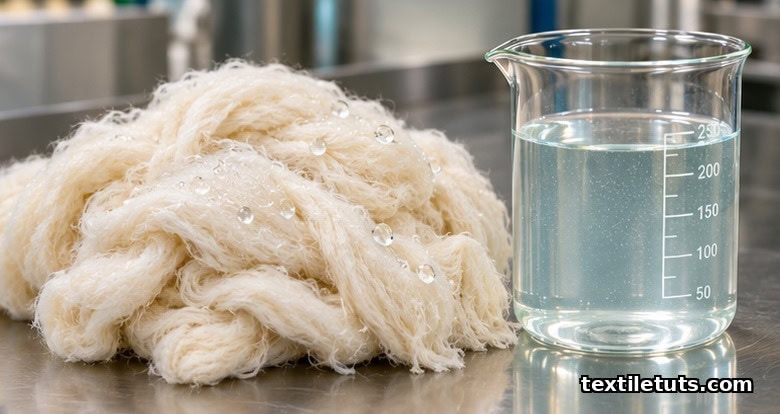
Cotton mercerization with 20-25% sodium hydroxide (NaOH) at 15-25°C swells the fiber cross-section by 20-25%, raises tensile strength by 10-20%, and increases dye uptake by 20-25% compared to untreated cotton, with yarn mercerization delivering more uniform fiber-level modification than fabric mercerization at higher processing cost.
Choosing between yarn and fabric mercerization affects luster, dye affinity, dimensional stability, and mill economics. This guide explains how each process works, where it fits in production, and how to decide which one a given cotton product actually needs.
By the end, you will know the chemistry behind mercerization, the equipment and conditions used in each variant, how the resulting properties compare in standardized tests, and which ISO, AATCC, and ASTM standards to apply when verifying results.
What Mercerization Does to Cotton at the Fiber Level
Cotton is roughly 88-96% cellulose, with the balance made up of pectins, waxes, and proteins that occupy the fiber surface and the hollow central lumen. When concentrated sodium hydroxide is applied to cotton, it penetrates the cuticle and primary wall and then attacks the secondary wall. The hydroxyl groups on the cellulose chains ionize under the high pH, and the resulting negative charges repel one another, forcing the cellulose chains apart.
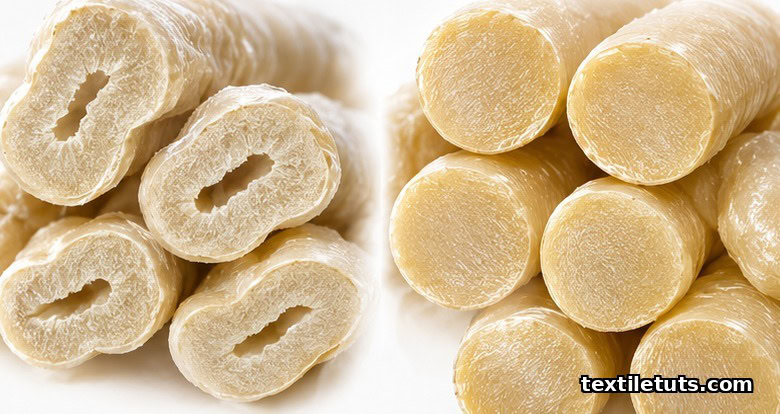
This swelling has three measurable effects on the fiber itself. The lumen collapses and the cross-section shifts from a kidney-bean shape toward a more circular profile, which reflects light more uniformly and produces the silk-like luster that Horace Lowe commercialized in the 1890s. The crystalline lattice of native cellulose I converts partially to cellulose II, a thermodynamically more stable form. And the increased surface area exposes more hydroxyl groups for water and dye molecules to bond with.
The classical Mercer numbers remain the working reference for finishing chemists: roughly 20-25% NaOH by weight, 15-25°C for cold mercerization, and tension applied during and after the NaOH bath to lock in the swollen geometry. Under those conditions, fiber strength rises by 10-20%, dye uptake increases by 20-25%, and the fiber becomes more receptive to subsequent finishing steps such as bleaching or resin treatment.
Yarn Mercerization: Process and Outcome
Yarn mercerization treats cotton yarns before they are woven or knitted. Yarn is plied onto a warp beam or a chain Mercerizing machine and run through a series of baths in continuous tension. The yarn passes through a 20-25% NaOH bath at 15-25°C for 30-60 seconds, then through a tension zone that stretches the swollen fibers lengthwise while keeping them swollen in cross-section. Acid neutralization and washing complete the cycle.
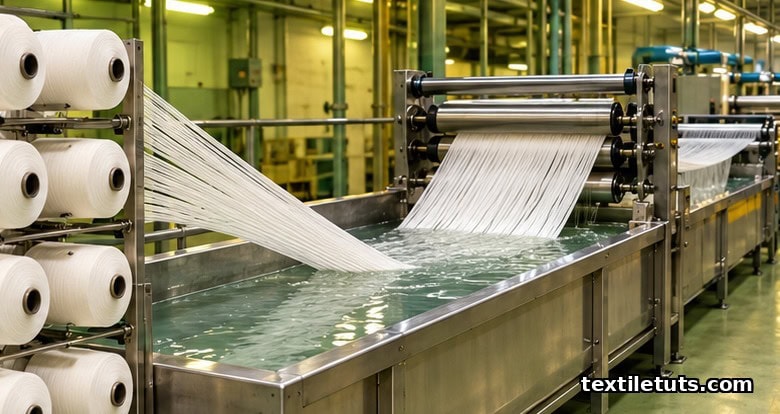
The benefits of treating yarn are tied to penetration. Each filament or staple fiber in the yarn bundle is exposed to the NaOH solution on all sides, so the swelling reaction proceeds to completion at the fiber core, not just the surface. Dye uptake, luster, and strength gains therefore reach the higher end of the Mercer range. Yarn mercerization is also the only practical way to achieve the round, smooth cross-section that gives true mercerized cotton its visual sheen.
The trade-offs are throughput and cost. Yarn mercerizing lines run at speeds of 20-50 m/min for staple yarns and up to 100-200 m/min for filament, but each meter must be processed before fabric construction. Mills that produce yarn-dyed or piece-dyed fabrics both use yarn mercerization, but it is most common in high-end combed cotton for shirting, dress fabrics, and knitwear that needs deep dye shades and a soft, lustrous hand.
Fabric Mercerization: Process and Outcome
Fabric mercerization treats greige or bleached cotton cloth after weaving or knitting. The two main routes are chain mercerization, where open-width fabric passes through a pad-roll system with controlled tension, and hot mercerization, where the fabric is treated with NaOH at elevated temperature for shorter contact times.
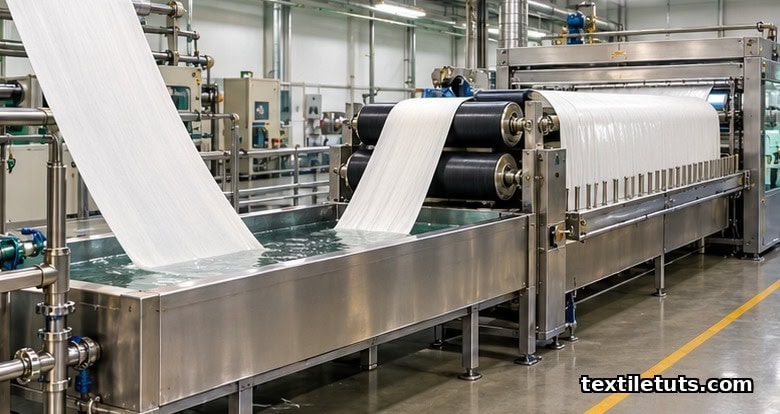
In chain mercerization, the fabric passes through a NaOH bath at 15-25°C, then over a series of rollers or through a stenter frame that maintains warp and weft tension while the fibers swell. The padder applies 20-25% NaOH, dwell time is 30-90 seconds, and washing plus acid neutralization follows in separate chambers. The fabric is held under tension through the entire sequence to lock in dimensional stability and luster.
Hot mercerization uses 5-10% NaOH at 80-95°C and shortens the reaction time, but it does not produce the same degree of cross-sectional swelling. It is used to pre-shrink fabric, improve dye affinity for dark shades, and prepare cotton for resin finishing, where full cold mercerization is not required. The trade-off in fabric mercerization is uneven penetration at the yarn core: the outer fibers in each yarn bundle receive the full treatment, while fibers at the yarn center may see only partial swelling. The result is a fabric that looks mercerized on the surface but does not reach the luster or dye-uptake levels of yarn-mercerized equivalents.
Yarn vs Fabric Mercerization: Side-by-Side Property Comparison
| Property | Yarn Mercerization | Fabric Mercerization (cold, chain) | Fabric Mercerization (hot) |
|---|---|---|---|
| NaOH concentration | 20-25% | 20-25% | 5-10% |
| Temperature | 15-25°C | 15-25°C | 80-95°C |
| Contact time | 30-60 s | 30-90 s | 10-30 s |
| Tensile strength gain | +15-20% | +10-15% | +5-10% |
| Dye uptake gain | +20-25% | +15-20% | +10-15% |
| Luster | Highest (silk-like) | Moderate to high | Low |
| Dimensional stability | Set at yarn stage | Set at fabric stage | Partial |
| Penetration uniformity | Uniform through yarn bundle | Higher at yarn surface | Surface-dominant |
| Capital cost | Higher (per-meter) | Moderate | Lower |
| Typical end-use | Premium shirting, knitwear, lace, embroidery thread | Apparel fabrics, sheets, towels | Pre-treatment before resin finishing, technical textiles |
Process Economics and Equipment Considerations
Yarn mercerizing lines require a chain Mercerizing machine, a NaOH recovery system, and downstream wash baths. Capital cost runs higher than fabric mercerization because every meter of yarn must be processed individually, but the per-meter operating cost is competitive when NaOH is recovered and reused. Modern NaOH recovery systems reclaim 90-95% of the applied alkali, which keeps the chemistry cost in line.
Fabric mercerization lines are pad-stenter combinations, which are standard equipment in most finishing mills. The capital cost is lower because the line can run at 30-60 m/min for open-width fabric. The operating cost is also lower because one pass treats the whole fabric surface in one operation. The trade-off, as noted above, is penetration depth and uniformity at the yarn level.
For a mill that already produces yarn-dyed fabrics, for example woven shirtings with colored warp and weft, yarn mercerization fits naturally into the workflow. For a mill that buys greige fabric and finishes it for piece-dyed apparel or home textiles, fabric mercerization is the only practical choice. Some mills run both: they mercerize greige fabric for general apparel and mercerize specific yarns that go into premium product lines.
Quality Control: Standards and Tests That Verify Mercerization
The standards that govern mercerized cotton testing fall into three families. Conditioning follows ISO 139 (Textiles, Standard atmospheres for conditioning and testing), which sets 20°C and 65% relative humidity for all textile tests. Dimensional change after washing follows ISO 5077 and AATCC TM 89, which together cover the wash cycles and measurement methods used to confirm that mercerized fabric stays stable through laundering. Tensile strength is typically measured by ASTM D5034 (breaking strength and elongation, grab method) or ISO 13934-1 (strip method).
Dye uptake is verified by reflectance measurement before and after dyeing, comparing the K/S value (Kubelka-Munk) of mercerized versus unmercerized control samples. A 20-25% increase in K/S for a given dye concentration is the working benchmark for true mercerization. Luster is measured by gloss meter at fixed geometry, typically 45°/45° or 60°/60°, comparing the specular reflectance to a calibrated standard.
In a mill QC lab, the typical sequence is: confirm NaOH concentration by titration before the bath (target 20-25% w/w for cold mercerization), check bath temperature against the process card (15-25°C), pull a fabric or yarn sample at the end of the line, condition it per ISO 139, then run dimensional change, tensile, and dye-uptake tests against the standard reference. Any sample that falls outside the expected property range is flagged and the upstream process is reviewed.
Frequently Asked Questions
Is yarn mercerization better than fabric mercerization?
Yarn mercerization produces higher luster, deeper dye uptake, and more uniform fiber-level modification because the NaOH penetrates every filament in the yarn bundle. Fabric mercerization is more economical and fits mills that buy greige goods, but the surface-dominant treatment leaves core fibers less modified. The choice depends on the end-use: premium apparel and knitwear favor yarn mercerization, while general apparel and home textiles favor fabric mercerization.
What is the standard sodium hydroxide concentration for mercerization?
The classical Mercer specification is 20-25% NaOH by weight for cold mercerization at 15-25°C, applied under tension. Hot mercerization uses a lower 5-10% NaOH at 80-95°C, but does not produce the same degree of cross-sectional swelling. Going above 25% risks fiber damage, while going below 18% produces an incomplete swelling reaction and inconsistent properties.
Can a cotton fabric be mercerized twice without damage?
Double mercerization, meaning yarn mercerization followed by fabric mercerization, or fabric mercerization applied twice, is used in some premium cotton goods for maximum luster, but it must be tightly controlled. Each cycle removes more non-cellulosic material and increases fiber swelling, so tensile strength does not double with each pass and the second pass typically delivers smaller incremental gains than the first. Process control, neutralization, and gentle tension are essential to avoid fiber damage.
Does mercerization make cotton shrink less?
Yes. Mercerization sets the fibers in a swollen, more stable geometry and reduces the residual shrinkage that greige cotton normally releases on first laundering. AATCC TM 89 and ISO 5077 both show that properly mercerized cotton has 30-50% less residual shrinkage than unmercerized cotton of the same construction. This is one of the reasons mercerized cotton is standard in quality shirting and bed linen.
Does mercerized cotton take dye more evenly than unmercerized cotton?
Yes. The 20-25% increase in dye uptake comes with a corresponding improvement in shade uniformity, because the swollen, more accessible fiber structure absorbs dye at a more consistent rate across the fabric surface. This is why mercerized cotton is the preferred base for deep blacks, navies, and other dark shades where any unlevelness is visible. Reactive and direct dyes both show improved exhaustion on mercerized cotton compared to unmercerized controls.
References
- ASTM International. ASTM D5034, Standard Test Method for Breaking Strength and Elongation of Textile Fabrics (Grab Method). https://www.astm.org/d5034 — reference method for tensile-strength verification of mercerized cotton.
- American Association of Textile Chemists and Colorists. AATCC TM 89, Dimensional Changes in Laundering of Woven and Knitted Fabrics. https://www.aatcc.org — covers wash-cycle dimensional-change testing for mercerized cotton.
- International Organization for Standardization. ISO 5077, Determination of Dimensional Change. https://www.iso.org — paired with ISO 13934-1 for the textile property tests used to verify mercerization.
- International Organization for Standardization. ISO 139, Textiles, Standard Atmospheres for Conditioning and Testing. https://www.iso.org — conditioning protocol applied before all mercerized-cotton QC tests.
- International Organization for Standardization. ISO 13934-1, Tensile Properties of Fabrics, Part 1: Strip Method. https://www.iso.org — alternative tensile test for mercerized cotton.
- Lewin, M., ed. Handbook of Fiber Chemistry, 3rd Edition. CRC Press / Taylor & Francis. https://www.routledge.com — the working reference for mercerization chemistry and property data.
- ResearchGate. Effect of Mercerization on the Structural and Dyeing Properties of Cotton. https://www.researchgate.net — peer-reviewed study confirming the 20-25% dye-uptake gain in cold-mercerized cotton.
This article is the working reference for mercerization at the yarn and fabric stages. Editorial by Shahrukh Islam, TextileTuts. Sources: ASTM D5034, AATCC TM 89, ISO 5077, ISO 139, ISO 13934-1, and Lewin (Handbook of Fiber Chemistry, 3rd ed.) as cited.


