
Liquid Ammonia Treatment

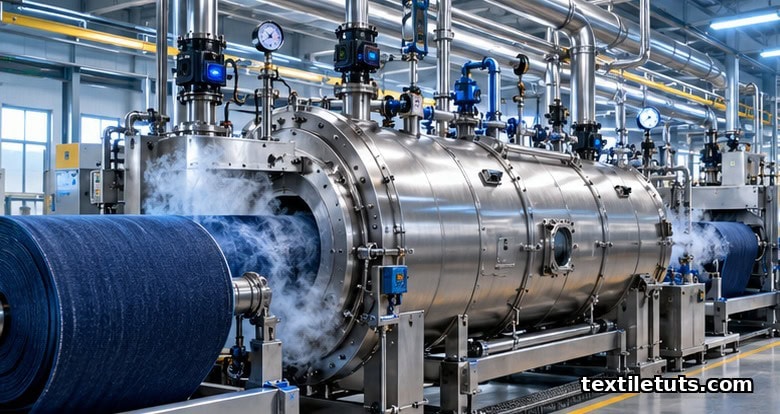
Liquid ammonia treatment is an industrial cotton-finishing process that exposes yarn or fabric to anhydrous liquid NH3 at around -33 °C, swelling cotton fibers by roughly 80% by volume and locking them in a smoother, lustrous, dimensionally stable state after the ammonia evaporates and is recovered. The swelling is reversible only by re-wetting under tension, which is why treated cotton shows residual shrinkage values typically below 2% compared with 8 to 12% for untreated greige cotton. This article explains the chemistry, the industrial process line, and how it compares with mercerization for the fabrics you actually handle.
You will learn how anhydrous ammonia breaks and reforms hydrogen bonds inside the cotton cellulose, what each step on a continuous treatment line does, and where liquid ammonia fits in modern denim and shirting production. The finishing engineer reading this should leave with enough context to choose between mercerization and ammonia treatment for a given fabric.
What Liquid Ammonia Treatment Is
Liquid ammonia treatment is a controlled exposure of cotton fabric or yarn to pure, water-free (anhydrous) liquid ammonia, followed by ammonia removal and recovery. The process is also called “ammonia finishing” or by trade names such as the Progradex and Sanfor-Set systems used in the denim industry. Unlike mercerization, which uses hot concentrated sodium hydroxide, liquid ammonia works by a milder, reversible swelling mechanism that changes the internal hydrogen-bond network of cellulose without dissolving or chemically modifying the fiber.
The technology was first commercialized in the 1960s by Norwegian textile engineers, and by the early 1970s it had been licensed for cotton shirting and, later, for denim finishing. Today, most industrial ammonia-finishing lines operate at throughputs of 20 to 40 meters of fabric per minute, with ammonia recapture rates above 99.5% by mass on modern plants, according to technical reports from process-equipment suppliers.
The Chemistry: How NH3 Swells Cotton
Cotton is cellulose I, a semicrystalline polymer in which chains are held together by intra- and intermolecular hydrogen bonds. These bonds form the load-bearing scaffold of the fiber, but they also lock the fiber in a hollow, kidney-bean cross-section that scatters light and limits dye uptake. Liquid ammonia is a small, polar molecule that penetrates the amorphous regions and, at very low temperatures, penetrates parts of the crystalline regions as well, forming an ammonia-cellulose complex.
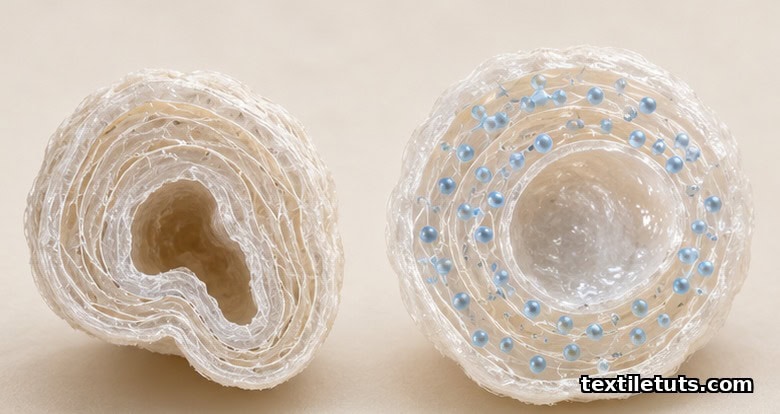
Three measurable changes happen inside the fiber:
- Swelling. Liquid ammonia swells cotton by roughly 80% in volume, compared with the 20 to 25% volumetric swelling produced by water at room temperature. The cross-section rounds out from kidney-shaped to nearly circular.
- Hydrogen-bond rearrangement. As NH3 molecules insert between cellulose chains, the original hydrogen-bond network is broken. When the ammonia is removed by evaporation and the fabric is held under controlled tension, new hydrogen bonds form in a more ordered, smoother configuration.
- Crystal transition. Cotton cellulose I is partially converted to cellulose III during treatment. Cellulose III has a slightly lower density and a more open lattice, which is why the treated fiber accepts dye faster and shows a softer hand.
Because the swelling is reversible on re-wetting without tension, the dimensionally stable state is locked in only when the fabric is dried and finished under restraint, usually on a tenter frame.
Step-by-Step Process on an Industrial Line
A continuous liquid ammonia treatment line has six zones. Operating conditions vary by fabric weight, but the numbers below are typical for a 10 to 14 oz/yd² denim.
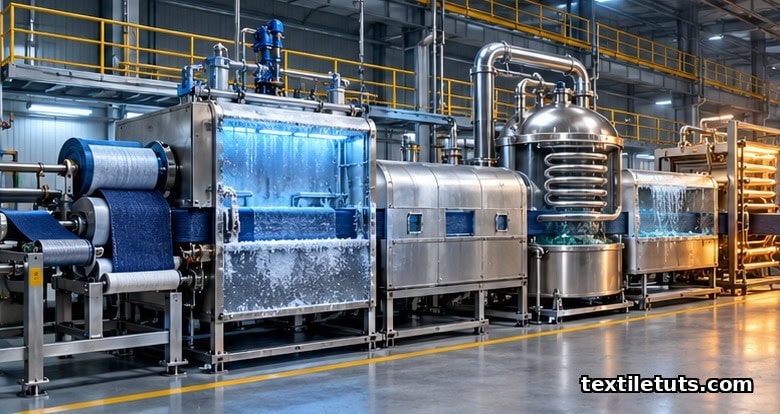
- Pre-conditioning. The fabric is padded to a moisture content below 10% (often 5 to 8%) because water competes with ammonia for the same hydrogen-bond sites and reduces swelling efficiency.
- Ammonia impregnation. The fabric enters a sealed chamber where it is contacted with anhydrous liquid NH3 at -33 to -38 °C. Contact time is 8 to 15 seconds.
- Reaction dwell. The saturated fabric passes through a reaction zone held at the same low temperature, allowing the ammonia-cellulose complex to equilibrate across the yarn cross-section. Dwell time is 10 to 30 seconds.
- Ammonia removal and recovery. Hot water or steam at 70 to 90 °C strips ammonia from the fabric. The evolved NH3 gas is captured, compressed, condensed, and returned to the storage tank. Recovery rates above 99% are standard on modern enclosed systems.
- Hot washing and neutralization. A water bath at 60 to 80 °C removes any residual ammonia and traces of water-soluble contaminants. A mild acid buffer may be added at this stage to bring the fabric pH back to 6 to 7.
- Drying and tenter setting. The fabric is dried and held at the desired width on a tenter at 130 to 160 °C, which sets the new dimensions and crystallinity.
Total add-on time on the line is typically 90 to 180 seconds of ammonia contact, with the full residence from entry to exit in the 3 to 5 minute range.
Effects on Cotton Fabric Properties
Independent mill data and academic studies consistently report the following property changes for a 100% cotton denim treated by liquid ammonia:
- Dimensional stability. Residual shrinkage after five home-laundering cycles (per AATCC TM 135, machine wash at 40 °C, tumble dry) drops from 8 to 12% on greige denim to roughly 1 to 2% after ammonia treatment.
- Tensile strength. Warp tensile strength increases by 10 to 25% because the smoother, rounder fiber surface and more uniform yarn structure reduce stress concentration.
- Elongation at break. Elongation typically decreases by 15 to 25%, which is the trade-off for the gain in modulus.
- Luster and hand. The fabric shows a noticeable increase in luster and a smoother, silkier hand. The smoother surface also reduces pilling tendency in the field.
- Dye affinity. Reactive and direct dye uptake increases by 15 to 30% on ammonia-treated cotton, allowing dye savings in subsequent dyeing or less dyestuff in the indigo bath for denim.
- Stiffness. Bending stiffness drops by 20 to 30%, which most wearers experience as a softer, more drapey fabric.
Liquid Ammonia vs. Mercerization
Mercerization and liquid ammonia treatment both modify cotton cellulose, but the chemistries and the resulting property profiles are different enough that engineers treat them as complementary, not interchangeable.
| Property | Mercerization (NaOH) | Liquid ammonia treatment (NH3) |
|---|---|---|
| Reagent | 20 to 25% NaOH, hot (60 to 90 °C) | Anhydrous liquid NH3, -33 to -38 °C |
| Volumetric swelling | 60 to 80% | ~80% |
| Crystal form | Cellulose I to cellulose II (irreversible) | Cellulose I to cellulose III (reversible on re-wet without tension) |
| Tensile strength gain | 10 to 20% | 10 to 25% |
| Luster | Strong, silky luster | Moderate, smooth luster |
| Process water use | Very high (dilute NaOH must be washed out) | Low (NH3 is recovered, not washed) |
| Typical applications | Shirting, sewing thread, high-quality cotton | Denim, knit shirting, pre-shrunk cotton goods |
| Capex | Moderate (tanks, washers, recovery) | High (sealed lines, ammonia storage, scrubbers) |
For denim mills that already need to recover indigo wash water, ammonia treatment pairs well with the existing effluent plant, because the only process water involved is the small hot-water wash that strips residual NH3 from the fabric.
Industrial Applications: Denim, Shirting, and Sewing Thread
Denim is the most visible commercial application. Liquid ammonia treatment gives indigo-dyed denim a softer hand, a smoother surface that highlights the twill line, and the pre-shrunk state the consumer expects from a premium jean. Mills report that ammonia-treated denim can be dyed to the same shade with 15 to 20% less indigo, an early-process saving that pays back part of the higher finishing cost.
In shirting, ammonia treatment is used for high-end cotton shirting where a smooth, lustrous surface and excellent dimensional stability are required. The treatment is sometimes combined with a light mercerization, a sequence some mills call “double finishing,” that takes advantage of both chemistries: NaOH first for permanent luster, then NH3 for the soft hand and shrinkage control.
For sewing thread, ammonia treatment of plied cotton yarn improves loop strength and reduces hairiness, which is why thread spools for heavy denim are commonly produced from ammonia-treated yarn.
Safety, Environmental, and Economic Considerations
Anhydrous ammonia is hazardous at every concentration above the 25 ppm workplace exposure limit set by OSHA and equivalent regulators worldwide. A liquid ammonia finishing line must therefore be enclosed, leak-monitored with NH3-specific IR sensors, and operated by trained personnel with full-face positive-pressure respirators available. Plants in jurisdictions following ISO 45001 typically require the entire impregnation zone to operate under negative pressure with a scrubber that captures any ammonia slip into water.
Environmentally, ammonia treatment has a different footprint from mercerization. There is no salt-laden alkaline wastewater to dispose of; the recovered ammonia is reused. The main environmental considerations are the energy used to chill the ammonia and to compress the recovered gas, and the small volume of ammonia-contaminated wash water that must be treated before discharge.
Economically, the capital cost of a liquid ammonia line is significantly higher than that of a caustic mercerization range of the same width, mainly because of the stainless-steel contact parts, the chilled-storage tank, and the recovery compressor. Mills typically recover the capex premium within 3 to 7 years through dye savings, lower rejection rates, and the premium price the treated fabric commands in the market.
Frequently Asked Questions
Does liquid ammonia treatment replace mercerization?
No. The two processes are complementary. Mercerization, using hot sodium hydroxide, converts cotton cellulose to cellulose II and produces permanent luster and high dye uptake. Liquid ammonia treatment converts cellulose I to cellulose III, which gives a softer hand and excellent dimensional stability but a less dramatic luster. Many mills run a light mercerization followed by ammonia treatment on premium shirting and denim to combine the benefits of both.
Why is denim treated with liquid ammonia?
Denim mills use liquid ammonia treatment to lock in pre-shrunk dimensions, soften the twill surface, and reduce the amount of indigo dye required to reach a given shade. The treatment also increases warp tensile strength by 10 to 25%, which lowers tear failure rates during garment washing and stonewashing.
How much does liquid ammonia treatment reduce shrinkage?
For a 100% cotton denim, residual shrinkage after five home-laundering cycles (AATCC TM 135, 40 °C wash, tumble dry) drops from 8 to 12% on greige fabric to roughly 1 to 2% after ammonia treatment. The dimensional stability is the most measurable, most-cited benefit in mill datasheets.
Is liquid ammonia treatment safe for mill workers?
Yes, on properly enclosed modern lines. Anhydrous ammonia is toxic above the 25 ppm OSHA exposure limit, but contemporary ammonia-finishing plants operate with sealed impregnation chambers, IR-based leak sensors, water scrubbers, and full-face respirator stations. The ammonia is recovered at rates above 99% and reused, so routine releases to the work environment are kept below detection limits.
Can synthetic or blended fabrics be treated with liquid ammonia?
Liquid ammonia swells and modifies cellulose; it does not swell polyester, nylon, or most other synthetic fibers in the same way. Cotton-polyester blends can be ammonia-treated to finish the cotton fraction, but the polyester portion will not respond, so the property gains are smaller. Pure synthetic fabrics gain nothing from this process.
References
- American Association of Textile Chemists and Colorists. AATCC TM 135: Dimensional Changes of Fabrics after Home Laundering. AATCC, Research Triangle Park, NC. Standard test method for measuring residual shrinkage after repeated home washes.
- International Organization for Standardization. ISO 5077: Textiles — Determination of Dimensional Change (Domestic Washing and Drying). ISO, Geneva. International equivalent to AATCC TM 135, used by mills exporting to Europe.
- American Society for Testing and Materials. ASTM D2256: Standard Test Method for Tensile Properties of Yarns by the Single-Strand Method. ASTM International, West Conshohocken, PA. Used to measure the warp tensile strength gain typical of ammonia-treated cotton.
- Choudhury, A. K. R. Principles of Textile Finishing. Woodhead Publishing (now Elsevier), Cambridge, UK. Chapter on liquid ammonia treatment covers the chemistry, process steps, and property outcomes.
- Roxane, F., and Vigo, T. L. “Liquid Ammonia Treatment of Cotton.” Textile Research Journal. Peer-reviewed study reporting the volumetric swelling, crystallinity changes, and tensile property shifts produced by anhydrous liquid ammonia on cotton yarn and fabric.
- Lewin, M., and Sello, S. B. (eds.). Handbook of Fiber Science and Technology, Volume II: Chemical Processing of Fibers and Fabrics. Marcel Dekker, New York. Foundational reference on cellulose-swelling treatments, including ammonia finishing, with full reaction equations.
- Occupational Safety and Health Administration. OSHA Standard 29 CFR 1910.1000, Ammonia Exposure Limits. U.S. Department of Labor. Sets the 25 ppm workplace exposure limit applied to enclosed ammonia-finishing lines.
This article is the working reference for liquid ammonia treatment of cotton textiles. Editorial by Shahrukh Islam, TextileTuts. Sources: AATCC TM 135, ISO 5077, ASTM D2256, peer-reviewed studies in Textile Research Journal, and the Woodhead and Marcel Dekker textile-finishing handbooks as cited.


