
Mercerization: Cold vs Hot


Cold mercerization of cotton at 15-25°C in 23-25% sodium hydroxide raises fiber tensile strength by 20-30%, luster by 60-90 photometric units, and reactive-dye uptake by 30-40% compared to greige yarn, while hot mercerization at 60-80°C recovers only 50-70% of these gains but finishes fiber swelling in 30-60 seconds rather than the 2-5 minutes required for cold treatment.
The trade-off between cold and hot mercerization decides whether a mill optimizes for premium fiber quality or throughput per liter of caustic, and the right choice depends on yarn count, fabric construction, and the end-use dye class.
Below is a working comparison of both processes, the chemistry behind the temperature effect, and the property numbers that distinguish them on a mill floor.
What Mercerization Does to Cotton
Mercerization is the controlled treatment of cotton yarn or fabric with concentrated sodium hydroxide, a process patented by John Mercer in 1850 and refined with applied tension by Horace Low in 1890. When the NaOH concentration enters the 18-25% range by weight, the cotton fiber swells radially, the cell wall collapses from a kidney-bean cross-section into a round tube, and the cellulose microfibrils reorient from a steep helix to one closer to the fiber axis. After rinsing, acid neutralization, and drying under controlled tension, these morphological changes are locked in and the fiber carries the new properties permanently.
Three measurable outcomes define a properly mercerized cotton: higher tensile strength, higher luster, and higher moisture regain (which is what improves dye affinity). A fourth outcome, improved dimensional stability, comes from the straightened microfibrils resisting the swelling-shrinkage cycle of later wet processing. The combination of temperature, NaOH concentration, treatment time, and applied tension controls how much of each outcome a mill actually achieves, and temperature is the single biggest dial.
The underlying chemistry is a partial conversion of native cellulose I to the more stable cellulose II polymorph. Sodium hydroxide hydrates penetrate between the cellulose chains, break the existing hydrogen-bond network, and let the chains re-arrange into the denser cellulose II packing. Cold temperatures slow the deswelling step and let this conversion run closer to completion, which is the root cause of every property difference between the two processes.
Cold Mercerization: Process Parameters and Fiber Changes
Cold mercerization runs at 15-25°C, most often 18-20°C in practice, with 23-25% NaOH by weight. The yarn or fabric dwells in the bath for 2-5 minutes, then passes through a stenter or back-padder frame that holds it under warp and weft tension while it is rinsed and acid-neutralized. Total reaction time on the line is 90-180 seconds including dwell, rinse, and neutralization.
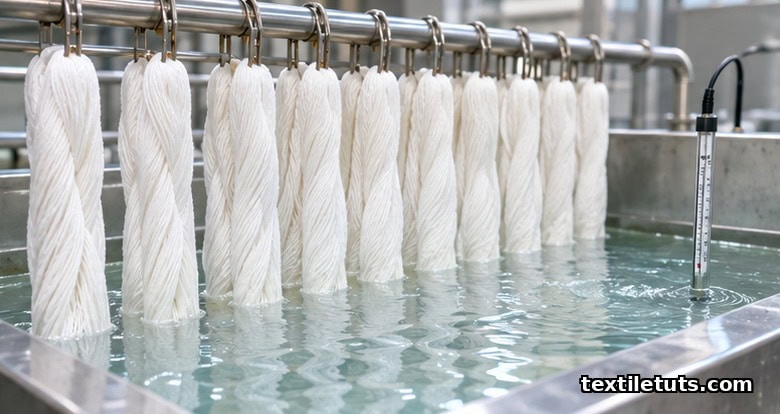
The lower temperature slows the deswelling reaction, so cotton fibers stay in their fully swollen, round, smooth state long enough for the alkali to penetrate the secondary cell wall completely. The result is a fiber with more complete lattice conversion from cellulose I to cellulose II. Reported property gains against greige cotton: tensile strength +20-30%, luster +60 to +90 units on the Hunter Lab scale for combed yarn, moisture regain rising from 7.0% to roughly 9.5%, and reactive-dye exhaustion improving by 30-40% under equivalent dyeing conditions.
The cost is throughput and energy. Cold liquor must be chilled with a refrigeration loop, dwell times are longer, and the bath must be re-cooled continuously as it picks up heat from the fabric and from ambient conditions. A cold mercerization range typically runs at 30-50 m/min on woven cotton, where a hot range runs at 60-90 m/min. Cold treatment is therefore reserved for premium yarns and premium fabrics where the property premium justifies the line-speed penalty.
Hot Mercerization: Process Parameters and Trade-offs
Hot mercerization runs at 60-80°C, most often 70-75°C in commercial ranges, in 20-25% NaOH. Dwell time drops to 30-60 seconds because heat accelerates the alkali diffusion through the cuticle and into the cell wall. The fiber still swells, still rounds, still converts some of its cellulose I to cellulose II, but the conversion is less complete because the fiber begins to deswell as soon as it leaves the bath.
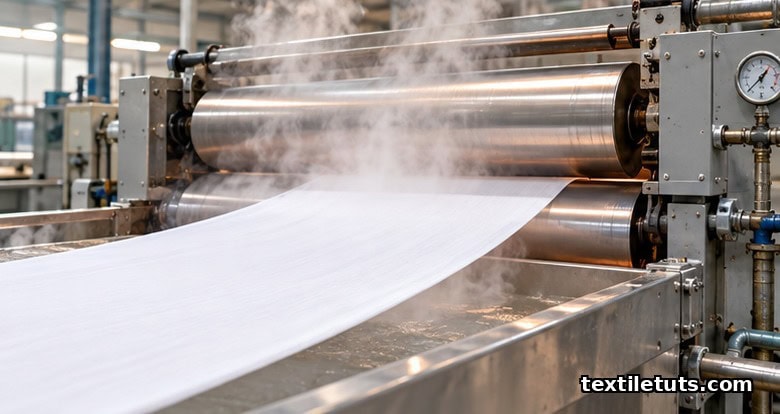
Hot mercerization is the standard process for commodity woven cotton and for most knit fabrics, where the priority is consistent caustic impregnation at line speed rather than maximum luster. Typical property gains against greige cotton: tensile strength +10-18%, luster +20 to +40 photometric units, moisture regain 8.0-8.5%, and reactive-dye uptake +15-22%. These numbers run roughly half to two-thirds of what a cold treatment achieves on the same yarn count, which is still a meaningful upgrade over unmercerized cotton.
The savings are real. A hot range uses 30-40% less refrigeration load than a cold range, fits inside a standard pad-steam finishing line without a separate cooling section, and runs at 60-90 m/min on woven cotton. It is the default choice for cotton shirting, sheetings, bottom-weight fabrics, and knit jersey where the mercerization bonus is welcome but premium luster is not required.
Side-by-Side Property Comparison
| Property | Cold mercerization (15-25°C) | Hot mercerization (60-80°C) |
|---|---|---|
| Typical NaOH concentration | 23-25% | 20-25% |
| Treatment time | 2-5 min | 30-60 s |
| Line speed (woven cotton) | 30-50 m/min | 60-90 m/min |
| Tensile strength gain vs greige | +20-30% | +10-18% |
| Luster gain (Hunter units) | +60 to +90 | +20 to +40 |
| Moisture regain | ~9.5% | 8.0-8.5% |
| Reactive-dye uptake gain | +30-40% | +15-22% |
| Cellulose I to II conversion | More complete | Partial |
| Energy cost (heating or cooling) | High (chilled liquor) | Lower (no chilling) |
| Best fit | Yarn, premium woven, embroidery thread | Commodity woven, knit, piece-dyed |
Selection Criteria: When Cold Wins, When Hot Wins
Cold mercerization is the right choice when the end-use demands high luster, premium dye depth, or both. Mercerized cotton sold as “mercerized” or “pearl cotton” for embroidery, crochet thread, and premium knit shirting almost always receives cold treatment, because the luster gain is what justifies the upcharge. Cold treatment is also favored for yarn-dyed products where the dye is applied after mercerization and where better exhaustion reduces the dyebath cost per kilogram of fiber.
Hot mercerization is the right choice for high-volume commodity cotton, especially when the fabric will be piece-dyed rather than yarn-dyed and when the mill is integrating mercerization into a continuous pad-steam range. It is also the only practical option for knit fabrics that cannot tolerate the long dwell and tension profile of a cold range without distorting the loop structure.
Hybrid setups exist in commercial mills. Some ranges run a hot caustic impregnation followed by a cold dwell section, gaining throughput on the entry side while preserving the longer reaction time on the fiber. Others run cold mercerization on yarn (where dwell is easy to control on a package or muff) and hot mercerization on greige fabric (where line speed matters). The choice is made per fabric, not per shift.
Quality Control: How Mills Verify the Difference
Cold and hot mercerized cotton can be distinguished by three standard tests. AATCC TM 89 measures the barium activity number, which rises with the completeness of mercerization; properly cold-mercerized yarn scores 130-160, hot-mercerized yarn scores 95-125, and greige cotton scores below 70. ISO 105-J01 and the related ISO 105 series methods confirm the dye-uptake gain under controlled conditions, allowing the mill to compare actual dye exhaustion against the expected 30-40% premium for cold-treated yarn.
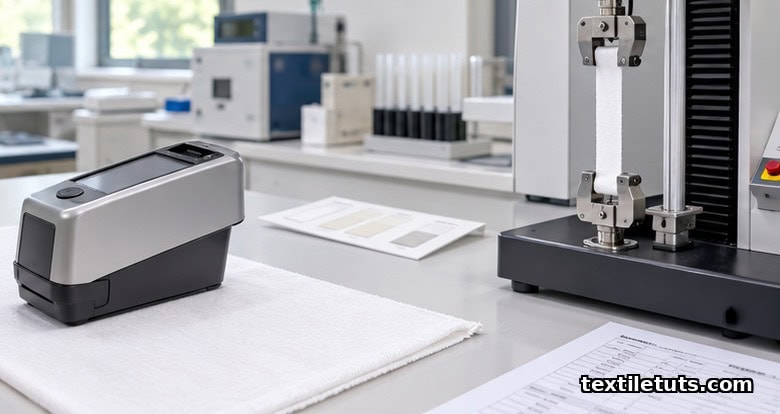
Tensile strength and elongation are checked against ASTM D5035 (strip method for fabric) or ASTM D2256 (single-yarn method), and luster is read on a Hunter Lab or BYK-Gardner gloss meter at a fixed 45°/45° geometry. A drop of more than 10 Hunter units between batches, or a barium number below 110 on a cold line, typically triggers a line-speed, temperature, or concentration review before the fabric is released to the dyehouse.
Frequently Asked Questions
Is cold mercerization always better than hot mercerization?
No. Cold mercerization produces higher luster, higher strength, and better dye uptake, but it is slower, more energy-intensive, and requires chilled caustic. Hot mercerization is the standard choice for commodity cotton and knit fabrics where premium luster is not a selling point and where line speed controls mill economics.
What sodium hydroxide concentration is used in each process?
Cold mercerization typically uses 23-25% NaOH by weight; hot mercerization uses 20-25% NaOH. Concentrations below 18% do not fully swell the cotton fiber and produce an incomplete mercerization, regardless of temperature.
Does hot mercerization damage the cotton fiber?
No. Hot mercerization does not degrade the cellulose polymer chain at 60-80°C in dilute alkali; the loss in property gain comes from incomplete swelling rather than fiber damage. The fiber still gains 10-18% in tensile strength and 15-22% in reactive-dye uptake, both meaningful improvements over greige cotton.
Why does tension matter during mercerization?
Without tension, mercerized cotton shrinks lengthwise and gains bulk rather than luster. Tension holds the fiber at its original length while it swells, so the round, smooth cross-section and the straightened microfibrils produce the characteristic silk-like sheen. Cold mercerization without tension is sometimes used as a finishing step called “causticizing” when bulk rather than luster is the goal.
Can a mill switch between cold and hot mercerization on the same line?
Yes, with a chiller or refrigerated liquor loop in front of the pad mangle. Most modern ranges are designed for both modes, and the choice is made per fabric rather than per shift. Yarn count, fabric construction, and end-use dye class are the three variables that decide which mode runs on a given day.
References
- American Association of Textile Chemists and Colorists. AATCC Technical Manual, Test Method 89: Mercerization in Cotton. aatcc.org — the standard test for completeness of mercerization via barium activity number.
- ASTM International. ASTM D5035 and D2256: Standard Test Methods for Breaking Strength and Elongation of Textile Fabrics. astm.org — strip and single-yarn tensile methods used to verify mercerization gains.
- International Organization for Standardization. ISO 105-J01: Textiles, Tests for Colour Fastness, General Principles for Measurement of Surface Colour. iso.org — the J-series methods quantify dye-uptake differences between mercerized and greige cotton.
- Rashid, M. et al. Effect of Mercerization on the Physical and Chemical Properties of Cotton Fiber. ResearchGate — peer-reviewed comparison of tensile, luster, and moisture-regain gains between cold and hot processes.
- Karmakar, S.R. Chemical Technology in the Pre-Treatment Processes of Textiles. Elsevier, ScienceDirect — textbook treatment of caustic concentration, temperature, and tension profiles for both processes.
- Polymers (MDPI). Structural Changes in Cotton Cellulose after Mercerization at Different Temperatures. mdpi.com — XRD and microscopy evidence of cellulose I to II conversion under cold versus hot conditions.
- Cotton Incorporated. Technical Bulletin: Mercerization of Cotton Yarn and Fabric. cottoninc.com — industry trade reference for line-speed and concentration ranges used in commercial mills.
This article is the working reference for mercerization process selection. Editorial by Shahrukh Islam, TextileTuts. Sources: AATCC TM 89, ASTM D5035, ASTM D2256, ISO 105-J01, Rashid et al. (ResearchGate), Karmakar (Elsevier/ScienceDirect), Polymers (MDPI), and Cotton Incorporated as cited.


