
Medical Textile Standards (ISO 13485)


ISO 13485:2016 is the global quality management system standard for medical devices, and every textile manufacturer producing surgical gowns, drapes, implants, wound dressings, or personal protective equipment for healthcare must comply with it before shipping product into regulated markets. The standard covers the full life cycle of a medical textile, from fiber selection and biocompatibility testing under ISO 10993 through risk management per ISO 14971 and sterilization validation per ISO 11137.
This guide maps the standards landscape for medical textiles, explains how ISO 13485 connects to material-specific test methods, and shows what a manufacturer actually has to do to keep a surgical gown or a wound dressing on the market.
What ISO 13485:2016 Covers (and Why It Exists)
ISO 13485:2016, published in March 2016 as the third edition of the standard, specifies the requirements for a quality management system (QMS) where an organization needs to demonstrate its ability to provide medical devices and related services that consistently meet customer and applicable regulatory requirements.
The standard is used by more than 28,000 organizations across 130+ countries, according to the ISO Survey of certifications to management system standards. It is the basis for regulatory compliance in major medical-device markets: the United States FDA Quality System Regulation (21 CFR Part 820), the EU Medical Device Regulation (EU MDR 2017/745), Health Canada, Japan’s PMDA, and Australia’s TGA all align their QMS expectations with the ISO 13485 framework.
For textile producers, ISO 13485 pulls the entire supply chain into a single regulated boundary. Raw fiber suppliers, yarn spinners, weavers and knitters, finishers, converters, and the final medical-device manufacturer all sit inside the QMS scope. The standard requires documented procedures for design and development (clause 7.3), purchasing and supplier control (clause 7.4), production and service provision (clause 7.5), and post-market surveillance (clause 8.2.1).
The Companion Standards Every Medical Textile Engineer Has to Read
ISO 13485 sits on top of a stack of material- and risk-specific standards that govern the medical textile itself. The four most important companion documents are:
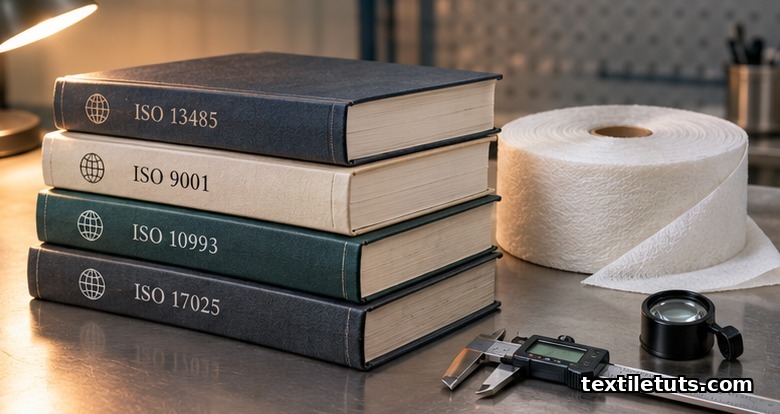
- ISO 14971:2019 — application of risk management to medical devices. Mandates a documented risk management process covering the product life cycle, with a risk management file, risk analysis, risk evaluation, and a risk management report reviewed at every design or process change.
- ISO 10993 series — biological evaluation of medical devices. ISO 10993-5 covers in vitro cytotoxicity; ISO 10993-10 deals with irritation and skin sensitization; ISO 10993-23 specifies irritation testing. Every textile in contact with skin, tissue, or blood for more than 24 hours must pass the relevant panel.
- ISO 11137 series — sterilization by radiation. ISO 11137-1 sets the requirements for development, validation, and routine control; ISO 11137-2 sets the dose for single-product sterilization.
- EN 13795:2019 — surgical drapes, gowns, and clean-air suits. This is the EU harmonized standard under the MDR. It defines performance requirements (microbial penetration, liquid penetration, tensile strength, bursting strength) and the test methods from the ISO 9073 series used to verify each property.
For surgical gowns and drapes sold in the United States, the equivalent performance framework is AAMI PB70:2012, which defines four ascending levels of liquid barrier protection (Level 1 minimal, Level 4 highest) and pairs with ASTM F2407 for the gown itself and ASTM F1670/F1671 for resistance to penetration by synthetic blood and viral pathogens.
Material Test Methods That Sit Under ISO 13485
Beyond the QMS, a medical textile has to pass measurable physical and biological tests. The table below pairs the property with the standard method normally cited in a technical file submitted for CE marking or 510(k) clearance.
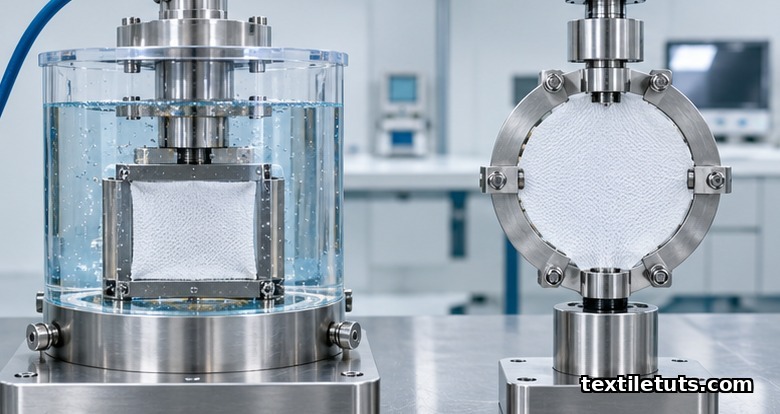
| Property | Standard test method |
|---|---|
| Tensile strength (nonwovens) | ISO 9073-3 (now ISO 13934-1 for woven) |
| Bursting strength | ISO 13938-1 (hydraulic), ISO 13938-2 (pneumatic) |
| Liquid penetration (hydrostatic head) | ISO 811, AATCC 127 |
| Water splash resistance | AATCC 42 |
| Synthetic blood penetration | ASTM F1670 |
| Viral penetration (phi-X174 bacteriophage) | ASTM F1671 |
| Microbial penetration (dry) | ISO 9073-10 |
| Microbial penetration (wet) | ISO 9073-11 |
| Particle release (linting) | ISO 9073-10 |
| Biocompatibility (cytotoxicity) | ISO 10993-5 |
| Skin sensitization | ISO 10993-10 (or ISO 10993-23) |
| Bioburden | ISO 11737-1 |
| Sterility | ISO 11137 (radiation) or ISO 11135 (EtO) or ISO 17665 (steam) |
A complete technical file under the EU MDR or a 510(k) submission lists every standard, the version date, the pass/fail criterion, and the test report from the lab that ran it. ISO 17025-accredited laboratories are the typical path for these reports because regulatory auditors look for accreditation first.
How a Surgical Gown Goes Through the System
A Level 3 or Level 4 surgical gown, AAMI PB70 classification, is the clearest case study because all four standard families (QMS, risk, biocompatibility, performance) intersect in one product.
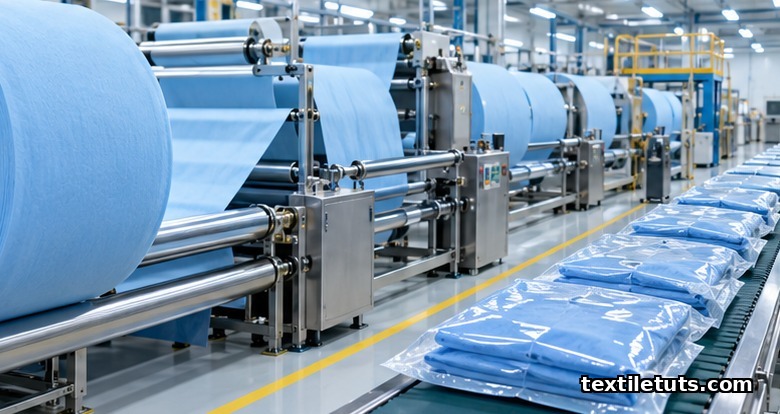
First, the QMS audit confirms that the production facility maintains ISO 13485 certification and that the supplier chain for the SMS (spunbond-meltblown-spunbond) fabric is documented and approved under clause 7.4 of the standard. Second, the risk file per ISO 14971 lists every hazard from raw-fiber contamination through transportation damage to disposal, with a documented mitigation for each. Third, biocompatibility testing per ISO 10993-5 and ISO 10993-10 confirms that the fabric finish, dye, and any antimicrobial treatment are not cytotoxic and do not cause skin sensitization. Fourth, performance testing per AAMI PB70 plus ANSI/AAMI PB70 and ASTM F1671 shows the finished gown resists penetration by synthetic blood under the hydrostatic pressure set for the claimed level.
Once the gown is on the market, post-market surveillance (clause 8.2.1 of ISO 13485) obliges the manufacturer to collect and review complaints, adverse events, and feedback at planned intervals and to feed any signal back into the risk file and design history file.
ISO 13485 vs. ISO 9001 — the Difference That Trips Up New Manufacturers
ISO 13485 is built on the ISO 9001 base structure but adds sector-specific requirements for medical devices. The four differences that textile teams most often miss:
- Risk-based approach. ISO 13485 requires documented risk management throughout product realization, not just at design review. The risk management process under ISO 14971 is a controlled document, and the output (the risk management report) is an audit object.
- Design and development. Clause 7.3 of ISO 13485 requires design and development planning, inputs (regulatory requirements, user needs, risk), outputs (drawings, material specs, packaging), reviews, verification, validation, and transfer to production, all with retained objective evidence. Every change after release triggers design change control.
- Process validation. Any production process whose output cannot be fully verified by subsequent monitoring (most sterilization processes, certain wash cycles, coating application) must be validated before use and re-validated after change.
- Documentation and records. Medical-device records must be retained for at least the lifetime of the device plus a regulatory-defined period (commonly 10 years in the EU and at least two years beyond the last release in the US). ISO 9001’s lighter documentation expectations will not satisfy an EU MDR notified body audit.
Frequently Asked Questions
Is ISO 13485 mandatory for selling medical textiles?
ISO 13485 is a voluntary standard in most jurisdictions, but regulatory authorities in the EU, the United States, Canada, Japan, Australia, and Brazil make a QMS meeting ISO 13485 effectively mandatory before a medical device can be marketed. For textile-only products that are not classified as medical devices, ISO 13485 does not apply; however, products such as surgical gowns, wound dressings with antimicrobial claims, and implantable hernia meshes fall inside the medical-device definition and the standard is required.
What is the latest version of ISO 13485, and is a transition deadline in force?
ISO 13485:2016 is the current edition, published on 1 March 2016. The European transition period for ISO 13485:2012 certificates to be updated to ISO 13485:2016 closed at the end of February 2024 per the ISO 13485 transition plan. Manufacturers holding expired 2003 edition certificates must now obtain 2016 edition certification before re-certification or new CE marking under EU MDR 2017/745.
Which standards apply to face masks versus surgical gowns?
Medical face masks in the EU fall under EN 14683:2019 with the type IIR classification requiring splash resistance per ISO 22609. In the United States, ASTM F2100 covers the equivalent performance levels (Levels 1-3). Surgical gowns use AAMI PB70 plus ASTM F2407 in the US and EN 13795 in the EU. Both mask and gown production lines must operate under an ISO 13485 QMS for the finished product to enter regulated channels.
How does biocompatibility testing (ISO 10993) interact with ISO 13485?
ISO 13485 clause 7.3.4 requires design and development verification, and biocompatibility is part of that verification for any device in contact with the body. ISO 10993 tells you which panel of tests to run (cytotoxicity, sensitization, irritation, systemic toxicity, implantation as applicable) and the reporting format regulators expect. A 10993-compliant test report is the most common objective evidence cited in 510(k) submissions and CE technical files for medical textiles.
Do reusable surgical textiles need different certification than single-use products?
Yes. Reusable surgical gowns and drapes must demonstrate that the claimed reuse cycle (commonly 75 to 100 industrial laundry cycles) does not degrade the barrier performance. This requires laundering validation studies using a defined wash protocol and re-testing the AAMI PB70, EN 13795, or ISO 9073 properties at the end of the claimed life. Single-use products skip the laundry validation but still need sterile-barrier packaging validation per ISO 11607.
References
- ISO. ISO 13485:2016 Medical devices — Quality management systems — Requirements for regulatory purposes. https://www.iso.org/standard/59752.html — the current edition of the QMS standard with clause-by-clause requirements.
- ISO. ISO 14971:2019 Medical devices — Application of risk management to medical devices. https://www.iso.org/standard/72704.html — the harmonized risk-management process required across the medical-device sector.
- ISO. ISO 10993-5:2009 Biological evaluation of medical devices — Part 5: Tests for in vitro cytotoxicity. https://www.iso.org/standard/36406.html — the cytotoxicity test panel cited in nearly every textile technical file.
- AAMI. ANSI/AAMI PB70:2012 Liquid barrier performance and classification for protective apparel and drapes in health care facilities. https://www.aami.org — defines the four protection levels used in US hospital procurement.
- ASTM. ASTM F2407-20 Standard Specification for Surgical Gowns Intended for Use in Healthcare Facilities. https://www.astm.org/f2407-20.html — the US material specification for surgical gown construction.
- ISO. EN 13795:2019 Surgical drapes, gowns and clean air suits, used as medical devices, for patients, clinical staff and equipment — General requirements for manufacturers, processors and products, test methods, performance requirements and performance levels. https://www.iso.org/standard/70855.html — the EU harmonized standard for surgical drapes and gowns.
This article is the working reference for medical textile quality and standards compliance under ISO 13485. Editorial by Md. Asad Ullah (Meem), TextileTuts. Sources: ISO 13485:2016, ISO 14971:2019, ISO 10993-5, AAMI PB70, ASTM F2407, and EN 13795:2019 as cited.


