
Medical Textile Sterilization Methods

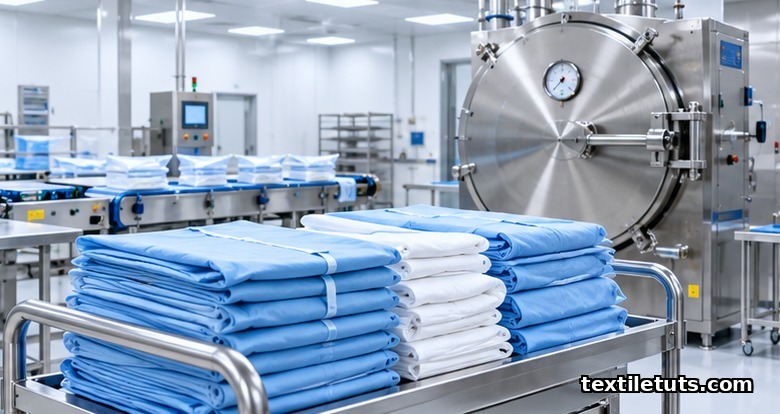
Steam autoclaving at 121 °C for 15 minutes at 103 kPa (15 psi), or at 134 °C for 3 minutes at 207 kPa (30 psi), remains the reference sterilization cycle for reusable woven and nonwoven medical textiles, achieving a 10⁻⁶ sterility assurance level (SAL) per ISO 17665 when validated on the specific fabric load.
That single sentence frames everything that follows, because the right sterilization method for a surgical gown, drape, wound dressing, or implant cover is dictated by the textile’s fiber chemistry, the presence of absorbent cellulose, and how the device must perform inside a sterile field. This article walks through the four industrial-grade sterilization modalities in routine use for medical textiles, the standards that govern each one, and the practical limitations engineers run into when a fabric can or cannot survive the cycle.
Why the sterilization method is decided by the textile, not the device
Medical textiles are a small subset of technical textiles that come into contact with open tissue, sterile body cavities, or compromised skin during use. The two governing performance requirements come from European standard EN 13795 (surgical drapes, gowns, and clean air suits) and ANSI/AAMI PB70 (liquid-barrier performance for surgical gowns in the U.S.). Both standards classify the textile first, then specify what kind of contamination barrier and post-sterilization integrity the product must keep. The sterilization process is selected after that classification, not before.
Three textile properties dominate the choice:
- Fiber type. Cotton and viscose tolerate high-temperature steam but degrade under repeated gamma radiation. Polyester, polypropylene, and high-performance polyethylene (UHMWPE) hold up under both, while polylactic acid and other bioabsorbable fibers break down under moist heat above 121 °C.
- Absorbency. Cellulosic webs absorb the liquid water carried by steam and become a reservoir for residual moisture. That is acceptable for reusables but disqualifies steam for many single-use dressings that must exit the cycle bone-dry.
- Surface finish and coatings. Antimicrobial finishes, fluorocarbon repellent layers, and silicone lubricants are temperature-, radiation-, and chemistry-sensitive. Each coating must be qualified against the chosen modality before a sterilization validation is approved.
Steam sterilization (moist heat) under ISO 17665
Steam is the default for woven and knit reusable surgical textiles that can survive repeated cycles. The instrument is the porous-load steam sterilizer (autoclave) operating with saturated steam under controlled pressure.
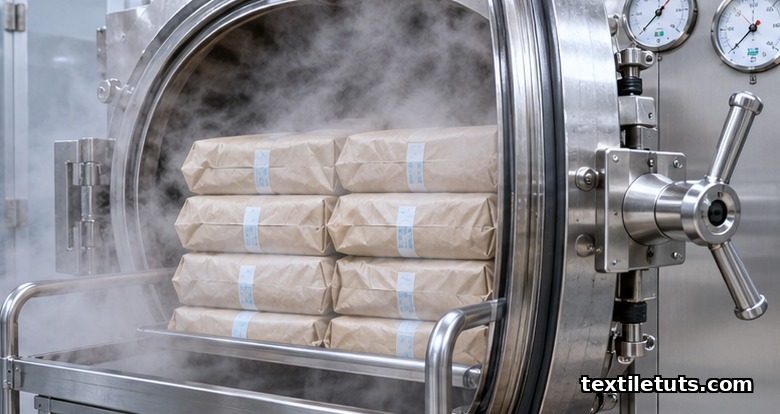
The two reference cycles are:
- 121 °C / 103 kPa / 15 min minimum hold: the universal cycle for general-purpose textiles, validated per ISO 17665-1:2024 against a representative load and an SAL of 10⁻⁶.
- 134 °C / 207 kPa / 3 to 3.5 min hold (prion cycle): used where there is concern about variant Creutzfeldt-Jakob disease, per the WHO/CDC recommendations adopted by many national bodies and incorporated into EN 285 large-scale sterilizer testing.
ANSI/AAMI ST79:2017 (the comprehensive guide to steam sterilization in healthcare facilities) layers load-density, weight, and packaging requirements on top of the ISO cycle. Porous loads up to about 7 kg of woven cotton and 12 kg of mixed synthetic/cotton are typical maximums for a 121 °C cycle in a standard 60 L chamber.
What steam does to textiles is real and cumulative. Per peer-reviewed aging studies on polyester/cotton blends, repeated 134 °C cycles reduce tensile strength by roughly 8 to 12% over 50 cycles and reach 25 to 30% loss by the 100th cycle, which is why most hospital laundry protocols cap the cycle count on a reusable gown at 75 to 80 washes and re-sterilizations. Cotton fares better in tensile retention but loses optical brightness and accumulates the microscopic calcium oxalate deposits that show up as white “specks” on surgical gowns after years in service.
Ethylene oxide (EtO) sterilization under ISO 11135
Heat-sensitive medical textiles (those made from or bonded to polymers that soften, deform, or hydrolyze above 60 °C) cannot pass an autoclave cycle without damage. The standard low-temperature alternative is ethylene oxide gas, and the governing standard is ISO 11135:2014 (“Sterilization of health care products — Ethylene oxide — Requirements for the development, validation and routine control of a sterilization process for medical devices”).
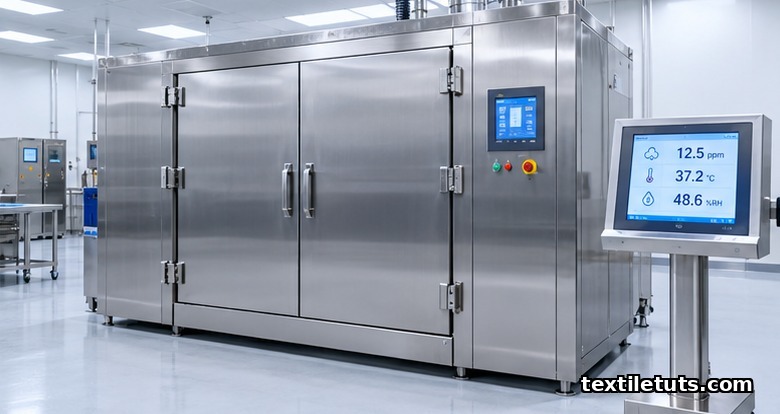
A typical EtO exposure for a textile-load medical device is:
- Gas concentration: 600 to 1200 mg/L EtO in a balance of inert diluent gas (often HCFC-free blends or 100% nitrogen in modern chambers).
- Temperature: 37 °C to 63 °C, depending on material compatibility.
- Relative humidity: 40% to 80% (humidity is critical because EtO kills by alkylating nucleic acids only after diffusing into hydrated microorganisms).
- Exposure time: 1 to 6 hours, followed by an aeration phase of 8 to 48 hours to drive off residual EtO and ethylene glycol to below the limits in ISO 10993-7 (the biocompatibility cap of 4 mg/device for a 30-day contact device).
EtO is effective on cellulosics, synthetics, and combinations, but it carries two trade-offs textile engineers must own. First, residuals: cellulose absorbs EtO and releases it slowly, which is why aeration time for cellulose-containing devices is longer than for all-synthetic ones. Second, regulatory pressure: the U.S. EPA’s 2024 rule on commercial sterilization facilities tightened EtO emissions to 0.2 micrograms per cubic meter at the property fence, pushing many large-scale medical-textile sterilizers toward alternatives, with subsequent investment in vaporized hydrogen peroxide and NO₂-based systems.
Radiation sterilization: gamma and electron beam under ISO 11137
Single-use medical textiles (wound dressings, surgical drapes, sterilization wrap, gowns) are overwhelmingly sterilized by ionizing radiation because the cycle is continuous, scalable, and does not require heat or post-cycle aeration. The governing standard is ISO 11137-1:2006 (with -2 establishing dose limits and -3 covering dosimetry).
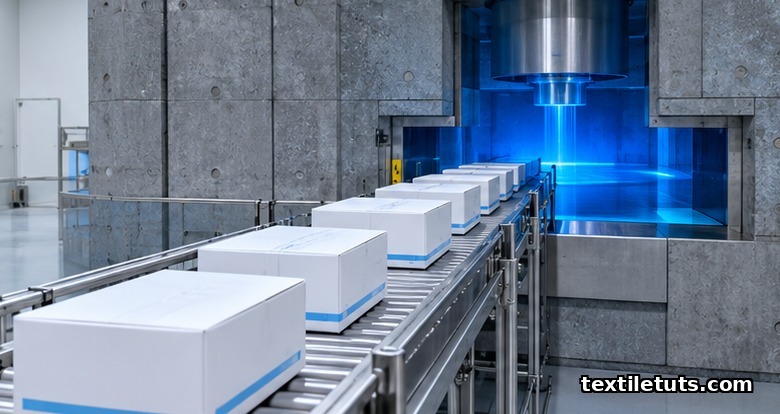
Two modalities exist:
- Gamma irradiation: cobalt-60 sources delivering 25 to 40 kGy as a single dose (most common verification doses for textiles cluster around 25 to 30 kGy, with subsequent dose audits keeping the cycle at 25 kGy target ±25% per ISO 11137-2).
- Electron-beam (e-beam): 10 to 35 kGy with limited penetration (typically effective through about 30 to 40 g/m² of fabric density at standard 10 MeV beam energy), making it best for thin nonwovens and surface sterilization.
A peer-reviewed review of radiation effects on textile polymers (ScienceDirect, 2023) reports that polypropylene nonwovens lose 14 to 22% of breaking strength at 25 kGy and 35 to 45% at 50 kGy, while polyethylene terephthalate (PET) is more tolerant, losing 4 to 9% at 25 kGy. Cellulosics yellow and embrittle under gamma irradiation because cellulose chain scission dominates over crosslinking above 10 kGy. That is why the same review recommends dose audits on every textile product family, and why method VDmax25 (verification dose at SAL 10⁻² with subsequent 25 kGy exposure) is the most common dose-setting approach for single-use textiles with low, consistent bioburden.
Low-temperature hydrogen peroxide and other newer modalities
Two non-heat, non-oxide modalities have grown for heat-sensitive medical textiles where EtO residuals are unacceptable or where the cycle must be faster than 24 hours:
- Vaporized hydrogen peroxide (VHP) and H₂O₂ plasma (Sterrad systems): 6 to 15 minutes of exposure at 45 to 55 °C, no toxic residues, no aeration. Validated under ISO 22441 (“Sterilization of health care products — Low temperature steam and formaldehyde”), or in H₂O₂-specific guidance from the FDA. Limitation: hydrogen peroxide does not penetrate dense cellulose bundles as well as steam or EtO, so very absorbent multilayer dressings may need preconditioning.
- Nitrogen dioxide (NO₂): marketed under the Noxilizer and Andersen Sterilizers platforms, with cycles of 30 to 60 minutes at 10 to 25 °C; effective on cellulose, polypropylene, and silicone-elastomer laminates. ISO 22466 was published in 2020 and is now the governing standard for NO₂ medical-device sterilization.
These are not universally interchangeable. A 2022 peer-reviewed comparison in the Journal of Hospital Infection found that VHP cycles were less effective than EtO at penetrating 12-layer crepe-paper sterilization wrap stacks (per ISO 11607 packaging requirements) once the load exceeded 8 kg, which is why facility validation always tests the actual load, not just the sterilization modality.
Sterilization Method Comparison for Medical Textiles
| Method | Standard | Cycle parameters | Best for | Avoid |
|---|---|---|---|---|
| Steam (moist heat) | ISO 17665; ANSI/AAMI ST79 | 121 °C / 15 min or 134 °C / 3 min, 103-207 kPa | Reusable cotton, polyester/cotton gowns, drapes, instrument wraps | Thermoplastics, bioabsorbable fibers, moisture-sensitive electronics-integrated textiles |
| Ethylene oxide (EtO) | ISO 11135; ISO 10993-7 | 600-1200 mg/L, 37-63 °C, 40-80% RH, 1-6 h + aeration | Heat-sensitive polymer dressings, sealed multilayer constructs, cellulose-synthetic hybrids | Devices with breathability needs post-cycle; facilities with strict EtO emissions caps |
| Gamma / e-beam radiation | ISO 11137-1/-2/-3 | 25 kGy (single-use), with dose audits; e-beam 10-35 kGy | Single-use nonwoven gowns, drapes, sterilization wrap, wound dressings | Thick multilayer cellulose bundles (incomplete penetration at low dose) |
| VHP / H₂O₂ plasma | ISO 22441; FDA guidance | 6-15 min, 45-55 °C, no aeration | Heat-sensitive devices, in-hospital reprocessing of durable textiles | Dense cellulose stacks, oil- or grease-laden loads |
| Nitrogen dioxide | ISO 22466 | 30-60 min, 10-25 °C | Cellulose/silicone laminates, sutures, polymer dressings | Products with nitrocellulose components (degrades in NO₂) |
Validation and the 10⁻⁶ sterility assurance level
All five modalities converge on the same numerical target: an SAL of 10⁻⁶, meaning the probability of a single viable microorganism surviving on or in a sterilized unit is one in a million or less. EN 556-1:2024 specifies this SAL as the European definition of “sterile” for terminally sterilized medical devices, and U.S. Pharmacopeia General Chapter <71> gives the testing protocol.
Validation is the act of proving the cycle achieves 10⁻⁶ on the actual textile load, in the actual packaging (per ISO 11607-1:2019), in the actual facility. Three batches of product are used: an installation qualification (IQ), operational qualification (OQ), and performance qualification (PQ). The PQ run uses biological indicators (Geobacillus stearothermophilus for steam and H₂O₂; Bacillus atrophaeus for EtO and dry heat) at half the cycle exposure to demonstrate the difference between kill kinetics at the worst-case load position and a successful full-cycle exposure.
Once validated, every production cycle is monitored with chemical integrators (class 1 to 6 per ANSI/AAMI ST79) and biological indicators run at least weekly in steam and EtO programs, with every load release still requiring parametric confirmation of time, temperature, and pressure.
Frequently Asked Questions
Which sterilization method is most common for single-use surgical gowns?
Gamma irradiation at 25 kGy is the dominant method worldwide for single-use nonwoven gowns because it penetrates sealed packs uniformly, leaves no chemical residue, and operates as a continuous flow-through process compatible with the high volumes that disposable surgical-gown manufacturers produce. E-beam is used where penetration depth (under 30 to 40 g/m² of fabric) is sufficient and faster turnaround is needed.
Can cotton surgical gowns be steam-sterilized?
Yes. Cotton and cotton-rich blends are the original steam-sterilizable surgical textiles and remain common in reusable-gown programs worldwide. They tolerate the 121 °C / 15 min and 134 °C / 3 min cycles of ISO 17665, with most programs capping lifetime at 75 to 80 reprocessing cycles to keep tensile loss below the limits set by EN 13795 for critical-product zones.
Why is EtO still used if it is so regulated?
EtO is the only widely validated low-temperature method that penetrates dense multilayer constructs (laminated barrier fabrics, sealed cellulosic webs, polymer-cotton hybrids) at production scale. Newer alternatives (VHP, NO₂) are catching up, but for many device categories EtO remains the only cycle that achieves 10⁻⁶ without thermal or radiation damage to the textile, which is why the 2024 EPA emissions rule triggered industry-wide investment rather than a phase-out.
How does bioburden affect the sterilization dose for textiles?
Bioburden (the population of viable microorganisms on a product before sterilization) sets the minimum dose for radiation cycles and the kill time for gas cycles. ISO 11137-1 uses the average bioburden per product to calculate the verification dose at SAL 10⁻², and typical textile bioburden averages run between 1 and 100 CFU per device when the manufacturing environment is ISO 14644 class 7 or cleaner, which is why many single-use textile products settle around 25 kGy as their sterilization dose.
Does sterilization weaken medical textiles over time?
Yes, every modality causes cumulative physicochemical change. Steam cycles above 121 °C cause hydrolytic and thermal degradation of cellulose, EtO and H₂O₂ cycles slowly oxidize finishes and polymer chain ends, and gamma radiation above 25 kGy causes measurable chain scission in polypropylene and polyethylene. Real-world qualification of a medical textile always includes post-sterilization tensile, burst, and barrier testing at end-of-life cycle count to confirm the product still meets EN 13795 or AAMI PB70 performance after the maximum number of reprocessings specified by the manufacturer.
References
- International Organization for Standardization. ISO 17665-1:2024 — Sterilization of health care products — Moist heat — Part 1: Requirements for the development, validation and routine control of a sterilization process for medical devices. iso.org — defines the 121 °C / 15 min and 134 °C / 3 min reference steam cycles.
- International Organization for Standardization. ISO 11135:2014 — Sterilization of health care products — Ethylene oxide — Requirements for the development, validation and routine control of a sterilization process for medical devices. iso.org — governs EtO cycle design, residuals, and aeration.
- International Organization for Standardization. ISO 11137-1:2006 — Sterilization of health care products — Radiation — Part 1: Requirements for the development, validation and routine control of a sterilization process for medical devices. iso.org — sets 25 kGy verification dose methods and dose audit frequency.
- Association for the Advancement of Medical Instrumentation. ANSI/AAMI ST79:2017 — Comprehensive guide to steam sterilization and sterility assurance in health care facilities. aami.org — U.S. healthcare-facility load, packaging, and biological-indicator schedule.
- European Committee for Standardization. EN 13795:2019 — Surgical drapes, gowns and clean air suits, used as medical devices for patients, clinical staff and equipment. cen.eu — fabric performance and zone classification for reusable and single-use surgical textiles.
- International Organization for Standardization. ISO 11607-1:2019 — Packaging for terminally sterilized medical devices — Part 1: Requirements for materials, sterile barrier systems and packaging systems. iso.org — defines the sealed-pack constraints that sterilization cycles must penetrate.
- Buhr, K. and Gresser, G. Effect of ionizing radiation on the mechanical properties of textile fabrics used for medical applications. ScienceDirect, Textile Research Journal (2023). sciencedirect.com — peer-reviewed tensile-loss data for polypropylene and PET at 25 to 50 kGy.
- Rutala, W. A. and Weber, D. J. New disinfection and sterilization methods in healthcare facilities. Journal of Hospital Infection (2022). sciencedirect.com — peer-reviewed comparison of VHP, NO₂, and EtO on wrapped textile loads.
This article is the working reference for medical textile sterilization methods, covering steam, EtO, radiation, VHP, and NO₂ modalities under ISO 17665, 11135, 11137, 22441, and 22466. Editorial by Md. Asad Ullah (Meem), TextileTuts. Sources: ISO, ANSI/AAMI, EN/CEN, ScienceDirect, and Journal of Hospital Infection as cited.


