
Warp and Weft Yarns: Roles and Selection

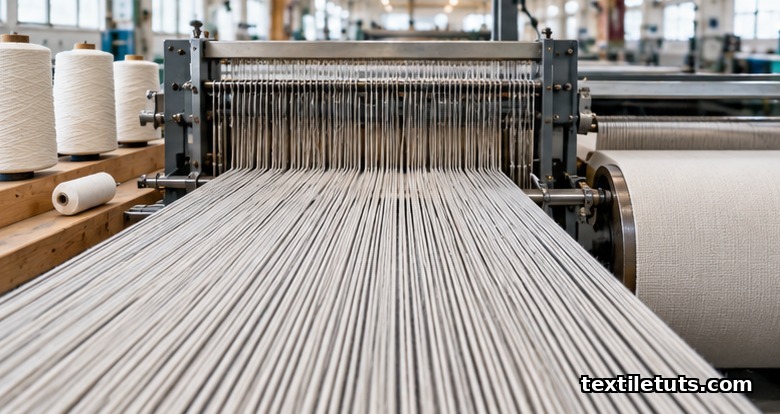
Warp yarns run lengthwise on the loom and absorb 70–80% of the cyclic tension generated during weaving, while weft yarns pass crosswise between them and are beaten into place at 8–25 insertions per minute on a conventional shuttle loom, which is why warp yarns are typically spun with higher twist, sized with starch or PVA, and selected for tensile strength, while weft yarns are chosen for cover, softness, and surface appearance.
The two yarn sets look identical in a finished fabric, but their jobs inside the loom are very different, and the wrong swap between them is one of the most common causes of weaving breaks, set marks, and uneven hand-feel.
This guide walks through how warp and weft yarns differ mechanically, how to choose each one for a given fabric, and where textile engineers typically make selection mistakes when a project goes from sample to bulk.
What Warp and Weft Yarns Actually Are
The warp is the set of yarns that are held under tension on the loom, running parallel to the selvage and to the take-up roller. On a power loom, the warp is first sized, then mounted on the warp beam, then threaded through the heddles and the reed before a single pick is inserted. The number of warp ends per unit width is set by the warp count and the loom reed count, which are usually fixed before the first weft yarn is loaded.
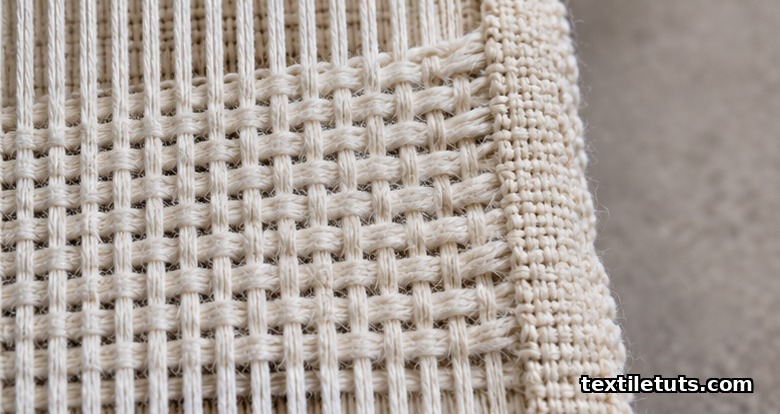
The weft is the set of yarns that travel crosswise. Each pick (a single length of weft yarn) is carried across the shed by a shuttle, projectile, rapier, or jet of air or water, then beaten up against the previous pick by the reed. The weft is wound onto packages (cones, cheeses, or pirns) and feeds from one or both sides of the loom depending on the machine.
In a plain weave, warp yarns sit on top roughly 50% of the time and weft yarns sit on top the other 50%. In a 3/1 twill, warp yarns are on the face about 75% of the time, which is why the warp is the dominant yarn for tensile strength and abrasion resistance in most apparel fabrics.
Mechanical Roles: Why the Loads Are Not Symmetric
During weaving, every warp end is repeatedly tensioned, slackened, and abraded as the shed opens and closes. The cycle runs at the loom speed, typically 400–600 picks per minute on a modern rapier or air-jet loom, and the warp end sees one tension peak per pick. ISO 7211-5, the standard method for determining the mass per unit area of a woven fabric, assumes the warp end count and weft pick count that the weaver specified, which in turn fixes the density that drives those tension peaks.
The weft yarn sees far less tension. It is tensioned only briefly as it is carried across the shed, and once it has been beaten into the fabric, it sits in compression between adjacent picks. Beat-up force on a modern air-jet loom commonly reaches 8–14 kN at the reed, and that force is absorbed almost entirely by the warp, not by the weft being inserted.
For these reasons, warp yarns are sized with a film-forming polymer (usually starch, PVA, carboxymethyl cellulose, or an acrylic) to glue protruding fibers back onto the yarn surface, reduce hairiness, and lower the coefficient of friction against the heddles and reed. Weft yarns, by contrast, are usually not sized, because the abrasion and friction they see in the loom is much smaller.
Yarn Count and Twist: How Selection Differs Between Warp and Weft
Warp yarns are normally spun to a finer count than the weft in the same fabric, because more warp ends are packed into the same width. A typical poplin shirt fabric may use 60s Ne (≈ 9.8 tex) warp and 40s Ne (≈ 14.8 tex) weft, which lets the weaver pack 60–72 ends per cm in the warp and only 30–36 picks per cm in the weft. The finer warp keeps the fabric smooth on the face; the coarser weft adds cover and weight without adding stiffness.
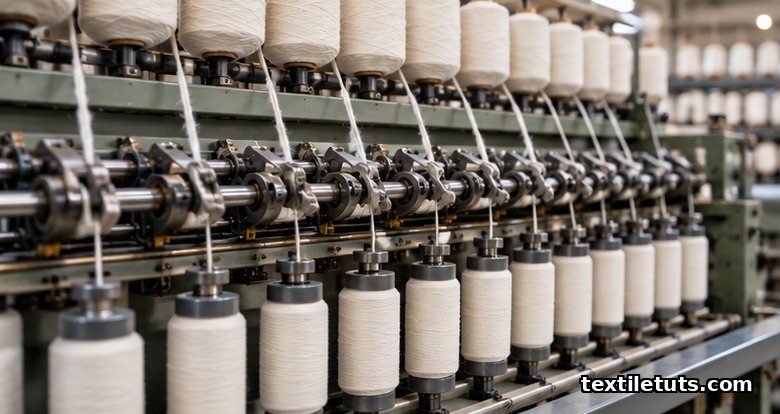
Twist levels follow the same logic. Warp yarns are usually spun to a twist multiplier of 3.6–4.2 (English cotton system, TM = turns per inch × √Ne), the upper end of the practical range for ring-spun cotton, to give them the tensile strength and abrasion resistance they need at the heddles and reed. Weft yarns for weaving are often spun to 3.0–3.6, where the yarn is fuller, softer, and gives better cover at the same count.
Filament yarns complicate the picture. For continuous-filament warp (polyester, nylon, viscose), the twist is very low (often 50–100 TPM, or T/m, turns per meter) because the filament bundle is already strong, but the filaments are still sized to prevent stripping at the heddles. Air-jet spun yarns are sometimes used for weft because they are cheaper and give good cover, but they are rarely used for warp on high-density fabrics because their tensile strength is 10–15% lower than ring-spun yarn at the same count.
Fiber Choice for Warp vs. Weft
The dominant fiber choice for warp in woven cotton shirting, sheeting, and bottom-weight fabrics is long-staple cotton (28–34 mm staple, 3.9–4.5 micronaire), because longer fibers resist the cyclic abrasion of the heddles better. Pima, Egyptian, and their machine-picked equivalents (such as Indian DCH-32 or West African SG-5110) are common warp choices when the warp needs to survive high loom speeds without breaking.
For weft, the weaver has more freedom. Coarser, shorter-staple cotton, blended cotton/polyester, or even air-jet spun yarn all work, because the weft does not see the same heddle abrasion. Many mills use rotor-spun (open-end) yarn as weft at 20–30% lower cost than ring-spun, with no penalty in fabric performance if the surface does not need to be perfectly smooth.
For synthetic filament warps (polyester 50–75 denier/24–36 filament for apparel, 150–300 denier for industrial fabric), the filament linear density and the number of filaments are the main levers. Higher filament count means finer individual filaments, which gives softer fabric but reduces the yarn’s resistance to abrasion at the heddles. A 75 denier/72 filament polyester yarn is more comfortable but breaks faster on the loom than a 75 denier/36 filament yarn at the same total linear density.
Sizing, Preparation, and Why Warp Sizing Is Non-Negotiable
Before a warp can be woven at production speed, it has to be sized. Sizing is the application of a film-forming polymer to the yarn surface, followed by drying on hot cylinders (typically 100–140 °C for cotton warp, 110–130 °C for polyester blends) and re-beaming. The size coat (commonly 6–12% add-on for cotton, 2–6% for polyester filament) glues the surface fibers down and reduces hairiness, which lowers the friction coefficient against the heddle eye from roughly 0.45 (unsized) to 0.20–0.25 (sized).
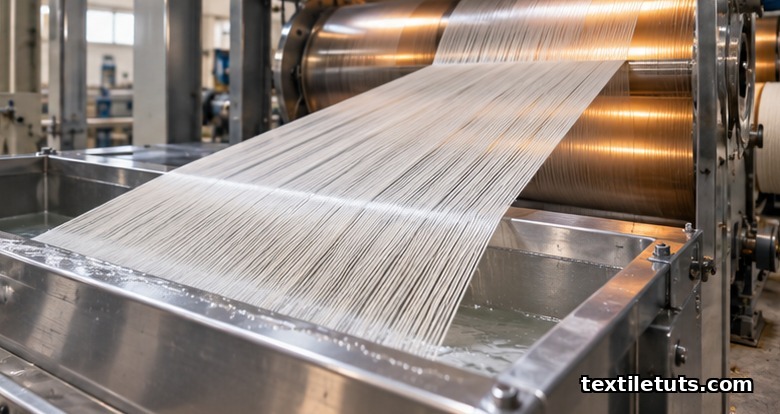
The size has to be removed again before dyeing or finishing, because residual size blocks dye uptake. Desizing is usually done with hot water (60–90 °C) and an amylase enzyme for starch, or with a hot caustic wash for PVA and acrylic sizes. Incomplete desizing is one of the most common causes of dye-defect claims in woven fabric finishing, and it shows up as pale, patchy areas on the face.
Weft preparation is much simpler. Cones or cheeses are simply mounted on the loom, sometimes waxed lightly to reduce the friction of the weft carrier, and that is the extent of it. No size coat is applied to the weft in conventional cotton weaving.
Warp vs. Weft at a Glance
| Property | Warp Yarn | Weft Yarn |
|---|---|---|
| Direction in fabric | Lengthwise (parallel to selvage) | Crosswise (perpendicular to selvage) |
| Tension during weaving | High, cyclic, peak per pick | Low, transient during insertion |
| Twist multiplier (cotton) | 3.6–4.2 | 3.0–3.6 |
| Typical count vs. weft | Finer (higher Ne or lower tex) | Coarser (lower Ne or higher tex) |
| Sizing | Yes, starch / PVA / acrylic, 2–12% add-on | No (light waxing only) |
| Fiber choice priority | Strength, abrasion resistance, long staple | Cover, softness, appearance |
| Spinning system commonly used | Ring-spun (compact preferred) | Ring, rotor, or air-jet |
| Dominant contributor to fabric tensile strength | Yes (in most apparel weaves) | Minor |
Common Selection Mistakes in Bulk Production
Three mistakes come up again and again when a sample that wove well in the lab fails in production:
- Using rotor-spun yarn as warp on a high-density fabric. Open-end yarn has 10–15% lower single-end tenacity than ring-spun at the same count and breaks disproportionately at the heddles. If the sample used ring-spun warp and the bulk order switched to rotor, the warp stop rate will climb and the loom efficiency will fall.
- Skipping the size coat on a filament warp because the yarn “looks strong”. A 75 denier polyester filament is strong, but the individual filaments will strip at the heddle eye within an hour of weaving at 500 picks per minute if the warp is not sized. Sizing is a surface treatment, not a strength treatment.
- Choosing a warp count that is too coarse for the reed. A 30 Ne cotton warp needs to fit through a reed of the right fineness (typically 1.5–2× the warp count expressed in dents per cm). If the reed is too coarse, the warp sits too far apart and the weft shows through, producing a sleazy, low-cover fabric. If the reed is too fine, the warp ends are jammed and abrade against each other.
How to Choose Yarns for a New Fabric
Start from the fabric specification, not from the yarn shelf. Work out the target warp count, weft count, ends per cm, picks per cm, and loom speed, then pick the yarn that will survive the loom. The sequence that works for most woven cotton and poly-cotton developments is:
- Set the warp count first (drives cover and fabric weight).
- Set the warp twist multiplier at 3.8–4.0 for ring-spun cotton, or pick a filament count that survives the reed.
- Pick the weft count to give the right fabric weight and cover, with more freedom on spinning system.
- Confirm sizing chemistry, desizing recipe, and loom conditions match the yarn choice.
If any step does not match, the loom is where the mismatch shows up first.
Frequently Asked Questions
Is warp yarn always stronger than weft yarn?
Not always, but in most apparel fabrics the warp is the stronger direction. Warp yarns are usually spun to a higher twist multiplier and a finer count, and they are sized, which raises single-end tenacity by 8–15%. In a 3/1 twill, the warp also carries about 75% of the surface, so it dominates the fabric’s tensile and tear strength.
Can the same yarn be used for both warp and weft?
Yes. Linen sheeting, some woolen fabrics, and many filament-based fabrics use the same yarn in both directions. When the same yarn is used, the fabric is usually described as “balanced”. The trade-off is that the weaver loses the freedom to optimize the weft for cover and softness separately.
Why do warp yarns need to be sized but weft yarns do not?
The warp rubs against every heddle and every dent of the reed on every pick, which can run to 30,000–50,000 cycles per shift. The size coat glues surface fibers down and lowers friction, so the warp survives that many cycles. The weft travels across the shed once, then sits in the fabric; the abrasion it sees is much smaller, so sizing is unnecessary.
What happens if warp and weft are accidentally swapped on the loom?
If a yarn meant for weft is mounted as warp, the loom will usually show the problem within minutes: end breaks will rise sharply, the yarn will pile up at the heddles, and the fabric will show set marks from the constant stop-starts. Stop the loom, re-beam the correct yarn, and check whether the lot needs to be re-sourced before continuing.
How do I know which direction is warp on a piece of finished fabric?
Three practical checks work on most woven fabrics. First, the warp is parallel to the selvage. Second, the warp yarns are usually straighter and more tightly packed, while the weft yarns show more crimp. Third, if you tear the fabric, it usually tears along the warp, because the warp dominates tensile strength in most weaves. AATCC TM 143 describes a similar procedure for appearance evaluation after repeated home laundering, which also relies on identifying warp and weft correctly before grading.
References
- International Organization for Standardization. ISO 7211-5: Textiles — Determination of mass per unit area of woven fabrics. ISO, Geneva — standard method used to verify woven fabric construction, including warp and weft density.
- ASTM International. ASTM D3775 — Standard Test Method for Warp (End) and Filling (Pick) Count of Woven Fabrics. ASTM, West Conshohocken — defines how warp and weft density are counted for woven fabric acceptance.
- American Association of Textile Chemists and Colorists. AATCC Test Method 143 — Appearance of Apparel Fabrics After Repeated Home Laundering. AATCC, Research Triangle Park — appearance evaluation that depends on correctly identifying warp vs. weft.
- Das, A., & Ishtiaque, S. M. (2004). Yarn quality and weaving performance. Journal of the Textile Institute, 95(1–6), 105–116 — peer-reviewed study on how yarn properties map to weaving breakage rates.
- Resin-treated cotton warp sizing and desizing study, peer-reviewed textile chemistry literature. Sizing and desizing of warp yarns. ResearchGate / Springer Open, multiple chapters — covers starch, PVA, and acrylic size chemistry and removal.
- Goswami, K. K. (2017). Advances in Carpet Manufacturing. Woodhead Publishing (Elsevier) — peer-reviewed volume covering yarn selection for face vs. back in woven carpets, where warp and weft roles are strongly differentiated.
This article is the working reference for warp and weft yarn roles and selection on conventional looms. Editorial by Mohammad Yousuf (Anik), TextileTuts. Sources: ISO 7211-5, ASTM D3775, AATCC TM 143, peer-reviewed work by Das and Ishtiaque (Textile Institute), and Springer Open sizing literature as cited.


