
Bra Construction: Types, Sizing, Materials

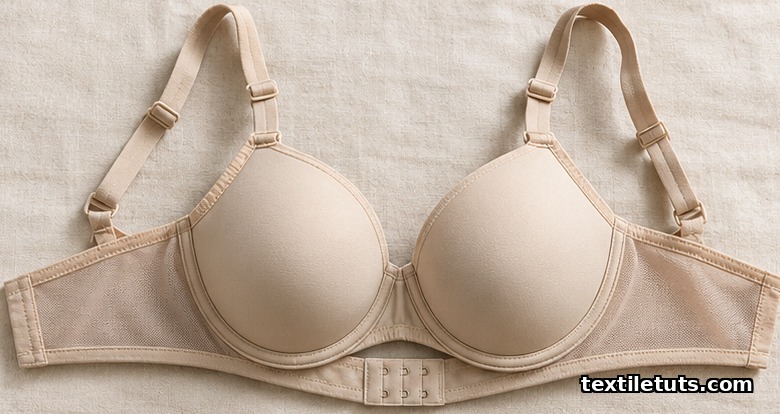
A correctly fitted bra combines an underbust band measured in centimeters and graded in 5 cm steps per ISO 8559-1, a cup volume that increases roughly 2 cm per cup letter on the same band, and a band that carries approximately 80% of breast support when fitted parallel to the floor. The straps guide the breast upward and shape the silhouette; the cup encases and contours the breast tissue; and the wing (the side panel between the cup seam and the hook closure) anchors the whole assembly to the ribcage. This article maps the components of a contemporary bra, walks through how the four major sizing systems translate the same body into different labels, and breaks down why a finished bra contains between 20 and 40 separate parts drawn from cotton, polyamide, elastane, and engineered knit laminates.
Understanding bra construction matters because no other apparel category combines medical-grade fit requirements, intimate contact with the skin, and a consumer base that has historically fit itself incorrectly. Surveys conducted in Australia, the United Kingdom, and the United States between 2010 and 2020 reported that between 70% and 100% of women sampled were wearing a band that was too loose and a cup that was too small, a mismatch usually rooted in outdated sizing charts rather than body shape. A bra is also one of the few garments where the underband must feel snug at first wear (because the elastane relaxes roughly 10% over the first 20 wearing cycles) yet comfortable after warm-up.
Bra Anatomy and Component Map
A fully constructed underwire bra contains roughly 25 to 35 individual parts, depending on whether the design uses molded cups or cut-and-sewn cups. The pieces fall into four functional zones, and every zone has its own fabric specification.
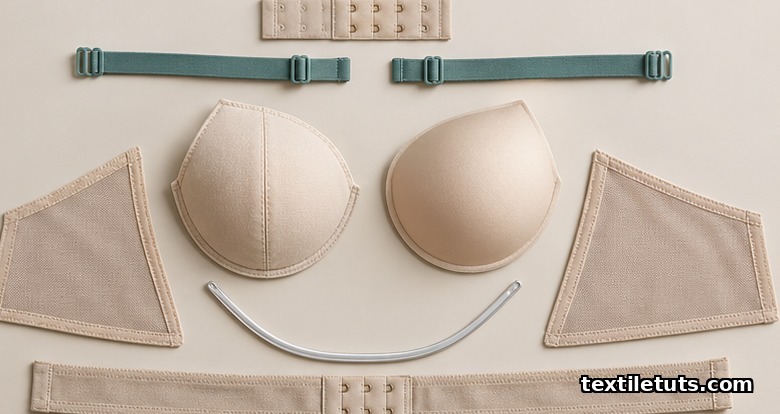
The band (also called the underband, frame, or cradle) is the structural foundation. It runs around the ribcage below the breast and joins at the back through a hook-and-eye closure of two, four, or sometimes six hooks. The closure row count is a sizing signal: bras in larger band sizes (above 95 cm underbust) almost always add hooks to spread the load across more fastener points and reduce individual hook stress. The band carries approximately 80% of the breast weight when correctly fitted, a figure reproduced in multiple peer-reviewed biomechanics studies including work by McGhee and colleagues published in the British Journal of Sports Medicine.
The wings (sometimes called the side panels or back panels) extend from the band to the closure. They are typically cut from a powernet, a stabilized weft-knit with 12% to 25% elastane content, because this zone needs horizontal stretch to wrap the ribcage while resisting vertical elongation under load.
The cups hold and shape the breast. They are produced by one of three construction routes: cut-and-sewn from two or three fabric panels with a central seam (a vertical seam or three-part panel that provides projection), molded (a single piece thermoformed over a cup-shaped mold using a knitted or warp-knit jersey laminated to a thin foam or spacer fabric), or seamless (knit directly to shape on circular or warp knitting machines). Underwire bras add a coated or plastic-coated metal channel along the lower cup edge; the channel sits in the inframammary fold.
The straps connect the front of the cup apex to the back of the band via adjustable sliders. Straps are not load-bearing in a well-fitted bra and carry roughly 20% of breast weight, which is why most fittings allow straps that fall off the shoulder until the band is tightened to the correct tension.
Cup Types and Coverage Styles
Cup geometry is one of the most variable features of bra design, because cup shape interacts directly with breast shape and outfit neckline. The major families in commercial production are listed below.
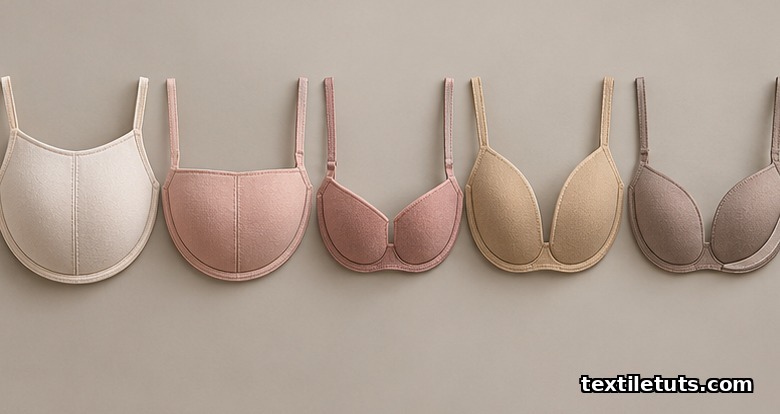
Full cup cups encase the entire breast with fabric reaching the shoulder strap on the upper edge. They give the maximum coverage and the most support per gram of elastane and are the default in cup sizes D and above. Balconette (sometimes called balcony or shelf) cups have a horizontal top edge that sits roughly 2 cm to 3 cm below the shoulder line, exposing the upper breast. They are designed for lower-cut necklines and square or boat necklines. Demi-cup (or half-cup) covers half to two-thirds of the breast and is the typical pairing for v-neck tops. Plunge cups angle the central gore (the fabric strip between the cups) almost vertically so that the cups can meet low-cut tops without the gore showing. Push-up and enhancer cups add crescent-shaped padding along the lower outer cup to rotate breast tissue inward and upward. Minimizer cups redistribute breast tissue across a wider cup footprint to reduce projection by roughly 1 cm to 2 cm without compressing the breast.
Sports bras form their own category and are graded by impact level rather than by cup letter. The standard reference here is the work of McGhee, Steele, and colleagues at the University of Wollongong, whose classification divides bras into low-impact, medium-impact, and high-impact designs based on laboratory measurement of breast displacement during treadmill running.
Band Sizing and the Underbust Measurement
The band number printed on every bra label corresponds to the snug underbust measurement, the circumference of the ribcage directly under the breast, taken while exhaling and with the tape held parallel to the floor. ISO 8559-1:2017 defines the anthropometric landmarks and measurement posture used in size designation for women’s garments; ISO 4415 (size designation of clothes, bras) specifies how the underbust measurement maps onto a label number.
The four major commercial systems differ in their size step and label style:
- United States and Canada use even-numbered band labels in inches (32, 34, 36, 38, 40) that round up from the underbust in inches. The label value is the snug underbust in inches plus 0 to 2 inches of positive ease, depending on the manufacturer’s fit block. Most US brands add zero ease for soft-cup designs and roughly 2 inches for rigid underwire frames.
- United Kingdom uses even-numbered band labels in inches, identical to the US numbering for most sizes, but cup letters progress differently (see Cup Sizing section below).
- European Union uses the underbust directly in centimeters, with bands stepped in 5 cm increments (75, 80, 85, 90, 95). The label is usually the underbust plus roughly 0 cm to 1 cm of ease.
- Australia, New Zealand, and Japan use centimeter band labels similar to the EU system, but Japanese brands often use 5 cm steps as well while some Australian brands use a hybrid US/EU label.
Because the same body produces a 32 underbust label in the US and a 75 label in the EU (and a 70 label in many Japanese brands after a tighter fit block), cross-border bra shopping without conversion is a frequent source of fit failure. The cleanest translation rule is: underbust in centimeters equals the EU/AU label, and underbust in inches times 2.54 then rounded to the nearest even integer equals the US/UK band label.
Cup Sizing and the Bust-Band Differential
Cup letter is not an absolute breast volume. It is a differential: the difference between the bust measurement at the fullest point of the breast and the underbust measurement. Each cup step represents a roughly 2 cm (about 1 inch) increase in this differential. The system is the same in principle across the US, UK, EU, and AU markets, but the increments differ enough to produce real-world differences in cup label.
Under the most common US convention, an A cup is a 2.5 cm differential, B is 5 cm, C is 7.5 cm, D is 10 cm, and the alphabet continues upward. Under the UK convention, the same letters represent slightly larger differentials (A is 5 cm, B is 7.5 cm, C is 10 cm, D is 12.5 cm). The practical result is that a US D cup and a UK D cup are not the same breast volume on the same band; a UK D is closer to a US DD or E. EU and AU cups typically follow the UK convention.
This is the single largest source of cross-border size confusion. A woman who fits a 34D in a US brand often finds that the same 34D in a UK brand feels too small in the cup and that the matching UK size is 34E. The conversion rule that holds across the major markets is: when moving from a US label to a UK label, add one cup letter (US 34D equals UK 34E). When moving in the opposite direction, subtract one cup letter.
Material Composition by Component
Most bras combine at least three different fabric specifications, because each zone has different mechanical requirements. A representative wired bra uses the following material breakdown.
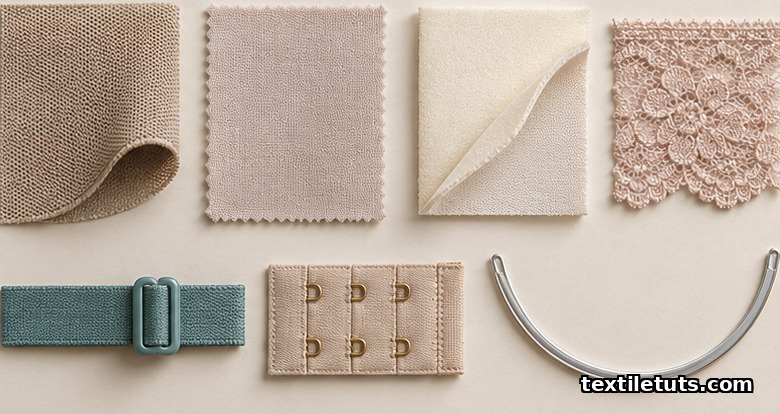
The band and wing powernet is typically a polyester or polyamide (nylon) warp-knit or weft-knit stabilized with 12% to 25% elastane (spandex or Lycra). The fabric is usually 110 g/m² to 180 g/m² in weight. Elastane content above 20% gives a softer hand and faster recovery but reduces the structural support of the band; below 12%, the fabric does not stretch enough to fit a range of body sizes within one label. The laminate construction (a face fabric bonded to a thin stabilizer such as a 20 g/m² nylon tulle) controls stretch in both directions, which is why high-end bras almost always use a laminate in the wing rather than a single-knit fabric.
The cup shell is either cut-and-sewn from a stable cotton or cotton/elastane jersey (for soft-cup and maternity styles) or molded from a polyamide/elastane circular knit laminated to a thin polyurethane foam. Molded cups use foam densities of 50 kg/m³ to 100 kg/m³ for everyday bras and 30 kg/m³ to 50 kg/m³ for push-up styles where lower density produces a softer silhouette.
The straps are a narrow polyamide or polyester webbing with a brushed back for skin comfort and an adjustable plastic or metal slider. The slider is the most stressed plastic component and is usually molded from acetal (POM) for its low friction and resistance to creep under load.
The hook-and-eye closure is typically a metal hook (sometimes plastic for low-cost designs) heat-stamped from brass or stainless steel wire, paired with a stamped eye tape made of polyester or polyamide. Reinforced bands on larger sizes use multiple hook rows so that the user can tighten the bra as the elastane relaxes over the first 20 wear cycles.
Quality Standards and Testing
Bra performance is verified against a small number of standardized test methods, most of which were originally written for general apparel but have been adapted for intimate apparel through specific tolerance bands.
ISO 139 fixes the standard atmosphere for conditioning textiles before testing (20 °C and 65% relative humidity), and almost every mechanical property cited on a bra specification sheet is measured after conditioning to that atmosphere. Stretch and recovery of the band and wing fabric is commonly reported per ASTM D4964 (Standard Test Method for Stretch and Recovery Properties of Knitted Fabrics Having Low Power) for low-power stretch or per ISO 14704-style protocols for higher loads. Colorfastness to perspiration, washing, and light is graded per the ISO 105 family, the AATCC 135 (dimensional stability to home laundering) wash cycle, and AATCC 16 (colorfastness to light).
ASTM D7019 covers performance specifications for brassieres in the US market and sets tolerance bands for component dimensions, seam strength, and hook-and-eye fastening strength. A peer-reviewed reference of particular interest to material specifiers is the work by Yu and colleagues on the biomechanical support requirements of breast support garments, published through Springer Open, which documents the load distribution between the band and straps across cup sizes.
Compliance with the OEKO-TEX Standard 100 is now widely used as the safety benchmark for skin-contact intimate apparel, although it is not a fit standard. The standard limits extractable heavy metals, formaldehyde, and a defined list of aromatic amines that can be released from certain disperse dye residues.
Frequently Asked Questions
How do I know if my band size is right?
The band should sit horizontal around the ribcage, parallel to the floor, and stay in place when you raise both arms overhead. If the band rides up at the back, it is too loose, even if the hooks feel tight at first wear. Most elastane fibers in bra bands relax about 10% over the first 20 wear cycles, so a new bra should feel snug on the loosest hook and graduate to the tighter hooks over the first months of wear.
What does a D cup actually mean in real measurements?
A D cup is a differential of roughly 10 cm (about 4 inches) between the bust measurement at the fullest point and the underbust measurement, under the US convention. The same letter in a UK brand represents about 12.5 cm, which is one reason a US D cup can fit as a UK E cup. Cup letter is not a fixed breast volume, and the same label means different cup sizes in different markets.
How does bra sizing differ between the US, UK, EU, and Japan?
The US and UK label bands in inches (32, 34, 36) and cups in letters, with the UK cup running one letter larger than the US at the same differential. The EU and AU label bands in centimeters (75, 80, 85) using 5 cm steps. Japanese brands use centimeter bands as well but often use a smaller fit block, so a Japanese 75 may correspond to a US 32 band rather than a US 34. Cup letters are not standardized across regions.
Which fabric is best for everyday bras, cotton, microfiber, or lace?
Cotton-rich cups are the most breathable and the most comfortable for skin sensitivity, but they have limited recovery and lose shape faster than synthetic alternatives. Polyamide and elastane microfiber knits (often labeled as nylon/spandex) hold their shape through 40+ wash cycles and dry faster, which is why they dominate the wired-bra market. Lace is decorative rather than structural; it is usually layered over a powernet or jersey ground, and its open construction means it contributes little support on its own.
Why do underwires sometimes poke through the fabric after a few months of wear?
Underwire tips escape their channels when the channel fabric abrades from repeated washing and body movement, when the cup fabric is too thin to anchor the channel stitch, or when the bra has been machine-dried at high temperature. The fix is to hand-wash the bra, air-dry it flat, and replace bras where the underwire has migrated more than a few millimeters from the original channel. Underwire bras typically last 6 to 12 months under daily rotation before the elastane relaxes beyond useful support.
This article is the working reference for bra construction, sizing systems, and material composition. Editorial by Kazi Sifat Muntasir, TextileTuts. Sources: ISO 8559-1, ISO 4415, ISO 139, ASTM D7019, ASTM D4964, AATCC 135, AATCC 16, and the biomechanics work by McGhee and Steele as cited.


