
Letters of Credit in Textile Trade

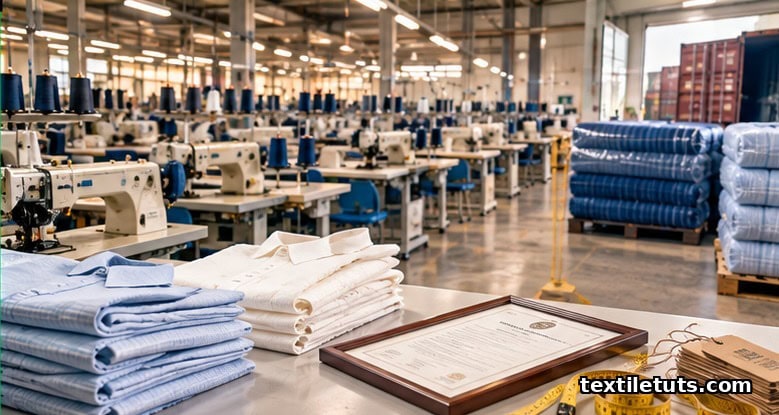
A letter of credit (LC) is a bank-issued payment instrument that pays a textile exporter once the shipping and commercial documents listed in the LC are presented in compliance with UCP 600, the International Chamber of Commerce’s 39-article rulebook adopted by banks in more than 175 countries.
Bangladesh Bank, the country’s central bank, reports that scheduled banks settled foreign-currency import and export letters of credit worth roughly BDT 4.7 trillion in FY 2023-24, with cotton, fabric, and accessories imports for the ready-made garment (RMG) sector accounting for the largest single share of that volume.
This guide explains how LCs work in textile trade, the documents exporters must prepare, the discrepancies that most often delay payment, the LC types buyers and suppliers choose for woven, knit, and technical textile deals, and how to structure margin money and confirmation costs into a workable export contract.
What a Letter of Credit Does in Textile Trade
A letter of credit substitutes a bank’s credit for the buyer’s credit. When a European apparel brand orders woven shirts from a Bangladeshi manufacturer, neither party wants to carry the other’s risk. The brand does not want to ship money before the goods leave the factory; the factory does not want to produce 50,000 shirts without guaranteed payment. The LC solves that standoff by inserting a bank, usually the buyer’s bank (the issuing bank), which promises to pay the seller once a defined set of documents is presented.
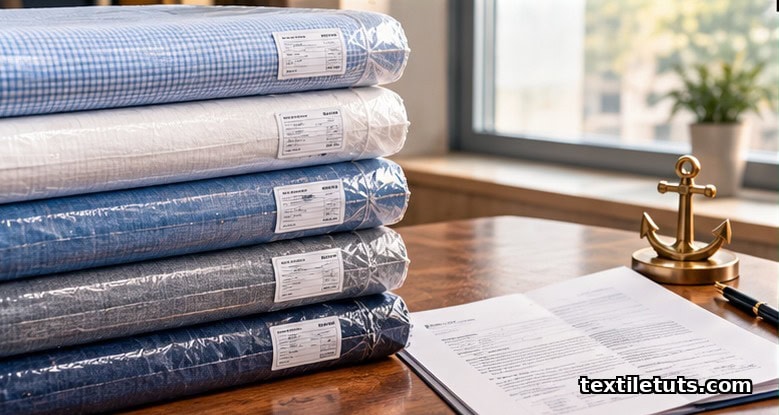
For textile transactions, the LC matters more than in most other commodity trades because the goods are often custom-made, non-resellable, and produced against a buyer’s private label. A shipment of rejected garments cannot easily be rerouted to a different buyer, so the seller needs payment certainty from a financial institution, not a promise from a trading house.
UCP 600 and the Documentary Rules That Govern Textile LCs
Most textile LCs are issued subject to UCP 600, ICC Publication 600, which entered into force on 1 July 2007 and is the seventh revision of the Uniform Customs and Practice for Documentary Credits. UCP 600 is binding on the issuing bank, the advising bank, the confirming bank, and the seller, even if the seller is not an ICC member.
The rulebook contains 39 articles. The seller-relevant ones in textile trade include Article 14 (standard for examination of documents and maximum 5 banking days following the day of presentation), Article 17 (originals and copies), Article 18 (commercial invoice), Article 23 (transport document), and Article 28 (insurance document). The buyer’s merchandising team should also be familiar with eUCP, the supplement that extends UCP 600 to electronic presentations such as electronic bills of lading and scanned commercial invoices.
ISBP 745 (International Standard Banking Practice for the Examination of Documents under UCP 600) is the ICC’s accompanying interpretation document. Under ISBP, an invoice description of goods must correspond to the LC description; a tolerance of plus or minus 10% in quantity or unit price is allowed unless the LC forbids it (UCP 600 sub-article 30(f)).
The 10 Most Common Discrepancies in Textile LC Presentations
The ICC Banking Commission’s Global Survey on Trade Finance has repeatedly found that 60 to 70 percent of documentary credit presentations are rejected on first examination for discrepancies. For textile exporters, most rejections come from a small list of avoidable mistakes.
- Late shipment beyond the latest shipping date stated in the LC.
- Goods description on the invoice differs from the description on the LC (for example “ladies’ blouses” instead of “ladies’ woven shirts”).
- Bill of lading shows a transshipment when the LC forbids it, or vice versa.
- Insurance cover is below 110% of the CIF value or shows the wrong currency.
- Certificate of origin issued by a chamber not listed in the LC.
- Quantity or weight on the invoice exceeds the tolerance permitted by the LC.
- Packing list shows net weight but invoice shows gross weight, or units are inconsistent.
- Required document such as a pre-shipment inspection certificate (for example SGS, Bureau Veritas, or Intertek) is missing.
- Beneficiary’s name on the invoice does not match the beneficiary named in the LC by a single character.
- Date of documents is later than the 21-day presentation rule (UCP 600 sub-article 14(c)).
Each discrepancy adds a banking day to the 5-day examination window and, more importantly, gives the buyer an excuse to delay or refuse payment until the discrepancy is waived.
LC Types Used in Garment and Fabric Trade
| LC Type | Who It Protects | Typical Textile Use Case | Cost Layer |
|---|---|---|---|
| Irrevocable | Seller | Standard for woven and knit fabric exports; cannot be changed without all-party consent. | Issuance + advising fees only |
| Confirmed | Seller against issuing-bank risk | Sales to buyers in markets where the issuing bank’s country risk is high. | Issuance + advising + confirmation fee |
| Transferable | Intermediate trader | Buying house in Dhaka sourcing fabric from multiple mills on one master LC. | Issuance + advising + transfer fee |
| Back-to-Back | Trading company without warehouse | Trading house receives master LC from brand and opens back-to-back LC to its mill supplier. | Two issuance fees + two advising fees |
| Revolving | Recurring shipments | Continuous knit fabric supply to a single buyer over 6 or 12 months. | Issuance + per-shipment advising |
| Standby LC | Performance guarantee | Often used as a warranty or advance-payment guarantee, not as primary payment. | Issuance + advising |
| Red Clause LC | Seller working capital | Allows the advising bank to pre-finance raw material purchases (for example cotton yarn) before shipment. | Issuance + advising + advance finance interest |
For most Bangladesh-to-EU or Bangladesh-to-US apparel shipments, the irrevocable confirmed LC at sight is the default. Sight LCs are paid on presentation of compliant documents; usance LCs add a deferred payment period of 30, 60, 90, or 180 days, which the seller usually discounts at a cost equal to 2 to 6 percent of the LC value per year of deferral.
How an LC Transaction Flows from Proforma Invoice to Settlement
The lifecycle of a textile LC has eight stages, and missing any of them creates a discrepancy risk:
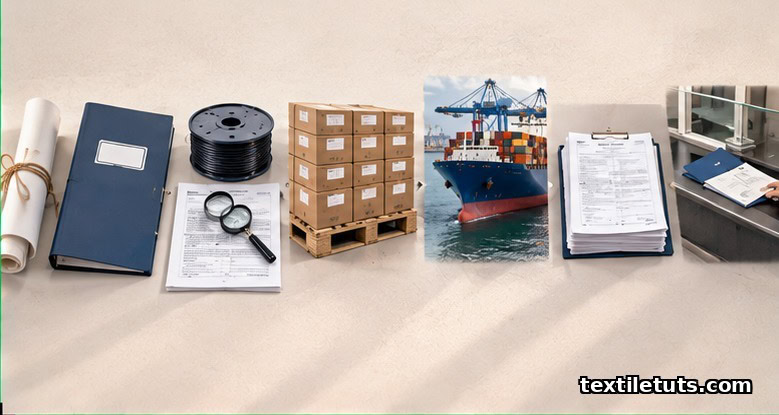
- The buyer issues a purchase order or proforma invoice to the seller specifying fabric composition, GSM, yarn count, color, quantity, shipment date, and payment terms.
- The seller prepares a sales contract and the buyer instructs its bank to issue an LC in favor of the seller, naming the advising bank in the seller’s country.
- The issuing bank transmits the LC through SWIFT MT700 to the advising bank in Bangladesh, which authenticates it and delivers it to the seller.
- The seller reviews every LC clause against the sales contract, especially the goods description, latest shipment date, and document list, and requests amendments if any clause is wrong.
- The seller produces or procures the goods (greige fabric, dyed fabric, or finished garments), books space on a vessel, and arranges for any required pre-shipment inspection.
- The seller presents the documents (signed commercial invoice, full set of clean on-board bills of lading, packing list, certificate of origin, GSP Form A if applicable, insurance certificate, and inspection certificate) to the advising bank within 21 days of the bill of lading date.
- The advising bank examines the documents against the LC and UCP 600 within 5 banking days; if compliant, it pays or, in a confirmed LC, honors its confirmation undertaking.
- The issuing bank reimburses the advising bank, and the buyer receives the documents needed to clear the goods through customs in the destination country.
Cost, Fees, and Margin Money in a Textile LC
Bangladesh Bank’s Foreign Exchange Policy Department regulates LC charges through circulars issued to authorized dealers. As of recent circulars, the typical cost stack for a USD 1 million export LC at sight includes:
- Issuance commission: 0.10 to 0.40 percent per quarter or part thereof, charged by the issuing bank to the buyer.
- Advising commission: BDT equivalent of USD 50 to USD 200, charged by the advising bank to the seller.
- Confirmation commission: 0.50 to 2.00 percent per annum, charged by the confirming bank (if any) for its additional undertaking.
- Negotiation commission: 0.10 to 0.25 percent of the LC value.
- SWIFT charges: USD 30 to USD 75 per message.
Margin money, also called cash margin or collateral, is the buyer’s or seller’s own cash that the bank holds against the LC. For a buyer, the issuing bank typically blocks 10 to 100 percent of the LC value as margin depending on the buyer’s credit history and the country’s reserve position. For a seller seeking post-shipment finance, the advising bank may advance 70 to 80 percent of the invoice value against a compliant document set, which is a key source of working capital for small and medium textile mills.
LC Risks and How Buyers and Sellers Mitigate Them
The single largest LC risk for a textile exporter is a credit risk plus documentary risk. The issuing bank may be solvent, but if the buyer’s country faces a foreign-currency shortage, the bank may delay reimbursement for months. The ICC Banking Commission’s Trade Finance Survey documents persistent trade finance gaps in South Asia and Sub-Saharan Africa, where textile exporters are concentrated. Mitigation tactics include insisting on a confirming bank in a tier-1 jurisdiction (for example London, Singapore, or Frankfurt), using shorter usance periods, and registering the LC with the Export Promotion Bureau so the seller retains claim to export incentives.
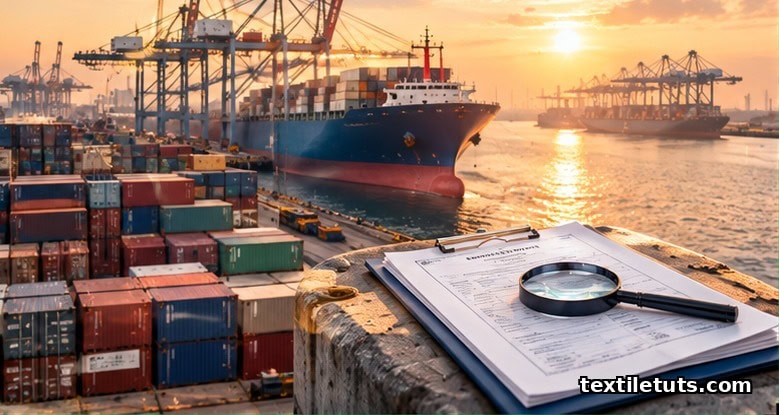
For a buyer, the largest risk is a fraudulent or non-conforming shipment. Mitigation is procedural: independent pre-shipment inspection by SGS, Bureau Veritas, or Intertek, a “no transshipment” clause to ensure the goods are loaded at the named port, and a sight LC rather than a usance LC so payment happens only after documents prove shipment. A trade credit insurance policy from Euler Hermes, Coface, or the Bangladesh Sadharan Bima Corporation can also cover the gap between LC payment and the buyer’s resale of the goods.
Operational risk, not fraud, causes the majority of LC disputes. According to the World Trade Organization’s 2023 World Trade Report, an estimated 80 percent of small cross-border trade finance requests are rejected or underserved, and most rejections are driven by paperwork problems, not creditworthiness. Investing in a trade-finance compliance officer and a checklist of UCP 600 and ISBP 745 requirements is therefore a higher-return activity than negotiating the LC fee.
Frequently Asked Questions
What is the difference between a confirmed and an unconfirmed letter of credit?
A confirmed LC adds a second bank’s payment undertaking, usually a bank in the seller’s country or a tier-1 international bank, on top of the issuing bank’s promise. The confirming bank pays the seller against compliant documents even if the issuing bank defaults. An unconfirmed LC carries only the issuing bank’s promise. Confirmed LCs cost more (0.50 to 2.00 percent per year of confirmation) but are standard for textile sales to buyers in markets with country-risk concerns.
How long does an LC negotiation take in a typical Bangladesh garment shipment?
From LC receipt to first document presentation, a 30,000-piece woven shirt shipment usually takes 25 to 45 days depending on fabric lead time, with a further 5 banking days for the advising bank to examine the documents. Total cash-to-cash cycle, from issuance to reimbursement, runs 35 to 60 days for a sight LC and 90 to 180 days for a 90-day usance LC.
Can a textile LC be amended after issuance, and who pays for the amendment?
Yes. UCP 600 sub-article 10(e) allows amendments with the consent of the issuing bank, the confirming bank (if any), and the beneficiary. Common amendments in textile deals are extensions of the latest shipment date, quantity changes within the 10 percent tolerance, and corrections to the goods description. Each SWIFT MT707 amendment costs USD 30 to USD 100 in SWIFT charges plus a bank handling fee of USD 50 to USD 200, and is usually borne by the party that requested the change.
What happens if the goods are rejected at the destination port?
A documentary LC is paid on the basis of documents, not the physical goods. If the documents are compliant but the buyer rejects the goods on quality grounds, the issuing bank must still pay the seller, and the buyer’s remedy is a separate quality claim under the sales contract, not a refusal to honor the LC. This is why buyers insist on a pre-shipment inspection certificate, SGS or Intertek being the most common in Bangladesh textile exports.
Is an LC required for small textile orders, or only large ones?
No minimum size exists in UCP 600, and LCs are issued for orders as small as USD 5,000. In practice, buyers use open-account or advance-payment terms for orders below roughly USD 20,000 because LC issuance fees become a larger percentage of contract value. Bangladeshi woven fabric mills supplying directly to small European brands often accept 30 percent advance by wire transfer and 70 percent against a copy of the bill of lading for sub-USD 20,000 deals.
References
- International Chamber of Commerce. Uniform Customs and Practice for Documentary Credits, UCP 600, ICC Publication No. 600. ICC Banking Commission, 2007 revision.
- International Chamber of Commerce. ISBP 745: International Standard Banking Practice for the Examination of Documents under UCP 600. ICC Banking Commission.
- Bangladesh Bank. Foreign Exchange Policy Department Circulars on Import and Export Letters of Credit. Scheduled Banks Statistics, FY 2023-24.
- World Trade Organization. World Trade Report 2023: Re-globalization for a Secure, Inclusive, and Sustainable Future. WTO Publications, Geneva.
- ICC Banking Commission. Global Survey on Trade Finance: Industry Insights. International Chamber of Commerce, latest annual edition.
- Bangladesh Garment Manufacturers and Exporters Association. Annual Export Statistics, Ready-Made Garment Sector. BGMEA, Dhaka.
- Export Promotion Bureau, Bangladesh. Export Promotion Bureau Statistics: Country-wise and Product-wise Export Data. Ministry of Commerce, Government of Bangladesh.
This article is the working reference for letter-of-credit practice in textile and apparel trade. Editorial by Mohammad Yousuf (Anik), TextileTuts. Sources: ICC UCP 600 and ISBP 745 (ICC Banking Commission); Bangladesh Bank Foreign Exchange Policy Department circulars; WTO World Trade Report 2023; BGMEA Annual Statistics; Export Promotion Bureau Bangladesh; ICC Banking Commission Global Survey on Trade Finance, as cited.


