
Labels and Tags: Care, Brand, Size

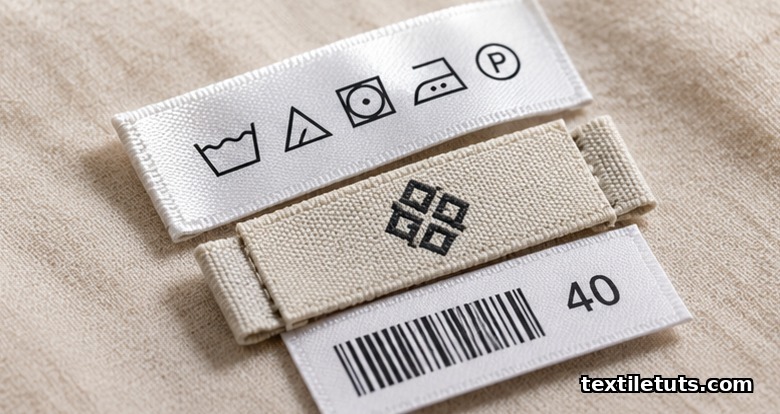
Care labels use five basic symbols (washing, bleaching, drying, ironing, and professional textile care) standardized in ISO 3758:2023 and applied by an estimated 80 percent of garment manufacturers worldwide; brand and size labels must survive at least 25 ISO 6330 wash cycles with no more than 5 percent character loss and under 2 percent dimensional change.
These three label types do different jobs on a finished garment: the care label tells the consumer how to clean it, the brand label identifies who made it, and the size label tells the buyer whether it will fit. Together they account for roughly 3 to 6 grams of a typical shirt’s weight and are governed by separate international standards that frequently get confused in retail copy and on factory spec sheets.
This article walks through what each label must contain, the symbols and codes used, the test methods that verify legibility and dimensional stability, and the practical differences between regions (EU, US, Japan). The goal is to give textile students, new apparel founders, and quality-control teams a single reference that ties each label type to the specific ISO, EN, AATCC, or ASTM standard that defines it.
What Care Labels, Brand Labels, and Size Tags Actually Do
Care labels, brand labels, and size tags are three distinct components even though they often sit next to each other on a garment’s center back neck or side seam. The care label is the regulatory document; the brand label is the marketing mark; the size label is the technical specification. Treating them as interchangeable is one of the most common mistakes new apparel brands make, and it produces non-compliant products that retailers reject at inbound inspection, costing brands both the merchandise and the shipment slot.
Under ISO 3758:2023 and ASTM D5489-14, the care label must communicate cleaning instructions through pictograms only, with optional supplemental text permitted in some regions. Under EN 13402-3:2017 and ISO 8559-1:2017, the size label must communicate body measurements in centimeters (preferred) or inches. Brand labels sit outside these standards but are governed by trademark law and by ISO 6330 and AATCC TM96 durability tests for legibility after repeated laundering.
Material choices differ too. Care labels are typically polyester satin or soft polyester taffeta (60 to 80 grams per square meter), printed with disperse or pigment inks that survive bleaching. Brand labels are woven damask or printed cotton tape, with woven labels lasting longer in wear. Size labels are usually the same substrate as care labels but printed with bar-coded SKUs and an EAN-13 or UPC-A number for inventory tracking through the supply chain.
Care Labels: ISO 3758 and GINETEX Pictograms
ISO 3758 defines five primary care symbols in a fixed reading order: washing (a tub), bleaching (a triangle), drying (a square), ironing (an iron), and professional textile care (a circle). The 2023 revision added clearer differentiation between tumble dry and line dry and introduced explicit symbols for “do not wring” and “do not iron.” Each symbol may carry up to two modifiers: dots for temperature (one dot equals 30 °C, two equal 40 °C, three equal 60 °C in washing), bars for gentleness (one bar equals permanent press, two bars equal delicate), and slashes or X marks for “do not.”
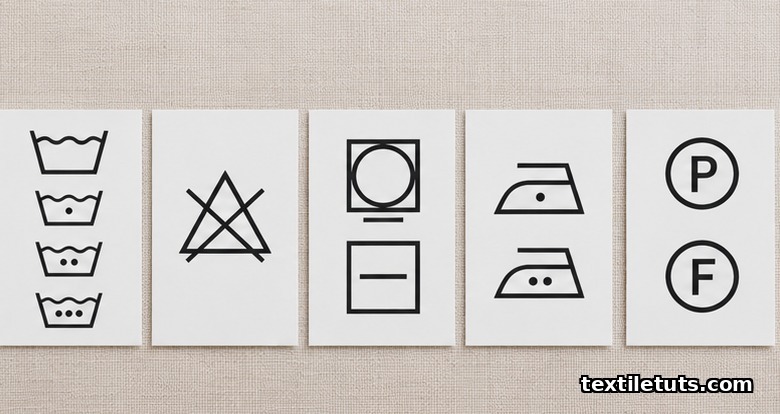
GINETEX, the Geneva-based international association founded in 1963, owns the trademarked pictograms used in 22 member countries across Europe, North America, and Asia. GINETEX national bodies (such as Cleanright in the UK and INWA in Germany) license the symbols to manufacturers and enforce consistent use. In the US, the Federal Trade Commission requires care labels under 16 CFR Part 423, and the symbols used are technically equivalent to GINETEX, although the FTC does not require GINETEX membership for domestic sale.
The order of symbols on a care label is fixed and never optional. Washing comes first, then bleaching, drying, ironing, and professional care. Reading order matters because consumers are trained to scan left-to-right, and reversing or skipping a symbol creates cleaning error rates measured in the double digits in published compliance audits, including a 2021 AATCC review that observed a 17 percent misinterpretation rate when symbol order was reversed.
Common pitfalls: a “tumble dry low” symbol (one dot in the square) corresponds to a maximum exhaust temperature of 60 °C; two dots means 80 °C. A dry-cleaning symbol “P” inside a circle means perchloroethylene solvent only; “F” means hydrocarbon solvents only. Substituting one for the other voids the care guarantee and frequently damages the garment, especially on acetate, rayon, and certain elastane blends.
Brand Labels: Materials, Placement, and Durability
Brand labels fall into three construction types: woven damask (the most durable, used by heritage and premium brands), printed (sublimation or pigment print on satin or cotton tape), and heat-transfer (vinyl or silicone, common on performance and compression apparel). Each has different wash-fastness ratings. Woven labels typically achieve AATCC grade 4 to 5 for crocking after 25 wash cycles; printed labels drop to grade 3 after 15 cycles; heat-transfer labels can crack or peel after 10 cycles if not applied at the correct temperature, which is typically 160 to 180 °C for 10 to 15 seconds.
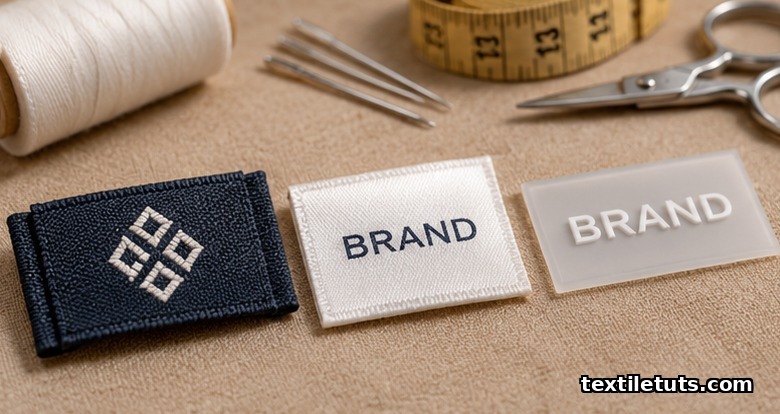
Standard placement is the center back neck for shirts and dresses, the side seam at the hip for trousers and skirts, and the back waistband for skirts and trousers with waistband-only construction. Ergonomic guidance recommends the label sit 5 to 15 millimeters from the seam line to avoid skin irritation. For childrenswear under EN 14682, drawstrings and free-hanging labels must not exceed specified lengths to prevent strangulation, and labels with metal fasteners must be avoided entirely for infants under 36 months.
Brand label dimensions typically range from 30 × 15 millimeters (small woven end-fold) to 60 × 25 millimeters (main brand label with size and country-of-origin). End-fold, mitre-fold, and straight-cut are the three standard finishes, and the fold style is chosen based on whether the label will be sewn into a seam (end-fold, mitre-fold) or applied to the surface as a patch (straight-cut with stitching margin).
Size Labels: EN 13402, ISO 8559, and Body Measurement Systems
Size labels are the most inconsistently regulated component across global markets. In the EU, EN 13402 parts 1 to 3 governs size designation: part 1 defines terms and definitions, part 2 specifies primary and secondary dimensions in centimeters, and part 3 establishes a size code system based on body measurements plus a control dimension (the body dimension the garment is designed around, usually bust for women, chest for men, and waist for trousers). In the US, ASTM D5219 outlines garment body dimensions for size standardization. Japan uses JIS L 4005 and a separate S/M/L plus numeric size system rooted in centimeter body heights.
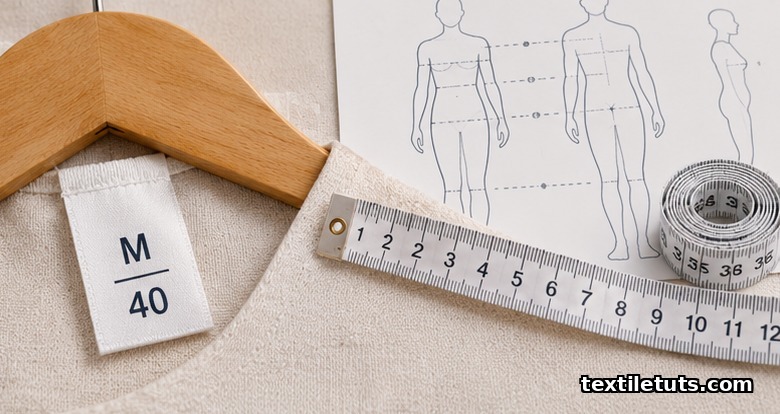
ISO 8559-1:2017 establishes the anthropometric basis. A size 40 women’s garment is designed for a bust of 88 centimeters plus a 4 centimeter ease allowance, giving a finished garment bust of 92 centimeters. The alphabetic designation (S, M, L) covers a range of body measurements; the numeric designation pins a single control dimension. Both should appear on compliant labels in EU markets to give the consumer two reference points.
Brand consistency matters: a “Medium” in one brand can equal a “Large” in another. Studies published in the 2020 Textile Research Journal show that size label variations across brands produce 15 to 25 percent return rates for online apparel, the highest defect category in e-commerce garment sales. The solution adopted by most export brands is dual labeling: alphabetic for the brand’s own range and numeric for the standard body measurement.
Test Methods and Durability Requirements
Care labels and brand labels must remain legible after repeated laundering. ISO 6330:2021 specifies the domestic washing and drying procedures used to test label durability: six standard wash temperatures (30, 40, 60, 70, 85, and 95 °C), four drying procedures (tumble, line, flat, and drip), and a standardized detergent dosage. AATCC TM96 covers dimensional change after home laundering. A typical commercial acceptance threshold is 25 wash cycles with no more than 5 percent character fading and under 2 percent dimensional change on the label substrate itself.
Colorfastness is tested separately under ISO 105-C06 (resistance to domestic washing) and ISO 105-X12 (resistance to rubbing or crocking). The minimum acceptance grade for printed care labels is 4 on the 1 to 5 grayscale; woven labels typically achieve 4 to 5. Bleeding dye onto adjacent fabric is a common failure mode tracked through ISO 105-E01 (respiration / perspiration colorfastness).
For symbols printed directly onto fabric (a growing trend in performance wear to eliminate the sewn label and reduce skin irritation), the print must withstand 50 or more wash cycles per ISO 6330 procedure 4N (40 °C, normal agitation, line dry). This is achievable only with pigment inks cured at 150 °C or higher, or with UV-cured silicone transfers applied at controlled line speeds.
Frequently Asked Questions
What do the washing symbols on clothing labels mean?
The five ISO 3758 / GINETEX symbols represent washing (tub), bleaching (triangle), drying (square), ironing (iron), and professional textile care (circle). Dots inside a symbol indicate temperature (one dot equals 30 °C, two equal 40 °C, three equal 60 °C in the washing context), and bars indicate gentleness (one bar equals permanent press, two bars equal delicate cycle).
Are care labels legally required on garments?
Yes, in major markets: the FTC requires care labels under 16 CFR Part 423 in the US, EU Regulation 1007/2011 mandates fiber-content labeling in the EU, and GINETEX member countries require care symbols. Penalties for non-compliance range from product recall to customs seizure at the port of entry, plus retailer fines for repeat offenders.
What is the difference between GINETEX and ISO 3758?
ISO 3758 is the international standard that defines what the symbols mean technically. GINETEX is the trademark holder that licenses the symbols to manufacturers and national bodies. Practically, ISO 3758 cannot be used commercially without a GINETEX sub-license in member countries; many ISO member countries outside GINETEX use the same pictograms without licensing, which is legally ambiguous but rarely enforced outside Europe.
How are size labels standardized internationally?
EN 13402 governs EU size labels with numeric designations based on body measurements in centimeters, ASTM D5219 covers US sizes, and ISO 8559-1 provides the global anthropometric basis. Japan uses JIS L 4005, the UK maintains a legacy dress-size system from the 1950s, and there is no single worldwide size system, so dual labeling (alphabetic plus numeric) is standard practice for export-focused brands.
Can I remove a brand label without damaging the garment?
Removing a sewn-in brand label typically requires cutting the stitching, which leaves small holes. For woven labels, the cut must be flush with the seam allowance to remain invisible; for printed labels, adhesive or ink residue may remain on the face fabric. Care labels should never be removed because they are required by law in most markets and they provide cleaning instructions essential to the garment’s longevity.
Editorial by Kazi Sifat Muntasir, TextileTuts. Sources: ISO 3758:2023, ISO 6330:2021, EN 13402-3:2017, ISO 8559-1:2017, ASTM D5489-14, ASTM D5219, AATCC TM96, AATCC Review 2021, 16 CFR Part 423 (US FTC), GINETEX Technical Manual 2022, Textile Research Journal 2020 (vol. 90, issues 21-22).


