
Buttons: Types, Materials, and Applications

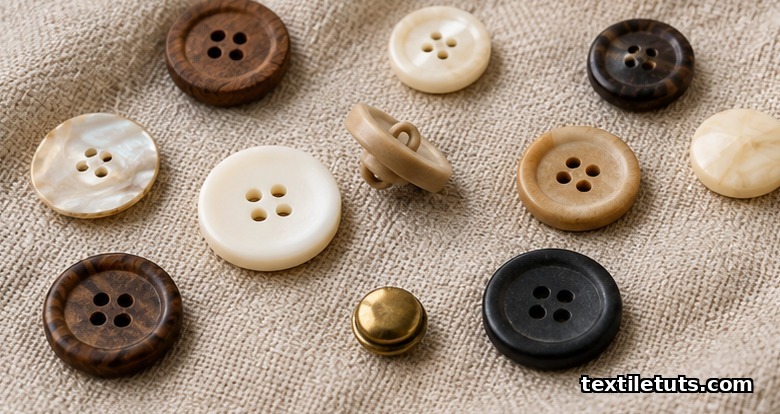
Buttons are classified into five structural types (flat, shank, toggle, snap, and stud) under ISO 4916:2016, sized in lignes where 1 ligne equals 0.635 mm, and tested for tensile strength per ASTM D5497-94 with a minimum pull-off force of 13.3 N for shirt applications.
The right button is determined by garment weight, expected wash cycles, and intended decoration; a 7.62 mm (12 ligne) polyester flat button is the global default for men’s woven shirts, while a 3.81 mm to 5.08 mm (6L to 8L) corozo or mother-of-pearl flat button remains the standard for higher-end dress shirts.
This article walks through the classification system, the most common materials, the lignes sizing convention, and the testing standards that every button must pass before it reaches a sewing line.
What Is a Button and How Does ISO 4916 Define One?
ISO 4916:2016, “Textiles: Classification of buttons,” defines a button as a rigid or semi-rigid disc-shaped fastener that passes through a buttonhole or loop to close a garment or accessory. The standard separates buttons into two main groups: through-buttons (those with a central or offset hole, also called flat or sew-through buttons) and buttons with a shank (those that use a loop, ring, or moulded shank for attachment).
The ISO classification does not cover press fasteners (snaps), which are standardized separately under ISO 15797 for industrial wash testing of the assembled garment. Snap buttons fall under their own dimensional standard at the manufacturer level. Understanding this distinction matters because a garment specification that calls for “buttons to ISO 4916” excludes snaps, toggles, and stud buttons unless they are explicitly listed as alternatives.
The Five Structural Types of Buttons
Buttons are grouped by how they attach to fabric and how they pass through a closure. The five most common structural types, with their typical applications, are:
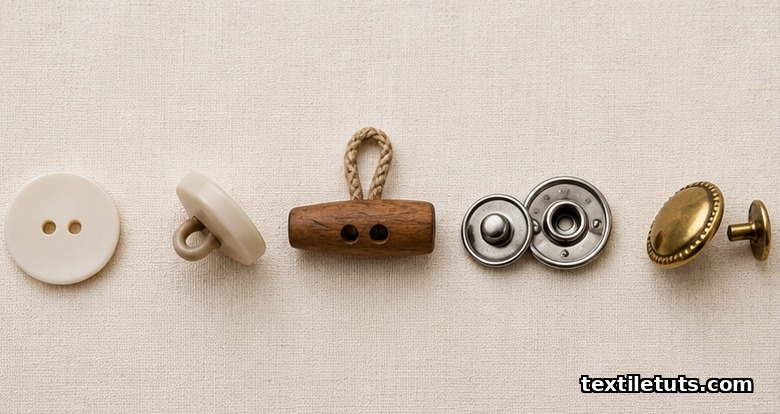
- Flat buttons (through-buttons): Two or four holes through the face, sewn flat against the garment. Most common on shirts, blouses, trousers, and jackets.
- Shank buttons: A loop or moulded shank on the underside holds the button away from the fabric. Used on coats, blazers, and decorative applications where the button must sit proud of the face fabric.
- Toggle buttons: A cylindrical or T-shaped bar, often wood or plastic, with a loop at the base. Common on duffle coats, cardigans, and outerwear.
- Snap buttons (press fasteners): Two interlocking metal or plastic discs that fasten under pressure. Used on workwear, denim jackets, infant clothing, and pockets.
- Stud buttons: A two- or four-part metal fastener mechanically clamped through the fabric, often with a decorative front. Standard on jeans (the riveted button at the waistband), workwear, and some outerwear.
Each type has its own test method. Snap strength is measured by the force required to disengage the components, while stud buttons are tested for both pull-off strength and rotational torque.
Button Materials and Their Properties
Button material choice is driven by aesthetics, durability, laundering temperature, and cost. The most widely used materials in global garment manufacturing are:
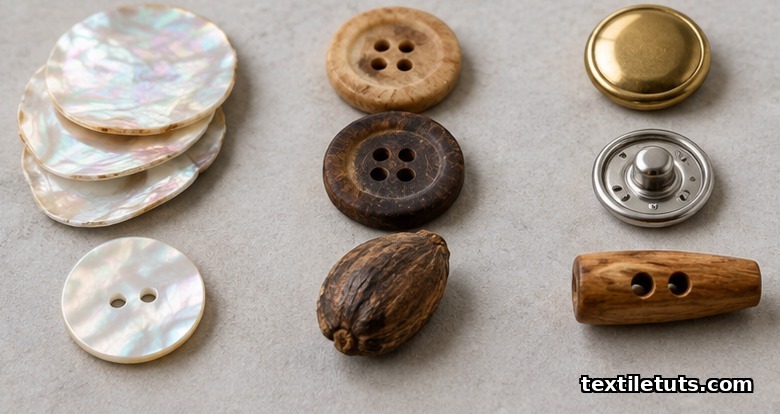
Polyester (polyethylene terephthalate, PET): The dominant shirt button material because it resists alkaline detergents, chlorine bleach, and dry-cleaning solvents. Polyester dyes uniformly, holds colour through industrial laundering at 85 °C, and produces consistent flat buttons at high speed through injection moulding.
Polyamide (nylon): More flexible and impact-resistant than polyester, but with lower heat tolerance. Polyamide is used for snap components and for buttons that must flex without cracking under repeated stress.
Corozo (vegetable ivory from the tagua palm): A natural, biodegradable alternative with a slightly grainy texture that takes dye unevenly, which the tailoring industry treats as an aesthetic feature rather than a defect. Corozo is common on premium shirts and tailored garments.
Mother-of-pearl (nacre from mollusc shells): Cut and polished from the inner shell layer, prized for its iridescence and tensile strength. Mother-of-pearl is used on high-end dress shirts where the button must look translucent under light.
Brass and stainless steel: Used for stud buttons, snap fasteners, and decorative metal buttons on denim and outerwear. Brass offers a warm finish; stainless steel is selected where corrosion resistance matters.
Wood and leather: Used for toggle and decorative buttons. Wood is light and warm to the touch but can split under impact; leather-wrapped buttons are made by bonding a leather cover over a moulded plastic or metal base.
How Button Sizing Works: The Ligne System
Buttons are sized in lignes (abbreviated “L” or “line”), a French unit where 1 ligne equals exactly 0.635 mm (one-twelfth of a French inch, or approximately 0.025 inch). A button’s ligne number is its outer diameter expressed in lignes.
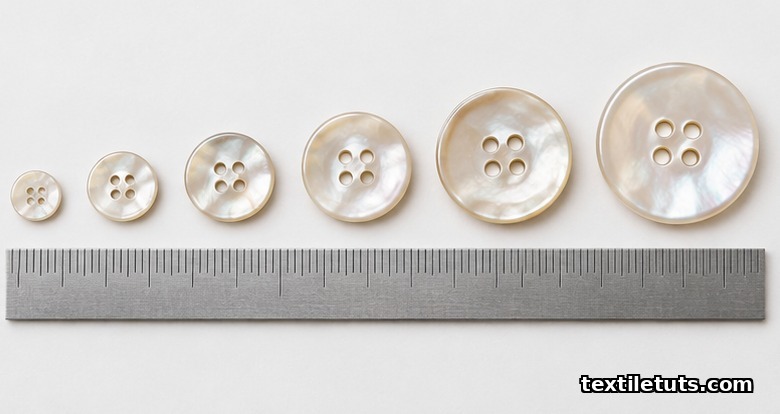
The system is the global standard because it offers integer values across the common button range. Standard shirt buttons are 10L to 12L (6.35 mm to 7.62 mm). Coat buttons are typically 18L to 24L (11.43 mm to 15.24 mm). Trouser buttons are 14L to 16L (8.89 mm to 10.16 mm). Buttonholes on the corresponding garment are cut slightly larger than the button diameter so the button can pass through without stress on the thread or fabric.
| Button Type | Typical Ligne Size | Diameter (mm) | Common Application |
|---|---|---|---|
| Shirt button (flat, polyester) | 10L to 12L | 6.35 to 7.62 | Men’s woven shirts, blouses |
| Trouser button (flat) | 14L to 16L | 8.89 to 10.16 | Trousers, chinos |
| Coat button (shank or flat) | 18L to 24L | 11.43 to 15.24 | Coats, blazers, jackets |
| Dress shirt (mother-of-pearl) | 6L to 8L | 3.81 to 5.08 | Premium dress shirts |
| Snap fastener (component) | 8L to 14L | 5.08 to 8.89 | Workwear, pockets, infant wear |
Application by Garment Type
Button selection is dictated by the garment’s end use and care instructions. A polyester 12L flat button is the default for mass-produced men’s shirts because it tolerates industrial laundering, hot ironing (up to 200 °C), and tumble drying without distortion. A corozo or mother-of-pearl button of the same size is specified for dress shirts because the visual depth and slight surface irregularity signal higher quality, and because the natural material feels comfortable against the skin on collar and cuff positions.
Outerwear buttons are larger and almost always shanked, because a flat button on a thick wool or padded coat would sit too close to the surface and fail to clear the buttonhole properly. Stud buttons on denim jeans are mechanically attached because the button must survive repeated stress from belt tension and waistband stretching; a sewn button would eventually tear through the denim.
Infant clothing uses snap fasteners almost exclusively, because a press fastener is safer than a sewn button (no choking risk if it detaches) and easier for caregivers to operate one-handed.
Testing Standards: ASTM D5497 and ISO 4916
ASTM D5497-94, “Standard Test Method for Determination of Button Strength,” specifies the procedure for measuring the pull-off force of a button from its substrate fabric. The button is mounted on a standardized fabric, and a tensile load is applied perpendicular to the fabric surface until the button, thread, or fabric fails. The reported value is the peak force in newtons (N).
The minimum acceptable pull-off force depends on the garment application. For shirt buttons, a typical specification is 13.3 N (3 lbf) minimum; for coat buttons, the minimum rises to 22.2 N (5 lbf). Buttons that fail below these thresholds are rejected at incoming quality inspection.
ISO 4916 works alongside ISO 15797, which defines industrial laundering test conditions at 75 °C and 90 °C. A button intended for industrial workwear must retain colour, dimensional stability, and attachment strength after 50 wash cycles under ISO 15797 conditions. Buttons that fail this test are not suitable for rental textile or hospital applications.
Frequently Asked Questions
What is the standard button size for a men’s shirt?
The standard men’s shirt button is 10L to 12L, which is 6.35 mm to 7.62 mm in diameter. The 12L is the most common because it allows the button to pass through a 7 mm buttonhole without stress on the thread while remaining visually proportionate to a standard shirt placket.
What is the difference between a flat button and a shank button?
A flat button (through-button) is sewn flat against the fabric using holes in its face. A shank button has a small loop or moulded projection on the underside, and the thread passes through that loop instead of through the button face. Shank buttons sit slightly proud of the fabric, which makes them the correct choice for thick or pile fabrics where a flat button would be swallowed by the surface.
How strong does a button need to be to pass quality control?
Under ASTM D5497-94, the typical minimum pull-off strength is 13.3 N (3 lbf) for shirt buttons and 22.2 N (5 lbf) for coat buttons. Buttons that fall below these thresholds are considered non-conforming and are rejected at incoming quality inspection.
Are plastic buttons safe for industrial laundry?
Polyester and polyamide buttons withstand industrial laundering at 75 °C and 90 °C as defined in ISO 15797, with no significant loss of tensile strength or colour over 50 cycles. Buttons made from cellulose acetate or lower-grade plastics can deform or soften at these temperatures and should not be specified for workwear or rental textile applications.
What is the strongest material for a button?
Stainless steel and brass have the highest tensile strength of any common button material, but they are not always suitable for garments because of weight, heat conduction, and cost. For most apparel applications, polyester delivers the best balance of strength, colour stability, and cost, which is why it accounts for the majority of shirt buttons globally.
References
- ASTM International. ASTM D5497-94: Standard Test Method for Determination of Button Strength. astm.org: defines the pull-off force test procedure for sewn buttons.
- ISO. ISO 4916:2016 Textiles: Classification of buttons. iso.org: five structural categories and dimensional terminology.
- ISO. ISO 15797:2017 Textiles: Industrial washing and finishing procedures for testing of workwear. iso.org: defines the laundering temperatures and cycle counts used to qualify workwear buttons.
- ResearchGate. A Review on Button Manufacturing and Materials. researchgate.net: peer-reviewed survey of button production methods and material selection.
- ScienceDirect. Mechanical Properties of Polyester and Polyamide Buttons for Apparel. sciencedirect.com: tensile-strength data and laundering tolerance for plastic buttons.
- MDPI Textiles. Snap Fastener Performance in Workwear Applications. mdpi.com: pull-off and engagement force data for press fasteners.
Editorial by Kazi Sifat Muntasir, TextileTuts. Sources: ASTM D5497-94, ISO 4916:2016, ISO 15797:2017, and the cited peer-reviewed literature on button materials and testing.


