
Knit Fabric Finishing: Compacting, Calendering, Decating

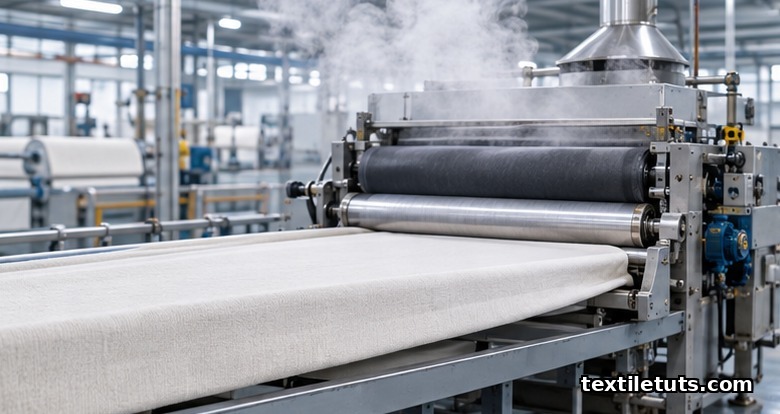
Knit fabric finishing uses compacting, calendering, and decating to take loop-structured knits from a 25–45% greige shrinkage state to a finished 3–5% residual shrinkage, with compactors operating at 100–130 °C against a rubber blanket, calenders pressing at 20–80 N/cm between heated rollers at 80–200 °C, and decators applying saturated steam at 110–130 °C for 3–10 minutes to stabilize yarn swelling and surface texture. These three mechanical/thermal finishing steps are the difference between a knit that grows on the first wash and one that holds its GSM, width, and loop clarity through dozens of laundry cycles.
This guide walks through what each of these processes does to the fiber, yarn, and loop geometry of a weft knit, the machine parameters that drive the result, the order in which they typically run on a cotton or cotton-blend finishing line, and how mills verify the effect against ISO 5077, AATCC TM135, and ISO 6330 dimensional-change methods. Readers include knit merchandisers, dyeing-house QC staff, and apparel technologists sizing finishing recipes for a new style.
Why knit fabric needs mechanical finishing
A circular or flat knit comes off the knitting machine in a strained, lubricated state. The yarn is held under take-up tension, the loop shape is elongated in the wales direction, and the fabric carries knitting oil, coning oil, and size residues that will repel dye and contaminate downstream baths. Knit loops are also inherently unstable: a relaxed single-jersey cotton jersey typically measures 25–45% more length than its fully-relaxed state, with most of that length locked into the loop as wale curvature rather than yarn length.
Wet processing (scouring, bleaching, dyeing) relaxes much of this strain, but it cannot by itself hold the fabric to a target width or lock the GSM. Mechanical finishing closes that gap. Compacting sets the length, calendering sets the surface and hand, and decating stabilizes yarn swelling and reduces internal fiber stresses left over from dyeing and drying. Each step is load-bearing; skipping one shows up immediately in cut-and-sew as skewed grain lines, off-spec width, or panels that grow visibly after the first wash.
Compacting (compressive shrinkage finishing)
Compacting, also called compressive shrinkage or zero-shrinkage finishing, forces the fabric length-wise against a heated main cylinder using a rubber blanket or rubber-covered roller running at a slower surface speed. The friction differential between the rubber blanket (slower) and the fabric (overfed at 5–20%) physically pushes loops back into the fabric body, shortening the length and increasing the GSM without compressing the fabric thickness.
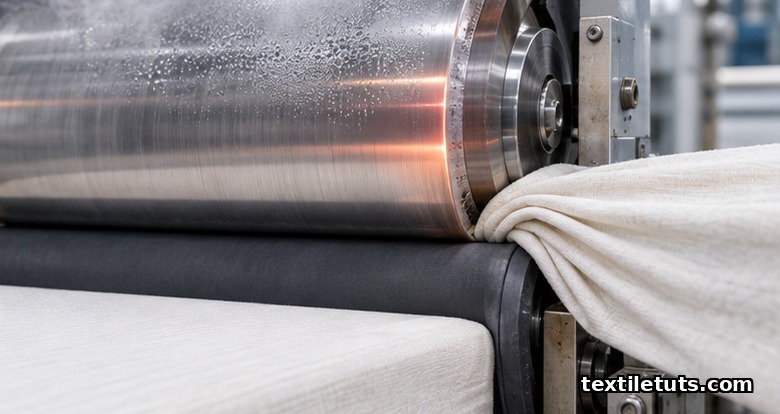
The measurable target is residual relaxation shrinkage after a controlled wash cycle, not zero absolute shrinkage. A well-compacted 100% cotton single jersey at 180 GSM typically lands at 2–4% residual length shrinkage by ISO 5077 (3 washes at 40 °C, flat dry), down from 8–12% on the greige side. Compactness is verified with the compactness index, the ratio of compacted length to original length, expressed as a percentage; commercial compactors (Tubular, Sperotto Rimar, Monforts) typically operate at 100–130 °C cylinder temperature, 10–30 m/min line speed, and a feed/overfeed ratio tuned per fabric weight.
Three things decide the outcome: the overfeed percentage (more overfeed = more compaction, up to a stability ceiling around 25%), the rubber blanket hardness (Shore A 60–80 for most single jersey, harder for heavier fleece), and the dwell time on the heated cylinder (the dwell window where the loop set is thermally fixed). Mills targeting a 3% length shrink tolerance usually run 8–15% overfeed on a 160–200 °C steam-heated cylinder with a 2–4 second contact zone.
Calendering
Calendering passes fabric through a stack of heated rollers under controlled line load to smooth the surface, set the width, reduce thickness, and modify the fabric’s optical properties (luster, cover, print smoothness). For knits, the most common configurations are three-roll (chase calender for light surface compaction) and seven-roll (for higher luster and stiffness); compacting calenders combine the compressive-shrinkage step with a light surface compact pass in a single machine.
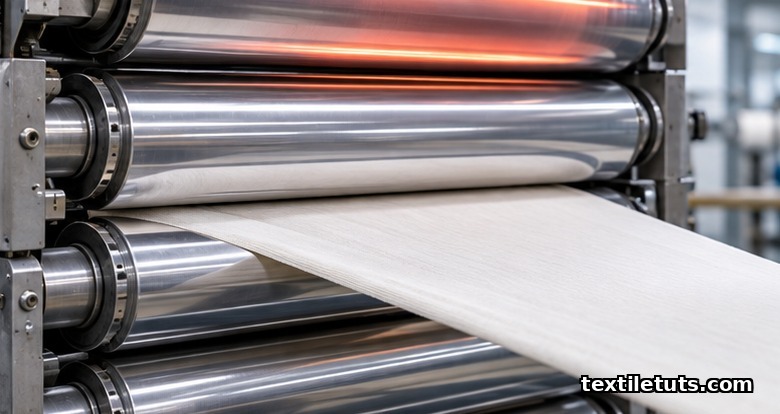
Calender parameters matter. Roller temperature for knit finishing typically runs 80–200 °C depending on fiber (cotton at the lower end, polyester blends can go higher with care for yellowing), linear pressure runs 20–80 N/cm of fabric width, and line speed 20–60 m/min. Higher pressure and temperature give a smoother, glossier, thinner fabric with reduced air permeability; lower pressure preserves softness and stitch definition. For a 160 GSM cotton single jersey going to a print substrate, a 120 °C / 40 N/cm chase calender is a typical starting recipe; for a pique or interlock going to a lustrous polo, a 160–180 °C / 60 N/cm multi-roll calender is more common.
The trade-off is always between surface and hand. Over-calendering crushes the loop structure, flattens the fabric optically, and reduces elongation and recovery in the wales direction. Under-calendering leaves the fabric lofty but can leave yarn surface fibers protruding (pilling risk), fabric width off the tolerance, and print substrates with uneven ink laydown. The right calender recipe is part of the dyehouse-to-finisher hand-off, not a default setting.
Decating (decatizing)
Decating, originally developed for wool worsted and woolen piece goods, stabilizes yarn swelling and locks in surface finish by exposing the finished fabric to saturated steam under controlled tension. In knit finishing, decating is most often applied to wool and wool-blend knitwear, to fine-gauge cotton and cotton-modal knits where surface smoothness and stitch clarity matter, and to synthetic blends where residual dyeing stresses need a thermal reset.
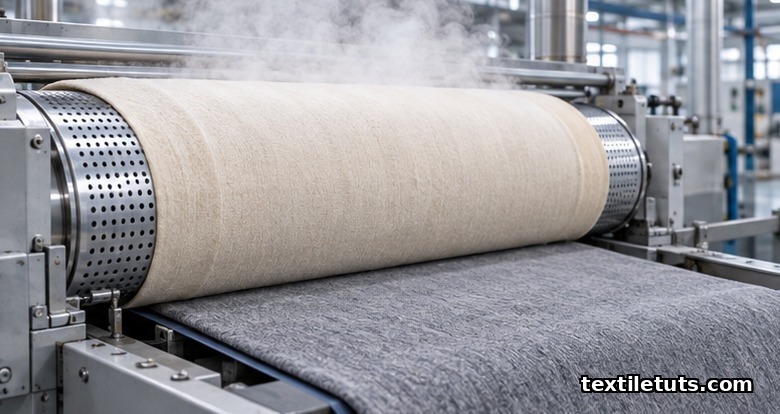
Two machine types dominate. Continuous decating uses a perforated cylinder wrapped in cotton decating cloth (cotton molleton) through which saturated steam at 110–130 °C passes for 3–10 minutes; the wrapper cloth absorbs condensate and prevents shine on face yarns. Autoclave (batch) decating loads fabric wrapped with decating cloth into a pressure vessel, pulls a soft vacuum, then admits steam at 0.5–1.5 bar for 5–15 minutes; this is the conventional route for wool knitwear finishing.
The functional effect is twofold. First, steam penetrates the yarn cross-section and equalizes fiber swelling from any prior wet processing, locking a uniform yarn diameter into the fabric. Second, the wrapper-and-steam cycle applies a controlled compressive set that reduces the fabric’s tendency to felt or grow on subsequent wet cleaning. For wool knitwear, the decating step typically delivers the final hand (soft, lofty, dimensionally stable) and sets the surface appearance before pressing and make-up.
Process sequence on a knit finishing line
The order matters. A typical cotton single-jersey finishing sequence runs: singeing, scouring/bleaching, dyeing, hydro-extraction, stenter setting (width and overfeed), drying, compacting, calendering, and optionally decating. The stenter sets the width and warp-wise overfeed before compaction; the compactor sets the length and locks the loop geometry; the calender sets the surface; the optional decator smooths and stabilizes for premium end-uses.
For cotton-rich knitwear (sweater knits, fleece, French terry) the order shifts: the compactor is run before raising or after a controlled relaxation dry, and decating is frequently used in place of aggressive calendering to preserve the loft. For polyester-cotton blends going to technical end-uses (performance tees, base layers), heat-setting on a stenter at 180–200 °C is added upstream, and the compactor runs at lower overfeed (3–7%) because polyester’s thermal memory has already stabilized the loop.
Quality control: how mills verify the effect
Dimensional stability is the headline test. ISO 5077 (determination of dimensional change of fabrics after home laundering) paired with ISO 6330 (domestic washing procedures) is the international baseline; AATCC TM135 is the US equivalent for dimensional change after automatic home laundering, and AATCC TM150 covers similar ground for smaller specimens. AATCC TM99 reports dimensional changes after commercial laundering, useful for uniform and workwear end-uses. Mills typically declare a maximum of 3–5% length and width shrinkage after 3 wash cycles at 40 °C tumble dry.
Other QC checks paired with finishing include GSM (ISO 3801 or ASTM D3776), fabric width (ISO 22198 or ASTM D3774), bursting strength (ISO 13938-1 for knitted fabrics, the right method for knits because grab/ravel tests are not meaningful on loop-structured fabric), and air permeability (ISO 9237 or ASTM D737). Calendered surface is verified by pilling resistance (ISO 12945-2 Martindale, after a defined number of rubs) and where luster matters, by gloss measurement per ASTM D2454 or a comparable photometric method.
Comparison table: compacting vs. calendering vs. decating
| Property | Compacting | Calendering | Decating |
|---|---|---|---|
| Primary purpose | Reduce length, lock GSM | Smooth surface, set width/luster | Stabilize yarn swelling, set finish |
| Mechanism | Rubber blanket vs. heated cylinder, overfeed | Heated roller stack under line load | Saturated steam through wrapper cloth or autoclave |
| Key parameter | 5–20% overfeed, 100–130 °C | 20–80 N/cm, 80–200 °C | 110–130 °C, 3–10 min steam exposure |
| Effect on shrinkage | Largest (greige 8–12% down to 2–4%) | Small (width set, length minimal) | Moderate (stabilizes residual stresses) |
| Effect on hand | Slight densification | Smoothing, optional stiffness | Soft, lofty (especially wool) |
| Typical fabrics | Cotton/PC single jersey, fleece | Cotton, PC, pique, interlock | Wool knitwear, fine cotton, premium PC |
| Standard test pairings | ISO 5077, AATCC TM135 | ISO 12945-2 (pilling), ISO 9237 (air) | ISO 5077 (wool), AATCC TM135 (cotton) |
Frequently Asked Questions
What shrinkage percentage does compacting actually remove from a knit?
A well-tuned compactor on a 100% cotton single jersey at 160–200 GSM takes residual length shrinkage from a greige-side 8–12% down to a finished 2–4% by ISO 5077 (3 washes at 40 °C flat dry). The compactor cannot reach absolute zero shrinkage; the realistic commercial target is 3% or less after a defined wash cycle.
Can compacting replace stenter setting?
No. The stenter sets fabric width and warp-wise overfeed (course direction), and the compactor sets length (wale direction). They address orthogonal axes of knit distortion. Skipping the stenter and trying to fix width on the compactor leads to over-compacted, dense, harsh-hand fabric. The standard sequence is stenter first, then compactor.
Does calendering damage knit stretch and recovery?
Aggressive calendering reduces elongation and recovery in the wales direction because it crushes loop curvature and flattens the yarn cross-section. Moderate calendering at 40 N/cm or below on cotton jersey preserves most of the stretch. The trade-off is between surface smoothness (which goes up with pressure) and recovery (which goes down). For high-stretch end-uses, finishers use a chase calender or skip calendering entirely.
Is decating only for wool?
Decating originated with wool finishing and remains standard for wool knitwear. It is also applied to fine-gauge cotton and cotton-modal knits for premium end-uses, and to some synthetic-blend knits as a thermal reset after dyeing. For commodity cotton single jersey, the cost of a decating pass is rarely justified by the hand improvement; for wool and premium blends, it is the finishing step that defines the final fabric.
Which standard should I cite for knit shrinkage tolerance?
Use ISO 5077 paired with ISO 6330 for international technical documents, and AATCC TM135 for US-bound apparel. For commercial-laundry end-uses (uniforms, workwear, healthcare), cite AATCC TM99. The shrinkage figure in a finished-knit specification should always reference the test method and wash conditions, not a bare percentage.
References
- International Organization for Standardization. ISO 5077:2007, Textiles — Determination of dimensional change (machine wash). https://www.iso.org/standard/36275.html — the international reference method for knit dimensional-change reporting.
- International Organization for Standardization. ISO 6330:2021, Domestic washing and drying procedures for textile testing. https://www.iso.org/standard/76063.html — paired with ISO 5077 for wash-cycle definition.
- AATCC. AATCC TM135-2018, Dimensional Changes of Fabrics after Automatic Home Laundering. https://www.aatcc.org/ — the US equivalent dimensional-change method.
- AATCC. AATCC TM99-2019, Dimensional Changes of Fabrics after Commercial Laundering. https://www.aatcc.org/ — for commercial-laundry end-uses.
- International Organization for Standardization. ISO 13938-1:2019, Textiles — Bursting properties of fabrics — Part 1: Hydraulic method for determination of bursting strength and bursting pressure. https://www.iso.org/standard/73829.html — the relevant strength test for knits.
- International Organization for Standardization. ISO 12945-2:2020, Textiles — Determination of fabric propensity to surface pilling — Part 2: Modified Martindale method. https://www.iso.org/standard/76655.html — pilling-resistance verification after calendering.
- ResearchGate (peer-reviewed textile-engineering literature on compressive shrinkage of weft knits, rubber-blanket compactor mechanics, and the compactness index). https://www.researchgate.net/ — open-access papers on knit compacting machine parameters.
Editorial by Shahrukh Islam, TextileTuts. Sources: ISO 5077, ISO 6330, AATCC TM135, AATCC TM99, ISO 13938-1, ISO 12945-2, peer-reviewed textile-engineering literature on knit finishing as cited.


