
Knitting Machine Gauge: E, EE, Needle per Inch

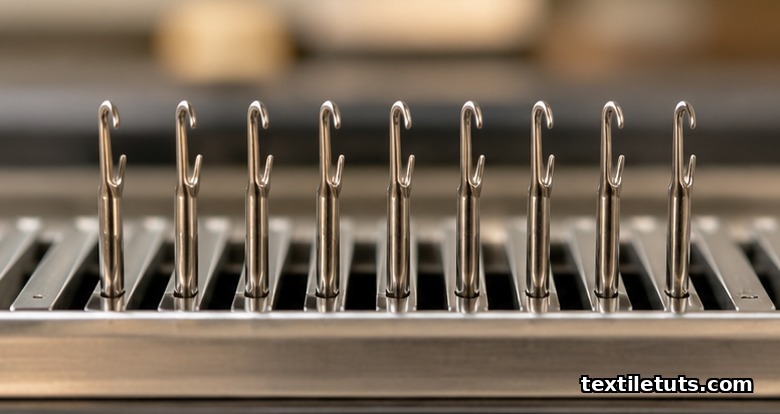
Knitting machine gauge E equals 9 needles per inch (NPI) and EE equals 12 NPI, the standard measure of needle-bed density that controls which yarn counts, fabric weights, and stitch lengths a machine can knit without distortion.
This letter convention, used across home flat-bed machines and many circular knitting frames, lets knitters match machine gauge to yarn weight before loading the yarn onto the feeder, which removes the trial-and-error loop that wastes yarn and time.
What follows is a working reference for the E and EE classes: the exact NPI values, the needle-to-needle spacing in millimetres, the yarn-count window each gauge is designed to run, the fabric GSM range produced at matched stitch length, and the ISO and ASTM test methods used to verify those numbers.
What “Gauge” Actually Measures on a Knitting Machine
Gauge on a knitting machine is the number of needles contained in one inch (25.4 mm) of needle bed, expressed as needles per inch (NPI) or, in metric specifications, needles per cm (NPC). It is the machine equivalent of “sett” on a loom and sets the smallest needle spacing the machine can present to the yarn at the knitting point.
ISO 8388:1998 defines the test method for counting stitches per unit length and per unit width on a finished knitted fabric, which is the same metric a machine builder uses to classify its beds. A higher NPI means needles sit closer together, so each needle knits a shorter loop for the same yarn and the resulting fabric is denser at any given yarn count.
Gauge is fixed by the needle-bed pitch at manufacture and cannot be changed without replacing the bed. A 9 NPI machine stays a 9 NPI machine. What can be varied is the cam setting, the stitch-length dial position, and the yarn count loaded onto the feeder.
E Gauge and EE Gauge: The Specific Numbers
E gauge on a knitting machine bed is 9 NPI, equivalent to roughly 3.54 needles per cm. It sits between the 4.5 NPI standard home-machine gauge and the extra-fine industrial gauges used for sheer hosiery, and is the upper limit on most home flat-bed ribber attachments.
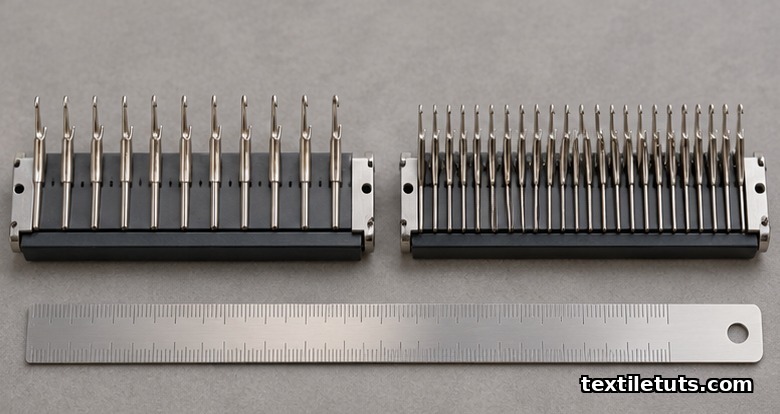
EE gauge is 12 NPI, equivalent to roughly 4.72 needles per cm. EE is two letter grades finer than E and three grades finer than the common 4.5 NPI standard home gauge. The needle-to-needle spacing is 2.82 mm on E and 2.12 mm on EE, a 25% reduction in pitch that pushes the bed into lace-yarn territory.
These letter codes originated on European flat-bed machine lines and propagated through Japanese home knitting machines (Brother, Silver Reed, Passap) and into the labelling of compatible ribber attachments and cams. The same bed pitch is sold across brands with the same letter, so a Silver Reed ribber marked “EE” matches any other EE-gauge ribber regardless of maker.
How Gauge Constrains Yarn Selection
A practical rule taught in knitting-technology textbooks such as Spencer’s “Knitting Technology” is to pick a yarn whose recommended needle size is roughly 1.0 to 1.5 times the needle-to-needle spacing in millimetres. On a 9 NPI bed, the spacing is 2.82 mm; on a 12 NPI bed, it is 2.12 mm.
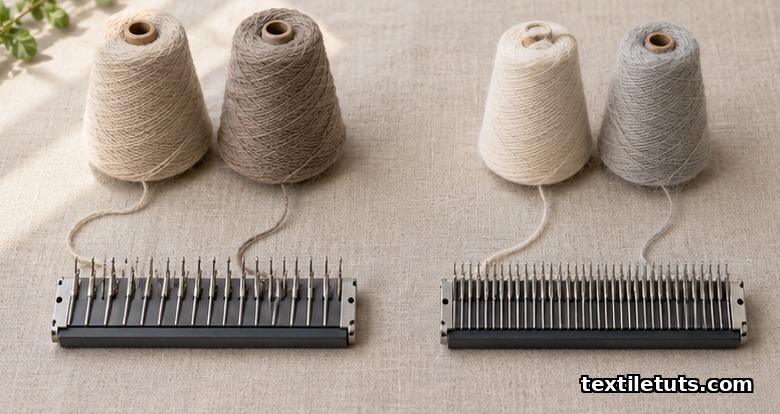
For 9 NPI (E gauge), this points to yarns in the fingering to sport range, typically 1/20 to 1/32 Nm (cotton or worsted), 2/16 to 4/16 Nm wool, or hand-knitting yarns of around 7 to 9 wraps per inch (wpi). Lace-weight yarns run too thin and slip between needles; DK weight yarn deflects needles and causes dropped stitches.
For 12 NPI (EE gauge), the yarn moves one full count finer, into the lace and 1-ply hosiery range, typically 1/40 to 1/64 Nm or yarns measuring 10 to 14 wpi. EE yarn must be smooth, evenly spun, and free of thick slubs that would snag between 2.12 mm needles.
Knitting a yarn that is too thick for the gauge produces fabric with poor stitch definition, pinched loops, and tension spikes that can deflect needles. Knitting a yarn that is too thin leaves the fabric open and ladder-prone, with low cover factor and high air permeability. Both failure modes are visible on the swatch before the knitting reaches a full panel.
Stitch Density, GSM, and Cover Factor
Gauge, yarn count, and stitch length together control the fabric’s areal density, measured in grams per square metre (GSM), and its cover factor, the fraction of fabric surface covered by yarn. ASTM D3776 describes the small-cut sample method for measuring GSM on a knitted swatch.
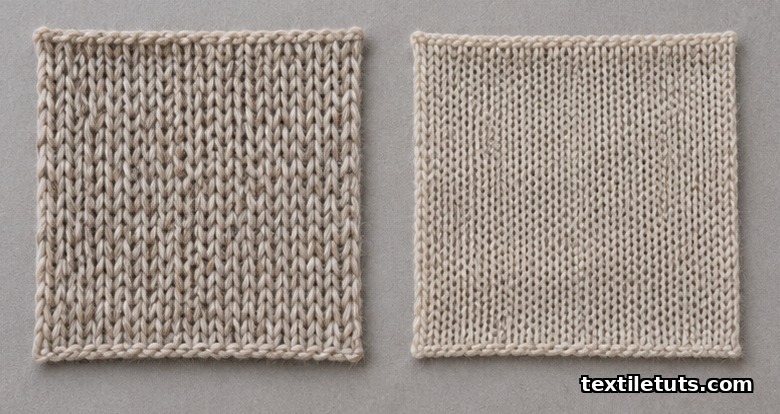
Two fabrics knitted on different gauges from the same yarn at the same stitch length will have different GSM. As an example, a 1/30 Nm cotton knitted at 4.5 NPI with a stitch length of 3.5 mm typically yields 130 to 150 GSM single jersey, while the same yarn knitted at 9 NPI at the same stitch length yields 90 to 110 GSM single jersey. EE at 12 NPI drops GSM further, often to 60 to 80 for the same yarn and stitch length.
This matters in product development because cover factor, not GSM alone, controls how opaque, warm, and windproof a fabric feels. A 90 GSM single jersey knitted at 9 NPI has roughly 20 to 30% more cover factor than the same 90 GSM knitted at 4.5 NPI from a thicker yarn. The 4.5 NPI fabric is warmer and more wind-blocking because its fibres overlap more.
Standard Test Methods That Reference Gauge
ISO 8388:1998 “Textiles, Knitted fabrics, Determination of number of stitches per unit length and per unit width” is the primary ISO reference for measuring wales per cm and courses per cm on a finished fabric, the inverse side of the machine gauge that produced it.
ASTM D3887 covers abrasion resistance of knitted fabrics using a uniform abrasion machine, an important durability check on fine-gauge single jerseys that show scuffing at lower cycles than their coarse-gauge counterparts. EE-gauge single jersey typically fails sooner than E-gauge single jersey on this test, all else equal, because the loops are smaller and individual fibre ends work loose faster.
ASTM D3787 covers bursting strength using the ball-burst method, the standard for knit fabrics that are easier to grab in two directions than to cut into a tensile strip. ASTM D4964 covers tension and elongation of elastic fabrics using a constant-rate-of-extension tensile machine, applicable to elasticised knits knitted on E or EE gauge with elastane plaiting.
Gauge Comparison Table
| Gauge | NPI | NPC (needles/cm) | Needle spacing (mm) | Typical yarn (Nm) | Typical end-use |
|---|---|---|---|---|---|
| Standard (home) | 4.5 | 1.77 | 5.64 | 1/8 to 1/15 | Mid-gauge garments, blankets |
| Mid (home) | 6 to 7 | 2.36 to 2.76 | 3.62 to 4.23 | 1/15 to 1/24 | Sport-weight garments |
| E | 9 | 3.54 | 2.82 | 1/20 to 1/32 | Fingering weight, fine single jersey |
| EE | 12 | 4.72 | 2.12 | 1/40 to 1/64 | Lace, hosiery, fine shawls |
| Industrial fine (circular) | 18 to 24 | 7.09 to 9.45 | 1.06 to 1.41 | 1/80 to 1/150 | Ladies’ hosiery, technical liners |
Frequently Asked Questions
What is the difference between knitting machine gauge E and EE?
E gauge is 9 needles per inch (3.54 needles per cm) and EE gauge is 12 needles per inch (4.72 needles per cm). The needle spacing on EE is 2.12 mm versus 2.82 mm on E, so EE requires yarn one full count finer for the same stitch definition, and produces a denser, lighter, and more open-work fabric than E at matched stitch length.
Can a 9 NPI (E gauge) machine knit the same yarns as a 12 NPI (EE gauge) machine?
No. The yarn-count window narrows as gauge increases. A 9 NPI bed can run 1/20 to 1/32 Nm comfortably; a 12 NPI bed needs 1/40 to 1/64 Nm for clean loops. Forcing a thick yarn onto an EE bed deflects needles and drops stitches; forcing a thin yarn onto an E bed produces open, ladder-prone fabric with low cover factor.
Does a finer knitting machine gauge produce stronger fabric?
Not always. Tensile and bursting strength depend on yarn tenacity, stitch density, and yarn-to-yarn friction more than on gauge alone. ISO 8388 measurements show that two fabrics knitted on different gauges from the same yarn at matched cover factor show comparable bursting strength, with finer-gauge fabrics slightly ahead because there are more loops per unit area distributing the load.
Will switching from an E ribber to an EE ribber damage a standard-gauge carriage?
No, as long as the carriage is rated for the ribber pitch. Most home flat-bed carriages are designed to span a 4.5 mm pitch and can clear both 2.82 mm (E) and 2.12 mm (EE) ribbers with the correct cam carriage. Mismatched carriages cause dropped stitches but do not bend needles; the failure mode shows up in the fabric, not the metalwork.
How do I measure gauge on an existing knitting machine?
Count the working needles across exactly one inch of needle bed with the carriage pushed aside. ISO 8388 and ASTM D4964 do not measure the machine bed directly, but the count you take on the bed matches the inverse of the stitch count you would measure on a swatch. For a precise measurement, use a steel ruler and count over 2 inches, then divide by 2.
References
- International Organization for Standardization. ISO 8388:1998, Textiles, Knitted fabrics, Determination of number of stitches per unit length and per unit width.
- ASTM International. ASTM D3887, Standard Test Method for Abrasion Resistance of Knitted Fabrics.
- ASTM International. ASTM D3787, Standard Test Method for Bursting Strength of Textiles, Constant-Rate-of-Traverse (CRT) Ball Burst Test.
- ASTM International. ASTM D4964, Standard Test Method for Tension and Elongation of Elastic Fabrics (Constant-Rate-of-Extension Type Tensile Testing Machine).
- ASTM International. ASTM D3776, Standard Test Methods for Mass Per Unit Area (Weight) of Fabric.
- Spencer, David J. Knitting Technology: A Comprehensive Handbook and Practical Guide. Woodhead Publishing.
- Ray, Sadhan C. Fundamentals and Advances in Knitting Technology. Woodhead Publishing India.
This article is the working reference for knitting machine gauge E and EE in needle-per-inch terms, with stitch-density links to ISO and ASTM test methods. Editorial by Iftay Khairul Alam, TextileTuts. Sources: ISO 8388, ASTM D3887, ASTM D3787, ASTM D4964, ASTM D3776, Spencer, Ray as cited.


