
Flat Bed Knitting Machine: Gauge and Needle Selection

A flat bed knitting machine gauge is the number of needles per inch (commonly 3, 5, 7, 8, 10, 12, 14, 16, or 20), and selecting the correct gauge requires matching that needle spacing to the yarn diameter such that the yarn occupies roughly 60–75% of the needle gap.
Get the gauge wrong and the fabric fails: too coarse a gauge for a fine yarn produces a see-through, holey cloth; too fine a gauge for a coarse yarn either refuses to knit or jams the needles. This guide explains how ISO defines gauge, how needle selection maps to yarn count, and the practical rules a knitting engineer follows on a flat bed V-bed or full-fashioned machine.
You will learn the standard gauge-to-spacing conversions, the four physical variables that drive needle choice, and the four needle types used on flat bed machines today.
What Gauge Means on a Flat Bed Knitting Machine
According to ISO 8388:1998 (Knitting machines — Determination of the gauge), gauge is defined as the number of needles contained in a defined unit of working width, conventionally 1 inch (25.4 mm) for English-unit systems or 1 cm for metric reporting. A machine stamped “10 gauge” therefore has 10 needles in every inch of needle bed; a 14 gauge machine packs 14 needles into the same inch.
Gauge determines three coupled properties of the fabric:
- Stitch density. More needles per inch means more stitch wales per cm and a tighter, more opaque fabric.
- Yarn compatibility. Each needle’s hook and slot width is sized for a specific yarn diameter range. A 3-gauge machine expects a bulky yarn; a 20-gauge machine expects a fine one.
- Fabric weight (GSM). For a given yarn count, doubling the gauge roughly doubles the stitches per unit area and therefore raises fabric GSM by 40–60%, depending on stitch length setting.
The same ISO 8388 standard notes that gauge is a nominal figure; the actual measured needle count may vary by ±2% across the bed and is checked with a gauge glass before production runs.
Common Gauge Ranges and Their Applications
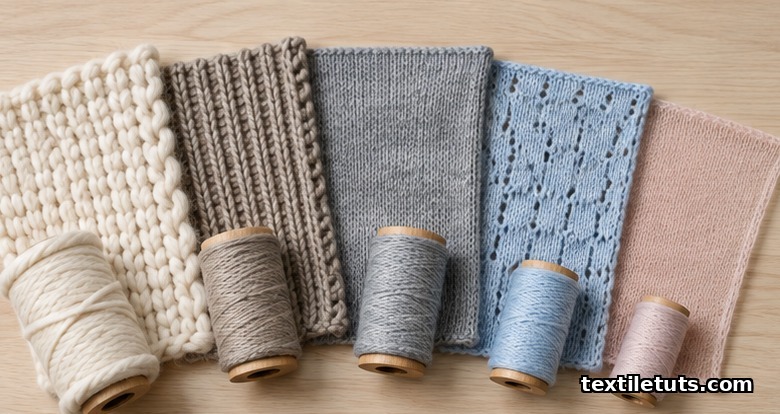
Flat bed knitting machines used in apparel and technical knitting cluster into five practical gauge bands. The table below summarises the typical yarn, fabric, and end-use for each.
| Gauge (needles/inch) | Typical yarn count | Yarn diameter (mm) | Common fabric | End use |
|---|---|---|---|---|
| 3–5 | 0.6–1.2 Nm (≈ 0.4–1.0 Ne) | 0.9–2.0 | Heavy knit, blanket, fisher rib | Blankets, chunky sweaters, upholstery |
| 7–8 | 1.5–2.5 Nm (≈ 1.2–2.0 Ne) | 0.6–0.9 | Rough knit, half-cardigan | Heavy outerwear, scarves |
| 10–12 | 2/24–2/40 Nm (worsted) | 0.3–0.5 | Plain jersey, 1×1 rib | Mid-gauge sweaters, knitwear, fashion shirting |
| 14 | 2/48–2/60 Nm | 0.25–0.35 | Fine jersey, pointelle, intarsia | Lightweight sweaters, fine gauge knitwear |
| 16–20 | 2/80–2/120 Nm | 0.15–0.25 | Very fine jersey, hosiery knits | Underwear, hosiery, fine knit shirting |
The yarn diameter figures are derived from the standard linear-density formula D (mm) ≈ 0.0355 / √(Nm/1) for a round cross-section; real yarn deviates by ±10% depending on twist and finish.
Needle Selection: The Four Critical Variables
Choosing a needle is not just about gauge; it is about four interacting variables. The engineer who treats gauge as the only input usually ends up with broken needles or loose fabric.
1. Yarn linear density (count). The yarn’s count in Nm, Ne, Tex, or denier sets the diameter. The needle hook must close around that diameter with enough overswing to retain the loop but not so much overswing that the yarn slips out.
2. Yarn fibre and surface friction. Wool and wool-blend yarns have higher surface friction than combed cotton or filament polyester. Higher friction lets a slightly looser needle still retain the loop; lower friction demands a tighter needle or a smaller hook geometry.
3. Stitch length setting (cam setting). A long stitch length stretches the loop around the hook and risks the loop sliding off during the knock-over phase. Fine gauges require shorter stitch lengths, typically 2.5–3.5 mm on a 14-gauge bed for combed cotton.
4. Fabric end-use. A fabric that will be raised, brushed, or compacted downstream needs extra needle-room; a fabric for print or lamination wants tight, regular loops. These downstream conditions influence needle-point shape as much as gauge.
The Yarn-to-Gauge Matching Rule
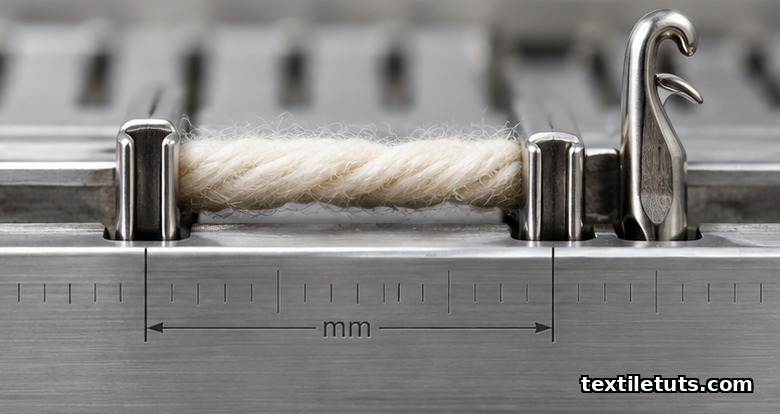
The widely used rule of thumb in flat bed knitting is that the yarn diameter should occupy roughly 60–75% of the gap between two adjacent needle slots. This range balances two failure modes:
- Below 50% occupancy, the fabric becomes open, ladder-prone, and dimensionally unstable.
- Above 80% occupancy, the yarn cannot slide over the needle latch and needle wear accelerates sharply.
Concretely, on a 12-gauge bed the needle spacing is 25.4 / 12 = 2.12 mm. A yarn that should occupy 60–75% of that gap needs a diameter of 1.27–1.59 mm, which corresponds to a coarse Nm of about 1.0–1.5 (or roughly Ne 0.6–0.9). On the same bed, a 2/30 Nm cotton (about 0.38 mm diameter) would be too fine and would knit a see-through single-jersey; a 2/8 Nm wool (about 0.8 mm) would be marginal and would need a tight cam setting.
ISO 3635:1981 (Textiles — Woven or knitted fabrics — Determination of length per unit mass) provides the equivalent mass-per-unit-length values used to convert these yarn counts into the spacing calculations above, and it is the standard reference for any conversion done on the production floor.
Needle Types Used on Flat Bed Machines
Three needle types dominate flat bed knitting, plus one compound variant.
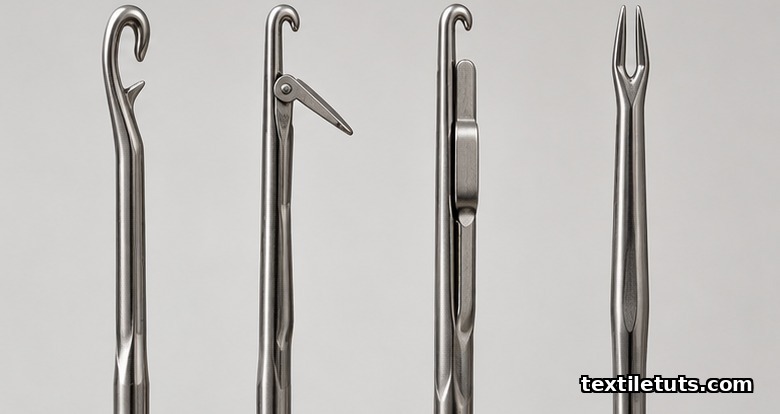
Bearded needles. The oldest design. The needle has a flexible hook (the “beard”) that closes over the yarn during loop formation. Used on older Cotton’s-type and bearded-needle full-fashioned frames. Still preferred for very fine gauges (16+) because the beard geometry can be made thinner than a latch.
Latch needles. Today the standard on V-bed flat machines and most circular machines. The latch is a small pivoting blade that closes the hook automatically as the new loop slides past. Latch needles tolerate a wider yarn-diameter range than bearded needles and are easier to re-latch after a yarn break.
Compound needles. A needle with a separately actuated tongue or slider that closes the hook. Used on high-speed circular machines but increasingly found on advanced flat bed machines for technical textiles, where the closed hook geometry gives better loop control at very high cam speeds.
Spring beard (or “transfer”) needles. A hybrid designed for transferring stitches between beds without dropping them. Common on full-fashioned flat machines and on intarsia-style machines.
The choice between them is governed by machine class, not by the engineer. Within a chosen needle type, however, point style (regular, half-point, open-point, half-tap), hook depth, and slot width can all be varied. These micro-choices are how a machine shop matches one needle bed to multiple yarn counts.
How Gauge and Needle Choice Affect Fabric Quality
ASTM D3887 (Standard Specification for Tolerances for Knitted Fabrics) defines the dimensional tolerances a knit must meet: courses per cm, wales per cm, stitch length, and mass per unit area, each with an allowable ± range. Falling outside that range usually traces back to a gauge-and-needle mismatch:
- Wales too few → needle spacing too wide for the yarn → fabric too open.
- Wales too many → needle spacing too narrow → fabric too stiff, hand-feel drops.
- Stitch length too long → needle hook not closing cleanly → dropped stitches.
- Mass per unit area out of tolerance → yarn count choice wrong for the gauge → reject.
A second layer of control is ISO 4921:2000 (Knitting — Basic concepts — Vocabulary), which defines the knit-loop geometry terms (wale, course, stitch length, tuck, float) and is the reference document for any tolerance discussion in a technical specification.
Common Selection Mistakes and How to Avoid Them
Three mistakes recur in new flat bed setups. First, selecting gauge from the fabric end-use alone without checking the available yarn count. A designer may request a 14-gauge “fine” sweater, but if the available yarn is 2/8 Nm, the practical gauge is 7 and the fabric weight must be revised. Second, ignoring yarn frictional properties. A 14-gauge bed with combed cotton 2/60 Nm will knit cleanly; the same bed with merino wool of the same nominal count will be loopier because the wool fibres are more compressible. Third, leaving the same needles in place after a cam re-set. A longer stitch length on the same needles is one of the fastest routes to needle breakage.
The fix in each case is to document the intended yarn, run a 10 cm × 10 cm swatch on the planned gauge, measure wales and courses against the ASTM D3887 envelope, and adjust before committing to a production run.
Frequently Asked Questions
What gauge is best for cotton knit fabrics on a flat bed machine?
For combed cotton between 2/30 and 2/60 Nm, a 12–14 gauge flat bed is the most common production setting. The combination delivers 8–10 wales per cm, a smooth surface for print, and a finished GSM in the 140–180 range suitable for shirting and lightweight knitwear.
How do you convert gauge to needle spacing in millimetres?
Needle spacing (mm) = 25.4 / gauge. A 10-gauge bed spaces needles at 2.54 mm, a 14-gauge bed at 1.81 mm, and a 20-gauge bed at 1.27 mm. ISO 8388:1998 normalises this conversion.
Can the same flat bed machine knit multiple gauges?
Only within the engineering tolerance of the needle bed. A V-bed flat machine built for 12 gauge can be re-stroked to run 10 or 14 gauge by changing the needle strips, but only if the cam system, yarn feed, and take-down tension are re-set for the new needle spacing. Most production machines are dedicated to one gauge.
What happens if the yarn is too thick for the gauge?
The needle latch fails to close fully, the new loop pushes the old loop off the hook, and the result is repeated drop stitches. Sustained over-thickness bends the needle hook permanently within 30 minutes of running. Stop the machine, change yarn or gauge, and inspect the needle strip for hook deformation before resuming.
Which needle type should I choose for a beginner flat bed knitter?
Latch needles on a 7- or 10-gauge V-bed machine. Latch needles are the most forgiving of yarn thickness variation, the easiest to re-latch after a yarn break, and the most widely supported with consumables and tutorials. Bearded and compound needles are reserved for production specialists.
References
- International Organization for Standardization. ISO 8388:1998 — Knitting machines — Determination of the gauge. ISO, 1998. https://www.iso.org/standard/25744.html — Defines gauge as needles per unit working width and the method of measurement.
- International Organization for Standardization. ISO 4921:2000 — Knitting — Basic concepts — Vocabulary. ISO, 2000. https://www.iso.org/standard/8196.html — Standard vocabulary for knit-loop geometry (wale, course, stitch length).
- International Organization for Standardization. ISO 3635:1981 — Textiles — Woven or knitted fabrics — Determination of length per unit mass. ISO, 1981. https://www.iso.org/standard/9033.html — Reference for converting yarn count into linear-density calculations.
- ASTM International. ASTM D3887 — Standard Specification for Tolerances for Knitted Fabrics. ASTM, current edition. https://www.astm.org/d3887 — Defines the wale, course, stitch length, and GSM tolerance envelopes for knit fabrics.
- Spencer, D. J. Knitting Technology: A Comprehensive Handbook and Practical Guide. Woodhead Publishing, 2001 (3rd ed.). https://www.sciencedirect.com/book/9781855733336 — Peer-reviewed textile engineering reference covering gauge, needle selection, and flat bed mechanics.
- Iyer, C., Mammel, B., and Schach, W. Circular Knitting. Meisenbach, Bamberg, 1992. https://www.researchgate.net/publication/271811522 — Standard reference on needle geometry and gauge selection for knit production.
This article is the working reference for flat bed knitting machine gauge and needle selection. Editorial by Iftay Khairul Alam, TextileTuts. Sources: ISO 8388:1998, ISO 4921:2000, ISO 3635:1981, ASTM D3887, Spencer (Woodhead, 2001), and Iyer, Mammel and Schach (1992) as cited.


