
Circular Knitting Machine: Cylinder, Dial, Needles

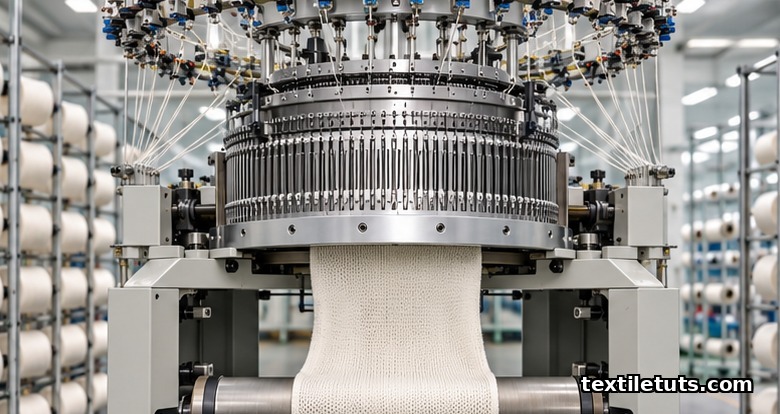
A circular knitting machine is a weft knitting machine built around a rotating cylinder that holds 800 to 6,000 latch needles in vertical slots (called “tricks”) arranged around its circumference, with machines above 12 inches in diameter adding a horizontal dial above the cylinder that holds up to half that needle count to knit double jersey structures such as rib and interlock.
The cylinder diameter (commonly 7 to 60 inches) and the gauge (needles per inch of circumference, typically 5 to 40) together set the total needle count, so a 30 inch cylinder running at gauge 24 carries roughly 2,261 needles while a 22 inch cylinder at gauge 18 carries around 1,244 needles.
This article explains how the cylinder, dial, and needle assembly on a circular knitting machine work together, why needle selection and gauge shape the fabric you can produce, and what each component does during the four motions of knit loop formation: casting on, knitting, looping, and knocking over.
What is a Circular Knitting Machine?
A circular knitting machine produces tubular weft knit fabric by feeding yarn to needles arranged in a circle rather than on a flat bed. Yarn is fed from creels mounted above the machine, passes through yarn carriers (typically 2 to 96 feeders per machine), and is drawn down to the needles as the cylinder rotates through a cam system that controls needle motion. Each completed loop is fed through the previous one, building fabric downward that is drawn off the bottom of the machine as a continuous tube.
The cylinder, dial, and needles form the heart of the system. Cylinders are precision machined from steel alloys, with vertical slots (tricks) cut at a fixed spacing determined by the gauge. Each trick holds one needle whose hook and latch form the loop, with the latch closing over the hook when the new loop pulls the previous one off. Cylinders can be changed on most machines to switch between gauges and diameters, although the cam systems are usually built around the original cylinder dimensions.
The machine also includes sinkers (thin metal strips between needles that hold the fabric down while loops form), cams (curved tracks that push the needles up and down), and a fabric take-down roller. Together these elements convert continuous yarn into fabric, with the cylinder and dial geometry determining fabric width, weight, and structure.
The Cylinder: The Main Needle Bed
The cylinder is the primary needle bed on every circular knitting machine. It is a hollow steel cylinder with thousands of vertical tricks machined into its outer surface, each trick holding one latch needle, spring beard needle, or transfer needle depending on the machine and fabric type. Standard commercial cylinders run from 7 inches in diameter for small fine gauge machines used in apparel trims and hosiery, up to 60 inches in diameter for fabric production lines targeting open width cotton knits.
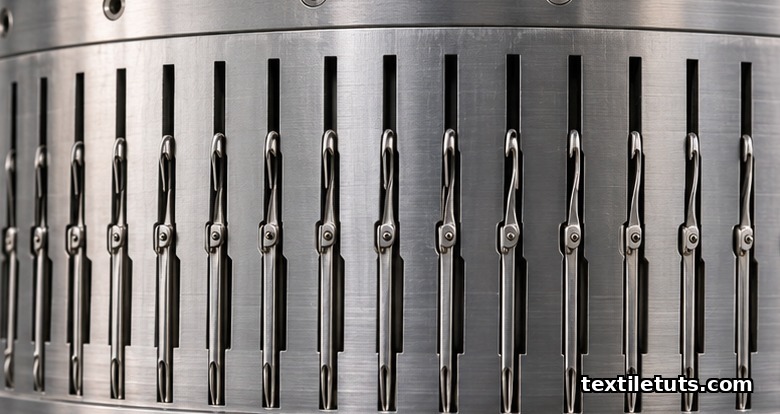
Cylinders for jersey, rib, and interlock knitting are typically constructed of alloyed tool steel hardened to a depth of 1 to 2 mm through the inner trick surface, with the cylinder wall 4 to 8 mm thick. The trick spacing sets the gauge; a 24 gauge cylinder has 24 needles per inch of circumference, while a 28 gauge cylinder has 28 needles per inch. Common production gauges span 18 (coarser knits), 20, 22, 24, 28 (fine knits for apparel), 32, 36, and 40 (very fine knits for hosiery and technical fabrics).
The number of needles on a cylinder is calculated as circumference times gauge: N equals pi times D times G, where D is the cylinder diameter in inches and G is the needles per inch. A 26 inch diameter cylinder at 24 gauge carries approximately 1,960 needles, while a 30 inch cylinder at the same gauge carries around 2,261 needles. Each needle has an associated cam follower (a butt at the bottom or top of the needle that rides in the cam track) which controls its vertical movement as the cylinder rotates past the fixed cam box.
The Dial: Upper Needle Bed on Larger Machines
The dial is a horizontal needle bed that sits above the cylinder on larger circular knitting machines, mounted so its needles point downward toward the cylinder needles. Machines without a dial (called single jersey machines) knit only plain jersey, lacoste, and similar single face fabrics. Machines with a dial (called double jersey machines) knit rib, interlock, and double piqué structures in which both faces of the fabric show knit stitches.
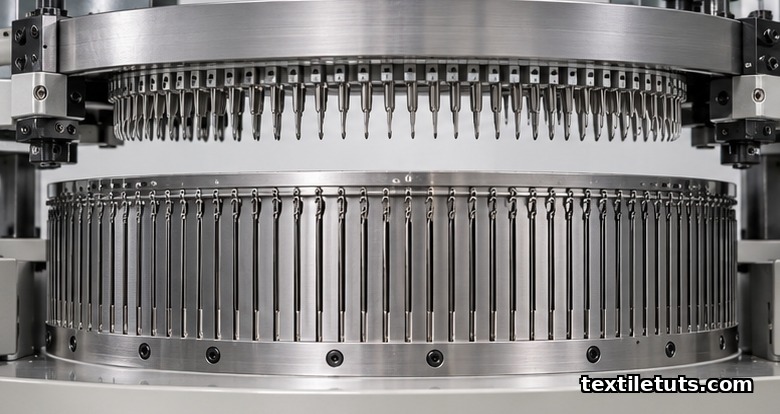
Dial needle counts range from roughly 600 to 3,000 needles depending on diameter and gauge, and they are arranged in a circle on a flat annular bed rather than on a curved surface. The dial needle alignment relative to the cylinder needles determines the fabric structure: needles aligned directly opposite cylinder needles knit interlock (because they knit alternately with the cylinder in different feeder passes), while needles positioned between cylinder needles knit rib (because cylinder and dial needles form opposite loops in the same course).
On a typical 30 inch diameter double jersey machine running at gauge 24, the cylinder carries approximately 2,261 needles and the dial carries approximately 1,131 needles (half the cylinder count). The dial remains stationary while the cylinder rotates past the cam systems; both sets of needles are driven by separate cams that synchronize their knitting, looping, and knocking over motions across each feeder.
Needles: Latch, Loop, and Trick Geometry
The latch needle is the standard needle used on modern circular knitting machines. It consists of three main parts: the hook (a curved end that catches the new yarn), the latch (a hinged wire that closes over the hook once the old loop passes), and the needle stem that sits in the trick. Each needle sits in a vertical trick cut into the cylinder or dial surface, with the hook and latch protruding outward into the knitting zone.
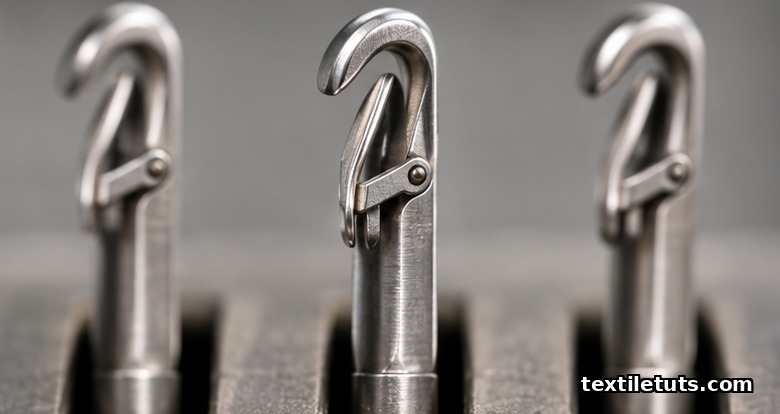
Needles are made from high carbon steel wire, typically 0.4 to 1.2 mm in diameter depending on gauge, and are hardened and tempered to a Rockwell hardness of about 60 HRC so the hook and latch can withstand millions of knitting cycles without deformation. The latch pivots on a small slot near the top of the needle stem, and the geometry of the hook and latch determines how cleanly the old loop is knocked over the new one. Modern circular machines commonly run at 30 to 35 revolutions per minute on cylinder diameters of 30 inches, producing up to 3 million knit cycles per needle per day on high output lines.
Two other needle types occasionally appear on circular machines: spring beard needles (which use a flexible beard that closes the hook rather than a latch), used on some older cotton machines and certain bearded needle hosiery machines, and compound needles (which use a sliding closing element rather than a latch), used on modern high speed machines for technical and automotive textiles. Latch needles remain dominant because of their simplicity, low cost, and ease of replacement.
How Cylinder, Dial, and Needles Work Together
During one revolution of the cylinder, each needle completes the four motions of loop formation: casting on, where the yarn is laid over the open hook; knitting, where the needle rises to pull the new yarn through the previous loop; looping, where the needle descends so the previous loop slides up the stem onto the closed latch; and knocking over, where the previous loop slides off the latch over the new loop, completing the stitch.
On a double jersey machine with both cylinder and dial, each feeder is set up with synchronized cam boxes for both needle beds. As the cylinder rotates past a feeder, the cylinder needles knit one course on the face of the fabric while the dial needles knit the reverse course. In interlock, the two sets of needles knit on alternate feeders, producing a balanced fabric with nearly identical face and back appearance and dimensional stability closer to a woven fabric than a plain jersey.
The cam system that drives the needles is the main control surface on a circular knitting machine. By changing cam segments, the machine can switch from knitting to missing (tucking), transferring loops between cylinder and dial needles for true rib structures, or holding loops for plating and striping effects. The combination of cylinder rotation speed, dial timing, and cam geometry determines the machine’s effective productivity, which on modern circular machines runs 1.0 to 1.5 meters of fabric per minute per feeder.
Gauge, Diameter, and Choosing the Right Setup
When textile engineers specify a circular knitting machine, three numbers define what the machine can produce: diameter (sets fabric width off the machine), gauge (sets fabric weight and stitch density), and the number of feeders (sets output speed and pattern complexity). These numbers cannot be changed independently because needle count, cam box width, and machine frame size all derive from them.
For example, a 30 inch diameter, 24 gauge, 90 feeder circular knitting machine is a common production specification for cotton jersey in apparel, while a 22 inch, 28 gauge, 32 feeder machine is typical for rib trim and cuffs. Smaller diameter machines (8 to 14 inches) at finer gauges (28 to 40) are common in hosiery and underwear knitting. Switching between diameter and gauge requires physical cylinder and dial changes, while pattern and structure changes are made by swapping cam segments or, on electronic machines, by changing the needle selection program.
For yarn count and fabric weight calculations on circular knit fabrics, the Yarn Count to GSM Calculator on TextileTuts.com converts between linear yarn density and fabric GSM based on stitch density and yarn count. For consumption estimates on circular knit fabric used in T shirts and similar garments, the Basic T Shirt Fabric Consumption Calculator provides a starting point based on garment dimensions, fabric width, and stitch density.
Frequently Asked Questions
How many needles are in a circular knitting machine cylinder?
The needle count of a circular knitting machine cylinder is set by the cylinder diameter and the machine gauge (needles per inch of circumference). The count is calculated as N equals pi times D times G, where D is the diameter in inches and G is the needles per inch. A 30 inch cylinder at gauge 24 therefore carries about 2,261 needles, while a 22 inch cylinder at gauge 18 carries around 1,244 needles. Standard production cylinders carry 800 to 6,000 needles depending on size.
What is the difference between a cylinder and a dial on a circular knitting machine?
The cylinder is the main, rotating needle bed at the bottom of the machine; the dial is a stationary horizontal needle bed mounted above the cylinder on larger machines. The cylinder carries needles around its curved outer surface, while the dial carries needles on a flat annular surface with the hooks pointing downward. Cylinder only machines knit single jersey fabrics. Machines with a dial knit double jersey structures (rib, interlock, double piqué) by having both needle sets form loops.
Which needle type is used in circular knitting machines?
Most modern circular knitting machines use latch needles, which consist of a hook, a hinged latch, and a stem that sits in a vertical slot (trick) in the cylinder or dial. Latch needles are preferred because they are simple, inexpensive, and easy to replace. Some high speed machines, especially those knitting technical and automotive textiles, use compound needles with a sliding closing element rather than a latch. Spring beard needles appear only on certain older cotton machines and bearded needle hosiery machines.
What is the standard gauge range for a circular knitting machine?
Standard circular knitting machine gauges range from 5 needles per inch (coarse gauge, used for coarse knit blankets and industrial fabrics) to 40 needles per inch (very fine gauge, used for hosiery and underwear). The most common production gauges for apparel circular knitting sit between 18 and 28 needles per inch. Fabric GSM and stitch density rise with gauge, while yarn count becomes finer at higher gauge settings.
Can a circular knitting machine knit both single jersey and rib fabrics?
Single jersey machines (cylinder only) knit plain jersey, lacoste, and fleece structures. Rib and interlock fabrics require a machine with both cylinder and dial (a double jersey machine). The dial’s needle alignment relative to the cylinder needles determines whether the machine knits interlock (needles aligned) or rib (needles positioned between cylinder needles). Most modern production circular machines are double jersey machines with quick change cylinders and dials for flexibility.
References
- International Organization for Standardization. ISO 8388:1998 Textiles — Knitting machines — Vocabulary. iso.org — defines circular knitting machine terms including cylinder, dial, gauge, and needle components.
- ASTM International. ASTM D3887 / D3887M Standard Test Method for Measuring Abrasion Resistance of Knitted Fabrics. astm.org — knit fabric abrasion testing applied to circular knit output.
- ASTM International. ASTM D3787 Standard Test Method for Bursting Strength of Knitted Fabrics. astm.org — knit fabric burst strength testing for circular knit structures.
- AATCC. AATCC TM 135 Dimensional Changes of Fabrics after Home Laundering. aatcc.org — dimensional stability reference applicable to circular knit fabrics.
- Spencer, D.J. (2001). Knitting Technology: A Comprehensive Handbook and Practical Guide. 3rd edition, Woodhead Publishing — the standard textile engineering reference on weft knitting, circular machines, cylinder and dial construction.
- Elmogahzy, Y. (2019). Engineering Textiles: Integrating the Design and Manufacture of Textile Products. 2nd edition, Woodhead Publishing — chapter on weft knitting structures including circular knit cylinder and dial setup.
This article is the working reference for circular knitting machine cylinder, dial, and needle construction. Editorial by Iftay Khairul Alam, TextileTuts. Sources: ISO 8388, ASTM D3887, ASTM D3787, AATCC TM 135, Spencer (Woodhead), Elmogahzy (Woodhead) as cited.


