
Knitting Fabric Relaxation: Why Knits Shrink

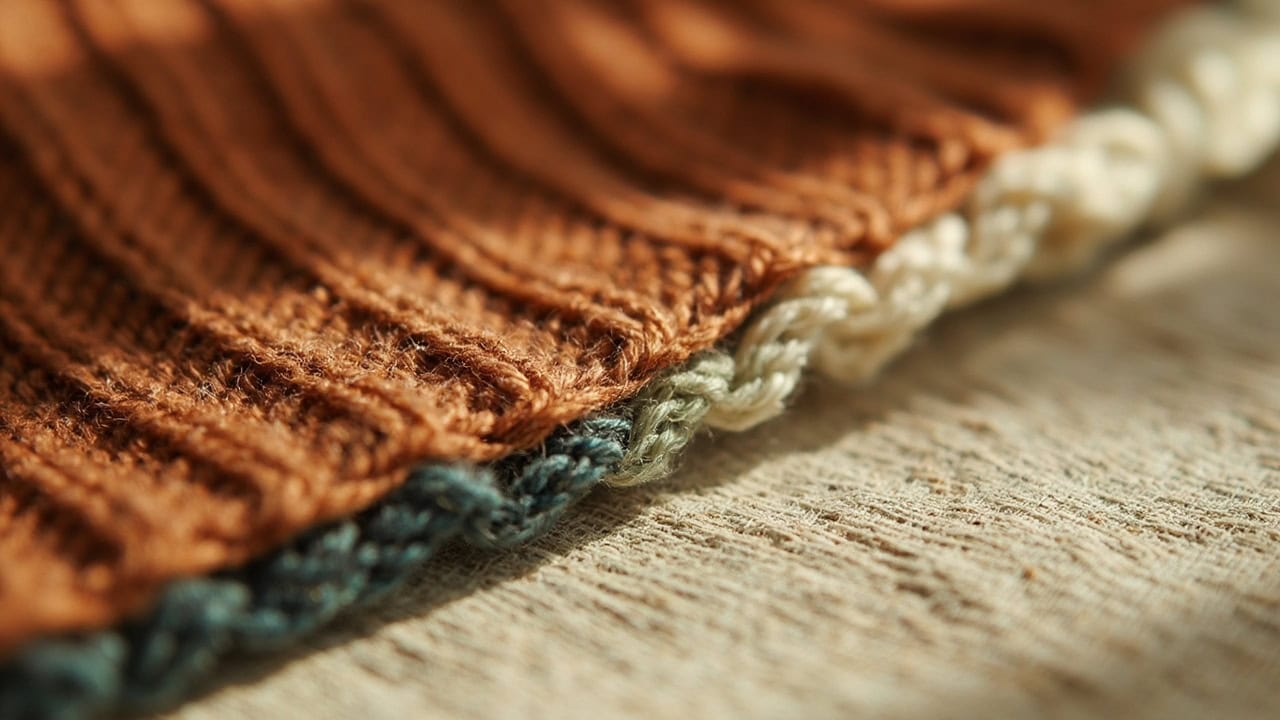
Knitted fabrics shrink between 5% and 25% in length and width after laundering because their loop structure stores knitting tension that releases as the yarn relaxes into equilibrium, with an additional 40–60% area loss possible on wool from felting. The same knit can lose three sizes in a single hot wash if the finishing did not stabilise the loops, while a properly relaxed and heat-set knit returns to its original dimensions cycle after cycle. This article explains why knits behave the way they do, separates relaxation shrinkage from felting and from swelling, and shows how stitch length, yarn type, and finishing control the final numbers.
You will learn the three distinct mechanisms that move a knit on the first wash, the role of loop geometry in setting the lower bound on dimensional change, the test methods that put a number on each mechanism, and what a knit finisher actually does on a stenter or compactor to lock the dimensions in place.
Why a Knitted Loop Is Inherently Unstable
A knitted fabric is not a flat grid. Each yarn follows a three-dimensional path that loops through its neighbour, so the cloth has built-in curvature and stored bending energy from the moment it leaves the needle. When the yarn is drawn from a creel, fed through tension devices, and bent into stitches at speeds of 1,000–2,000 courses per minute on a circular knitting machine, every loop is held in a slightly elongated shape by the take-down roller and the winding tension. The fabric that rolls onto the bolt is therefore in a metastable state, with the loops longer than they want to be and the courses closer together than the yarn geometry would naturally allow.
Once that fabric meets water, agitation, and heat, two things happen at once. The yarns swell as moisture enters the amorphous regions of the fibre, and the inter-yarn friction drops as a water film lubricates the contact points. Both effects allow the loops to rearrange toward the configuration that minimises the yarn’s bending energy, which is a wider, shorter, and thicker loop. Dimensional change measured after a single wash is the difference between the as-knit geometry and this relaxed geometry.
This is why knits behave so differently from wovens. A plain weave has straight yarns interlaced at 90°, and shrinkage is mostly fibre swelling plus yarn crimp interchange, which produces only 1–3% change on a well-set cotton. A knit has slack loops that can collapse almost freely, so the same cotton in a single jersey can shrink 8–12% in length and 5–8% in width on the first cycle if it has not been compacted.
The Three Mechanisms Behind Knit Shrinkage
Dimensional change in a knitted fabric is not a single phenomenon. Knit engineers separate three mechanisms, and each one has its own test method, its own typical magnitude, and its own fix.
Relaxation Shrinkage
Relaxation shrinkage is the strain recovery that occurs as knitting and finishing tension dissipates. On a cotton single jersey, the as-knit loop length is typically 10–20% longer than the fully relaxed loop length, so relaxation alone can account for 6–10% length change and 4–7% width change on the first wash. The standard for measuring this is ISO 5077 paired with ISO 6330 washing procedures, where specimens are conditioned, measured, washed in a domestic drum, dried, and re-measured under standard atmosphere.
Hygral Expansion
Hygral expansion is the reversible change that happens when a fibre swells in water and recovers when it dries. Cotton swells roughly 20% in cross-section at saturation, which forces the loops wider and shorter on the wet side and lets them spring back on drying. This effect is largely reversible across cycles and is responsible for the slight relaxation of fit you feel when a T-shirt is damp. AATCC TM 135 tracks the cumulative change across several laundering cycles, which separates reversible swelling from irreversible relaxation.
Felting Shrinkage
Felting is unique to wool and other animal-hair fibers with scales on the cuticle. Under heat, moisture, and agitation, the directional friction difference causes the fibres to migrate root-ward and pack together irreversibly. Area shrinkage of 40–60% is achievable on an untreated wool knit, which is why machine-washing a hand-knit sweater at 40 °C often produces a child’s garment. The standard method for characterising this is ISO 137, which uses a controlled cubical agitation box.
How Loop Geometry Sets the Floor on Shrinkage
Every knit has a property called the K constant, defined as the ratio of loop length to fabric square root of area. Peirce’s geometric model and the subsequent work by Leaf and Glaskin showed that an ideal loop has a minimum length below which the yarn cannot physically form the stitch. In practical terms, a cotton jersey knitted at a loop length of 2.8 mm will sit at roughly 180 g/m², while the same yarn knitted at 3.4 mm will sit at about 145 g/m² and be measurably more dimensionally stable, because the longer loop has more slack already built into its geometry.
This is why knit designers can control shrinkage from the knitting machine itself. Increasing loop length by 5% reduces potential relaxation shrinkage by 2–4 percentage points in length, with the trade-off coming in fabric weight and opacity. The downstream compactor can only squeeze a fixed amount of length back into the fabric, so the cleaner path is to knit slightly looser and then compact.
Why Finishing Matters More Than Knitting
The single biggest contributor to consumer-side shrinkage is not the knitting machine but the finishing sequence. A greige cotton jersey coming off the knitting machine has a stitch length set by the machine gauge and the cam profile, and the fabric is held extended by the take-down and winding tensions. Three finishing steps convert this into a dimensionally stable knit.
First, scouring and bleaching relax the fabric so the loops find their equilibrium geometry. This is typically done on a winch or jet dyeing machine, where the fabric is allowed to float freely in hot water at 60–95 °C for 20–40 minutes. The relaxation that the consumer would otherwise pay for on the first home wash happens here, and the machine captures it.
Second, drying on a stenter sets the width. The fabric is pinned or clipped to a chain that holds it at the target width while passing through a heated chamber at 130–180 °C for cotton or 180–220 °C for polyester blends. Cotton does not heat-set, so the width is held only until the fabric cools; a small amount of width shrinkage (1–3%) returns on the next wash if the overfeed is wrong. Polyester and poly-blends heat-set in this zone, which is why a 65/35 poly-cotton single jersey can be marketed as shrink-resistant.
Third, compacting removes the residual length shrinkage. A compactor feeds the fabric between a heated roller and a rubber belt or blanket, with the belt running slower than the feed so the fabric is physically shortened, often by 15–25%. A properly compacted cotton jersey will shrink no more than 3% in length and 3% in width across five ISO 6330 wash cycles at 40 °C.
Shrinkage Numbers by Fiber and Construction
The table below summarises typical first-wash dimensional change figures for the most common knit constructions. Values are taken from ISO 6330 / ISO 5077 testing at wash procedure 4N (40 °C, normal agitation, flat dry) on fabrics finished for the retail market. They are typical, not guaranteed, and a specific fabric should always be tested under AATCC TM 135 or ISO 5077.
| Construction | Fiber | Length change | Width change | Main mechanism |
|---|---|---|---|---|
| Single jersey | Cotton, compacted | -3% to -5% | -3% to -5% | Relaxation |
| Single jersey | Cotton, uncompacted | -8% to -12% | -5% to -8% | Relaxation |
| Single jersey | Polyester, heat-set | -1% to -2% | -1% to -2% | Thermal set |
| Rib 1×1 | Cotton | -5% to -8% length, grows in width | +2% to +5% | Loop rearrangement |
| Interlock | Cotton, compacted | -3% to -4% | -3% to -4% | Relaxation |
| Purl knit | Wool, untreated | -25% to -40% | -25% to -40% | Felting |
| Plain knit | Wool, machine-washable (chlorinated) | -3% to -5% | -3% to -5% | Felting (suppressed) |
The “grows in width” entry on the rib is worth flagging. Rib structures store width stability as recovery, not as set geometry, and the first wash typically relaxes the rib into a wider, shorter configuration. This is why rib cuffs on a sweatshirt often look loose after one wash even when the body is unchanged.
How Manufacturers Test Dimensional Stability
AATCC and ISO both expose fabric to accelerated laundering cycles and measure the change against bench marks. AATCC TM 135 uses a standard top-loading or front-loading reference machine with controlled water level, agitation, and spin, while ISO 6330 defines 16 different wash procedures (1N through 9N plus 1H through 9H) that span hand wash at 30 °C through boil wash at 95 °C. ISO 5077 is the companion standard that tells you how to mark, measure, and calculate the change.
The procedure is straightforward. Specimens are cut to 500 mm × 500 mm with bench marks 350 mm apart, conditioned at 20 °C and 65% relative humidity for 4 hours or more, and measured. They are then washed and dried according to one of the ISO 6330 procedures. After drying and reconditioning, the same bench marks are remeasured. The change is reported as a percentage of the original distance, with negative numbers indicating shrinkage. Five cycles are typical for a final-article test.
The clever part is the drying step. Tumble drying at high heat drives more relaxation than flat drying, which is why care labels often say “lay flat to dry” for knitwear that has not been fully stabilised. For cotton knits that have been fully compacted, however, tumble drying at 60–80 °C is a feature, not a bug, because it confirms that the residual shrinkage budget has been spent.
Reading a Knit Care Label
The label inside a knit garment tells you what test the manufacturer has designed for. “Machine wash cold, tumble dry low” means the knit has been relaxed, heat-set (if synthetic), and compacted to less than 3% change at 30 °C. “Hand wash cold, lay flat to dry” means the knit has either not been fully stabilised (often the case for wool) or is a low-loop construction where aggressive agitation would felting-shrink it. “Dry clean only” is uncommon on knits and usually points to a trimmings problem, not a fabric problem.
What You Can Do at Home
For cotton knits that have already shrunk, a soak in cool water with a tablespoon of hair conditioner for 20 minutes relaxes the fibres, after which the garment can be gently pulled back to shape and laid flat to dry. This works because the conditioner lubricates the fibres and lets the loops re-arrange toward their pre-shrinkage geometry. For wool, do not try this on a machine-washable garment that has felting-shrunk, because the felting is irreversible by design.
Prevention is cheaper. Wash knits in cool water (≤30 °C), use a gentle cycle, skip the hot tumble dryer, and fold rather than hang, because wet knits stretch under their own weight on a hanger.
Frequently Asked Questions
Why does my cotton T-shirt keep shrinking wash after wash?
The first three to five washes remove most of the relaxation shrinkage, but each cycle also drives a small amount of additional hygral expansion and recovery. If the T-shirt was finished to 5% residual shrinkage, expect that 5% to arrive over the first five cycles rather than the first wash. Past that, the fabric is at equilibrium and further change is sub-1%.
Do polyester knits really not shrink?
Heat-set polyester is dimensionally stable to within 1–2% across normal home laundering because the thermoplastic fibre is set into its loop geometry at 180–220 °C during finishing. Unset polyester, by contrast, can shrink 5–8% at 60 °C because the fibre returns to its as-extruded memory.
What is the difference between relaxation shrinkage and felting shrinkage?
Relaxation shrinkage is the mechanical recovery of stretched loops and is reversible by re-knitting or re-setting. Felting shrinkage is the irreversible packing of wool fibres caused by the directional friction of the cuticle scales and is permanent once the fibres have migrated.
Why do some knits grow in width instead of shrinking?
Rib structures and other highly elastic constructions store width stability as elastic recovery. On the first wash, the loops relax and the fabric settles into a wider configuration, producing a small width gain (often 2–5%) alongside the expected length loss.
Is pre-washing knit fabric at home worth it before sewing?
For cotton and linen knits, yes. A pre-wash in the same temperature water you will use for the finished garment removes the relaxation shrinkage so the cut pieces stay the size you measured. For wool, pre-wash is risky unless the fabric is labelled machine-washable, because agitation can trigger felting before you have even cut the cloth.
References
- International Organization for Standardization. ISO 5077:2007, Textiles — Determination of dimensional change of fabrics after domestic washing and drying. iso.org — the reference method for bench-mark marking, washing, drying, and calculating knit dimensional change.
- International Organization for Standardization. ISO 6330:2012, Textiles — Domestic washing and drying procedures for textile testing. iso.org — defines the 16 wash procedures used to drive relaxation shrinkage in knit test specimens.
- American Association of Textile Chemists and Colorists. AATCC TM 135, Dimensional Changes of Fabrics after Home Laundering. aatcc.org — the AATCC parallel to ISO 5077, used widely for cotton knit dimensional stability testing.
- International Organization for Standardization. ISO 137:2015, Wool — Determination of fibre diameter by projection microscope method. iso.org — paired with felting-shrinkage methods for characterising wool knit behaviour.
- Spencer, D. J. Knitting Technology: A Comprehensive Handbook and Practical Guide. Woodhead Publishing, 3rd edition — the standard textbook on knit loop geometry, K constants, and finishing-line behaviour, including the Leaf and Glaskin geometric models.
- Textile Institute. Woven and Knit Fabric Dimensional Stability: A Technical Review. textileinstitute.org — industry trade-association review of the relaxation, swelling, and felting mechanisms covered in this article.
This article is the working reference for knit dimensional change. Editorial by Iftay Khairul Alam, TextileTuts. Sources: ISO 5077:2007, ISO 6330:2012, AATCC TM 135, ISO 137:2015, Spencer (Knitting Technology, 3rd ed.), and the Textile Institute dimensional-stability review as cited.


