
Knit Fabric Printing Process

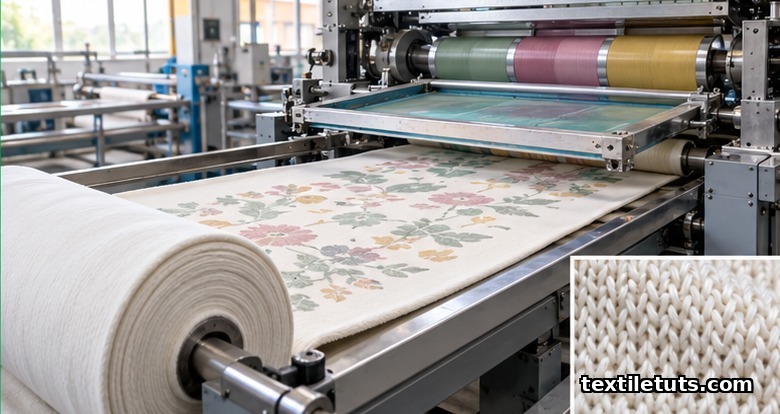
Knit fabric printing applies color or design to loop-structured textiles using reactive dyes on cotton knits at 60°C or disperse dyes on polyester knits at 130°C, with screen, digital, and heat-transfer methods together accounting for approximately 80% of global knit-fabric print production. Unlike woven fabrics, knitted structures stretch 15–40% along the course and wales, so the printing line must control loop distortion while delivering a color yield above 70% for reactive systems and fastness grades of 4–5 on the ISO 105 grey scale.
This guide walks through the knit printing line step by step, from grey-fabric preparation through fixation, washing-off, and quality control. It also covers the printing methods that work best on relaxed versus tubular knits, the dye classes matched to fiber chemistry, and the AATCC and ISO test methods that determine whether a printed knit will survive repeated laundering.
Why Knit Fabrics Need a Different Printing Approach
A knit is a series of interlocking loops, not a grid of warp and weft yarns. That structural difference changes everything a printer must do. A single jersey stretches 25–35% in the width direction and 30–40% in the length direction under standard ASTM D2594 tensile testing, while a balanced interlock stretches 40–60% in both directions. When a knit is held under uneven tension across a printing blanket or a rotary screen, the loops skew and the resulting distortion shows up as bowing or skewing after washing.
Knit printers therefore work with relaxed, pre-shrunk fabric on blanket or tubular lines, hold tension below 5 cN/cm at the entry to the print zone, and overfeed the fabric by 3–8% relative to the blanket speed. They also avoid thickener build-up, since residual print paste inside the loops stiffens the hand-feel and lifts the fabric weight by 5–15 g/m².
The second reason knits print differently is fiber selection. The global knit-print market is dominated by cotton (about 60%), polyester (about 20%), and cotton/polyester blends (about 15%), with viscose, modal, and wool making up the remainder. Each fiber binds a different dye class, so a print line built for reactive dyes on cotton will not deliver acceptable yield on a polyester fleece.
Pre-Treatment: Scouring, Bleaching, and Surface Preparation
Before any ink touches a knit, the fabric must be clean, absorbent, and dimensionally stable. The pre-treatment sequence typically follows this order.
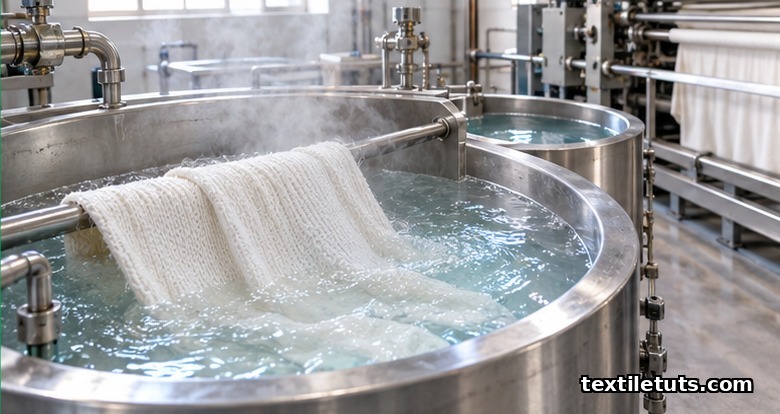
- Scouring. Removes knitting oils, coning oils, and machine lubricants using 2–5 g/L non-ionic surfactant at 80–95°C for 20–30 minutes. Cotton knits lose 1–3% mass during scouring.
- Bleaching. Hydrogen peroxide at 2–4 g/L with sodium silicate stabilizer at 90–98°C for 30–60 minutes lifts the whiteness index to 70–80 on the Berger scale, depending on the cotton grade.
- Neutralization and rinsing. Acetic acid brings the pH to 6.5–7.0 before the fabric leaves the dye range.
- Stenter setting. Knits are dried and overfed 8–12% on a stenter to lock width and reduce residual shrinkage to 3–5% after five AATCC TM 135 home-laundering cycles.
- Singeing and mercerizing (optional). For fine-gauge cotton jersey, singeing at 800–1000°C removes protruding fiber ends, and mercerizing with 22–25°Bé sodium hydroxide improves dye uptake by 15–25%.
A well-prepared knit absorbs water in under 2 seconds (AATCC TM 79 drop test) and shows a pH between 6.0 and 7.5 when tested with AATCC TM 81. Skip any of these steps and the printed colors will look uneven, even if the ink chemistry is correct.
Printing Methods for Knit Fabric
Six printing methods are in commercial use on knits today. Each balances speed, color yield, design complexity, and minimum order size.
Flat-Bed Screen Printing
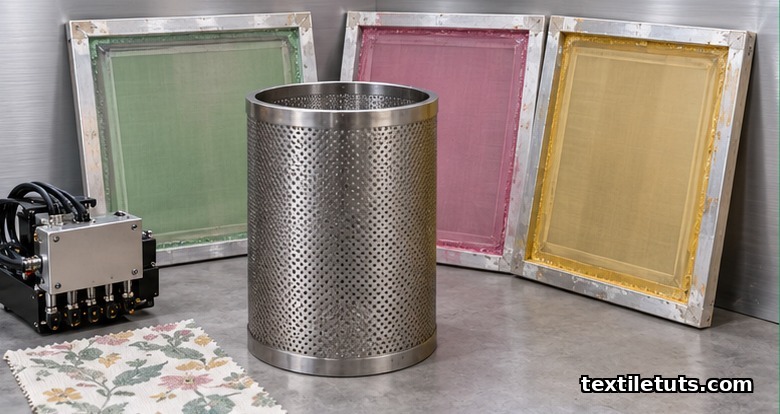
Flat-bed screen printing uses a screen for each color, pressed onto the fabric on a long rubber blanket. It handles small to medium runs (200–5,000 m), delivers 8–12 colors, and reaches speeds of 12–20 m/min. It is the workhorse method for cotton jersey in cut-and-sew apparel because the gentle blanket transport keeps loop distortion below 1.5%.
Rotary Screen Printing
Rotary screen printing uses cylindrical nickel screens rotating against a pressure roller at speeds of 30–80 m/min. Output reaches 8–16 million linear meters per year on a single line, with 12–18 colors. Rotary dominates long runs of cotton knit for fashion basics and children’s wear.
Digital Inkjet Printing
Digital inkjet printing of knit fabric uses piezo print heads with drop volumes of 1.5–10 picolitres at resolutions of 600–1200 dpi, laying down reactive or disperse ink without screens. Setup time drops from 60–90 minutes (screen) to under 5 minutes, and minimum order quantities shrink to a single 30 m roll. Speed is still the bottleneck: 8-color reactive inkjet prints at 25–40 m/min versus 60 m/min for rotary screen on the same fabric, though newer Kyocera print heads reach 65 m/min in production lines.
Heat-Transfer (Sublimation) Printing
Heat-transfer printing pre-prints disperse dyes onto paper at 200–400 m/min, then transfers the design to polyester knit at 200–220°C for 30–45 seconds under 30–50 g/m² pressure. The method is hand-feel friendly because the ink sits inside the fiber rather than on the surface. Polyester knits above 80% polyester content take 90–95% of the dye, while blends below 60% polyester give a noticeably washed-out look.
Discharge Printing
Discharge printing lays down a reducing agent (typically 30–80 g/L sodium formaldehyde sulphoxylate) that destroys a pre-dyed ground color on the knit, leaving a white or recolored pattern. It is the standard method for dark-ground cotton knits where direct printing would change the hand-feel.
Roller Printing
Roller printing uses engraved copper rollers and is reserved for very long runs of narrow designs. It has largely been replaced by rotary screen for knit fabric because rollers leave visible distortion marks across the loop rows.
Dye Selection for Common Knit Fibers
The dye class is set by fiber chemistry, not by printer preference. Reactive dyes form covalent bonds with the hydroxyl groups on cellulose, so they are the standard for cotton, viscose, modal, and lyocell knits. Disperse dyes diffuse into the hydrophobic structure of polyester under thermal fixation. Acid dyes bind to the amine and carboxyl groups on wool and silk knits. Pigment inks sit on the fiber surface bound by a resin and are used across fiber types when fastness requirements are moderate.
For a reactive print on cotton knit, the recipe typically uses 30–80 g/L reactive dye, 100–150 g/L urea (humectant), 20–40 g/L sodium bicarbonate (alkali), 30–50 g/L sodium alginate thickener, and 5–10 g/L Ludigol (resist salt). The color yield on a properly prepared knit reaches 75–85% for monochlorotriazine dyes and 85–92% for vinyl sulphone dyes under two-minute steam fixation at 102–105°C. Pigment prints on cotton knit hit 90–100% surface color yield but lose 5–15% wash fastness compared with reactives.
Fixation: Steaming and Curing
Print paste is only laid down; it must be fixed for the color to bond with the fiber. Steam fixation for reactive dyes on cotton knit runs 102–105°C saturated steam for 8–15 minutes. Inadequate steam time is the most common cause of shade variation across a printed roll. Polyester disperse prints require dry-heat fixation at 180–200°C for 60–90 seconds or pressure steaming at 130°C for 20–30 minutes. Pigment prints cure at 150–160°C for 3–5 minutes.
Continuous steamers for knit fabric use a loop-free transport that prevents elongation marks. The steamer temperature must stay within ±2°C of setpoint; any larger drift changes the hydrolysis rate of reactive dyes and shifts the final shade.
Washing-Off and Finishing
After fixation, the printed knit carries 10–30% unfixed dye, 50–80% thickener, and residual chemicals that must be removed. The wash-off sequence for a reactive print on cotton knit looks like this.
- Cold rinse to remove thickener and salt.
- Hot wash at 90–95°C with 1–2 g/L non-ionic soap for 10–15 minutes (soaping) to lift unfixed dye.
- Warm rinse at 60°C.
- Optional neutralization with acetic acid.
- Cold rinse to finish.
A proper wash-off brings total fastness up by 0.5–1.0 grades on the ISO 105 grey scale. The final finishing steps include softening (5–15 g/L silicone micro-emulsion), stentering to lock width, and optionally compacting to reduce residual shrinkage to under 5% after five home launderings. Knit fabrics should be wound at low tension (under 15 cN/cm) to avoid stretch marks that show up later as uneven dye density.
Comparison of Knit Printing Methods
| Method | Typical Speed (m/min) | Color Yield (%) | Best Run Length | Hand-Feel Impact |
|---|---|---|---|---|
| Flat-bed screen | 12–20 | 75–85 | 200–5,000 m | Low–moderate |
| Rotary screen | 30–80 | 80–90 | 5,000–500,000 m | Low |
| Digital inkjet | 25–65 | 70–90 | 1–5,000 m | Very low |
| Heat-transfer (sublimation) | 15–30 (transfer) | 85–95 on polyester | 500–50,000 m | Very low |
| Discharge | 20–40 | 80–90 | 2,000–100,000 m | Moderate |
| Roller | 40–90 | 80–90 | Above 100,000 m | Moderate–high |
Quality Control: Colorfastness Testing
Every production lot of printed knit fabric is tested against the AATCC and ISO standards the buyer specifies. The most common tests are:
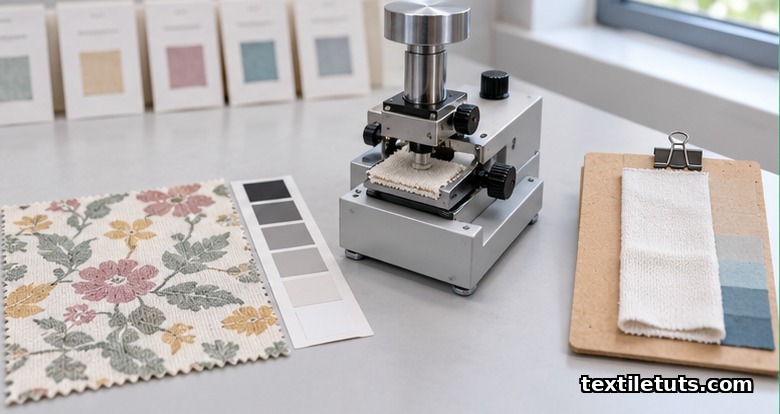
- AATCC TM 8 (ISO 105-X12): Colorfastness to crocking (dry and wet rubbing). Acceptable knitted garments score 4 on a 5-step grey scale for dry rub and 3–4 for wet rub.
- ISO 105-C10: Colorfastness to washing at 40°C and 60°C. Five home-laundering cycles should show a shade change within grade 4 and stain transfer within grade 3–4.
- AATCC TM 16.3: Colorfastness to light (xenon arc). Apparel knits typically need 20–40 AFU (AATCC Fading Units) to survive a season of retail and consumer wear.
- AATCC TM 135: Dimensional change after home laundering. Knits must shrink no more than 5% in length and width for a stable garment.
- AATCC TM 79: Wetting time, to confirm the pre-treatment was thorough. Drops should absorb in under 5 seconds.
Color matching uses spectrophotometric ΔE under D65 illumination, with a tolerance of ΔE ≤ 1.0 between lab dip and bulk production for fashion basics and ≤ 0.5 for engineered designs.
Frequently Asked Questions
Which printing method is best for small-batch knit orders?
Digital inkjet printing is the standard for orders under 5,000 m because it eliminates screens, drops setup time to under 5 minutes, and holds detail at 1200 dpi without affecting the loop structure. Expect a 15–25% cost premium per meter over rotary screen at low volumes.
Can you print on polyester knit without a heat-transfer paper step?
Yes. Direct disperse inkjet printing on polyester knit uses the same ink chemistry as heat-transfer paper, applied directly through piezo print heads, followed by fixation at 180–200°C in a continuous dryer. It avoids the paper and saves 0.5–1.0 USD per meter on long runs, though ink consumption runs 5–8% higher than transfer.
Why do printed knits sometimes look streaky or bowed after washing?
Streaking and bowing come from loop distortion during printing, not from dye failure. If the fabric entered the print zone under uneven tension above 5 cN/cm, the loops skewed and the distortion is locked in once the dye fixes. Correcting the entry tension and overfeeding the blanket by 3–8% reduces the defect to below 1% on a well-tuned line.
What is the difference between pigment printing and reactive printing on cotton knit?
Pigment printing lays dye on the fiber surface and binds it with a resin; reactive printing forms a covalent bond between dye and cellulose. Reactive prints deliver a softer hand-feel, deeper shades on dark grounds, and 0.5–1.0 grade higher wash fastness, but require wet steam fixation and a full wash-off. Pigment prints cure dry, skip the wash-off, and run on blends that reactive cannot address.
How much does shrinkage of printed knit fabric change after pre-treatment?
Greige cotton knit can shrink 8–12% in length and 6–10% in width after the first hot wash. Proper scouring, bleaching, stenter setting, and compaction bring residual shrinkage down to 3–5% after five AATCC TM 135 cycles, which is the industry target for cut-and-sew apparel.
References
- ISO. ISO 105-C10:2010 Textiles — Tests for colour fastness — Part C10: Colour fastness to washing with soap or soap and soda. iso.org — the standard wash-fastness test cited in §9 and §10.
- AATCC. Test Method 8-2016 Colorfastness to Crocking: AATCC Crockmeter Method. aatcc.org — the dry/wet rub test method cited in the QC section.
- AATCC. Test Method 16.3-2014 Colorfastness to Light: Xenon-Arc. aatcc.org — xenon-arc lightfastness used to grade printed knit apparel.
- AATCC. Test Method 135-2015 Dimensional Changes of Fabrics after Home Laundering. aatcc.org — the home-laundering dimensional-change test cited for knit shrinkage.
- ISO. ISO 105-X12:2016 Textiles — Tests for colour fastness — Part X12: Colour fastness to rubbing. iso.org — international rubbing-fastness standard paired with AATCC TM 8.
- ResearchGate / MDPI. Reactive Dye Printing on Cotton Knitted Fabrics: Process Optimization and Color Yield. researchgate.net — peer-reviewed optimization study cited for the 75–92% color-yield range.
- ResearchGate. Digital Inkjet Printing of Polyester Knits Using Disperse Dyes. researchgate.net — peer-reviewed study on direct disperse inkjet on polyester knit.
This article is the working reference for knit fabric printing processes. Editorial by Shahrukh Islam, TextileTuts. Sources: ISO 105-C10, ISO 105-X12, AATCC TM 8, AATCC TM 16.3, AATCC TM 135, and peer-reviewed studies on reactive and disperse dye printing of knits as cited.


