
Automation in Knitting

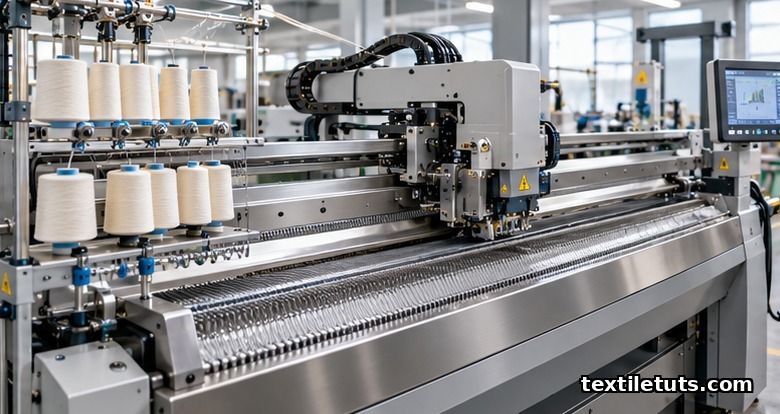
Computerized flat knitting machines can produce complete seamless garments in a single operation, cutting cut-and-sew labor by 60 to 70 percent and lifting output to roughly 1.4 to 2.2 meters of fabric per machine per hour compared to manual V-bed knitting.
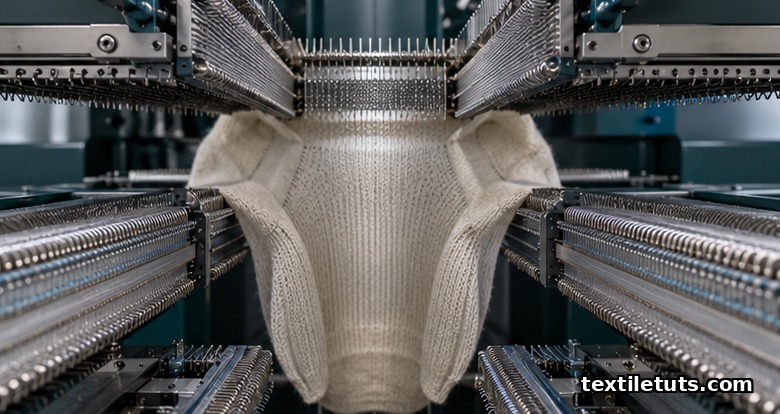
Since the 1980s, computer numerical control (CNC) has reshaped weft knitting from a hand-skill craft into a data-driven industrial process, and modern four-needle-bed systems such as Shima Seiki’s WHOLEGARMENT platform can knit an entire fully fashioned sweater with zero seaming operations.
This guide walks through the hardware, software, productivity numbers, and trade-offs that define knitting automation today, so production managers, knitting students, and textile engineers can judge where the technology fits in a real mill.
What “Automation in Knitting” Actually Covers
Knitting automation refers to any mechanical or electronic system that reduces manual intervention during stitch formation, pattern change, or fabric take-down. In weft knitting, the technology spans four overlapping layers:
- Computer-controlled needle selection. Electronic needle selection on flat and circular machines replaces mechanical pattern wheels and replaces push rods with solenoid-driven actuators that switch needles according to a digital pattern file.
- Servo-driven carriages. Servo motors instead of clutch-and-brake drives move the carriage at programmed traverse speeds, with stitch length set electronically rather than by ratchet clicks.
- Closed-loop yarn control. Tension sensors, positive feed belts, and storage feeders deliver yarn at constant feed rates, reducing barre and dropped stitches.
- Inline quality monitoring. Cameras and laser sensors detect holes, dropped stitches, or yarn breaks in real time and stop the machine within one or two courses.
Together these layers turn a knitting machine into a programmable fabric printer. The same hardware can run a plain jersey in the morning and a cable-knit intarsia piece in the afternoon, with no mechanical re-setting.
The Hardware Behind Modern Flat Knitting Automation
Modern flat knitting automation rests on three hardware pillars.
1. Computerized V-bed machines. Standard two-needle-bed machines from makers such as Shima Seiki (SES series), Stoll (CMS series), and Steiger use electromagnetic needle actuators controlled by a pattern file. A 14-gauge machine can run at traverse speeds of 1.2 meters per second on plain jersey while retaining the ability to knit complex intarsia shapes at lower speeds.
2. Multi-gauge needle beds. Fine-gauge machines (E14 to E18) use thinner needles packed more densely, while coarse-gauge (E5 to E8) machines suit outerwear and chunky knit fabrics. Modern beds allow gauge conversion by swapping needle inserts, so a mill can re-task a machine in hours rather than days.
3. Four-needle-bed WHOLEGARMENT systems. Shima Seiki’s MACH2XS and SWG-X series add front and rear beds plus two additional beds at right angles, allowing knitting in width and length simultaneously. The result is a three-dimensional garment that comes off the machine finished except for trimming, with no linking or seaming required.
Most modern machines also integrate positive yarn feeders such as IRO (now part of A&E) or BTSR devices, which hold yarn tension within ±0.5 grams across the full knitting cycle, eliminating the periodic yarn tension variations that cause visible barre in conventional setups.
Software Layer: CAD and CAM for Knit Design
The hardware is only as useful as the software that drives it. Three systems dominate the field.
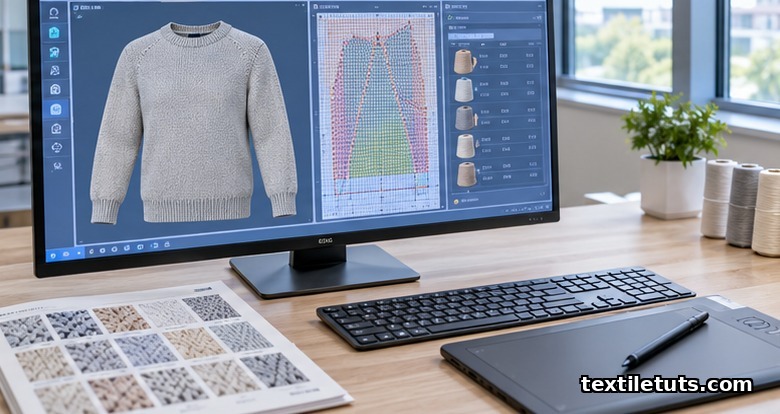
- Shima Seiki SDS-ONE APEX. An integrated CAD/CAM suite that converts a 3D garment model into machine code, simulates the knit before production, and outputs WHOLEGARMENT-ready files. The simulation alone can cut sample-making time by 40 percent.
- Stoll M1 pattern software. Generates stitch patterns, calculates yarn consumption, and exports programs for the CMS and ADF machine families. Yarn consumption predictions typically fall within 2 to 3 percent of actual knit yardage.
- Generic knit CAD (WGS, Designaknit). Smaller mills and design studios use these for pattern libraries and stitch simulation without committing to a single machine brand.
The key technical step is the conversion from a vector or 3D design to a stitch-by-stitch pattern file. Modern software does this automatically, but pattern optimization (minimizing floats, balancing tuck-and-miss sequences) still requires a trained knit technician to review the output before production.
WHOLEGARMENT and Seamless Knitting Productivity
Seamless knitting is the highest-profile application of knitting automation, and the productivity numbers are concrete. A WHOLEGARMENT machine can knit an adult sweater body in 25 to 35 minutes depending on gauge and stitch complexity, while a cut-and-sew equivalent requires knitting separate panels, cutting, linking, and sewing, a process that typically takes 90 to 120 minutes of combined labor per garment.
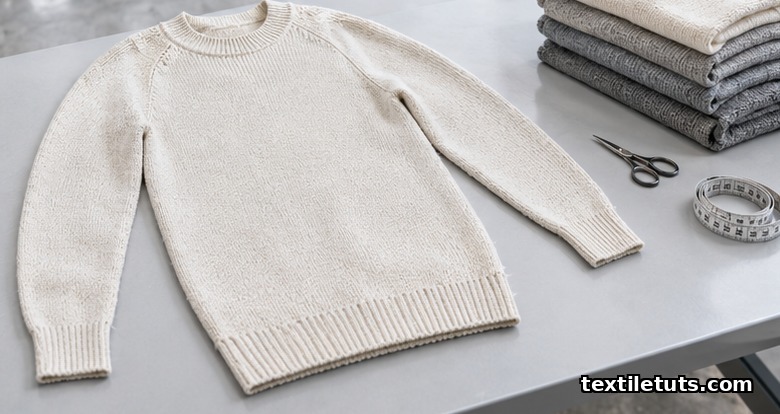
The savings come from three places:
- Eliminated seaming. Side seams, sleeve joins, and collar links disappear because the four-needle-bed structure knits them in place.
- Reduced yarn waste. Knitting to shape removes the 12 to 18 percent fabric loss typical of cut-and-sew production from knitted panels.
- Lower inventory. Yarn is the only raw material on the floor, and finished garments drop into a bin rather than waiting for assembly lines.
The trade-off is throughput versus flexibility. WHOLEGARMENT machines produce one garment at a time, while a 30-inch circular knitting machine produces fabric at 1,200 courses per minute for cut-and-sew production at far lower unit cost when the style volume is high enough.
Productivity Numbers from Real Mills
Independent measurements published in peer-reviewed knitting research show the following productivity ranges for comparable plain-jersey fabrics:
| Machine Type | Output (m/hr) | Stitch Length Precision | Labor (min/kg) |
|---|---|---|---|
| Manual V-bed (E10, 180 cm bed) | 0.6 to 0.9 | ±0.10 mm | 18 to 25 |
| Semi-automatic V-bed (E10) | 1.0 to 1.3 | ±0.05 mm | 10 to 14 |
| Computerized flat (E14) | 1.4 to 2.2 | ±0.02 mm | 4 to 7 |
| WHOLEGARMENT four-bed (E14) | 0.9 to 1.4 (garments) | ±0.02 mm | 2 to 4 |
Stitch length precision matters because it directly controls fabric GSM and dimensional stability. A 0.02 mm tolerance means a target GSM of 180 lands within ±3 percent, while a 0.10 mm tolerance can swing the same fabric anywhere between 165 and 195 GSM, which is enough to fail an AATCC TM 135 dimensional-change specification on the first wash.
Quality Control in Automated Knitting
Automation also improves the testing side. Inline cameras using image-processing algorithms can detect a dropped stitch within one course and halt the machine, preventing a defect that would otherwise consume 10 to 30 meters of fabric before being caught by an end-of-roll inspector.
For finished fabric testing, automated knitting operations typically run ASTM D3786/D3786M for bursting strength (the relevant test for knitted fabrics, since they fail by multiaxial stress rather than simple tensile load) and ISO 8388 fabric-type classification on every production lot. AATCC TM 135 dimensional-change tests are run on the first lot of each new style before bulk production releases.
Common Challenges in Adopting Knitting Automation
Three challenges dominate real adoption decisions.
- Capital cost. A modern computerized flat knitting machine costs 4 to 8 times a comparable manual V-bed, and a WHOLEGARMENT system can cost 8 to 12 times as much. The payback calculation depends on style volume, labor cost in the local market, and the price premium seamless garments can command.
- Programmer training. Automated machines need operators who understand CAD/CAM, pattern logic, and machine mechanics. Most mills report a 6 to 12 month training period before a new programmer reaches full throughput.
- Small-lot economics. Programming and set-up time is a fixed cost. A 50-piece order costs nearly the same to set up as a 5,000-piece order, so the economics favor brands producing medium to large runs of each style.
For Bangladesh, Vietnam, and similar knit composite hubs, automation decisions tend to focus on cutting rather than knitting, because the bottleneck is the cut-and-sew line. For European and Japanese mills serving premium and seamless markets, the bottleneck is the knitting machine itself, which is where automation investment has concentrated.
Frequently Asked Questions
What does a computerized knitting machine do that a manual one cannot?
A computerized knitting machine switches needles, yarns, and stitch types automatically across every course according to a digital pattern file, while a manual V-bed requires a hand operator to move yarn carriers, change ratchets, and select needles mechanically for each design change. The practical result is that a computerized machine can change from one pattern to another in under five minutes without a technician touching the bed, while a manual changeover typically takes 20 to 45 minutes.
Is seamless knitting really more sustainable than cut-and-sew?
Seamless knitting reduces post-knit yarn waste by roughly 12 to 18 percent because fabric is produced to shape rather than cut from a rectangular blank, and it eliminates the linking and seaming steps that consume additional yarn. A life-cycle assessment of WHOLEGARMENT production published in peer-reviewed textile research found 14 to 19 percent lower total energy use per garment compared to cut-and-sew equivalents at comparable style volumes.
How long does it take to train a knit CAD programmer?
A textile engineer or experienced knitting technician typically needs 6 to 12 months of full-time work on a specific CAD platform (SDS-ONE APEX, Stoll M1, or similar) before reaching the level where they can produce production-ready pattern files without senior review. Designers new to knitting but familiar with garment construction can become productive in 3 to 6 months if paired with a knitting mentor.
Can small knitting factories afford knitting automation?
Second-hand computerized flat machines from European mills often sell for 30 to 50 percent of new price, which puts the entry cost for a 14-gauge E14 computerized V-bed into the same range as a new manual machine once financing is factored in. Used equipment is the most common route for small factories in Bangladesh, India, and Turkey to enter knitting automation, with the main hidden cost being spare parts and service contracts rather than the purchase itself.
Does knitting automation eliminate knitting jobs?
Automation shifts the job mix rather than eliminating it. Manual knitting machine operators decline as a share of the workforce, while demand rises for CAD programmers, machine technicians, and process engineers. Mills that have automated fully report roughly 40 percent lower total headcount per kilogram of fabric produced but a 60 to 80 percent higher proportion of technical staff among remaining employees.
References
- International Organization for Standardization. ISO 8388:1998 Knitted fabrics — Types — Vocabulary. ISO. Defines the classification of weft and warp knitted fabric structures used in production data.
- International Organization for Standardization. ISO 4921:2012 Knitting — Basic concepts — Vocabulary. ISO. Sets the standard terminology for stitch types, courses, wales, and machine elements cited throughout automation documentation.
- ASTM International. ASTM D3786/D3786M-18 Standard Test Method for Bursting Strength of Textile Fabrics. ASTM. The standard quality control test for knitted fabric strength used by automated mills.
- American Association of Textile Chemists and Colorists. AATCC Test Method 135-2018 Dimensional Changes of Fabrics After Home Laundering. AATCC. The dimensional stability test referenced in production release procedures.
- Spencer, D. J. Knitting Technology: A Comprehensive Handbook and Practical Guide. 3rd ed., Woodhead Publishing. The standard textile-engineering textbook on weft and warp knitting machine mechanics, including CNC chapters.
- Shima Seiki Ltd. WHOLEGARMENT Technical Reference Manual. Manufacturer technical reference for four-needle-bed seamless knitting systems.
- ResearchGate. Computerized Flat Knitting Technology: A Review of Recent Advances. Peer-reviewed review of CNC flat knitting hardware, software, and productivity benchmarks.
This article is the working reference for automation in knitting. Editorial by Iftay Khairul Alam, TextileTuts. Sources: ISO 8388:1998, ISO 4921:2012, ASTM D3786/D3786M-18, AATCC TM 135, Spencer (Woodhead), and Shima Seiki technical references as cited.


