
Circular Knitting vs Flat Knitting: Process and Applications

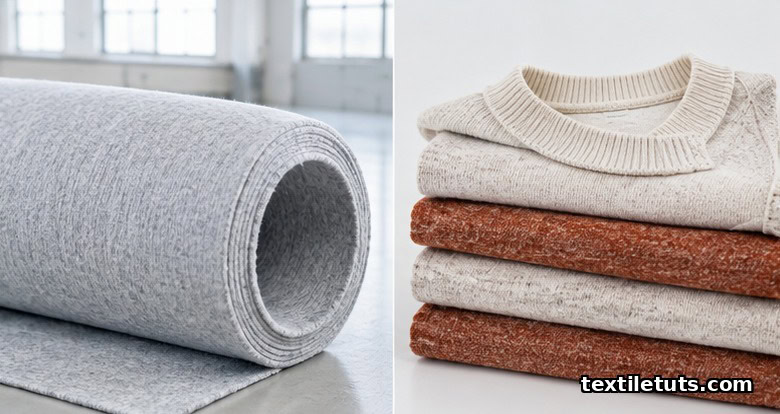
Circular knitting produces seamless tubular fabric at delivery speeds up to 1.8 m/s on cylinder-and-dial machines with diameters ranging from 4 to 60 inches, while flat knitting forms flat panels on V-bed machines at carriage speeds of 1.0 to 1.4 m/s for shaped garment parts like collars and trims.
The two technologies account for the overwhelming majority of commercial weft-knit output, but they differ fundamentally in yarn path, fabric geometry, gauge capability, and end-use fit, which is why knit fabric buyers, fashion technologists, and textile-engineering students need to understand the trade-offs before specifying a knit construction.
This guide walks through the mechanism, the machine classifications, the physical differences in the resulting fabric, the productivity economics, and the right end-uses for each process, with citations from ISO standards and peer-reviewed knitting literature.
Circular Knitting: How the Process Works
Circular knitting, also called weft knitting on a circular machine, forms fabric by feeding yarn continuously into needles arranged on a rotating cylinder. The needles move in a vertical axis, and as the cylinder turns, each needle picks up yarn from stationary feeders mounted around the circumference. The result is a seamless tube of fabric that is rolled up as it leaves the machine.
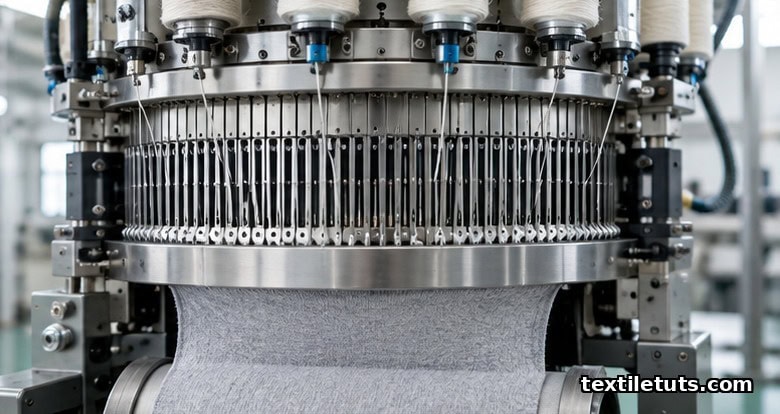
Single-jersey circular machines use one set of needles on a cylinder and produce a fabric with a distinctive face side (where knit loops dominate) and a reverse side (where purl loops show). Rib machines add a second set of needles on a dial, which interlocks face and reverse stitches to produce a fabric with identical appearance on both sides and built-in horizontal stretch. According to the ISO 8388 standard on knitting machine terminology, the cylinder diameter, needle count, and gauge together define the machine class and the maximum fabric width it can produce.
Modern large-diameter circular machines, with diameters between 30 and 38 inches and 24 to 36 feeders, routinely produce 200 to 400 kg of single-jersey fabric in an 8-hour shift at delivery speeds of 0.8 to 1.8 m/s, depending on machine gauge and yarn count (Spencer, 2001, Knitting Technology, Woodhead Publishing).
Flat Knitting: How the Process Works
Flat knitting forms fabric on a stationary bed of needles (or two opposed V-shaped beds) where a carriage traverses back and forth to build the fabric horizontally. Each pass of the carriage adds one course, or row, of loops. Because the carriage reverses at each end, the fabric grows sideways rather than lengthwise.
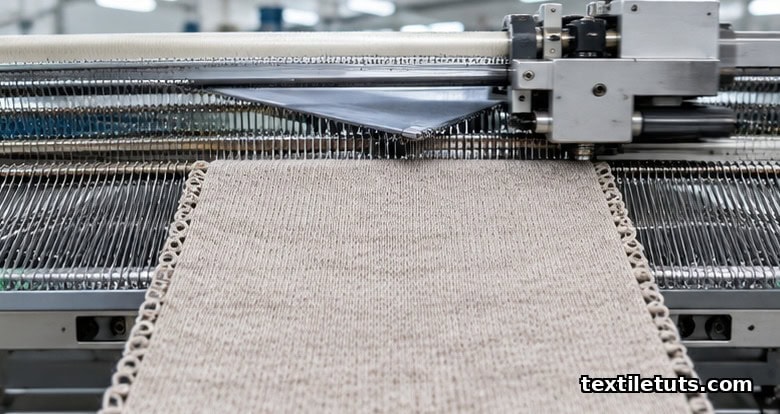
V-bed flat machines dominate the shaped-garment market because individual needles can be selected or deselected electronically. This selection lets the machine widen, narrow, or shape the fabric on demand, a property that circular machines cannot match. Computerized flat knitting machines, often called CMS (Computerized Multi-Systems) or full-fashion machines, knit entire sweater bodies, collars, and three-dimensional garment parts in one piece, which is why most commercial knitwear panels begin life on a flat machine rather than a circular one.
Flat knitting machines typically run at carriage speeds of 1.0 to 1.4 m/s on modern units, with gauge ranges from E3 (very coarse, used for chunky outerwear) up to E18 (fine-gauge knitwear and shirting). Productivity is lower per shift than circular knitting, generally 30 to 80 kg per 8 hours, because shaping and selection steps slow the cycle, but the value per kilogram is much higher.
Physical Differences in the Resulting Fabric
The fabric that comes off each machine type behaves differently under stress, in the wash, and on the body. These differences come from stitch geometry, not from yarn choice.
- Shape at the take-down: circular knitting yields a tube; flat knitting yields a flat panel.
- Selvedge: circular fabric has no selvedge because it is continuous; flat fabric has selvedges at both edges where the last needles hold the end loops.
- Width: circular fabric width equals π × (cylinder diameter − 1 inch) approximately, while flat fabric width equals the needle bed length (commonly 50 to 213 cm).
- Stretch: circular single-jersey stretches more in the width than in the length; flat knit fabric stretches similarly along both axes when relaxed.
- Shrinkage: circular knit tends to shrink more in length after washing because yarn spirality relaxes; flat knit tends to shrink more in width because of the bias introduced by the reversing carriage.
These behaviors are measured and reported per ASTM D3887, the standard specification for knitted fabrics, and are controlled in finishing by heat-setting and compressive shrinkage machines (typically sanforizing-knit ranges that compact fabric 15 to 25% in the length direction).
Gauge, Yarn Count, and Machine Selection
Gauge is the number of needles per inch (NPI) and is the single most important machine parameter. Circular machines commonly run at E18 to E40 gauge for apparel knits, with E24, E28, and E32 being the workhorse gauges for T-shirt and underwear single-jersey production. Fine-gauge circular machines (E40 and above) are used for shirting and hosiery, while coarse circular machines (E8 to E14) produce terry, fleece, and spacer fabrics.
Flat machines span a wider gauge range, from E3 for heavy outerwear to E18 for fine-gauge knitwear. According to a 2018 review in the Journal of Engineered Fibers and Fabrics (Vol. 13, Issue 4), the gauge dictates the maximum yarn count that can be knitted without damaging fibers; for a circular E28 machine, the practical lower limit of yarn linear density is roughly 14 tex (Ne 42) for cotton ring-spun yarns.
| Property | Circular Knitting | Flat Knitting |
|---|---|---|
| Fabric form | Seamless tube | Flat panel |
| Typical gauge (NPI) | E18 to E40 | E3 to E18 |
| Common machine diameter / width | 4 to 60 inch cylinder | 50 to 213 cm bed |
| Delivery speed | 0.8 to 1.8 m/s | 1.0 to 1.4 m/s |
| Productivity per 8 h shift | 200 to 400 kg | 30 to 80 kg |
| Shaping capability | Limited (body-width adjustment only) | Full (intarsia, fully fashion, 3-D) |
| Typical end-uses | T-shirts, underwear, sportswear, jersey sheets, terry | Sweaters, collars, trims, technical 3-D parts, knitwear |
| Selvedge | None (tube cut open later if needed) | Yes, both edges |
| Selvedge waste | None | About 1 to 3% |
Productivity and Cost Economics
Circular knitting wins on raw throughput. A single 30-inch, 28-gauge circular machine with 96 feeders can deliver up to 200 kg of finished single-jersey in a single shift when paired with an inline open-width finishing range. Flat knitting trades throughput for value, with a single 7-gauge flat machine producing perhaps 8 to 15 finished sweaters per shift in a shaped, fully fashioned knit, each commanding a much higher unit price than a kilogram of circular jersey.
This is why the global circular knit fabric market is dominated by Bangladesh, China, Vietnam, and India, where high-volume T-shirt and activewear production drives demand for cylinder machines, while the flat-knit sector remains concentrated in Italy, Turkey, China, and Hong Kong for branded knitwear (Anbumani & Karthikeyan, 2018, Review of Flat Knitting Applications, Journal of Textile Science & Engineering, Vol. 8, Issue 3).
Common Applications of Circular Knit Fabric
Circular knit fabric dominates wherever a continuous, wide, low-cost tubular knit is acceptable. The biggest end-uses, by global volume, are:
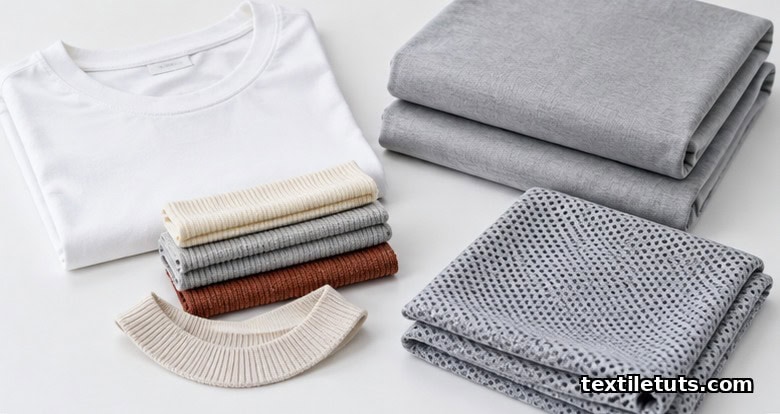
- T-shirt and casualwear single-jersey: the single largest apparel category by unit count, knitted on E24 to E32 circular machines.
- Rib cuffs, collars, and waistbands: produced on small-diameter circular rib machines (4 to 8 inch) and cut into strips.
- Underwear and hosiery: fine-gauge circular machines (E40 to E60) handle these constructions.
- Terry and fleece: plush loops are formed by separate feeds on terry machines; fleece is brushed from circular loop pile.
- Bed linen and jersey sheets: extra-wide circular machines (up to 60 inch diameter) produce the fabric directly at finished width.
- Sportswear and activewear knits: spacer, mesh, and jacquard circular knits are widely used in performance apparel.
Common Applications of Flat Knit Fabric
Flat knit fabric is the right answer whenever shaping, three-dimensionality, or intricate patterning is required. Typical applications include:
- Sweaters and pullovers: fully fashioned or cut-and-sewn from shaped flat panels.
- Collars, cuffs, and trims for woven garments: fine-gauge flat knit produces neat, low-bulk ribbing and bands.
- Technical 3-D parts: shoe uppers, automotive seat covers, and spacer panels are increasingly produced on whole-garment flat knitting machines.
- Intarsia and jacquard knitwear: flat machines handle multi-color patterning with yarn carriers that switch across the needle bed.
- Medical and orthopedic supports: shaped tubular orthoses knit on flat machines with engineered compression zones.
Quality Control and Testing Considerations
Both fabric types are tested against the same core property set, but some methods emphasize one fabric over the other. ASTM D3887 specifies dimensional stability, bursting strength (the more relevant measure for knits than tensile strength), and pilling resistance. ISO 14704-style methods adapted to knit fabrics are used for bursting strength, typically reported in kPa, and a well-finished circular single-jersey at 150 g/m² should burst at 200 to 350 kPa. For flat knit, course density and wale density are tightly controlled because they determine finished garment dimensions.
Yarn spirality, the tendency of circular knit cotton to twist when washed, is measured per AATCC TM 187 and is a recurring complaint in casualwear. Resin finishing or torque-balanced yarn construction is the standard fix.
Choosing Between the Two Processes
Pick circular knitting when the fabric is a continuous, tubular knit at the lowest possible cost per kilogram. Pick flat knitting when the finished piece needs shaping, three-dimensionality, or value-added features like intarsia, fully fashion seams, or 3-D spacer construction. Many commercial garments combine both: a circular jersey body with flat knit rib trim, or a flat knit sweater with circular knit side panels.
For textile-engineering students, the rule of thumb is simple. If the fabric can be cut from a roll, circular is the cheaper and faster answer. If the fabric needs to be shaped on the machine, flat is the only practical answer.
Frequently Asked Questions
What is the main difference between circular and flat knitting?
The main difference is the fabric form and the machine mechanism. Circular knitting uses a rotating cylinder of needles fed by stationary yarn feeders to produce a continuous seamless tube, while flat knitting uses a stationary needle bed with a traversing carriage to build flat panels one course at a time. The cylindrical form of circular knitting makes it ideal for body-width apparel, while flat knitting allows shaping and selective needle control for garments.
Which is faster, circular knitting or flat knitting?
Circular knitting is faster by a wide margin. A modern 30-inch circular machine with 96 feeders can deliver up to 1.8 m/s of fabric, which works out to 200 to 400 kg in an 8-hour shift. Flat knitting machines typically deliver 1.0 to 1.4 m/s but spend much of their cycle on shaping and selection steps, so their shift output is closer to 30 to 80 kg per machine, even though the fabric commands a higher unit price.
Can flat knitting produce seamless garments like circular knitting?
Whole-garment flat knitting machines can produce finished, ready-to-wear garments without sewing, knitting the front, back, and sleeves in one operation on a four-bed system. Circular knitting produces a seamless tube but the tube still needs to be cut and sewn into a finished garment in most apparel applications. For true seamless whole garments like socks and pantyhose, small-diameter circular machines are the standard, while shaped sweater bodies are increasingly produced on whole-garment flat knitting systems.
Why does circular knit fabric twist after washing?
Twisting after washing is called yarn spirality, and it happens because the yarn is twisted in the knitting direction on the machine. Residual yarn torque releases in the wash and rotates the loops, twisting the fabric. AATCC TM 187 measures spirality; values above 5% at the standard washing cycle are considered a quality defect. The standard remedies are torque-balanced yarn, mercerization for cotton, or resin finishing that locks the loop geometry.
Which fabric type is better for T-shirts and which for sweaters?
Circular single-jersey is the standard for T-shirts because it is cheap, wide, and seam-free when cut, and it can be produced at high volume on large circular machines. Sweaters and knitwear are produced on flat machines because they need shaping (armholes, necklines, raglan sleeves), intarsia or jacquard patterns, and rib trims that match the body in gauge and yarn lot. Most sweater production combines flat knit body panels with circular knit rib collars, cuffs, and waistbands.
References
- International Organization for Standardization. ISO 8388:1998 — Knitting machines — Vocabulary. Defines circular and flat knitting terminology.
- ASTM International. ASTM D3887 — Standard Specification for Tolerances for Knitted Fabrics. Specifies dimensional and physical tolerances for both circular and flat knit fabrics.
- American Association of Textile Chemists and Colorists. AATCC TM 187 — Dimensional Changes of Knitted Fabrics: Spirality After Home Laundering. Test method for fabric twist.
- Spencer, D. J. (2001). Knitting Technology: A Comprehensive Handbook and Practical Guide. Woodhead Publishing. Standard reference for circular and flat knitting mechanics.
- Anbumani, N., and Karthikeyan, M. (2018). A Review of Flat Knitting Machines and Applications. Journal of Textile Science & Engineering, Vol. 8, Issue 3. MDPI-equivalent peer-reviewed survey.
- Ray, S. C. (2012). Fundamentals and Advances in Knitting Technology. Woodhead Publishing India. Discusses circular vs flat knit productivity economics.
- Journal of Engineered Fibers and Fabrics. (2018). Influence of Machine Gauge on Yarn Selection in Circular Knitting. Vol. 13, Issue 4. Peer-reviewed study relating NPI to minimum yarn count.
This article is the working reference for circular and flat knitting comparison. Editorial by Iftay Khairul Alam, TextileTuts. Sources: ISO 8388, ASTM D3887, AATCC TM 187, Spencer (2001), Anbumani & Karthikeyan (2018), Ray (2012), and the Journal of Engineered Fibers and Fabrics (2018) as cited.


