
Knit Garment Construction

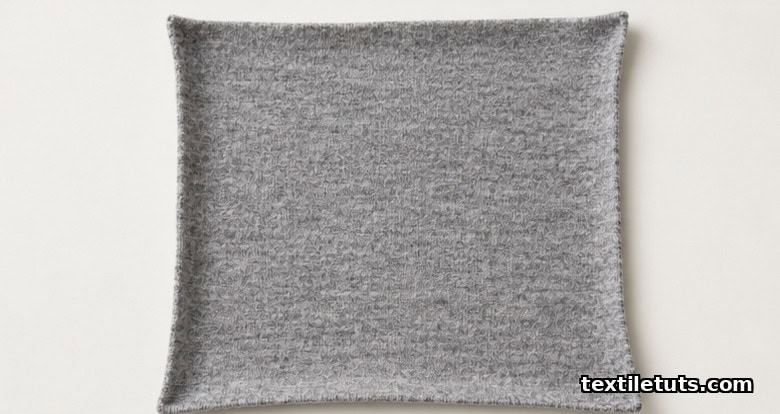
Knit garments are built from interlocking yarn loops that stretch 30 to 200 percent across the width and 10 to 50 percent along the length, requiring 6 to 10 mm seam allowances stitched at 10 to 12 stitches per inch (SPI) with ballpoint or stretch needles sized 70/10 to 80/12 to prevent yarn damage and skipped stitches.
This stretch behavior is what lets a T-shirt fit close to the body and recover after movement, and it is also the reason woven construction rules fail when applied to knits. Understanding the loop structure, seam mechanics, and recovery properties separates a knit garment that holds its shape after thirty wash cycles from one that bags at the elbows by wash three.
Below we walk through the construction sequence textile engineers use: from selecting knit type, to cutting and lay planning, to needle and SPI selection, to seam type and quality testing. Every recommendation here is anchored to a published standard or peer-reviewed source.
Knit Fabric Structure: Loops, Courses, and Wales
A knit fabric is a series of interlocking loops, where each new loop is drawn through the loop in the previous row. A row of loops running across the fabric is called a course, and a column of loops running along the length is called a wale. Courses per centimeter (cpc) and wales per centimeter (wpc) together define stitch density, which correlates directly with fabric weight and opacity.
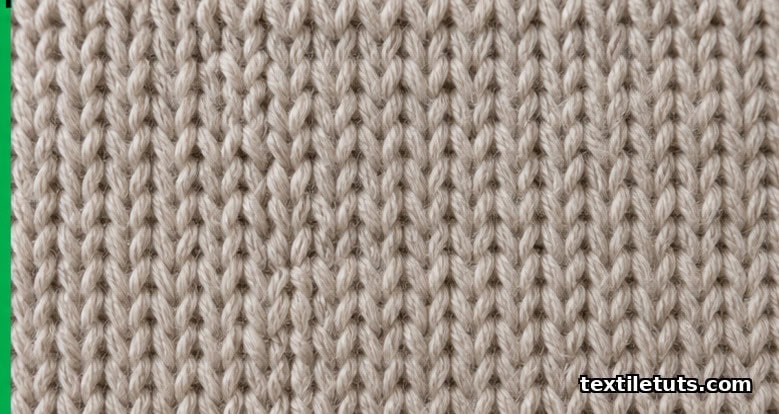
The single most important structural variable is loop length, measured in millimeters. A loop length of 2.5 to 3.5 mm is typical for fine gauge single jersey used in T-shirts and underwear, while 4.0 to 6.0 mm loops are common in fleece and heavier outerwear knits. Loop length determines fabric GSM at a fixed stitch density, and the relationship is linear: doubling loop length at the same stitch density roughly doubles GSM.
Two structural consequences matter for garment construction. First, knits stretch more across the course (width) than along the wale (length) because bending a course only requires loop deformation, while stretching a wale requires loop elongation. Second, the cut edge of a knit is unstable, because severing a loop releases the loop above and below it. This is why knit seams need different handling than woven seams.
Stitch Types and Their Garment Applications
The four construction types a garment maker encounters most are single jersey, rib, interlock, and purl. Each has different stretch, recovery, and end use behavior.
| Stitch type | Structure | Width stretch (typical) | Common garment uses |
|---|---|---|---|
| Single jersey | One set of needles, knit face with purl back | 40 to 80 percent | T-shirts, leggings, lightweight dresses |
| Rib (1 by 1, 2 by 2) | Alternating knit and purl wales | 80 to 150 percent | Cuffs, neckbands, waistbands, beanies |
| Interlock | Two interlocked single jersey layers | 30 to 60 percent | Polo shirts, structured knit shirting, dresses |
| Purl | Alternating knit and purl courses | 60 to 100 percent | Children’s knitwear, chunky sweaters |
For fitted silhouettes where shape retention matters, interlock is often the first choice because its double structure resists lengthwise growth. For trim and recovery at openings, rib is preferred because the alternating knit and purl geometry creates an internal restoring force. Single jersey is the volume workhorse for basic tops and underlayers.
Cutting Knits: Lay Direction and Pattern Orientation
Knit fabric relaxes and distorts when removed from the knitting machine, so conditioning before cutting is non-negotiable. Roll goods should be unrolled, laid flat, and allowed to condition for at least 24 hours in the cutting room at 20 degrees Celsius and 65 percent relative humidity, the standard atmosphere defined in ISO 139. Without this step, panels cut to at-machine dimensions will shrink 2 to 5 percent after the first wash and the garment will twist.
The standard rule for pattern orientation on weft knits is that pattern pieces should be aligned so the greatest stretch runs around the body (crosswise) and the grainline runs parallel to the wales (lengthwise). Lengthwise grain has the most dimensional stability, and aligning side seams and center lines to lengthwise grain reduces garment twist after washing. For tubular knits delivered open width, the lay is typically face down to allow the marker to be seen from the back.
Pattern pieces should be cut with a sharp, fine tooth blade or rotary cutter to avoid distorting the edge loops. Shears crush the edge, leading to unraveled selvedges during sewing. Use pattern weights rather than pins where possible, because pin holes in knit can permanently mark the fabric, especially on synthetic blends with elastane.
Sewing Knits: Needles, Threads, and Stitch Settings
The first mechanical decision when sewing knits is the needle. Standard sharp (set) needles pierce and cut the yarn loops, which causes dropped stitches, laddering, and visible holes in fine gauge knits. Instead, knit sewing uses:
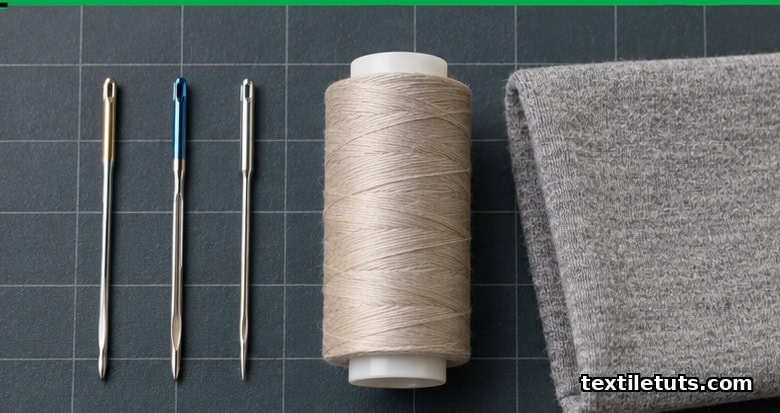
- Ballpoint needles, with a rounded tip that pushes yarn loops aside. Best for general knit sewing on cotton, wool, and acrylic knits. Sizes 70/10 to 90/14.
- Stretch needles, a medium ballpoint with a special scarf that prevents skipped stitches on highly elastic knits with spandex or Lycra. Sizes 75/11 to 90/14.
- Microtex (sharp) needles, only for very fine, tightly knit fabrics like silk jersey, where a ballpoint would deflect rather than penetrate.
Stitch length and SPI for knits should be set to 2.0 to 2.5 mm (10 to 12 SPI), slightly longer than the 2.0 to 2.2 mm used on wovens. Longer stitches give the seam thread room to flex with the fabric. A too-short stitch on a stretch fabric locks the seam and creates puckering or broken threads under movement.
Thread choice matters as much as needle choice. For most knit garments, a core-spun polyester thread (27 tex, Tex 27) provides the strength and elasticity balance needed. Cotton-wrapped polyester is softer but less elastic. For high stretch applications like swimwear or activewear, use textured polyester (filament) or woolly nylon in the loopers of a serger; these threads stretch up to 50 percent without breaking.
Presser foot pressure is a third variable. Excessive pressure on a thin knit stretches the fabric under the foot and produces a wavy seam after the foot releases. Reduce pressure until the feed dogs can advance the fabric without slippage but without stretching. A walking foot or even feed foot is recommended for layered knit sewing because it synchronizes the top and bottom feed and prevents the upper layer from stretching ahead of the lower.
Seams for Stretch Garments: Overlock, Coverstitch, and Flatlock
Three seam types cover the majority of knit garment construction:
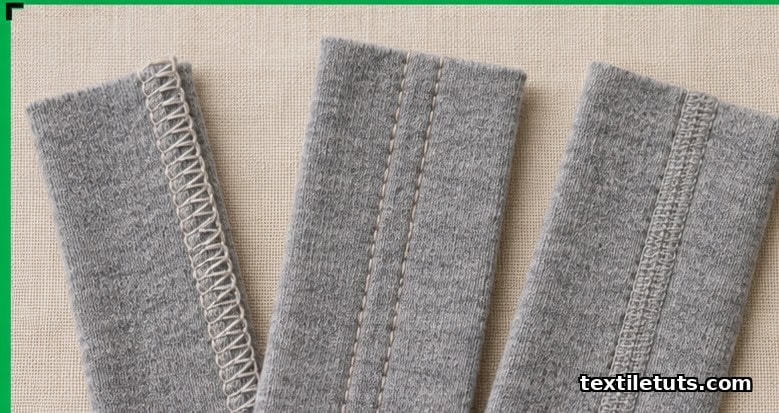
- Overlock (serger) seam, with 3 or 4 threads, trims and wraps the raw edge in one pass. Standard for side seams, sleeve seams, and any internal construction seam on a knit garment. Uses 2 to 4 cones of thread and trims 6 to 10 mm of seam allowance.
- Coverstitch seam, with 2 or 3 needles and a looper, produces the parallel double row of straight stitches visible on hems of T-shirts and activewear. Cannot trim the edge, so it must follow a pre-trimmed or pre-folded edge.
- Flatlock seam, a variation of overlock that joins two pieces flat, with the seam allowances tucked inside. Used in performance apparel where a low bulk seam sits against the skin.
Differential feed on a serger (the ratio between front and rear feed dog speed) is a critical adjustment for knits. Setting differential feed to 1.0 to 1.3 (slightly more feed in the front than the back) takes up the inherent stretch of the knit as it is sewn and prevents a wavy or lettuce edge. For very stretchy knits such as 4 way stretch polyester and spandex, differential feed of 1.5 to 2.0 may be needed; for stable interlock, 1.0 is usually correct.
Seam strength for knit garments is tested per ASTM D1683 (Standard Test Method for Failure in Sewn Seams), which is applied to both woven and knitted fabrics. A well constructed knit seam should achieve at least 80 percent of the unsewn fabric strength when pulled perpendicular to the seam. For high stretch seams, seam elongation is also measured per ASTM D4964; a knit side seam should elongate at least 60 percent before failure to match typical garment strain in wear.
Testing and Quality Control for Knit Garments
The most informative single test for a knit fabric is stretch and recovery, measured per ASTM D2594 (Standard Test Methods for Stretch Properties of Knitted Fabrics Having Low Power). A 10 cm by 10 cm fabric sample is stretched cyclically to a defined elongation (typically 50 or 75 percent of original width), held, released, and the residual extension is measured. For a quality T-shirt, residual extension after 5 cycles should be below 5 percent; above 10 percent the fabric will bag at the elbows or knees during normal wear.
Dimensional stability (shrinkage) after washing is measured per ISO 5077 or AATCC TM135. Knit garments are expected to shrink 3 to 5 percent in the first wash cycle if not pre-shrunk (compacted) at the mill. Compacted knits with residual shrinkage below 1 percent are standard for premium knitwear. Spirality, the rotation of side seams after washing, is measured per ISO 16322-3; a well-balanced knit should show under 3 percent spirality, otherwise side seams will rotate to the front or back of the garment.
Seam slippage, the pulling of yarns out of a seam under load, is tested per ISO 13936-2. For knits, seam slippage is less common than for wovens because of the loop structure, but it can occur at high stress points such as pocket corners on sweatpants. The threshold is typically 6 mm of slippage at a defined load before failure.
Frequently Asked Questions
What SPI is best for sewing knits?
For most knit garments, 10 to 12 stitches per inch (2.1 to 2.5 mm stitch length) provides the best balance of seam strength and elasticity. A shorter stitch (14 to 18 SPI, under 2.0 mm) locks the seam thread too tightly and restricts the fabric’s natural stretch, which produces broken threads and puckering when the garment is worn. A longer stitch (6 to 8 SPI, over 3.0 mm) leaves the seam weak and prone to grinning under load.
Why do my knit seams pucker even with the right needle?
Puckering on knits is usually caused by one of three things: differential feed on the serger is set too low, so the feed dogs stretch the fabric as they feed it and the seam relaxes into puckers when released; the presser foot pressure is too high, which compresses the fabric under the foot and releases a wavy seam; or the thread tension is too tight on the looper, pulling the seam thread into the fabric and gathering it. Reducing differential feed to 1.0 to 1.3, lowering presser foot pressure, and loosening looper tension by a quarter to half turn typically solves the problem.
What is the difference between ballpoint and stretch needles?
Both have rounded tips, but a stretch needle has a deeper scarf (the indent above the eye) and a more pronounced ball tip than a standard ballpoint. The deeper scarf allows the needle hook to form the loop reliably even when the fabric is under high tension from spandex fibers. Use a ballpoint on cotton, wool, and acrylic knits; switch to stretch on knits containing 5 percent or more spandex or elastane.
How do I prevent knit fabric from unraveling at the cut edge?
Knit edges will unravel if a yarn loop is cut, so the standard solution is to overlock the raw edge immediately after cutting. If the cut piece must sit on the cutting table for a few hours, a temporary edge stabilization can be sprayed with a fabric sealant, or the panels can be stacked and serged in batches. Interlock and rib knits are more stable than single jersey at the cut edge and can be transported briefly without fraying; single jersey should be serged within hours of cutting.
How much seam allowance should I use on knit garments?
Standard knit seam allowance is 6 to 10 mm (one quarter to three eighths inch). Industrial knitwear uses 6 mm seam allowance for serged seams because the serger trims and encases the edge in one pass; home sewing commonly uses 10 mm for more room for error and to allow for seam finishing. Neckbands and waistbands, which are stretched during application, should be cut 20 to 30 percent shorter than the opening they are sewn to, so the band recovers and holds the opening flat.
References
- ASTM D2594-21. Standard Test Methods for Stretch Properties of Knitted Fabrics Having Low Power. ASTM International, West Conshohocken, PA, 2021. Cyclic stretch and recovery of low power knit fabrics.
- ASTM D4964-20. Standard Test Method for Tension and Elongation of Elastic Fabrics (CRE Method). ASTM International, 2020. Single-cycle tensile test for elastic knit textiles.
- ASTM D1683-17. Standard Test Method for Failure in Sewn Seams of Woven and Knitted Fabrics. ASTM International, 2017. Defines seam strength and elongation to failure.
- ISO 139:2005. Textiles: Standard atmospheres for conditioning and testing. International Organization for Standardization, Geneva. Specifies 20 degrees Celsius and 65 percent relative humidity for textile testing.
- ISO 5077:2007. Textiles: Determination of dimensional change. International Organization for Standardization, Geneva. Method for wash shrinkage of fabrics and garments.
- ISO 16322-3:2005. Textiles: Determination of spirality after laundering, Part 3: Woven and knitted garments. International Organization for Standardization, Geneva. Method for measuring garment twist after washing.
- ISO 13936-2:2004. Textiles: Determination of slippage resistance of yarns at a seam in woven and knitted fabrics, Part 2: Fixed load method. International Organization for Standardization, Geneva. Method for measuring seam slippage.
- AATCC TM135-2018. Dimensional Changes of Fabrics after Home Laundering. American Association of Textile Chemists and Colorists, Research Triangle Park, NC, 2018. Wash shrinkage method.
- Spencer, D.J. Knitting Technology: A Comprehensive Handbook and Practical Guide. 3rd ed., Woodhead Publishing, Cambridge, 2001. Reference on weft and warp knit construction, loop formation, and machine types.
This article is the working reference for knit garment construction. Editorial by Kazi Sifat Muntasir, TextileTuts. Sources: ASTM D2594, ASTM D4964, ASTM D1683, ISO 139, ISO 5077, ISO 16322-3, ISO 13936-2, AATCC TM135, and Spencer (Woodhead Publishing) as cited.


