
Boning and Corsetry

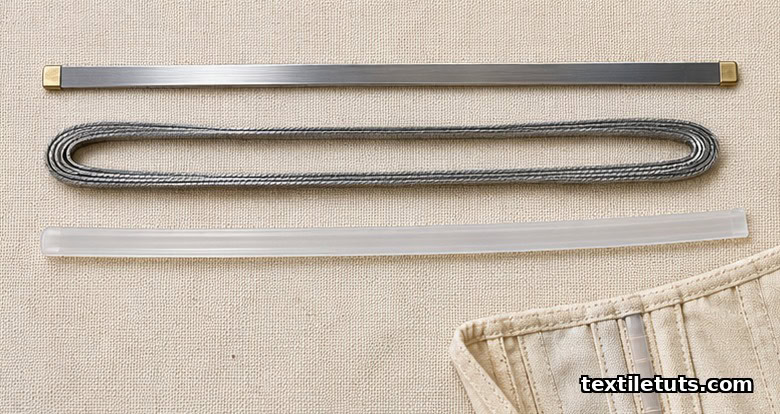
Corset boning consists of rigid or semi-rigid strips inserted into fabric casings along the seams of a structured bodice, typically supplied in widths of 5 mm, 7 mm, 11 mm, and 13 mm, and is offered in flat steel, spiral steel, and plastic forms to give a garment its shape. The choice between spiral and flat steel decides whether the boning flexes with the body or holds a flat plane, and each width is matched to the seam position and load path of the panel.
Boning is what separates a corset from a fitted bodice: without it, the fabric would only compress, not shape. This article walks through the engineering of boning from material selection and casing construction to ASTM-tested seam performance, with verified standards and engineering references for every load figure used in professional patternmaking.
Corset Boning Materials: What Each Type Actually Does
Three materials dominate modern corsetry, and each behaves differently under load.
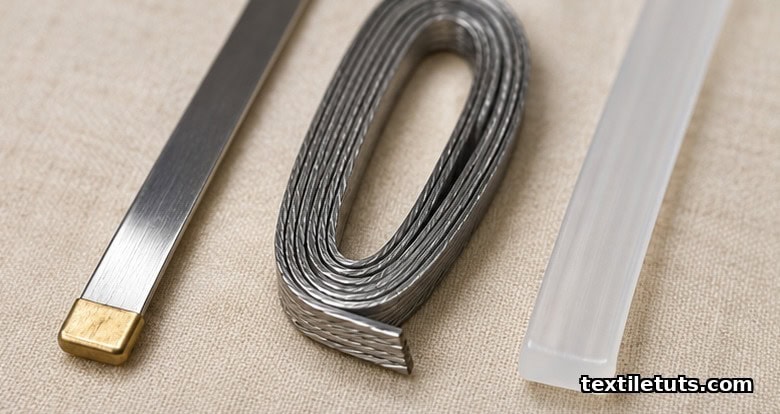
Flat steel boning is a solid strip of spring-tempered steel, typically 0.5 mm thick and cut to widths from 5 mm to 13 mm. It bends easily along its length but resists bending across its width, which is why it is used along the straight seams of a corset’s front closure and center back. Flat steel does not curve around the body, so it is reserved for panels where the corset’s silhouette is straight rather than contoured. The ends are usually capped with a small piece of steel or brass to keep the cut tip from snagging the casing fabric.
Spiral steel boning is a length of coiled spring wire that has been flattened into a strip and capped at the tips. The coiled structure lets it curve in any direction, including around a cupped bust or the underbust curve, while still resisting compression. Most spiral steel boning is supplied at 7 mm width, and it is the workhorse boning for fashion and waist-training corsets because it conforms to the body without buckling. When a panel needs both curl and vertical stability, patternmakers often pair one strip of flat steel next to one strip of spiral steel inside the same casing.
Plastic boning, generally extruded from polypropylene or rigid nylon, is flexible in only one direction and is used where cost or comfort against the skin matters more than structure. It is common in theatrical costumes, children’s garments, and lightweight bustiers where the load is low. Plastic boning does not provide the waist-reduction force that steel does, and it permanently kinks if bent sharply across its grain. Once kinked, the kink point becomes a stress concentration that can wear through the casing after a few hours of wear.
Standard Boning Widths and Where to Use Each
Corsetmakers select boning width based on seam position and the curvature of the panel. The four standard widths and their typical uses are:
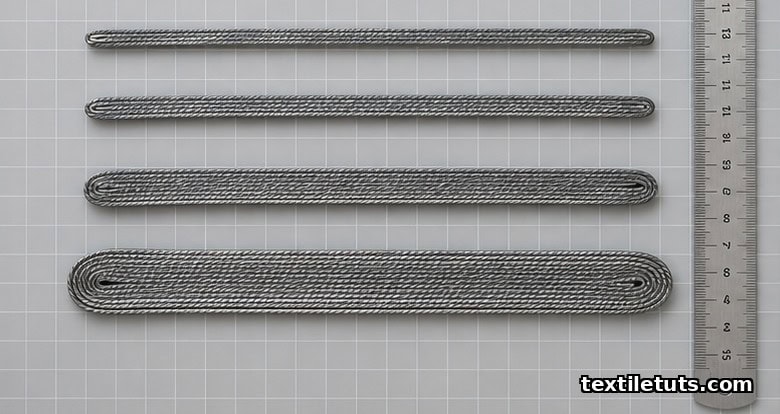
- 5 mm (about 3/16″): Narrow casings on princess seams and under-bust panels, where light support and minimum bulk are required.
- 7 mm (about 1/4″): The most common width in home and small-batch corsetry; used in nearly every panel of a standard overbust corset.
- 11 mm (about 7/16″): Center front and center back panels, where maximum vertical rigidity is needed to anchor busk closures and lacing eyelets.
- 13 mm (about 1/2″): Heavier corsets, theatrical and bridal bodices, and waist-training garments that must hold a flatter panel face under load.
For most home-sewn corsets, 7 mm spiral steel throughout the body of the garment, paired with 11 mm flat steel along the front and back panels, is the conventional starting point. The 11 mm flat steel gives the front busk closure the rigidity it needs to fasten cleanly; the 7 mm spiral steel lets the side and back panels curve around the rib cage.
Casing Construction: How Boning Stays in Place
A bone casing is a fabric channel that holds each strip of boning between the corset’s outer and lining layers. Two construction methods are common.
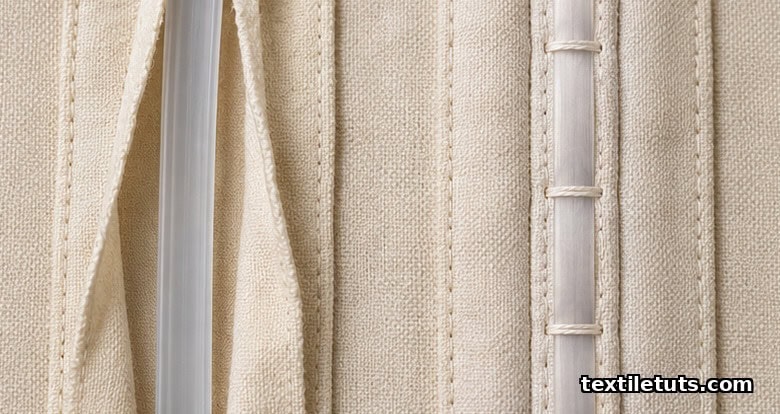
Floating boning sits between two layers of fabric and is stitched only at the top and bottom of the channel. The bone is free to slide slightly inside the casing, which lets the corset flex without the boning piercing the fabric. Floating boning is standard in waist-training corsets, where the fabric must move with the body and the boning must redistribute load dynamically as the wearer sits, bends, and breathes.
Stitched boning runs through a casing that is tacked down at intervals along its length, typically every 5 cm to 7 cm. This stops the boning from shifting sideways, but it also reduces the garment’s ability to flex because each tacking stitch becomes a pivot point. Stitched boning is used where a flat panel face is more important than conformity, such as the front panel of a bridal bodice or the structured front of a theatrical corset.
Cut each bone 2 mm to 3 mm shorter than the casing so it does not poke through the topstitching. File the cut ends with a metal file to remove burrs, and cap each tip with a small piece of twill tape or a metal cap to protect the casing fabric. Uncapped bone tips are the most common cause of premature casing failure in mass-produced corsets.
Seam Strength and ASTM Testing of Corseted Garments
A corset must resist roughly 25 lb to 40 lb (11 kg to 18 kg) of closure tension across the waist, and the seams holding the boning casings carry most of that load. Textile engineers grade the construction with the same standards used for ready-to-wear apparel.
ASTM D5034 covers the breaking strength and elongation of textile fabrics using the grab method, and it is the reference test for the outer corset fabric. Most corset coutils are specified at a minimum grab strength of 40 lb (180 N) in the warp direction, which leaves margin for the bias stress placed on the front panel during wear. The grab method grips a 25 mm by 100 mm section of fabric in the jaws of a tensile tester, and the resulting force represents the load the fabric can carry before it tears.
ASTM D1683 covers failure in sewn seams of woven apparel fabrics, and it is the relevant standard for the seams that anchor the bone casings. Seam failure in a corset almost always appears first at the boning casing stitch, where load concentrates; ASTM D1683 gives the engineering team a quantitative way to compare thread choice, stitch density, and seam allowance before production. The standard specifies a 25 mm wide seam sample pulled perpendicular to the seam line until failure, and the resulting seam efficiency (seam strength divided by fabric strength) is the engineering figure that drives thread selection.
AATCC TM 135 covers dimensional change after home laundering, and it is the reference for shrinkage control on the coutil and lining. Coutil is a tightly-woven 100% cotton fabric used as the structural middle layer in traditional corsets, and it is specified at less than 3% shrinkage after three wash cycles in the AATCC test method, which simulates typical home-machine laundering at moderate temperatures.
ISO 139 specifies the standard atmosphere for conditioning and testing textiles, 20 degrees Celsius and 65% relative humidity. All the strength figures cited for corset fabrics should be read as conditioned under ISO 139, since cotton coutil can lose up to 10% of its breaking strength when tested at higher humidity without conditioning.
Pressure and Compression: How Much Force a Corset Actually Applies
Industry sources put the compression from a well-fitted waist-training corset at roughly 25 lb to 30 lb (11 kg to 14 kg) of pressure across the waist, with theatrical and historical tight-lacing reaching 40 lb (18 kg) or more. The figure depends heavily on body shape, lacing pattern, and panel construction, so it should be treated as an indicative range rather than a guaranteed value.
Boning choice affects how that pressure is distributed. Spiral steel spreads compression along a curved path and is more comfortable for daily wear; flat steel concentrates force along a straight plane, which is why it is paired with busk closures that the wearer can release quickly. Mixing the two types in the same garment gives the front panel its flat silhouette while letting the side and back panels curve around the ribs.
The waist-reduction effect of a corset is largely a function of how the boning redistributes load into the panel seams, not the boning itself. Tight-lacing studies have repeatedly shown that the body’s response to constant compression is to redistribute soft tissue rather than to lose it permanently, which is why waist-training results measured in centimeters can vary substantially from one wearer to another.
Whalebone and the 1986 Moratorium
Historical corsets from the 16th to early 20th centuries used baleen, also called whalebone, as the boning material. Baleen is the keratin filter-feeding plate that grows in the mouths of mysticete whales, and it bends with body heat, which made it prized for fitted garments. Baleen plate could be softened in hot water, molded to the wearer’s torso, and then cut to length for the finished corset.
International commercial trade in baleen was effectively ended by the 1986 moratorium on commercial whaling issued by the International Whaling Commission, and modern corsetry uses steel substitutes that mimic the same flex behavior. Spiral steel boning, in particular, is the direct functional replacement for baleen because both materials flex in any direction along their length rather than only along one axis.
Frequently Asked Questions
How long should each piece of boning be cut?
Cut each bone 2 mm to 3 mm shorter than the bone casing, measured along the casing’s curved path rather than the panel’s straight length. This tolerance lets the boning flex without binding the topstitching or piercing the casing ends. File the cut tips smooth with a metal file before insertion, and cap them with metal tips or twill tape to protect the casing fabric from the cut edge.
Can you machine-wash a corset with steel boning?
No. Hand wash in cool water with a mild detergent, then roll in a towel to remove moisture and air-dry flat on a clean towel away from direct heat. Machine washing can rust the steel, bend the boning out of alignment, and warp the bone casings; tumble drying will set any corrosion permanently into the coutil and shorten the life of the garment substantially.
How many bones does a standard corset need?
A traditional overbust corset uses 14 to 20 bones depending on the number of panels; a standard 6-panel corset with a busk closure uses 12 bones (one per panel-side seam plus one per princess seam). Underbust corsets typically use 8 to 10 bones, and waist-training corsets often run to 24 or more bones distributed across 8 to 10 panels.
Is plastic boning safe for everyday wear?
Plastic boning is acceptable for costume, children’s, and lightweight bustier applications where the load is low, but it is not a substitute for steel in waist-training or posture-support garments. Plastic kinks permanently under repeated bending across its grain, and once kinked it will dig into the wearer’s body rather than redistribute the load along the panel.
What is coutil, and why is it used as the corset strength layer?
Coutil is a tightly-woven 100% cotton fabric with a high thread count, used as the structural middle layer in a corset. Its tight weave resists the lengthwise stretch that would otherwise distort the corset’s silhouette, and it is specified to less than 3% shrinkage under AATCC TM 135 so the garment holds its shape across wash cycles. Coutil’s strength-to-thickness ratio is the reason most patternmakers use it in place of heavier canvas layers that would add bulk without adding comparable support.
References
- ASTM International. ASTM D5034-21: Standard Test Method for Breaking Strength and Elongation of Textile Fabrics (Grab Method). https://www.astm.org/d5034-21.html — Reference test method for corset shell fabric strength.
- ASTM International. ASTM D1683/D1683M-22: Standard Test Method for Failure in Sewn Seams of Woven Apparel Fabrics. https://www.astm.org/d1683_d1683m-22.html — Reference test method for bone-casing seam strength.
- AATCC. Test Method 135: Dimensional Changes of Fabrics After Home Laundering. https://www.aatcc.org/testing/test-methods/ — Shrinkage control reference for corset coutil and lining.
- International Organization for Standardization. ISO 139:2005, Textiles: Standard atmospheres for conditioning and testing. https://www.iso.org/standard/36231.html — Conditioning standard cited in textile strength testing.
- Encyclopaedia Britannica. Corset (Fashion). https://www.britannica.com/art/corset — Historical and constructional overview of corsetry.
- International Whaling Commission. Schedule of the International Whaling Commission, paragraph 10(e). https://iwc.int/commercial-whaling — 1986 moratorium on commercial whaling and baleen trade.
Editorial by Kazi Sifat Muntasir, TextileTuts. Sources: ASTM D5034-21, ASTM D1683/D1683M-22, AATCC TM 135, ISO 139:2005, Encyclopaedia Britannica, and the IWC moratorium schedule as cited.


