
Knit Fabric Quality Control Tests

Knit fabric quality control relies on a battery of 12 to 18 standardized tests that measure shrinkage (≤5% after 5 washes per AATCC TM 135), bursting strength (100 to 800 kPa by ASTM D3786), spirality (≤5% per ISO 16322), and colorfastness (Grade 4 minimum per ISO 105-C06) before a single meter reaches a cutting table.
For mills, buying houses, and brand QC teams, a missing test step can mean rejected lots, chargebacks, and weeks of delayed shipment. Knits behave differently from wovens: they stretch, recover, and distort in ways woven cloth cannot, so the test methods and pass/fail thresholds must reflect knit-specific physics rather than borrowed woven-fabric rules.
This guide walks through the QC tests knit mills, third-party labs, and brand QA teams run every day, explains the standards behind each one, and gives the typical acceptance limits you should expect to see on a knit test report.
Why knit fabrics need their own QC framework
Woven fabric is held together by yarns interlacing at right angles. Knit fabric is held together by loops, which means it can stretch, recover, and distort in ways woven cloth cannot. A plain-weave cotton poplin tested for tensile strength on a strip is informative; a single-jersey cotton knit stretched the same way simply necks down and never breaks. The whole QC framework had to be re-invented for knits, with multi-directional bursting, spirality limits, and recovery-after-stretch numbers replacing single-direction grab strength.
The practical consequence is that knit QC is a longer checklist than woven QC. A 1,000 kg knit-fabric lot leaving a mill typically ships with 12 to 18 test results attached, and most brands will reject the lot if any single critical test misses its limit.
Dimensional stability and shrinkage (AATCC TM 135 / ISO 6330)
Shrinkage is the result buyers scrutinize most. Knit jerseys relax and contract during the first few wash cycles, and if the relaxation is not stable before cutting, every garment made from the lot ends up a size smaller than the spec sheet. The cost is charged back to the mill.
The standard method is AATCC TM 135, with ISO 6330 used for European buyers. A conditioned specimen is marked with bench marks, washed in a standardized home laundering machine using a defined cycle (typically normal at 40°C), tumble dried, then re-measured. Lengthwise and widthwise shrinkage are calculated as percentages of the original distance between marks. Most apparel specs require ≤5% shrinkage in either direction after five home-laundering cycles for general apparel, with ≤3% required for premium basics such as T-shirts and underwear.
A knit can pass AATCC TM 135 in the lab and still fail on a customer’s floor because home washers agitate differently. This is why many QC specs also call for ISO 5077 cumulative-relaxation testing on circular knits, and for a relaxation pre-shrinking (compacting) step at the finishing stage before the QC test is even run.
Bursting strength (ASTM D3786 / ISO 13938)
Knits cannot be tested for tensile strength the way wovens are, because pulling a strip of knit causes the loops to gather rather than the yarns to break. The industry uses bursting strength instead: a circular specimen is clamped and pressure is applied from below (hydraulic, by ASTM D3786) or pushed from above (pneumatic ball, by ISO 13938-2) until the fabric ruptures.
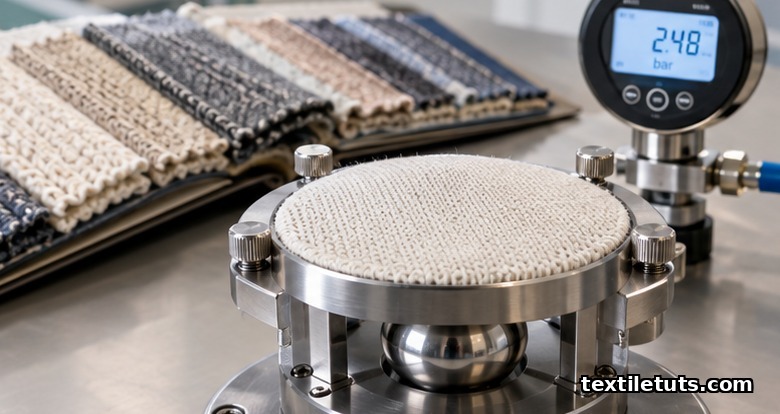
The pressure at rupture, in kilopascals (kPa), is the bursting strength. Typical acceptance limits for general apparel knit goods fall between 200 and 500 kPa; performance knits for activewear usually require 500 to 800 kPa; delicate knits such as silk jersey may run as low as 100 to 200 kPa.
Burst results also flag yarn quality problems. A burst pressure well below the expected range for a fabric’s weight and construction usually means low yarn tenacity, missed yarn count, or excessive loop length. A burst that is high but drops sharply after 5 washes points to finish loss rather than to a yarn-strength problem.
Spirality after washing (ISO 16322)
Spirality is the diagonal distortion you see when a T-shirt’s side seam drifts toward the front instead of running straight down. It happens because the wales and courses in a weft-knitted fabric are not perfectly perpendicular to each other, and residual yarn torque causes the loops to rotate after laundering.
ISO 16322 is the standard method. After a defined wash cycle (typically procedure A per ISO 6330), the specimen is laid flat and the angle between a course line and a wales line is measured, with the result expressed as a percentage. Most apparel specs allow up to 5% spirality; anything above 7% is considered a reject for fitted garments.
Spirality is largely controlled at the knitting and finishing stages. Anti-spirality devices on compactors, heat-setting of synthetic knits, and proper loop-length calibration during knitting all reduce the number before it ever reaches the lab.
Pilling resistance (ISO 12945-2 / ASTM D3512)
Pilling is the formation of tiny fiber balls on the fabric surface after abrasion. Knits pill easily because loose fiber ends are not trapped inside the structure the way they are in a tightly woven cloth. Two methods dominate QC work:
- ISO 12945-2 (Martindale): the fabric is rubbed against itself for a defined number of rubs (typically 2,000, 5,000, or 7,000), then visually graded 1 to 5 against photographic standards.
- ASTM D3512 (Random Tumble): the fabric tumbles in a chamber with cork linings for 30 minutes, then is graded against the same 1 to 5 scale.
Most apparel QC specs require Grade 3 minimum after 2,000 rubs for general wear; Grade 4 minimum is typical for school uniforms and high-end basics. Synthetic-blend knits (polyester and cotton) often fail pilling tests if the fibers are not treated with an anti-pilling finish at the dyeing stage.
Colorfastness (ISO 105 / AATCC series)
Colorfastness is tested in several sub-categories, each simulating a different real-world exposure:
- Wash fastness: ISO 105-C06 or AATCC TM 61, with shade change and staining graded 1 to 5. Most apparel specs require Grade 4 minimum on both.
- Lightfastness: ISO 105-B02 (xenon arc) or AATCC TM 16. Grade 4 minimum is typical for general apparel; Grade 5 is required for outdoor wear.
- Rub fastness (crocking): ISO 105-X12 or AATCC TM 8. Wet-rub fastness of Grade 2-3 minimum is common for deep shades, Grade 3-4 for light shades.
- Perspiration fastness: ISO 105-E04, important for sportswear and close-to-skin garments.
Reactive-dyed cotton knits (the bulk of T-shirt and underwear production) often hit Grade 4 to 5 on wash fastness when properly soaped after dyeing. Failures show up most often in deep navy, black, and turquoise shades where excess dye can re-deposit on adjacent fibers during the wash test.
Mass per unit area (ASTM D3776 / ISO 3801)
GSM, or grams per square meter, is the most quoted number on a knit QC report. ASTM D3776 and ISO 3801 describe the same procedure: cut a specimen with a known area (typically 100 cm²), weigh it, and scale up. Most knit specs accept ±5% GSM tolerance; tighter tolerances of ±3% are common for fashion knits where a 10 gsm difference changes the fabric hand noticeably.
GSM is also the anchor for many other tests. Bursting strength, course and wales density, and shrinkage limits are all expressed relative to GSM, so an incorrect GSM reading throws off every downstream check on the same report.
Course and wales density (ISO 7211-6 / ASTM D3887)
Course density (loops per cm across the fabric width) and wales density (loops per cm down the fabric length) define the structural tightness of the knit. ISO 7211-6 and ASTM D3887 describe counting loops under low magnification across a defined distance (typically 2.5 or 5 cm) and scaling to loops per cm or per inch.
Specs usually allow ±5% on each dimension. A fabric off by 10% on wales density is usually not the same fabric at all; it points to a knitting-machine set-up error at the mill and is one of the cheaper defects to catch early.
Stretch and recovery (ASTM D2594 / ISO 14704-1)
Stretch and recovery matter most for elastic knits used in underwear, sportswear, and compression garments. ASTM D2594 lays out a cycle test: a specimen is stretched to a defined elongation (often 80% of the fabric’s elongation at break), held, released, and the permanent deformation is measured after a defined recovery time.
ISO 14704-1 covers a similar procedure for elastane-containing fabrics. Common QC limits are ≤5% growth after 5 stretch-recovery cycles for general stretch knits and ≤3% for compression knits. A fabric that grows more than 5% after five cycles will visibly bag at the knees and elbows in normal wear.
Frequently Asked Questions
What is the most important QC test for knit fabrics?
Dimensional stability (AATCC TM 135 or ISO 6330) is the most consequential single test, because a fabric can pass every other check and still be rejected at the buyer if it shrinks more than the spec allows after five wash cycles. Shrinkage failure directly translates into garment size drift, which is the customer-visible defect that drives returns.
How is bursting strength measured on knits?
The most common method is ASTM D3786, the hydraulic diaphragm test. A circular fabric specimen is clamped, water is pumped under the diaphragm until the fabric bursts, and the pressure at rupture is the bursting strength in kPa. ISO 13938-2 uses a steel ball pushed through the fabric instead of hydraulic pressure, giving comparable but not identical numbers.
What shrinkage percentage is acceptable for knit fabric?
Most apparel specs allow up to 5% shrinkage in either length or width after five home-laundering cycles per AATCC TM 135. Premium basics (underwear, fitted T-shirts, school uniforms) typically require ≤3%. Anything above 7% is a near-automatic reject and usually results in a chargeback to the mill.
What causes spirality in knit fabrics?
Spirality comes from residual yarn torque in the loop structure. If the knitting machine’s loop length is set incorrectly, if the yarn carries too much twist, or if finishing does not include proper heat-setting (synthetics) or anti-spirality compacting (cotton), the loops rotate after washing and pull the side seams off-axis.
How do you test pilling resistance in knits?
The standard method is ISO 12945-2 (Martindale), which rubs the fabric against itself for a defined number of rubs (commonly 2,000 or 5,000) and grades pilling 1 to 5 against photographic standards. ASTM D3512 (Random Tumble) is the alternative used in some US labs; both methods are widely accepted by buyers.
References
- AATCC. Test Method 135: Dimensional Changes of Fabrics After Home Laundering. AATCC Technical Manual, latest edition.
- ASTM International. ASTM D3786/D3786M: Standard Test Method for Bursting Strength of Textile Fabrics, Diaphragm Bursting Strength Tester Method.
- ASTM International. ASTM D2594: Standard Test Method for Stretch Properties of Knitted Fabrics Having Low Power Stretch.
- ASTM International. ASTM D3776/D3776M: Standard Test Methods for Mass Per Unit Area (Weight) of Fabric.
- International Organization for Standardization. ISO 6330: Domestic Washing and Drying Procedures for Textile Testing.
- International Organization for Standardization. ISO 12945-2: Determination of Fabric Propensity to Surface Fuzzing and to Pilling, Part 2: Modified Martindale Method.
- International Organization for Standardization. ISO 16322: Determination of Spirality After Laundering.
- International Organization for Standardization. ISO 105-C06: Colour Fastness to Domestic and Commercial Laundering.
This article is the working reference for knit fabric quality control tests. Editorial by Sabbir Ahmed, TextileTuts. Sources: AATCC TM 135; ASTM D3786, D2594, D3776; ISO 6330, ISO 12945-2, ISO 16322, ISO 105-C06 as cited.


