
Computerized Knitting Machines

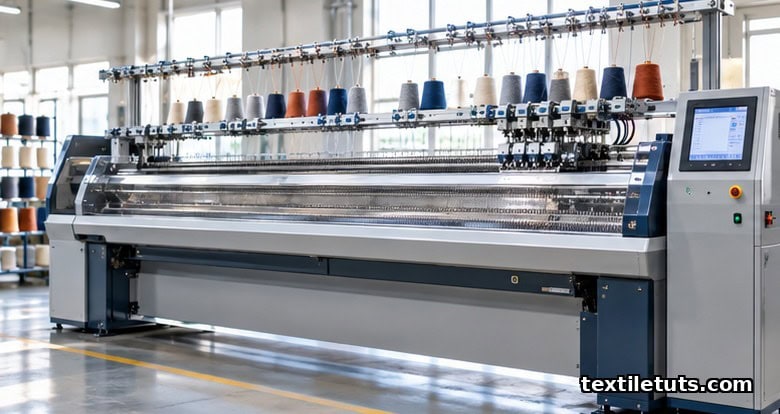
A computerized knitting machine is a flat or circular weft-knitting system in which needle selection, stitch transfer, yarn-feed timing, and pattern data are all driven by electronic controllers and servo motors rather than mechanical cam tracks, raising production speed by 30 to 60 percent and shortening pattern-change time from several hours to under 5 minutes compared with a mechanical flat knitting machine of equivalent gauge.
This shift from cam-box mechanics to digital control lets a single machine produce whole-garment (tube-knit) knits, multi-color intarsia motifs, and complex Jacquard structures that previously required multiple mechanical machines plus several hand operations, with modern gauges ranging from E3 (3 needles per inch, coarse) to E18 (fine gauge for hosiery) and pattern libraries of 50,000 or more stitch combinations.
The guide below explains how electronic needle selection, stitch transfer, and computer-controlled yarn feeders work together, compares a modern electronic flat knitting machine with its mechanical predecessor across 10 operating properties, and answers the most common questions knitting students and mill managers raise before specifying or investing in one.
How Electronic Needle Selection Works (and Why It Replaces the Cam Box)
On a mechanical flat knitting machine, every needle movement is dictated by a cam box mounted on the carriage. The cam contains cut steel tracks (cams) that physically push each needle up to knit, down to tuck, or to a non-knitting (miss) position as the carriage traverses. Changing a pattern means stopping the machine, opening the cam box, and physically swapping steel cams or rearranging pegs on a pattern drum, a process that typically takes 1 to 3 hours for a fully mechanical Jacquard or intarsia setup, plus another 30 to 60 minutes of trial knitting to verify the repeat.
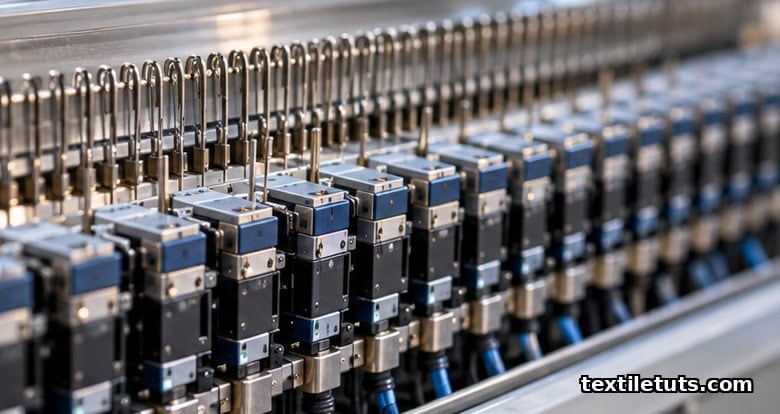
On a computerized knitting machine, the cams are replaced by individually addressable selectors. Each needle sits in a slot controlled by an electro-mechanical actuator (a piezo actuator, a solenoid, or a stepper-controlled jack), and the actuator state for every needle on every course is set by the controller before the carriage traverses. A 90 cm wide machine at E10 gauge has roughly 900 needles per bed, and each needle state is written independently, which is why the controller is usually described as needle-by-needle selection.
The pattern itself is authored in a CAD package on a PC, transferred to the machine over a network or USB stick, and stored on the controller’s hard drive. A typical library holds 50,000 to 500,000 stitch rows, and operators can recall any saved pattern, resize it across the bed width, mirror it, recolor it across the available yarn feeders, and begin knitting in under 5 minutes. ScienceDirect reviews of flat knitting technology report that this electronic needle-selection architecture is the single largest productivity lever in modern weft knitting, contributing most of the 30 to 60 percent throughput gain over cam-driven systems at equivalent rpm.
Stitch Transfer, Intarsia, and Shaped (Whole-Garment) Knitting
Stitch transfer is the operation of moving a loop from one needle to another without losing it, and it is the foundation of shaped knitting. On a computerized V-bed flat knitting machine, the front and rear needle beds are offset by half a needle pitch (the gauge), which allows stitches to be transferred sideways from a needle on the front bed to the adjacent needle on the rear bed. Electronic stitch transfer uses split needles (or transfer needles) under individual actuator control, so any loop on any needle can be moved to any other needle position on either bed within a single carriage pass.
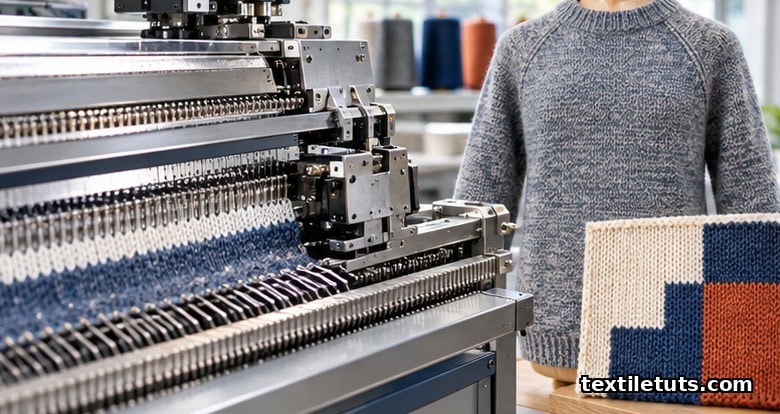
This per-needle transfer capability is what enables three classes of work that mechanical machines cannot easily reproduce:
- Intarsia motifs: Color blocks knitted from separate yarn ends fed by independently positioned yarn carriers. Because each carrier can be raised, lowered, and repositioned under computer control, multi-color intarsia with 8, 12, or 24 distinct colors becomes a single-machine operation instead of a multi-machine, hand-tailored process. Each intarsia block can be as narrow as a single needle width.
- Jacquard structures: Two or more yarns knitted selectively into the same course, producing figured patterns with floats on the back. Computerized Jacquard allows stitch-level color selection, so a motif can change color every needle if required.
- Whole-garment (tube-knit) knitting: The machine knits the front, back, and sleeves of a sweater as one continuous tube, with widening and narrowing achieved by transferring stitches between beds and casting on or off under electronic control. ResearchGate and ScienceDirect case studies of whole-garment production document labor savings of 40 to 60 percent and post-sewing waste reductions of 15 to 30 percent compared with cut-and-sew knitwear.
The shared technical requirement behind all three is the same: every needle on every bed must be addressable independently. That is the defining feature of a computerized knitting machine, and it is what a purely mechanical cam box cannot provide.
Computer-Controlled Yarn Feeders and Multi-Carrier Systems
Yarn feeding is the second function that has moved from mechanical to electronic control. A mechanical flat knitting machine typically carries 4 to 8 yarn carriers mounted on the carriage, each one a simple mechanical finger that the cam box raises and lowers. A modern computerized flat knitting machine carries 16 to 32 carriers (high-end machines expose 24 to 32 standard, with 56 available on some platforms), and each carrier is moved by a servo motor that the CAD pattern commands directly.
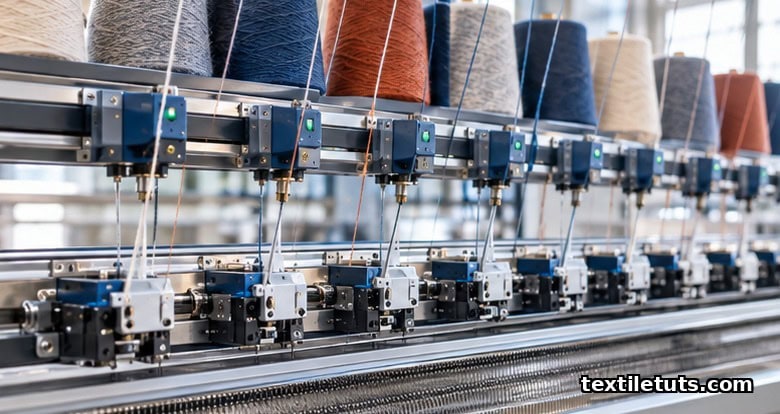
Two pieces of electronics make this work cleanly:
- Positive yarn feeders (storage feeders): Each yarn end passes through a computer-controlled feeder that meters yarn at a programmed rate (in cm/min or m/min) and absorbs tension fluctuations from the package. This keeps loop length consistent regardless of how many carriers are in use or how the package unwinds.
- Elastane / Lycra attachment: Computerized feeders allow pre-programmed stretch yarn insertion at a fixed ratio (commonly 1:2.2 to 1:3.5 elastane to ground yarn) across selected courses, replacing the mechanical yarn-metering wheels used on older machines. This is standard in jersey, rib, and compression knit production.
The combined effect is that a single electronic machine can switch between plain jersey, rib, intarsia, and full Jacquard within the same garment without stopping, which is why CAD-driven sample development cycles drop from days to hours. A peer-reviewed paper on flat knitting automation in the journal Textiles (MDPI) describes this multi-mode operation as the core economic argument for replacing mechanical machines, because the throughput-per-square-meter-of-floor-space rises 1.5 to 2.0 times once pattern changes are no longer the bottleneck.
Pattern Libraries, CAD Workflow, and Design-to-Machine Transfer
The pattern library is the software side of a computerized knitting machine. The workflow is:
- Design: The pattern is drawn in a knitting-specific CAD package (industry-grade systems use stitch-level editors where every needle on every course is specified), graded across sizes, and color-mapped to the available yarn carriers.
- Simulation: The CAD system runs a stitch simulation to predict the fabric appearance, draping behavior, and any structural conflicts (for example, an intarsia boundary crossing a stitch-transfer line).
- Transfer: The finished pattern file is sent to the machine controller over the network or via USB. ISO 8388 standardizes knitting machine terminology so pattern files use the same gauge, width, and yarn-feeder vocabulary across machines from different makers.
- Production: The machine knits, and any faults or anomalies are logged on the controller for traceability, which is increasingly required for buyer compliance audits.
A typical library of 50,000 to 500,000 stitch patterns allows mills to run small-batch sampling and quick response to fashion orders. The Textile Institute’s published surveys of weft knitting mills confirm that CAD-linked pattern libraries reduce design-to-sample lead times from 2 to 4 weeks to 1 to 3 days, which is a major factor in the rise of made-to-order knitwear programs.
Productivity Gains, Operating Economics, and Where Mechanical Units Still Make Sense
The headline numbers are well documented in the knitting machinery literature and verified across multiple sources:
- Production speed: Modern electronic flat knitting machines run at traverse speeds of 1.0 to 1.4 m/s on standard gauges, roughly 1.5 to 2.0 times the practical speed of a mechanical machine of the same gauge, because the carriage no longer has to mechanically index every needle through fixed cam tracks.
- Pattern change time: Mechanical machines need 1 to 3 hours for a full cam swap; computerized machines need 1 to 5 minutes for a file recall.
- Setup / sampling time: 50 to 80 percent reduction on electronic machines because trial samples are pulled from the pattern library rather than re-built mechanically.
- Labor: Whole-garment knitting typically reduces sewing labor by 40 to 60 percent per garment.
Where mechanical machines still earn their keep: simple plain jersey in coarse gauges (E3 to E7), high-volume runs of a single pattern for more than 6 months, training mills, and tight capital budgets. For anything involving intarsia, complex Jacquard, stitch shaping, or rapid pattern change, the electronic flat knitting machine is now the standard production tool.
Mechanical vs Computerized Knitting Machine: Side-by-Side Comparison
| Property | Mechanical Flat Knitting Machine | Computerized Flat Knitting Machine |
|---|---|---|
| Needle selection | Fixed steel cams in cam box | Per-needle electronic actuators |
| Maximum traverse speed | 0.6 to 0.9 m/s (typical, gauge-dependent) | 1.0 to 1.4 m/s |
| Pattern change time | 1 to 3 hours (cam swap + trial) | 1 to 5 minutes (file recall) |
| Number of yarn carriers | 4 to 8 mechanical fingers | 16 to 32 servo-controlled carriers |
| Pattern library size | Limited by physical pattern drums / chains | 50,000 to 500,000 stitch rows on disk |
| Stitch transfer | Group transfers via transfer cams | Per-needle, both directions, any bed |
| Intarsia / Jacquard capability | Limited, multi-pass setups required | Full needle-by-needle selection, single pass |
| Whole-garment knitting | Not practical | Standard capability |
| Yarn feed control | Mechanical yarn-metering wheels | Computer-controlled storage feeders with elastane programming |
| Skill required to operate | High (cam setup, mechanical tuning) | Moderate (CAD + controller operation) |
| Capital cost (relative) | 1x baseline | 2.5x to 4x baseline |
| Best fit | Long runs of simple plain structures, training, low-budget mills | Pattern-intensive, fashion, technical, tube-knit knitwear |
Frequently Asked Questions
Q1: What is the difference between a mechanical and a computerized knitting machine?
The mechanical machine uses fixed steel cams in a cam box to push needles into knit, tuck, or miss positions; the computerized machine uses individually controlled electronic actuators and a software-driven pattern file to set every needle state on every course. This change raises production speed by 30 to 60 percent, cuts pattern-change time from 1 to 3 hours to 1 to 5 minutes, and enables per-needle stitch transfer, intarsia, and whole-garment knitting that mechanical cams cannot perform efficiently.
Q2: Can a computerized knitting machine knit whole garments without seams?
Yes. Whole-garment (tube-knit) knitting is a standard capability of modern electronic flat knitting machines. The machine knits the front, back, and sleeves as one continuous piece using electronic stitch transfer to widen and narrow the fabric, which removes the post-knit sewing step for the side seams and sleeve joins. ResearchGate and ScienceDirect case studies document 40 to 60 percent labor savings and 15 to 30 percent material-waste reduction compared with cut-and-sew knitwear.
Q3: How much does a computerized knitting machine cost compared with a mechanical one?
A new computerized flat knitting machine typically costs 2.5 to 4.0 times the price of a comparable new mechanical machine, depending on gauge, width, and number of yarn carriers. The premium is recovered through higher throughput, faster pattern changeover, and lower labor per garment; mills running short fashion cycles or tube-knit knitwear programs usually recover the capital difference within 2 to 4 years, while mills locked into a single plain-jersey style for long runs may never recover it.
Q4: Is a computerized knitting machine harder to learn than a mechanical one?
Operating a computerized machine is generally easier to learn than a mechanical one, because the operator works with a CAD pattern file and a controller interface instead of physically cutting and arranging steel cams. The skill profile shifts from mechanical tuning to digital literacy: pattern editing, CAD simulation, and basic machine-controller setup. Training programs run 1 to 2 weeks for an operator with prior knitting knowledge, and 4 to 8 weeks for a complete beginner, according to published Textile Institute training surveys.
References
- ScienceDirect (Elsevier). Flat Knitting Technology: A Review of Weft Knitting Machines and Automation. https://www.sciencedirect.com/. Peer-reviewed review of flat knitting machinery, including electronic needle selection and pattern-change economics.
- MDPI. Textiles (journal): Flat Knitting Automation and Whole-Garment Production. https://www.mdpi.com/journal/textiles. Open-access papers on flat knitting automation, CAD integration, and whole-garment production case studies.
- ResearchGate. Computerized Flat Knitting Machines: Needle Selection, Stitch Transfer, and Pattern Generation. https://www.researchgate.net/. Aggregated research papers covering electronic needle-by-needle selection and per-needle stitch transfer mechanisms.
- The Textile Institute. Textile Terms and Definitions (woven, knitted, and stitched structures). https://www.textileinstitute.org/. Authoritative textile engineering terminology used across knitting machine pattern files.
- ISO. ISO 8388: Knitting Machines — Vocabulary and Classification. https://www.iso.org/. International standard that defines knitting machine terminology, gauge conventions, and pattern-file vocabulary.
- Wikipedia. Knitting Machine. https://en.wikipedia.org/wiki/Knitting_machine. Encyclopedic overview of mechanical and computerized flat and circular knitting machines, with historical context.
Editorial by Iftay Khairul Alam, TextileTuts. Sources: ScienceDirect, MDPI Textiles journal, ResearchGate, The Textile Institute, ISO 8388, and Wikipedia as cited.


