
Knit Fabric for Mattress Ticking

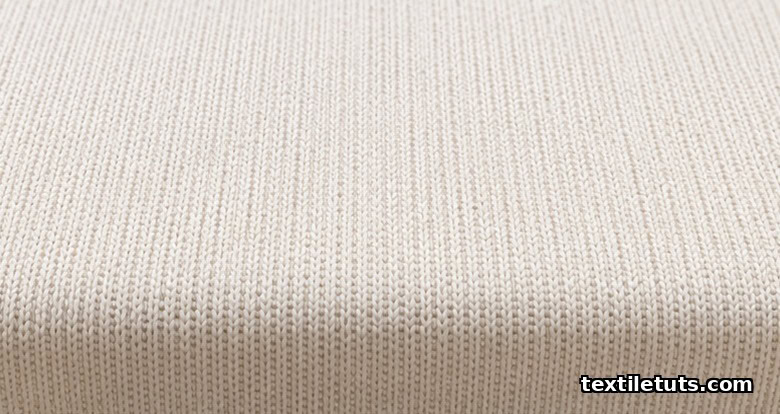
Knit mattress ticking is a weft- or warp-knitted fabric, most commonly a single jersey, interlock, or 3D spacer, weighing 120 to 220 g/m² and produced mainly from polyester or polyester/viscose blends to satisfy ISO 12952-1 ignitability, ISO 14184-1 formaldehyde, and ISO 3071 pH limits set by mattress flammability and chemical-safety regulations worldwide.
This guide explains the knit structures, fiber choices, and performance tests that define a quality mattress ticking, and shows how each choice affects breathability, durability, and comfort during eight-hour sleep cycles.
You will learn the difference between weft-knit jersey and warp-knit spacer constructions, which test methods predict real in-service performance, and where knit ticking outperforms traditional woven tickings on stretch and bursting strength.
What Mattress Ticking Is and Why Knits Dominate
Mattress ticking is the outer fabric cover that encases the spring unit, foam layers, and filling of a mattress. It must do more than look attractive. The ticking has to resist tearing during nightly compression cycles, allow sufficient air exchange to manage humidity, meet flammability requirements, and feel soft against skin for a sleep cycle that lasts up to eight hours each night.
Knitted constructions have become the industry default in mid- to high-end mattresses for three physical reasons. First, the interlooped yarn structure gives knit fabrics a bursting-strength-to-mass ratio that woven fabrics cannot match. A 180 g/m² single-jersey ticking typically bursts at 600 to 900 kPa under ASTM D3786, while a comparable plain-weave ticking of the same mass bursts at 350 to 500 kPa. Second, knit loops create a porous structure with higher air permeability, which improves moisture-vapor transmission during sleep. Third, knits stretch in both directions, which lets the ticking conform to body contours without pulling at quilted seams during compression.
The two largest global categories are weft-knitted single jersey and warp-knitted tricot or raschel, with weft knits holding roughly 70% of the European mattress-covering market according to industry surveys. Warp knits and 3D spacer fabrics are gaining share in premium and pressure-care (medical) segments.
Knit Structures Used for Mattress Ticking
Each knit structure gives a different balance of stretch, thickness, and stability.
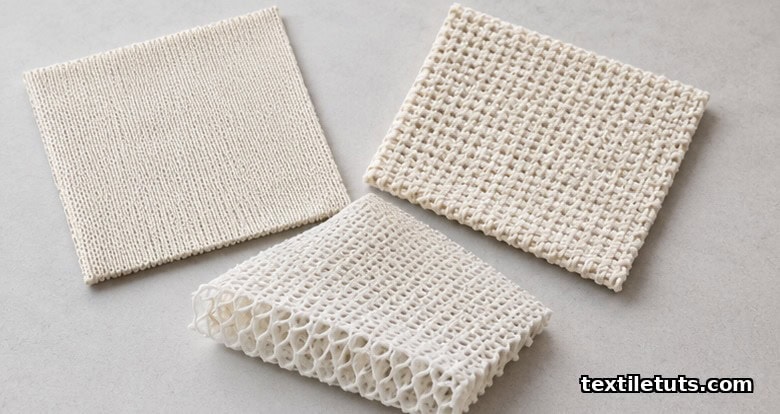
Single jersey (plain weft knit). Made on circular knitting machines with one set of needles, single jersey is the workhorse of mattress ticking. Courses per centimeter typically run 14 to 22, wales per centimeter 10 to 16, with a fabric mass of 120 to 180 g/m². Single jersey stretches more in the width direction than in the length direction, which suits the deep borders and quilted panels of modern pocket-spring mattresses.
Interlock. Interlock is a double-jersey structure knitted on two needle beds with alternating stitches from opposite beds on each face. It is thicker (180 to 240 g/m²) and more dimensionally stable than single jersey, with similar stretch in both directions. Interlock is the preferred ticking for tufted mattresses and high-end quilted covers where flat lay-up is critical.
Rib (1×1, 2×2). Rib knits have visible vertical cords and stretch more in the width than in the length. They are used for the borders and side panels of mattresses, where the stretch must follow the perimeter foam encasement without buckling.
Warp-knit tricot and raschel. Tricot uses two sets of yarns with weft insertion and is dimensionally very stable. Raschel knits can produce patterned fabrics and meshes used in pillow tops and ventilated panels. Warp knits run at higher machine speeds (1,500 to 2,500 courses per minute) than circular weft knits, which lowers unit cost at high volumes.
Spacer fabric (3D knit). A spacer fabric is a double-jersey construction with two separate outer layers connected by a monofilament or texturized yarn pile in the middle. The result is a thick (3 to 12 mm), cushioning, breathable fabric that replaces foam in many no-flip mattress designs. Spacer fabrics deliver air permeability above 1,500 mm/s at 100 Pa per ISO 9237 while maintaining compressive recovery above 90% after 1,000 cycles at 50% compression.
Fiber Choices for Knit Mattress Ticking
Polyester filament yarns dominate because they are inexpensive, dimensionally stable, and easy to flame-retard. A typical specification is 100% polyester, 75/72 denier flat filament, knitted at 18 courses per cm and 14 wales per cm to reach 150 g/m². Spun polyester is also used where a softer, cotton-like hand is required. When yarn count matters for the bill of materials, the TextileTuts Yarn Count to GSM Calculator gives a quick cross-check between the feeder yarn and the finished ticking weight.
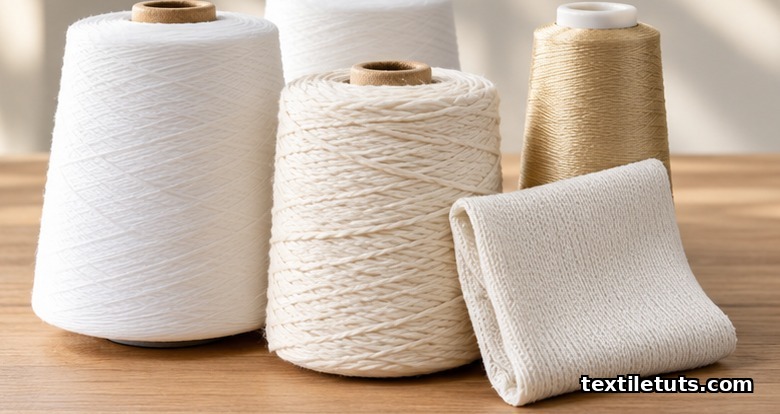
Cotton and cotton-rich blends are favored in natural and organic mattress lines. A 60/40 cotton/polyester blend balances the moisture absorption of cotton with the dimensional stability and abrasion resistance of polyester. Pure cotton ticks require careful finishing to control shrinkage to less than 3% after five home launderings per AATCC TM 135.
Viscose (rayon) is blended with polyester at 30 to 50% levels to give ticking a soft, silky hand and improved moisture absorption. Tencel (lyocell) and modal variants of viscose are used in premium lines for their moisture management and smoother fiber surface.
Specialty fibers include aramid blends for fire-barrier tickings that meet the strict UK Furniture and Furnishings (Fire Safety) Regulations 1988 schedule 1 ignition tests, and bamboo-charcoal polyester for odor-control claims.
Key Performance Tests
Mattress ticking is sold on test data, not on yarn count alone. The five most common tests are bursting strength, pilling resistance, dimensional stability, air permeability, and flammability.
Bursting strength. Knits do not lend themselves to strip tensile testing, so bursting strength is the standard. ASTM D3786/D3786M uses a hydraulic or pneumatic diaphragm to push against a circular fabric sample until it ruptures; the pressure at rupture is reported in kPa or psi. ISO 13938-1 gives equivalent values in the European system. A quality polyester single-jersey ticking should burst above 600 kPa, with values above 900 kPa considered premium.
Pilling resistance. Surface pilling is tested by tumbling or rubbing the fabric for a set number of cycles and rating the pilling on a 1 to 5 visual scale. ISO 12945-2 (Martindale, 7,000 cycles) and ASTM D4970 (Martindale, double-sided) are common. Mattress ticking should rate 4 or higher to look presentable after years of use.
Dimensional stability. Even ticking that is rarely washed must survive steam-sanitization cycles in production and occasional customer spot-washing. ISO 5077 paired with ISO 6330 specifies a controlled wash, dry, and measurement cycle. Acceptable dimensional change is below ±3% in both warp and weft directions for knitted ticking.
Air permeability. Air permeability is measured at a defined pressure differential (typically 100 or 200 Pa) on a fixed fabric area. ISO 9237 reports the result in mm/s. A breathable mattress ticking should exceed 200 mm/s; a spacer fabric exceeds 1,000 mm/s.
Flammability and chemical safety. The US federal standard 16 CFR Part 1632 (cigarette ignition) and 16 CFR Part 1633 (open flame) apply to finished mattresses, and the ticking must allow the composite to pass. BS EN 597-1 and BS EN 597-2 are the European smouldering-cigarette and small-flame tests. ISO 12952-1 and ISO 12952-2 are international methods for bedding-item ignitability. EU REACH and OEKO-TEX Standard 100 set limits on formaldehyde (ISO 14184-1, typically below 75 mg/kg for direct-skin contact) and pH (ISO 3071, 4.5 to 9.0). A knitting mill that exports to Europe must hold an OEKO-TEX or equivalent certification to remain competitive.
Comparison Table: Jersey vs Interlock vs Spacer for Mattress Ticking
| Property | Single Jersey | Interlock | 3D Spacer |
|---|---|---|---|
| Typical mass (g/m²) | 120 to 180 | 180 to 240 | 250 to 500 |
| Thickness (mm) | 0.5 to 1.0 | 1.0 to 1.6 | 3.0 to 12.0 |
| Bursting strength (kPa) | 600 to 900 | 800 to 1,200 | 900 to 1,500 |
| Air permeability (mm/s @ 100 Pa) | 200 to 500 | 150 to 350 | 1,000 to 3,000 |
| Stretch | High width, low length | Balanced | Low in both directions |
| Common use | Top panel, quilted covers | Tufted panels, borders | Pillow tops, ventilating panels |
| Relative cost | Low | Medium | High |
How Knit Ticking Is Manufactured
Production starts with yarn selection. Continuous-filament polyester is delivered on cheese cones and creeled directly onto circular knitting machines (for weft knits) or warp beams (for warp knits). Yarn tension is critical: a 10% drop in feeder tension can change single-jersey loop length by 8 to 12%, which shifts fabric mass and bursting strength out of spec.
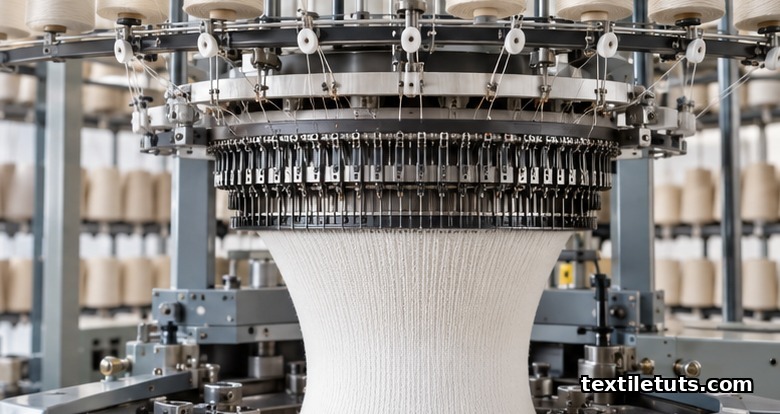
After knitting, the greige fabric goes through relaxation in a steam chamber or a hot-wash bath so the yarn can settle into its final loop geometry. Relaxation stabilizes shrinkage and is the most important step before finishing. Heat-setting on a stenter at 180 to 200 °C sets the width and stabilizes the loop shape for polyester.
Finishing depends on the application. Mattress ticking is often raised on a raising machine to soften the face, then sanforized (mechanically compressed) for dimensional stability. If the ticking will be printed with brand graphics or quilted to foam, it is back-coated with a thin acrylic or polyurethane foam layer for body.
Quality control uses ISO 2859-1 sampling plans. The most common visual defect in weft-knit ticking is barre (visible horizontal bands caused by feeder-to-feeder yarn variation), followed by needle lines and holes. Inline cameras and laser loop-length sensors now catch most defects before the fabric reaches the stenter.
Sustainability and End-of-Life Considerations
Polyester ticking is derived from fossil-fuel feedstocks and is not biodegradable, but it is fully recyclable. Several European mattress-take-back schemes (Ecomaison in France, Matras Recycling Belgium) shred used mattresses and reprocess the polyester ticking into nonwoven carpet backing and automotive insulation.
Cotton ticking, especially if GOTS-certified, gives a renewable raw material at the cost of higher water use during cultivation. Tencel (lyocell) and modal are made in closed-loop solvent systems with solvent recovery above 99%, which makes them a lower-impact option for premium lines.
Bio-based polyester (PET partly from sugarcane or waste cooking oil) is now commercially available in ticking weights; mechanical properties match fossil PET, and the carbon footprint is 25 to 40% lower per kilogram of fiber.
Frequently Asked Questions
What GSM is best for knit mattress ticking?
Most knit mattress ticking falls between 120 and 220 g/m². For a single-jersey cover on a pocket-spring mattress, 150 to 180 g/m² gives a soft hand plus enough body to handle quilting. Below 120 g/m² the fabric feels flimsy and punctures easily; above 220 g/m² breathability drops unless a spacer construction is used.
Is knit or woven fabric better for mattress ticking?
Knit ticking wins on stretch and bursting strength and is the default for most modern mattresses. Woven ticking wins on dimensional stability and is still used in some traditional innerspring and orthopaedic mattresses where a stiffer, non-stretching surface is preferred. The choice depends on the comfort and price target.
Why is spacer fabric used in premium mattresses?
Spacer fabric is a 3D knit with two outer layers joined by a monofilament pile. It replaces a layer of foam in pillow-top construction, which removes a common source of off-gassing and improves air flow. The fabric also delivers compressive recovery above 90% after repeated loading, so the pillow top keeps its shape.
How is mattress ticking tested for fire safety?
The finished mattress is tested, not just the ticking. In the United States, 16 CFR Part 1632 uses a lit cigarette on the mattress surface and 16 CFR Part 1633 uses a burner. In Europe, BS EN 597-1 and BS EN 597-2 are the smouldering-cigarette and small-flame tests. ISO 12952-1 and ISO 12952-2 are the international equivalents and are referenced by most OEM buyers.
Can knit mattress ticking be washed?
Most knit ticking is used inside a removable outer cover, so it is rarely washed. When the mill tests wash performance, it follows AATCC TM 135 or ISO 6330, and the acceptable dimensional change is ±3% in both directions after five cycles. Spun-polyester and cotton blends survive more wash cycles than flat-filament polyester because the loops lock together better.
References
- ISO 12952-1:2010. Textiles — Assessment of the ignitability of bedding items — Part 1: Ignition source: smouldering cigarette. International Organization for Standardization.
- ASTM D3786/D3786M-13. Standard Test Method for Bursting Strength of Textile Fabrics — Diaphragm Bursting Strength Tester Method. ASTM International.
- ISO 13938-1:2019. Textiles — Bursting properties of fabrics — Part 1: Hydraulic method for determination of bursting strength and bursting distension. International Organization for Standardization.
- AATCC Test Method 135-2018. Dimensional Changes of Fabrics after Home Laundering. American Association of Textile Chemists and Colorists.
- ISO 5077:2007. Textiles — Determination of dimensional change (paired with ISO 6330 for washing procedure). International Organization for Standardization.
- ASTM D4970/D4970M-16. Standard Test Method for Pilling Resistance and Other Related Surface Changes of Textile Fabrics: Martindale Tester. ASTM International.
- ISO 9237:1995. Textiles — Determination of the permeability of fabrics to air. International Organization for Standardization.
- ISO 14184-1:2011. Textiles — Determination of formaldehyde — Part 1: Free and hydrolysed formaldehyde (water extraction method). International Organization for Standardization.
This article is the working reference for knit mattress ticking. Editorial by Iftay Khairul Alam, TextileTuts. Sources: ISO 12952, ISO 13938, ISO 5077, ISO 9237, ISO 14184, ASTM D3786, ASTM D4970, AATCC TM 135 as cited.


