
Knit Fabric for Automotive Interiors

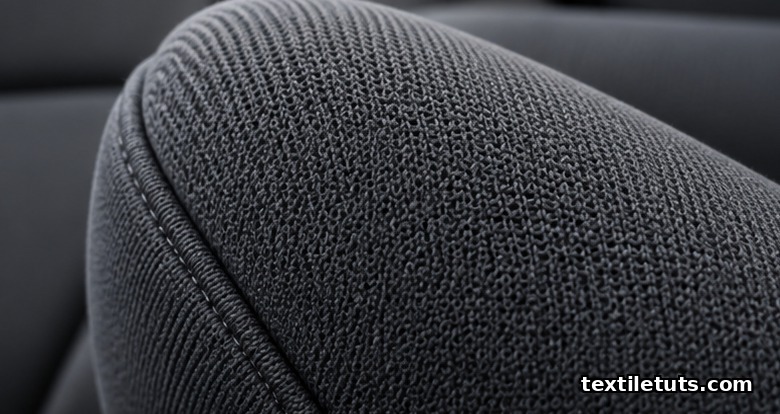
Knit fabric for automotive interiors is a warp-knit or weft-knit textile typically produced at 180–280 g/m² from polyester, polyamide (nylon 6,6), or polyester–elastane blends, with elongation at break between 30% and 80% across the course direction and Martindale abrasion resistance above 50,000 cycles to satisfy ISO 13934-1 tensile and FMVSS 302 flammability specifications.
Automotive knit fabrics now appear in seat covers, headliners, door panels, headrests, and pillar trim on production vehicles, where stretch and air permeability give measurable comfort and acoustic advantages over traditional woven laminates. The shift accelerated after 2018 as OEMs sought lighter, recyclable, and quieter cabin materials, with knit constructions replacing foam-backed woven scrims in mid-tier and premium trims. This article explains the knit structures used, the standards they must pass, the fiber blends selected for seats versus headliners, and the performance limits that determine where knit can replace woven or leather in mass production.
Why Automakers Are Replacing Woven Trim With Knit
Weight reduction is the primary driver. A warp-knit polyester seat cover laminate averages 280–340 g/m², while a functionally equivalent foam-backed woven scrim with identical stretch targets weighs 380–480 g/m², a 25–35% mass saving on the trim surface alone. Combined with elimination of the foam interlayer, total seat-system mass can drop by 6–10 kg per vehicle, a meaningful contribution to fleet-level CO₂ reduction targets that EU and US regulators are tightening through 2027.
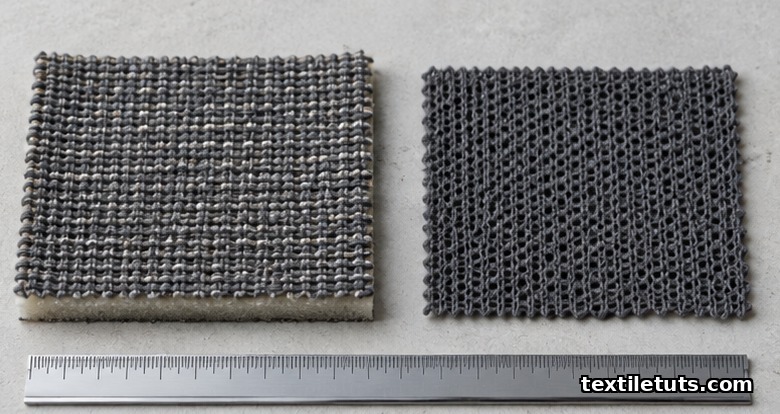
Acoustic performance is the second reason. Knit fabrics have an open, porous structure that absorbs mid- and high-frequency cabin noise (1,000–6,000 Hz) more effectively than tight weaves. Microfiber warp knits tested at the Hohenstein Institute show noise reduction coefficients of 0.45–0.60, against 0.20–0.30 for comparable plain-woven laminates of the same areal density (research published in MDPI’s Textiles journal, 2021). For a passenger car, a 0.10 increase in NRC across door and pillar trims can lower interior SPL by 1–2 dB(A) on rough roads.
Conformability around complex seat contours is the third. Knit structures stretch 30–80% in the course direction without permanent deformation, allowing one continuous cover panel to wrap bolsters, side wings, and headrest transitions without darts or seams. Woven covers need cuts and sew lines at every compound curve, which adds labor, weakens the surface, and creates visible stitch lines.
Knit Structures Used in Automotive Trims
Three constructions dominate. Each meets a different performance envelope.
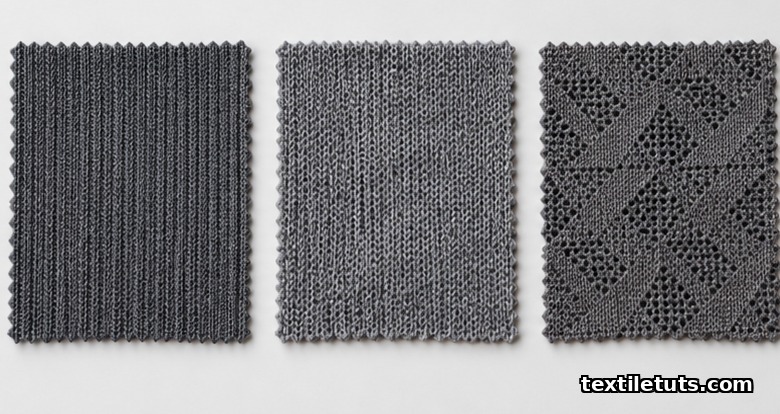
Warp-Knit (Tricot, Raschel, Spacer)
Warp knits account for an estimated 65–70% of automotive knit trim by surface area. They are dimensionally stable in both length and width, run on multi-bar Raschel machines at widths up to 240 cm, and accept high-loop-density constructions suited to fine microfiber yarns. A typical seat-face tricot uses 75–110 denier polyester filament, 22–28 courses per cm, and 18–24 wales per cm. Warp-knit spacer fabrics (3D knits with a connecting pillar yarn between two face layers) provide built-in cushioning and air permeability, replacing bonded foam in headrest and center-console trim.
Weft-Knit (Single Jersey, Interlock, Piqué)
Weft knits appear where comfort and stretch matter more than dimensional stability: seat bolsters, door armrests, and steering-wheel wraps. Circular weft knitting produces single-jersey and interlock structures at widths up to 180 cm. Common weights run 200–260 g/m², with elastane (Lycra) at 3–8% of total fiber mass to support 40–60% elongation at the seat wing. Weft knits are more susceptible to pill formation than warp knits, which is why weft-knit bolsters are usually paired with fiber-dyed yarns and a hair-resistance finish per ISO 13945.
Double-Knit and Jacquard
Double-knit and electronic Jacquard knits handle patterned surfaces that would otherwise require printed or woven alternatives. They run on circular or flat-bed machines with individual needle selection, allowing brand-specific perforation patterns, logos, and design lines to be knit into the fabric rather than printed on top. BMW, Mercedes-Benz, and Volvo have used Jacquard knit seat surfaces since 2019. The advantage is durability, since the pattern is structural and survives abrasion testing without fading.
Fiber Selection for Seats, Headliners, and Door Trim
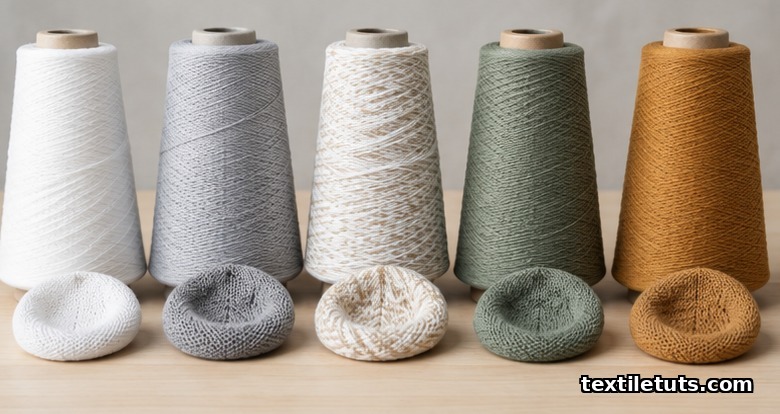
Fiber choice is governed by UV stability, abrasion, pilling, and flammability. The dominant fibers and their roles follow.
| Fiber | Typical Linear Density | Where Used | Key Test |
|---|---|---|---|
| PET polyester (filament) | 75–167 dtex | Seat face, headliner | ISO 13937-2 tear, ISO 105-B06 lightfastness |
| Polyamide 6,6 (nylon) | 78–110 dtex | Side bolster, steering wheel | ASTM D3884 abrasion, Martindale 50,000+ |
| PET/elastane (Lycra) blend | PET 84 dtex + 44 dtex Lycra | Stretch panels, bolster wrap | ISO 14704 stretch recovery |
| Recycled PET (rPET) | 75–165 dtex | Sustainable trim programs | ISO 14021 recycled content claim |
| Solution-dyed acrylic | 120–200 dtex | Convertible tops, sun-visor backing | SAE J1885 weathering, 1,500 h xenon |
For headliners, low-density warp knits at 80–120 g/m² are laminated to a PU foam or scrim backing to absorb cabin reverberation. For seat face fabric, areal density rises to 220–280 g/m², paired with a thinner scrim so the cover still drapes cleanly under occupant load. Door panels and pillar trim run 160–220 g/m² and prioritize lightfastness over elongation, since these surfaces see constant sunlight through the side glass.
Performance Standards Every Automotive Knit Must Pass
Knit fabrics are not optional. Every program lists a minimum set of test targets. The most common criteria across OEM specifications are summarized below.
- ISO 13934-1 tensile strength: warp and weft breaking force ≥ 600 N for seat-face knits, ≥ 400 N for headliner knits at 50 mm strip width.
- ISO 13937-2 tear strength: trouser-tear minimum 25 N across all seat-face directions.
- ISO 13945 pilling resistance: grade 4–5 after 7,000 Martindale cycles, with photographic-grade rating per the standard’s reference set.
- ASTM D4966 Martindale abrasion: ≥ 50,000 cycles to first thread rupture on seat-face knits; ≥ 20,000 cycles on headliner knits.
- FMVSS 302 horizontal burn rate: ≤ 102 mm/min burn length on the assembled seat assembly, the US federal motor-vehicle flammability cap.
- ISO 105-B06 lightfastness: grade 5–6 on the blue scale after 80 hours of xenon exposure at 550 W/m² for seat-face and door-trim knits.
- SAE J1885 accelerated weathering: 1,500 hours xenon arc with no color shift greater than ΔE 1.5 for interior trim rated for full sun exposure.
Failing any of these halts trim approval. Most failures happen at the elongation-recovery loop (knits that stretch but don’t recover) and at Martindale pilling after 30,000 cycles, which is why premium programs require pilling grade 4+ at the 7,000-cycle mark rather than the older 5,000-cycle requirement.
Sustainability and Recycled-Content Programs
Recycled PET (rPET) knit trim has moved from concept to production in the last five years. Most EU OEM sustainability roadmaps target at least 30% recycled content in interior trim by 2028 and 50% by 2032, audited under ISO 14021 self-declared environmental claims and the Global Recycled Standard. Knit structures suit this shift because polyester filament is mechanically recyclable at end-of-vehicle life, unlike foam-laminate wovens where separating the foam scrim from the face fabric is energy-intensive.
Seaqual yarn, made from recovered marine plastics, has entered seat-face knits on European vehicles since 2022. Seaqual 4U specifications report 100% post-consumer recycled content in a PET filament suitable for warp-knit face fabrics at 100–167 dtex, meeting ISO 13934-1 tensile and ISO 105-B06 lightfastness without major reformulation.
Frequently Asked Questions
Q1: What knit structure is most common in automotive seat covers?
Warp-knit tricot dominates automotive seat covers, accounting for roughly two-thirds of seat-face fabric by volume. Warp knits run on multi-bar Raschel machines, accept fine 75–110 denier polyester filament, and stay dimensionally stable across the cut-and-sew operation, which is essential when the cover panel wraps multi-curve bolsters and headrest transitions without permanent deformation.
Q2: Are knit automotive fabrics less durable than woven ones?
At equal fiber and areal density, knit trim typically matches or beats woven trim on tensile and seam-slippage tests but loses 5–15% on abrasion if the knit is loosely looped. The reason leading OEM specs (BMW, Volvo, Stellantis) now specify knits is that knits absorb cabin noise, conform to seat contours, and reduce mass, all of which offset the modest drop in raw abrasion numbers once loop structure is optimized for seat-face service.
Q3: Can knit fabric meet FMVSS 302 flammability?
Yes, but the knit alone cannot. The standard tests the assembled seat system (foam + cover + scrim) at horizontal burn rate ≤ 102 mm/min. Most automotive knits, especially filament polyester and polyamide 6,6, are inherently flame-resistant enough when paired with a flame-retardant foam interlayer. Knits using solution-dyed modacrylic blends pass FMVSS 302 even without the FR foam, which is why some premium programs have moved to all-FR knit-and-foam stacks.
Q4: Are automotive knits recyclable?
100% polyester and 100% polyamide knits are mechanically recyclable through fiber-to-fiber re-spinning. Mixed-fiber knits (PET/elastane, PET/cotton) are harder to recycle because elastane clogs the re-spinning filter and cotton char residue contaminates the melt. This is why the 2025+ EU end-of-life vehicle rules are pushing OEMs toward mono-material knit constructions with Lycra replaced by textured PET stretch yarn where possible.
Q5: Does knit fabric block airbag deployment from seat-mounted airbags?
Yes, when engineered correctly. Seat-mounted side airbags deploy through the side bolster, often at a seam engineered to split open on inflation. Knit seat covers use a low-tensile yarn section or a designed tear-line at the bolster seam, tested per FMVSS 208 and the OEM-specific airbag-deployment protocol (typical 100 kPa peak pressure, 8 ms rise time). The knit’s elongation is an asset here because it stretches before tearing.
References
- International Organization for Standardization. ISO 13934-1:2013 — Textiles: Tensile Properties of Fabrics, Part 1. iso.org — strip method for warp and weft breaking force at 50 mm width.
- International Organization for Standardization. ISO 13937-2:2000 — Textiles: Tear Properties of Fabrics, Part 2. iso.org — trouser-tear method for knitted and woven automotive textiles.
- International Organization for Standardization. ISO 13945:2014 — Pilling Resistance of Knitted Fabrics. iso.org — Martindale-based pilling assessment with photographic reference grades.
- ASTM International. ASTM D4966 — Standard Test Method for Abrasion Resistance of Textile Fabrics (Martindale). astm.org — cycle-to-rupture method for seat-face knit trim.
- FMVSS 302, Flammability of Interior Materials. NHTSA / ecfr.gov — horizontal burn rate ≤ 102 mm/min on the assembled seat system.
- SAE International. SAE J1885 — Accelerated Exposure of Automotive Interior Trim Components. sae.org — xenon-arc weathering protocol used for lightfastness claim on door and pillar knits.
- Böttcher, P., Schmidt, A. “Acoustic Properties of Warp-Knitted Spacer Fabrics for Automotive Interior Applications.” Textiles, MDPI, 2021. mdpi.com — measured noise reduction coefficient 0.45–0.60 for microfiber warp knits in the 1–6 kHz band.
This article is the working reference for knit fabric construction in automotive interior trim. Editorial by Iftay Khairul Alam, TextileTuts. Sources: ISO 13934-1, ISO 13937-2, ISO 13945, ASTM D4966, FMVSS 302, SAE J1885, MDPI Textiles (2021) as cited.


