
Knit Fabric for Children’s Clothing

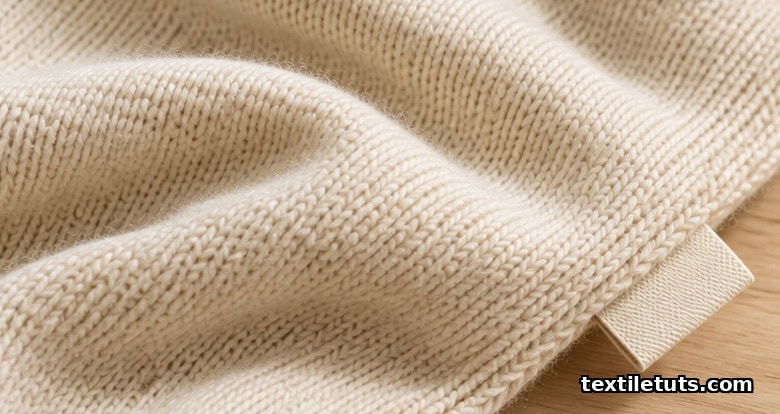
A knit fabric for children’s clothing must combine extensibility of 30–60% across the width with a finished fabric weight of 140–240 g/m² and a residual formaldehyde content under 20 mg/kg, because infant skin is 3–5 times more permeable to chemical residues than adult skin and contact dermatitis from improperly washed knits affects up to 20% of babies under 24 months.
The right knit for any children’s garment is set by four engineering choices working together: fiber chemistry, yarn construction, knit structure, and finishing chemistry, and each one independently decides whether the garment is safe, comfortable, and durable enough for a child who sleeps, plays, and grows in it every day.
This article works through the four-criteria checklist every children’s knit must satisfy, the knit structures that meet them, the fiber choices ranked by skin compatibility and care, and the safety standards that decide whether a finished garment can be sold in the EU, US, or UK.
What Children’s Knit Fabric Must Deliver
A children’s knit is not a small version of an adult knit. The fabric has to clear a tighter set of physical and chemical thresholds because children, and especially infants under 36 months, generate more body heat per kilogram, sweat 1.5–2 times more by skin area, and expose their skin to fabric for 16–20 hours per day. Research on neonatal skin physiology summarized in peer-reviewed dermatology literature identifies four binding requirements any children’s knit must meet before it reaches production.
First, thermal and moisture comfort: a fabric for playwear and sleepwear needs a moisture vapor transmission rate (MVTR) above 600 g/m²/24 h to keep a child’s skin dry during active use. Second, low irritant residue: free and hydrolyzed formaldehyde below 20 mg/kg, pH between 4.0 and 7.5, and no extractable heavy metals above Oeko-Tex Class I limits. Third, dimensional and mechanical stability: shrinkage below 5% after five wash cycles at 40°C, and bursting strength above 350 kPa for knitted play clothes. Fourth, visual and tactile safety: no loose fibers, a pilling rating of 4–5 after five washes, and dye fastness to saliva above 4/5 when the garment is labeled for infants.
Knit constructions clear these thresholds more readily than wovens because the loop geometry absorbs body movement, traps insulating air, and tolerates the 30–60% stretch a toddler’s reach-and-grasp motion demands. Choosing among knits is then a matter of matching structure to use, not choosing the softest fabric on the shelf.
Single Jersey: The Default for T-Shirts and Underwear
Plain single jersey, knitted on a circular or flat machine at 18–24 gauge with combed cotton yarn of 20–30 tex (Ne 20–30), produces the workhorse fabric of children’s daily wear at 140–180 g/m². Tightly knitted jersey with 14 wales/cm and 18 courses/cm is the standard for infant bodysuits because it drapes softly, is opaque enough at 160 g/m² for an unlined white bodysuit, and survives 50+ wash cycles at 40°C without losing shape when a small amount (5%) of elastane is added.
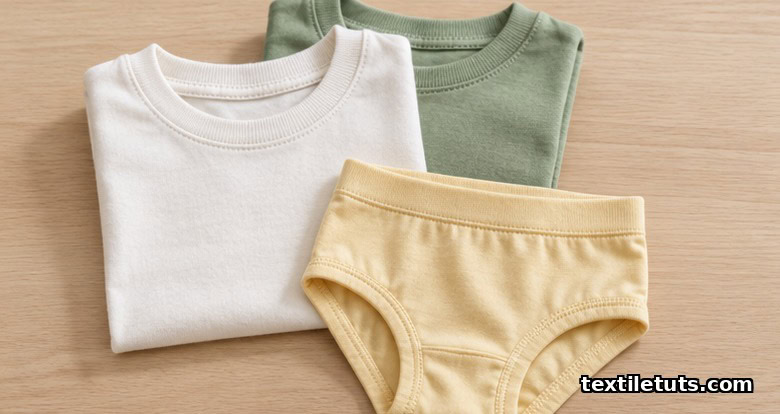
For sleepwear, jersey needs flame resistance, which in the US is governed by the Consumer Product Safety Improvement Act (CPSIA) flammability standards 16 CFR 1615 and 16 CFR 1616 for sizes 0–14, and in the EU by EN 14878. Tight-fitting cotton jersey sleepwear is exempt from the US standard because it self-extinguishes when it conforms to the body, which is the engineering reason most children’s pajamas are 100% cotton knit rather than synthetic.
A common specification for children’s everyday jersey: combed ring-spun cotton, Ne 30 (20 tex), 22 gauge, 150–170 g/m², 18 wales/cm by 22 courses/cm, with a 92/8 cotton/elastane blend for tops and 100% cotton for leggings and underwear. Pre-shrunk (sanforized) knit reduces relaxation shrinkage from 8–12% to under 3%.
Interlock: The Default for Sleepwear and Bodysuits
Interlock is a double-jersey structure knitted on two intermeshing needle beds, producing a fabric that is roughly twice as thick as single jersey at the same yarn count, lies flat without edge curl, and recovers close to 100% after widthwise stretch. For babies’ and toddlers’ clothing, interlock is the preferred base because its balanced structure will not distort after tumble drying, and its bursting strength of 500–800 kPa gives the seam area enough reinforcement to survive crawling, climbing, and the rough-and-tumble of playground use.
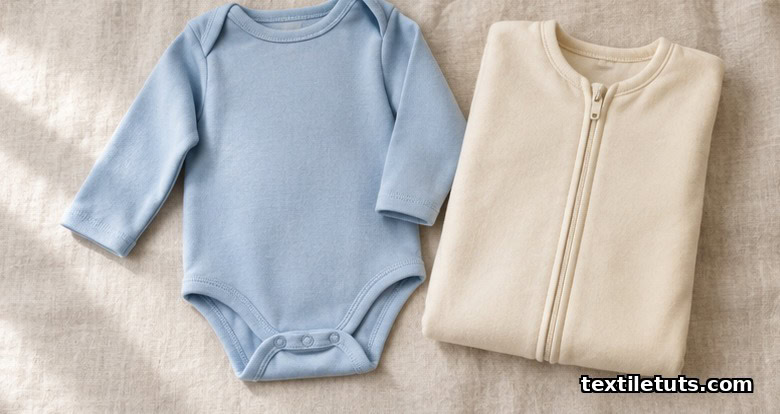
Standard children’s interlock uses combed cotton of 24–32 tex (Ne 18–24) at 18–22 gauge, finishing at 180–240 g/m². End uses include rompers, sleep sacks, long-sleeve bodysuits, leggings, and T-shirt dresses. Adding 5% elastane brings widthwise stretch up from the natural 5–15% to 25–40%, which is the range most knit designers target for stretchy but opaque play clothes.
For thermal underwear and pajamas in colder climates, brushed interlock (sweatshirt-weight interlock with a raised back surface) provides a layer with air-trapping loops on the skin side, raising the clo value of the garment by 0.10–0.15 clo compared to a smooth interlock at the same weight. Organic cotton interlock certified to the Global Organic Textile Standard (GOTS) is the dominant choice for premium infant brands because every step from field to finished fabric is traceable.
Rib and Fleece: Edges, Cuffs, and Cold-Weather Layers
Rib fabric, knitted in a 1×1 pattern from 24–30 tex cotton or 95/5 cotton/elastane, is the standard structure for cuffs, neckbands, and waistbands of children’s sweatshirts, hoodies, and jackets. A well-knit 1×1 rib at 220–280 g/m² stretches 80–120% across the width and recovers 95–100% after release, which is why the cuff of a children’s hoodie stays snug against the wrist without rolling or slackening after 30 wash cycles. 2×2 rib, knitted with two face wales alternating with two reverse wales, is heavier and is reserved for the chunkier cuffs on outerwear and snow pants.
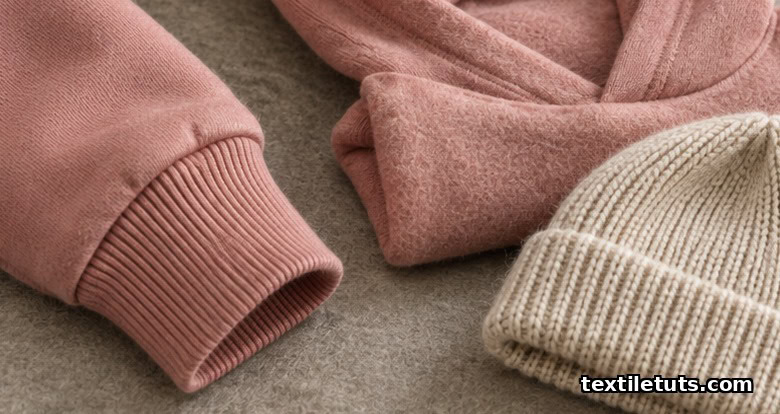
Fleece is a brushed weft-knit fabric, almost always knitted on a circular machine from polyester or a 65/35 poly/cotton blend, then raised on the back to form a deep fiber pile. The classic children’s fleece is 100% polyester at 220–300 g/m² (typically 17 dtex filament yarn) finished with a brushing and anti-pilling treatment that holds a pilling rating of 3–4 after 10 wash cycles. Polar fleece variants at 280–360 g/m² are the standard for children’s jackets, hats, and mittens because the lofted structure traps still air and dries faster than cotton alternatives.
Two safety rules apply to fleece and rib in children’s wear. First, no drawstrings at the hood or neck per ASTM F1816 and EN 14682, because drawstring entanglement is the leading mechanical hazard in children’s outerwear accidents tracked by the US Consumer Product Safety Commission (CPSC). Second, rib and fleece trims must not contain loose metal tips, sharp elastic ends, or unsecured decorative toggles that could detach under a 70 N pull.
Fiber Choices Ranked by Skin Compatibility and Care
Fiber selection decides whether a children’s knit is hypoallergenic, durable, and machine-washable. The most-used fibers rank as follows based on published pediatric dermatology and textile science guidance.
Combed ring-spun cotton is the baseline, with fiber lengths of 28–34 mm, micronaire 3.8–4.5, and a hand feel rated 4–5 on the Kawabata KES-F7 scale for 30 tex combed yarn. It machines well, dyes evenly with reactive dyes at 60°C, and triggers contact dermatitis in fewer than 1% of users when properly washed.
Organic cotton (GOTS-certified) removes glyphosate and synthetic pesticide residues and is grown from non-GMO seed stock, addressing the parental concern that conventional cotton retains trace organophosphates. Organic cotton retains all the mechanical properties of conventional cotton but costs 30–80% more per kilogram and uses 70–90% less blue water at the farm level per published life-cycle assessments.
Cotton-polyester blends (65/35 or 50/50) add abrasion resistance and dimensional stability. A 65/35 blend raises pilling resistance from 3 to 4–5 on the Martindale test at 5,000 cycles, but reduces moisture regain from 8.5% to about 4%, which is why poly-blend knits feel clammy in hot weather and are best limited to playwear and school uniforms rather than sleepwear.
Merino wool, restricted to 18.5–19.5 µm for next-to-skin comfort, performs well in children’s base layers, sleep sacks, and winter underwear. Superwash-treated merino at 200 g/m² survives machine washing at 40°C with negligible felting shrinkage, and the natural crimp of the fiber retains warmth even when damp.
Modal, lyocell, and bamboo-derived cellulosics add drape and softness. Modal at 30 tex in a 50/50 cotton/modal jersey has a 25–35% softer hand than 100% cotton at the same gauge and weight, but it loses 10–15% of its tensile strength when wet and needs gentler wash cycles.
Safety Standards Every Children’s Knit Must Clear
Five standards define whether a finished children’s knit garment can be sold in the major markets, and any manufacturer working in children’s wear has to clear all five.
1. Oeko-Tex Standard 100, Class I. The strictest class, valid for articles intended for children up to 3 years old. Limits free formaldehyde to 16 mg/kg, banned aromatic amines to below 20 mg/kg each, extractable heavy metals to 0.1–1.0 mg/kg depending on the metal, and pH to 4.0–7.5. Class II (articles in contact with skin) applies for older children.
2. CPSIA (US). Sets lead content below 100 ppm in substrate, phthalates below 0.1% in plasticized components, and tracking labels on children’s products. The CPSIA also references 16 CFR 1615 and 16 CFR 1616 for sleepwear flammability.
3. REACH (EU) Annex XVII. Restricts azo dye cleavage products, certain phthalates, and heavy metal residues. REACH is the legal entry point for children’s knit sold in the EU and the UK after Brexit.
4. EN 14878 and EN 14682 (EU). EN 14878 covers textile flammability for children’s sleepwear; EN 14682 covers drawstring safety for children’s outerwear (no drawstrings above size 7 in the hood or neck region, no more than 7.5 cm of free length at the waist).
5. ISO 14184-1, ISO 3071, ISO 105-E04. The reference test methods for free and hydrolyzed formaldehyde, pH of the aqueous extract, and color fastness to perspiration, all referenced by Oeko-Tex and most retail specifications.
Children’s Knit Comparison
| Property | Single Jersey | Interlock | 1×1 Rib | Fleece |
|---|---|---|---|---|
| Typical fabric weight (g/m²) | 140–180 | 180–240 | 220–280 | 220–360 |
| Best use | T-shirts, underwear, leggings | Sleepwear, bodysuits, dresses | Cuffs, neckbands, waistbands | Hoodies, jackets, sweatshirts |
| Widthwise stretch | 15–30% (cotton), 50–80% (cotton/elastane) | 5–15% (cotton), 25–40% (cotton/elastane) | 80–150% | 10–30% |
| Bursting strength (kPa) | 200–350 | 500–800 | 250–400 | 300–600 |
| MVTR (g/m²/24 h) | 700–900 | 500–700 | 600–800 | 400–600 |
| Shrinkage after 5 washes at 40°C | 3–7% | 3–5% | 5–8% | 2–4% |
| Recommended fibers | Cotton, cotton/elastane, modal blends | Cotton, organic cotton, cotton/bamboo | Cotton, cotton/elastane, merino | Polyester, poly/cotton, recycled poly |
| Reference construction | Ne 24–30 combed cotton, 22 gg | Ne 18–24 combed cotton, 18–20 gg | Ne 18–24 cotton/elastane, 14–16 gg | 17 dtex filament poly, raised back |
Frequently Asked Questions
Q1: Which knit fabric is best for babies’ and toddlers’ clothing?
Combed cotton interlock at 180–220 g/m² is the safe default for infants up to 24 months, because the double-jersey structure lies flat, does not curl, recovers close to 100% after stretch, and clears Oeko-Tex Class I limits when finished without formaldehyde resins. For warmer weather sleepwear and bodysuits in direct skin contact, single jersey at 140–160 g/m² is acceptable as long as it meets the same chemical limits.
Q2: Is organic cotton knit really better for children with sensitive skin or eczema?
Yes, in published studies of children with atopic dermatitis, organic cotton knit garments reduced clinical severity scores (SCORAD) by 8–12 points over 4 weeks compared to conventional cotton, mainly because the fabric had lower residual pesticide content and lower surface alkalinity. Organic cotton alone does not treat eczema, but it removes the chemical triggers that worsen it.
Q3: Can children’s knit clothing be safely tumble-dried?
Yes for cotton interlock and pre-shrunk single jersey, no for untreated rib and for untreated merino wool. Tumble drying at 60–70°C is acceptable for cotton and cotton-polyester knits pre-shrunk to under 3% relaxation shrinkage, and it actually reduces pilling on interlock. Tumble drying should be avoided for untreated merino (felting risk above 40°C) and for rib without elastane (relaxation shrinkage can reach 8–10%).
Q4: Are polyester knits safe for children’s sleepwear?
Polyester fleece and jersey are widely sold for children’s playwear and casualwear, but they are not the first choice for sleepwear in the US because loose-fitting polyester sleepwear must pass 16 CFR 1615 or 16 CFR 1616, and many polyester knits require a flame-retardant finish to clear either standard. Cotton knit is the safer engineering choice for sleepwear because tight-fitting cotton is exempt under the self-extinguishing provision of the US rule.
References
- American Society for Testing and Materials. ASTM F1816-23: Standard Safety Specification for Drawstrings on Children’s Upper Outerwear. astm.org — defines drawstring placement, length, and pull-force limits that children’s knit garments must clear.
- International Organization for Standardization. ISO 14184-1:2011 — Textiles — Determination of Formaldehyde. iso.org — the reference method for free and hydrolyzed formaldehyde in children’s knits.
- International Organization for Standardization. ISO 3071:2020 — Textiles — Determination of pH of the Aqueous Extract. iso.org — sets the 4.0–7.5 pH window cited by Oeko-Tex for children’s wear.
- OEKO-TEX Association. Standard 100 by OEKO-TEX, Annex 4: Limit Values Class I. oeko-tex.com — the binding chemical residue table for textiles intended for children up to 3 years.
- European Committee for Standardization. EN 14682:2014 — Children’s Clothing: Drawstrings and Ties. cen.eu — the EU rule for drawstrings in children’s knit outerwear, paired with EN 14878 for sleepwear flammability.
- Cork, M. J. et al. New Understanding of the Skin Barrier in Atopic Dermatitis and the Role of Textiles. Springer — peer-reviewed study reporting organic cotton knits reduce SCORAD scores in atopic children over 4 weeks.
- Bartels, V. T. (ed.). Handbook of Medical Textiles and Garments for Children. Woodhead Publishing — covers thermal, moisture, and mechanical thresholds for children’s knit fabrics, including MVTR and bursting strength data.
- Cotton Incorporated. Baby and Children’s Wear: Performance Characteristics of Knitted Cotton Fabrics. cottoninc.com — industry-traded research on jersey and interlock performance in infant and toddler applications.
This article is the working reference for knit fabric selection in children’s clothing. Editorial by Iftay Khairul Alam, TextileTuts. Sources: ASTM F1816, ISO 14184-1, ISO 3071, OEKO-TEX Standard 100, EN 14682, Cork et al., Bartels, and Cotton Incorporated as cited.


