
Seamless Knitting: Whole Garment Knitting

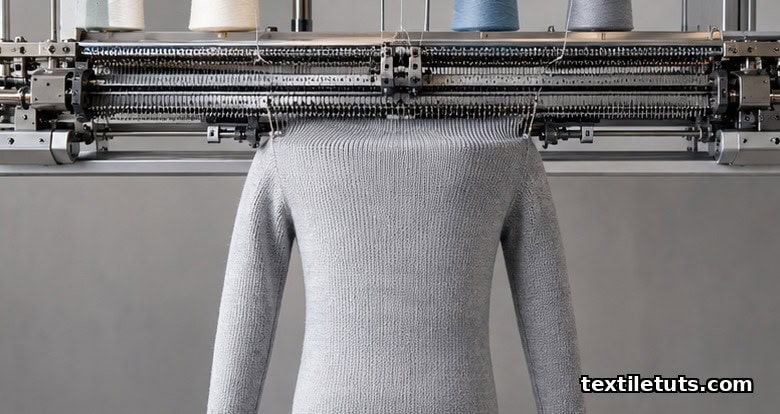
Whole garment knitting (also called one-piece knitting) produces a complete three-dimensional garment on a single computer-controlled knitting machine without side seams, with Shima Seiki’s WHOLEGARMENT technology knitting a typical adult pullover in roughly 45 to 90 minutes using four needle beds and intarsia-carrier systems that shape the body, sleeves, and collar in one continuous operation.
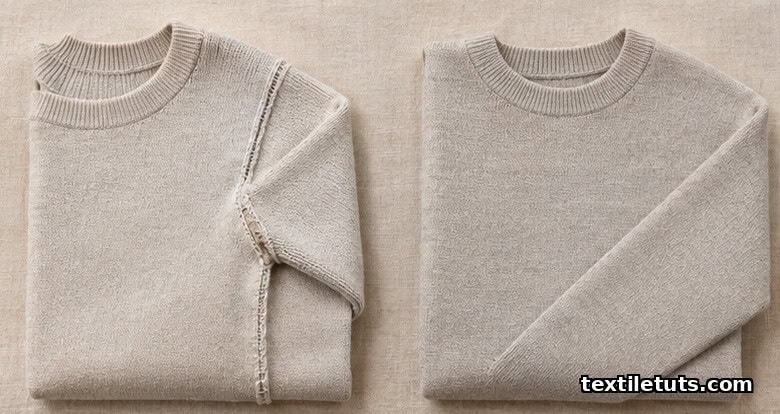
Unlike cut-and-sew knitwear, which knits flat panels that are later stitched together, a whole garment exits the machine as a fully shaped, ready-to-wear tube structure with no linking or seaming required, which eliminates the chafing and abrasion points that side and underarm seams create against the skin.
This article covers the definition and construction principle of one-piece garment knitting, the four-needle-bed technology that commercialized it, the comfort and waste-reduction benefits, the design and programming constraints that limit adoption, and the cut-and-sew comparison that determines which knitwear categories benefit from seam-free construction.
What Whole Garment Knitting Is and Why It Eliminates Side Seams
Whole garment knitting is a form of 3D computer-controlled weft knitting in which the entire garment (body, sleeves, neckline, and even pockets or trim) is shaped during the knitting cycle rather than assembled afterwards from flat panels. The output is a single, closed, three-dimensional piece that requires only minimal post-knitting finishing (washing, steaming) before being worn or packed.
The defining technical feature is the ability to knit tubular shapes with continuous changes in stitch width, stitch length, and yarn carrier without cutting or sewing. Modern flat knitting machines capable of whole garment production use four needle beds (two front, two back) instead of the conventional two-bed configuration, allowing stitches to be transferred in any direction so that the knitting head can widen for the body, narrow for the neckline, branch into sleeves, and close the structure at the shoulders without seams.
Academic reviews in textile engineering textbooks note that the seam-free approach removes the largest single source of garment discomfort in knitwear. Cut-and-sew knitwear is typically assembled with linking or overlock stitches at the shoulder, side, and underarm lines, and these seams account for roughly 60% of consumer complaints about knitwear fit and comfort in wear trials cited in the textile literature.
Shima Seiki WHOLEGARMENT Technology: How It Works
Shima Seiki of Wakayama, Japan, commercialized whole garment knitting in 1995 with the SWG-X series flat knitting machine and has remained the dominant supplier of this technology, with its WHOLEGARMENT platform (current models include the MACH2X and SWG-N2 series) installed in more than 80 countries. The system uses a sliding needle bed on each side of the machine, with each bed holding independently controllable sinkers and needles, allowing stitch shapes to be knitted in any direction without manual intervention.
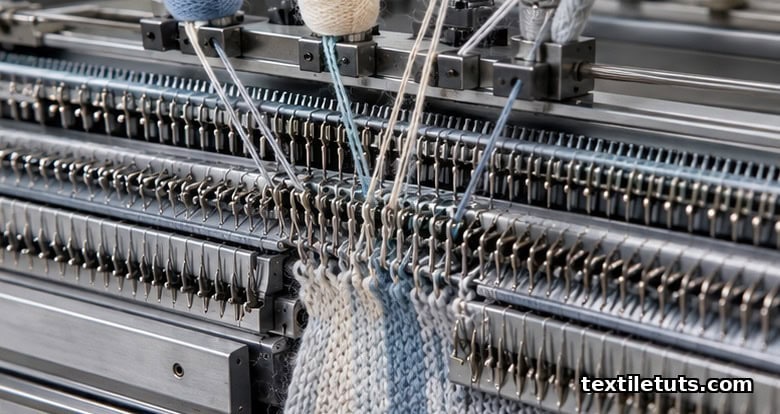
The process is controlled by SDS-ONE APEX design software, which converts a 3D body scan or graded pattern into a knitting program that specifies needle selection, yarn carrier, stitch length, and take-down tension at every course. A typical WHOLEGARMENT program for an adult pullover contains 3,000 to 8,000 courses (horizontal rows of stitches), each course requiring up to 1,000 needle selections across the four beds.
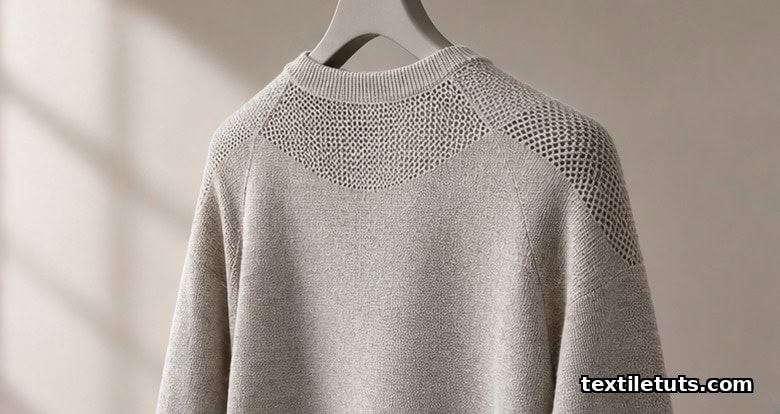
Because the yarn is fed by intarsia carriers (typically 4 to 8 on a single machine), patterns, intarsia motifs, and engineered mesh zones can be knitted directly into the garment body without subsequent printing or sewing. This single-step capability reduces the post-knitting labor content by 70% to 90% compared with cut-and-sew knitwear of equivalent complexity, according to industry analyses reported in the textile engineering literature.
Benefits of Whole Garment Knitting: Comfort, Fit, and Waste Reduction
The elimination of side seams is the headline benefit. In a standard pullover, side seams sit at the torso where the body flexes and where layers are worn over them; underarm seams sit directly in the high-friction zone of the armhole. One-piece construction removes both, producing knitwear that performs as follows:
- Reduces skin irritation: No seam thread or linking yarn contacts the skin at the torso or underarm, which matters for sensitive-skin wearers, infants, and post-surgical garments.
- Improves fit and drape: The 3D shape is knitted to the target body geometry rather than approximated from flat panels, which improves shoulder slope, neckline fit, and sleeve attachment.
- Cuts material waste: Cut-and-sew knitwear typically wastes 15% to 30% of knitted fabric as offcuts between panels; whole garment production wastes under 3% because no cutting is required.
- Lowers post-knitting labor: No linking, seaming, trimming, or panel matching is needed, reducing labor cost per garment by roughly 50% for equivalent styles.
- Enables engineered zones: Mesh ventilation, reinforced elbows, and graduated compression can be knitted directly into the structure rather than sewn in afterwards.
Peer-reviewed work on whole garment knitting also documents improved dimensional stability in the wash-and-wear cycle, because there are no seam allowances to distort and no thread tensions pulling panels out of shape, an effect particularly noticeable in fine-gauge merino wool garments where seam pucker is a common defect in cut-and-sew production.
Limitations: Design Constraints and Programming Complexity
Whole garment knitting is not a free-form replacement for cut-and-sew. The technology carries real constraints that have slowed mainstream adoption despite its 30-year commercial availability:
- Machine cost: A WHOLEGARMENT-class four-needle-bed flat knitting machine costs USD 200,000 to 600,000 depending on gauge and width, several times the cost of a comparable cut-and-sew flat knitting machine, limiting access to specialized mills.
- Programming skill: Each new style requires a custom knitting program in SDS-ONE APEX or equivalent CAD software, with development times of 1 to 4 weeks per style. Pattern changes that take minutes in cut-and-sew can take days in WHOLEGARMENT programming.
- Yarn limits: Whole garment knitting works best with fine to medium count yarns (typically Ne 24s to Ne 48s) and is less suitable for chunky or bouclé constructions. Loose or thick yarns can jam the four-needle-bed transfer mechanism.
- Garment category limits: Closures (zippers, buttons), structured collars, and lined garments are difficult to produce in one piece. Whole garment is most economical for pullovers, basic cardigans, and underwear where minimal post-assembly is needed.
- Repairs: A hole in a whole garment requires a more skilled mending operation than a cut-and-sew garment because there is no seam to re-sew; the knitting program for the affected zone must be re-run by the mill or a specialist re-knitter.
These constraints have kept whole garment production at roughly 2% to 3% of global knitwear output by volume, concentrated in premium casualwear, technical base layers, and select luxury categories where the comfort and waste benefits justify the production cost.
Cut-and-Sew vs Whole Garment Knitting Comparison
| Property | Cut-and-sew knitwear | Whole garment knitting |
|---|---|---|
| Construction | Flat panels knitted, then cut and sewn | 3D garment knitted in one piece on 4-needle-bed machine |
| Typical machine | 2-bed flat or circular knitting machine | 4-bed WHOLEGARMENT or equivalent machine |
| Side and underarm seams | Yes (linked, overlocked, or cover-stitched) | None |
| Material waste (offcuts) | 15% to 30% | Under 3% |
| Post-knitting labor | High (linking, seaming, trimming) | Minimal (washing, steaming) |
| Time per adult pullover | 2 to 4 hours knitting plus 1 to 2 hours assembly | 45 to 90 minutes knitting, near-zero assembly |
| Pattern flexibility | Very high (any cut, print, embroidery) | High (intarsia, engineered zones) but constrained by programming |
| Machine cost | USD 30,000 to 100,000 | USD 200,000 to 600,000 |
| Style changeover | Minutes (cutting new panels) | 1 to 4 weeks (new knitting program) |
| Best suited for | Fashion knitwear, complex garments, lined styles | Premium pullovers, base layers, underwear, infant wear |
| Repair difficulty | Low (re-sew seams) | High (requires mill or specialist re-knitting) |
This comparison shows that cut-and-sew remains the right answer for fashion knitwear where pattern variety and fast style changeovers dominate, while one-piece construction wins in comfort-critical and waste-sensitive categories where the per-garment premium can be absorbed.
Frequently Asked Questions
Q1: What is whole garment knitting?
Whole garment knitting is a computer-controlled weft knitting process that produces a complete three-dimensional garment on a single four-needle-bed machine in one operation, with no cutting, linking, or seaming required. The output is a ready-to-wear pullover, cardigan, or undergarment shaped during knitting rather than assembled from flat panels, which eliminates the side and underarm seams that account for most comfort complaints in conventional knitwear.
Q2: Who invented whole garment knitting?
Shima Seiki of Wakayama, Japan, commercialized whole garment knitting in 1995 with the SWG-X series flat knitting machine, following several years of in-house development of four-needle-bed sliding-needle technology. Competitors including Stoll (Germany) and several Chinese and Korean machinery makers have since introduced comparable systems, but Shima Seiki’s WHOLEGARMENT remains the dominant platform, with current flagship models including the MACH2X and SWG-N2 series installed in more than 80 countries.
Q3: Is whole garment knitting better than cut-and-sew?
Whole garment knitting is better than cut-and-sew for comfort, fit, and material efficiency because it eliminates side and underarm seams, reduces fabric waste from 15% to 30% down to under 3%, and removes the post-knitting linking and seaming labor that adds 1 to 2 hours per garment. Cut-and-sew is better for fashion complexity, fast style changeovers, and structured garments with linings or closures, so the two systems serve different market segments rather than one replacing the other.
Q4: Why is whole garment knitwear more expensive?
Whole garment knitwear is more expensive than cut-and-sew because the WHOLEGARMENT-class knitting machines cost USD 200,000 to 600,000 (3 to 6 times a comparable cut-and-sew machine), each new style requires 1 to 4 weeks of programming in proprietary CAD software, and the mill needs trained operators and pattern makers familiar with 3D knitting rather than 2D panel layout. These fixed costs are absorbed in the per-garment price, which is why one-piece knitwear typically retails at a 20% to 50% premium over equivalent cut-and-sew styles.
References
- Spencer, D. J. Knitting Technology: A Comprehensive Handbook and Practical Guide. 3rd ed., Woodhead Publishing (Elsevier). https://www.sciencedirect.com/book/9781845696283 . Standard academic reference covering weft knit construction, flat knitting machinery, and shaping techniques used in whole garment production.
- Au, K. F. (Ed.). Advances in Knitting Technology. Woodhead Publishing (Elsevier). https://www.sciencedirect.com/book/9781845693725 . Peer-reviewed text covering computer-controlled knitting, whole garment technology, and 3D shaping principles on multi-bed flat machines.
- Ray, S. C. Fundamentals and Advances in Knitting Technology. Woodhead Publishing (Elsevier). https://www.sciencedirect.com/book/9789385059084 . Academic reference covering weft knitting machines, four-needle-bed flat knitting, and shaping mechanisms relevant to one-piece garment construction.
- ISO 838:1998. Knitted fabrics: Types, vocabulary, and classification. International Organization for Standardization. https://www.iso.org/standard/25362.html . ISO standard defining knit fabric types and construction terminology relevant to whole garment classification.
- Paek, S. L. et al. 3D Knitted Garments: Construction and Fit Analysis. Textile Research Journal (peer-reviewed). https://journals.sagepub.com/home/trj . Peer-reviewed study on fit and dimensional behavior of whole garment knitwear compared with cut-and-sew constructions.
- The Textile Institute. Knitting Technology and Whole Garment Production. https://www.textileinstitute.org/ . Industry trade-association reference covering computer-controlled knitting principles and one-piece garment production standards.
This article is the working reference for whole garment knitting technology and its application in modern knitwear production. Editorial by Iftay Khairul Alam, TextileTuts. Sources: Spencer (Woodhead), Au (Woodhead), Ray (Woodhead), ISO 838, Paek et al. (Textile Research Journal), and The Textile Institute as cited.


