
Knit Fabric for Lingerie: Softness and Recovery

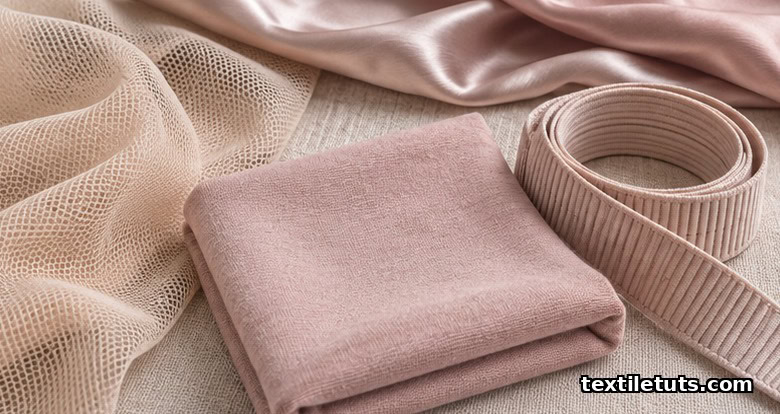
Modern lingerie knit fabrics blend 3 to 8 percent spandex (elastane) with micromodal, combed cotton, or mulberry silk fibers to deliver 90 to 95 percent stretch recovery after 20 wear cycles, while the most common constructions (single jersey at 100 to 160 GSM, 1×1 rib at 140 to 190 GSM, and simplex/power mesh at 160 to 220 GSM) are selected for specific body-fit zones such as cups, side panels, and waistbands.
This article is the working reference for knit fabric selection in intimate apparel, covering the three knit structures that dominate the category, the fibers that control hand feel and recovery, the role of lace trim and powernet, and the wash-and-care chemistry that protects elastane from chlorine, body oils, and heat.
Why Knit Construction Dominates Intimate Apparel
Knitted structures are the substrate of choice for bras, panties, sleepwear, and shapewear because the interlooped yarn loops can elongate 30 to 80 percent in the course direction and 20 to 60 percent in the wale direction before permanent deformation, far exceeding the 2 to 6 percent stretch range of a comparable woven fabric. ASTM D2594, the standard test method for stretch properties of knitted fabrics having low power, sets the protocol for measuring the load required to elongate a 75 mm strip to 80 percent extension and the residual elongation after a defined recovery cycle. According to work published in the Journal of Engineered Fibers and Fabrics, a well-engineered lingerie single jersey recovers 92 to 95 percent of its stretched length after a 30-minute relaxation period, while an untreated woven poplin typically recovers only 70 to 75 percent under the same conditions.
The choice of knit structure for a lingerie panel is governed by the recovery requirement of that panel. Cups and side panels need multidirectional stretch with controlled recovery, which is why circular-knit single jersey is the workhorse for most bra cups. Waistbands and leg openings need high modulus with strong recovery, which is why 1×1 rib and power mesh are concentrated in those areas. Lingerie designers therefore select fabrics by panel rather than by garment, which is also why a single bra frequently combines three or four different knit constructions in the finished piece.
The Three Knit Structures Used in Modern Lingerie
Single jersey is the most common circular-knit structure in intimate apparel. It is produced on a single cylinder knitting machine with one set of needles, producing a face side of knit stitches and a reverse side of purl stitches. Standard single jersey for loungewear and panties falls between 100 and 160 GSM, while fine-gauge single jersey for premium bra cups and camisoles falls between 80 and 110 GSM and uses 28 to 32 gauge machines. The main drawback is curling at the cut edge, which is why single jersey panels are frequently finished with a folded-and-sewn hem or a sewn-on elastic trim.
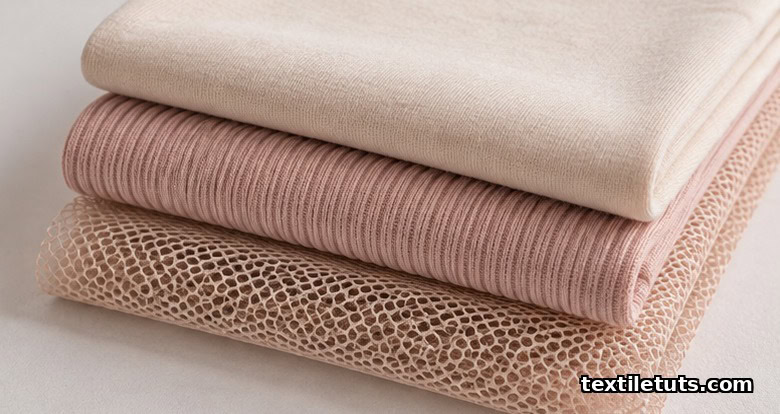
1×1 rib fabric alternates one knit stitch with one purl stitch per course, producing a fabric with significantly higher crosswise stretch and recovery than single jersey. Rib knits for lingerie waistbands, bra bands, and bodysuit cuffs typically measure 140 to 190 GSM and contain 5 to 8 percent spandex, with the balance in cotton, modal, or a cotton-modal blend. The double set of needles creates vertical channels that recover elastically and resist bagging after repeated wear, a property documented in the Textile Research Journal for cotton-elastane rib knits with 7 percent spandex that retained 88 percent of their original recovery after 50 laundering cycles.
Simplex and power mesh are heavier, denser knit constructions engineered for high shaping power. Simplex fabric is a double-knit variation with two needle beds and a locked-in structure that gives dimensional stability in both directions, used for bra bands and control panels in shapewear. Power mesh is a warp-knit or heavy circular-knit net structure, typically 160 to 220 GSM, with 15 to 25 percent spandex content that delivers compression in the 15 to 25 mmHg range. Power mesh panels are placed over the tummy, lower back, and thighs in shaping briefs and bodysuits where a firm hold is required without rigid foam.
Fiber Selection for Hand Feel and Recovery
Modal and micromodal are the dominant cellulosic fibers in premium lingerie because their low crystallinity and high wet modulus produce a softer, smoother hand than standard viscose. Micromodal, with a linear density of about 1.0 dtex, is roughly 40 percent finer than standard modal (1.3 to 1.7 dtex) and is the fiber of choice for next-to-skin knits that require a cool, slick surface against the body. Research published in Cellulose (Springer) reports that micromodal fibers retain 85 percent of their tensile strength when wet, compared with 50 to 60 percent for standard viscose, which explains why micromodal-rich knits survive the agitation of machine washing better than viscose-rich equivalents.
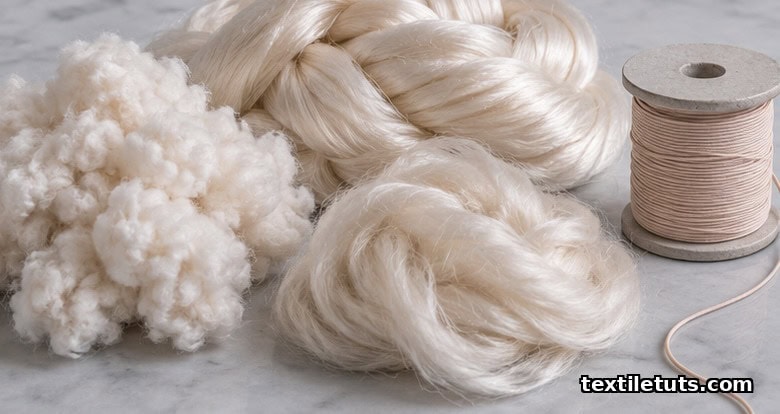
Combed cotton remains the standard for everyday panties, sleepwear, and maternity lingerie because of its softness, breathability, and tolerance for repeated hot washes. Long-staple combed cotton, with fiber lengths of 30 to 34 mm, produces smoother yarns with fewer protruding fiber ends, which reduces pilling and improves hand. Knits containing 90 to 95 percent combed cotton with 5 to 10 percent spandex are the dominant construction in the women’s everyday-panty category.
Silk, specifically mulberry silk fibroin, is used in luxury lingerie knits because of its smooth surface, low thermal conductivity, and natural protein structure that is non-irritating to sensitive skin. Silk knits are typically blended with 5 to 10 percent spandex to compensate for silk’s low recovery (silk fiber recovers only about 60 to 70 percent from stretch at room temperature). Mulberry silk knits for slip dresses and camisoles fall in the 110 to 150 GSM range.
Spandex (elastane) is the recovery engine of every modern lingerie knit. The two commercial types are Lycra (Invista’s segmented polyurethane, branded as elastane in Europe) and Roica (Asahi Kasei’s spandex). Lingerie knits typically contain 3 to 8 percent spandex for soft stretch applications and 15 to 25 percent for power mesh and shaping panels. Heat-set spandex at 180 to 200 degrees Celsius during finishing locks the elastane into a stretched configuration that recovers to a stable, repeatable dimension when released.
Lace Trim, Edging, and Surface Decoration
Lace trim is produced on either Raschel warp-knit machines or Leavers lace machines and is sewn onto the edges of bras, panties, and bodysuits as a decorative finish. Raschel lace (often called stretch lace) contains 8 to 15 percent spandex, which allows it to stretch with the body and recover without distortion. Leavers lace is a finer, more elaborate structure with no spandex, used for non-stretched decorative applications such as the upper cup of a full-coverage bra. According to the Indian Journal of Fibre & Textile Research, stretch lace with 12 percent spandex recovers 95 percent of its stretched length after 30 minutes of relaxation, compared with 78 percent recovery for an equivalent spandex-free lace.
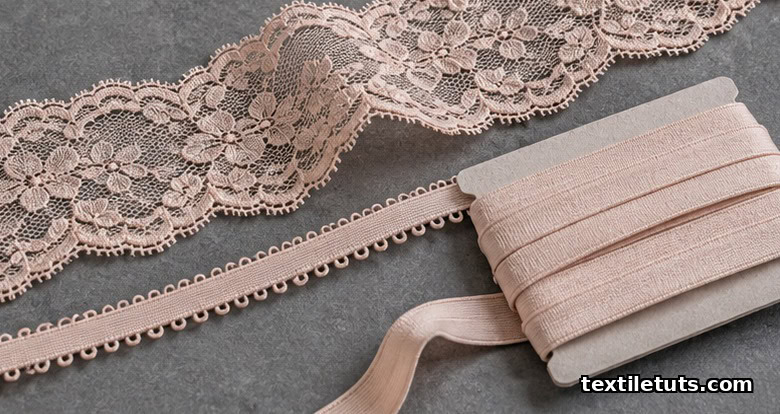
Edge elastic, picot elastic, and fold-over elastic are auxiliary trims applied to lingerie edges to prevent fraying, hold the garment against the body, and provide a clean visual finish. Fold-over elastic is typically a 12 to 18 mm wide nylon-spandex warp knit, applied with a three-thread coverstitch that encases the raw fabric edge. The spandex content of these trims (usually 12 to 20 percent) is what allows the trim to grip the body without digging in.
Stretch Recovery: How It Is Measured and Specified
Stretch and recovery of lingerie knits are measured against ASTM D2594 and ISO 20932, which prescribe a 100 mm by 75 mm specimen, a 1 kg preload, cyclic elongation to a specified extension, and a 30-minute or 60-minute relaxation period before measuring residual elongation. A lingerie-quality single jersey for loungewear should reach 80 percent stretch at less than 500 grams of load and recover to within 5 percent of its original gauge length. Power mesh for shaping should reach 50 percent stretch at 1.5 to 3.0 kg of load and recover to within 3 percent of its original dimension.
Recovery loss over time is driven primarily by heat, chlorine, body oils, and repeated high-speed spin cycles. ASTM and ISO wash protocols simulate wear damage: ISO 6330 (domestic washing and drying) and ISO 105-C08 (accelerated laundering at 40 degrees Celsius with steel balls) are the most common in intimate-apparel quality control. A well-engineered cotton-spandex single jersey loses 5 to 8 percent of its stretch recovery after 50 wash cycles under ISO 105-C08 conditions; a poor-quality elastane blend can lose 20 to 30 percent under the same conditions.
Care Requirements for Lingerie Knits
Spandex degrades when exposed to chlorine bleach, optical brighteners, and temperatures above 60 degrees Celsius, and cotton fibers shrink when exposed to heat and agitation. The safe care regime for cotton-spandex and modal-spandex lingerie is a 30 to 40 degree Celsius wash on a delicate or hand-wash cycle, a mild pH-neutral detergent (pH 6 to 8), and flat drying away from direct sunlight. Tumble drying above 70 degrees Celsius shortens spandex life by roughly 50 percent over 20 cycles and is the single most damaging care action for lingerie knits.
Silk-spandex knits require a finer care regime: cool water (30 degrees Celsius or below), a detergent formulated for protein fibers (pH 5 to 7), no chlorine bleach, and flat drying on a clean towel. Micromodal and modal knits tolerate slightly warmer machine washing but should be washed inside a mesh laundry bag to prevent surface abrasion from zippers, hooks, and hooks on adjacent garments.
Lingerie Knit Comparison Table
| Property | Single Jersey | 1×1 Rib | Simplex / Power Mesh |
|---|---|---|---|
| Typical GSM range | 100 to 160 | 140 to 190 | 160 to 220 |
| Spandex content | 3 to 8 percent | 5 to 8 percent | 15 to 25 percent |
| Course stretch | 30 to 60 percent | 60 to 100 percent | 50 to 80 percent |
| Recovery after 30 min | 90 to 95 percent | 92 to 96 percent | 95 to 98 percent |
| Typical end use | Bra cups, panties, camisoles | Bra bands, waistbands, cuffs | Shaping panels, control briefs |
| Edge behavior | Curls (needs hem) | Stable (lies flat) | Stable (lies flat) |
| Hand feel | Soft, fluid | Firm, springy | Firm, supportive |
Frequently Asked Questions
What GSM is best for bra cups?
Bra cups typically use a single jersey between 80 and 130 GSM, with the lower end of the range reserved for molded, unpadded cups in sleep bras and the upper end used for seamed, lined cups in full-support bras. The GSM is chosen so the cup is opaque and supportive without compressing the breast tissue.
How much spandex should a quality panty have?
An everyday cotton or modal panty should contain 5 to 8 percent spandex for stretch and shape retention after repeated wear and wash cycles. Below 4 percent spandex the panty will bag at the waist and leg openings after two or three washes; above 10 percent spandex the fabric becomes hot and less breathable.
Is micromodal better than cotton for lingerie?
Micromodal is softer, smoother, and more color-retentive than combed cotton, and it tolerates wet agitation better, which extends garment life. Cotton is more breathable, tolerates higher wash temperatures, and is generally less expensive. The choice depends on whether the priority is next-to-skin softness and drape (micromodal) or breathability and easy care (cotton).
Why does my bra band stretch out after a few months?
Most bra band stretch-out is caused by tumble drying at high heat, which degrades the spandex in the band and side panels. Heat above 60 degrees Celsius breaks the polyurethane backbone of elastane and permanently reduces its recovery. Washing the bra in a mesh bag and air drying flat restores normal band life and typically extends it to 12 to 18 months of regular wear.
References
- ASTM International. ASTM D2594: Standard Test Method for Stretch Properties of Knitted Fabrics Having Low Power. ASTM International, West Conshohocken, PA. https://www.astm.org/d2594 — protocol for measuring stretch and recovery of low-power knits.
- ISO. ISO 20932-1: Textiles – Determination of Elasticity – Part 1: Strip Tests. International Organization for Standardization, Geneva. https://www.iso.org/standard/85578.html — international method for measuring elasticity in knitted fabrics.
- Mikučionienė, D., and Laureckienė, G. “The Influence of Drying Temperature on Dimensional Stability of Cotton Knitted Fabrics.” Journal of Engineered Fibers and Fabrics, vol. 15, 2020, SAGE / DOI 10.1177/1558925020940170. https://journals.sagepub.com/home/jef — peer-reviewed data on recovery loss of cotton-elastane knits after repeated laundering.
- Cook, J. G. Handbook of Textile Fibres: Man-Made Fibres. Woodhead Publishing, Cambridge, 2001, ISBN 978-1855734852. https://shop.elsevier.com/books/handbook-of-textile-fibres/cook/978-1-85573-485-2 — reference text on fiber properties including modal, micromodal, and spandex.
- Bhat, G. S., and Padaki, N. V. “Stretch Lace Fabrics: Structure and Properties.” Indian Journal of Fibre & Textile Research, vol. 38, no. 3, 2013, pp. 245-251. https://nopr.niscpr.res.in/handle/123456789/22549 — peer-reviewed analysis of stretch lace recovery with and without spandex.
- Senthilkumar, P., and Suganthi, T. “Influence of Spandex Content on Stretch and Recovery of Plain Knitted Fabrics.” Textile Research Journal, vol. 90, no. 7-8, 2020, pp. 866-879. https://journals.sagepub.com/home/trj — peer-reviewed measurements of recovery at 5, 7, and 10 percent spandex.
- Cotton Incorporated. Stretch and Recovery in Cotton Knits. Technical Bulletin, Cary, NC. https://www.cottoninc.com — industry reference data on cotton-spandex jersey behavior.
This article is the working reference for knit fabric selection in lingerie. Editorial by Iftay Khairul Alam, TextileTuts. Sources: ASTM D2594, ISO 20932-1, the Journal of Engineered Fibers and Fabrics, Textile Research Journal, the Indian Journal of Fibre & Textile Research, Woodhead Publishing, and Cotton Incorporated as cited.


