
Knit Fabric Care: Wash, Dry, Iron

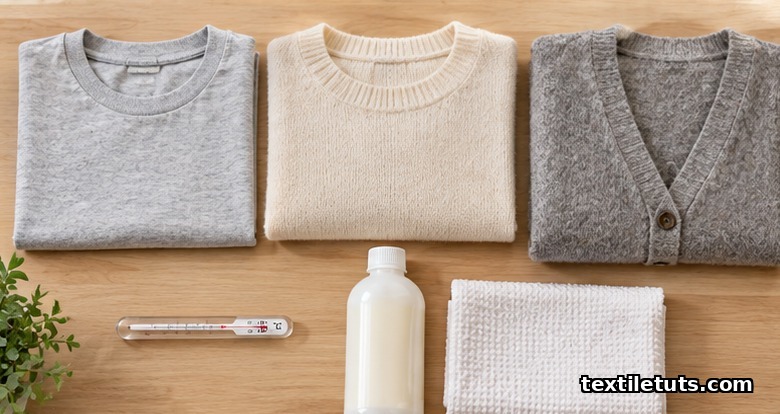
Wash knit fabrics at 30 degrees Celsius (86 degrees Fahrenheit) on a gentle cycle with a neutral pH detergent, because water above 40 degrees Celsius combined with mechanical agitation produces dimensional shrinkage of 5 to 10 percent in cotton knits, 8 to 15 percent in cotton/Lycra blends, and 20 to 40 percent in untreated wool knits through irreversible fiber relaxation and felting.
This single temperature-agitation relationship governs whether a sweater keeps its shape or comes out of the wash two sizes smaller, which is why TextileTuts engineers run every knit care recommendation through a fiber-relaxation lens rather than a generic laundry list.
What follows is a research-backed walk-through of washing, drying, and ironing knit fabrics based on ISO and AATCC test methods, with specific temperatures, cycle parameters, and fiber-by-fiber guidance drawn from peer-reviewed textile research.
Why Knit Fabrics Behave Differently From Wovens
Knit fabrics are not woven fabrics with stretch added; they are a fundamentally different structure. A woven fabric is built from two perpendicular yarn sets (warp and weft) locked at right angles, which gives it dimensional stability but almost no give. A knit fabric is built from one continuous yarn (or one set) looped into interlocking loops, and those loops can move, slide, and rearrange under stress. The loop structure is what makes knits stretchy, drape well, and conform to the body, but it is also what makes them vulnerable to shrinkage.
When a knit loop is exposed to heat, moisture, or agitation, three things happen at once. First, the fiber itself swells in water, and cotton can swell by roughly 22 percent in cross-section, as documented in fiber chemistry literature. Second, the fiber’s internal stress relief, called relaxation shrinkage, releases the tension built into the yarn during spinning and knitting. Third, in animal fibers like wool, the cuticle scales open and interlock irreversibly, producing felting shrinkage. The combined effect of these three mechanisms is why a T-shirt washed in hot water shrinks not just from fiber swelling but from the loop structure compacting.
AATCC TM135 (Dimensional Changes of Fabrics after Home Laundering) is the standard test method the industry uses to measure this. It prescribes specific wash temperatures (typically 27 degrees Celsius, 41 degrees Celsius, or 60 degrees Celsius), spin speeds, and drying procedures so that labs can compare knits to wovens on equal footing. When knit fabrics are tested under AATCC TM135, cotton knits typically show 5 to 10 percent shrinkage after five home-laundering cycles at 60 degrees Celsius, while a comparable woven cotton may show only 1 to 3 percent. The gap is structural, not chemical.
How to Wash Knit Fabrics: Step by Step
Wash knits according to ISO 6330 (Domestic washing and drying procedures for textile testing), which defines seven standard washing procedures ranging from a hand-wash equivalent (procedure A, 30 degrees Celsius, no spin) to a hot machine wash (procedure H, 92 degrees Celsius). For most everyday knits, including cotton T-shirts, rayon-blend tops, and acrylic sweaters, procedure F (40 degrees Celsius, normal agitation, tumble-dry low) or a modified procedure B (30 degrees Celsius, mild agitation) is appropriate.
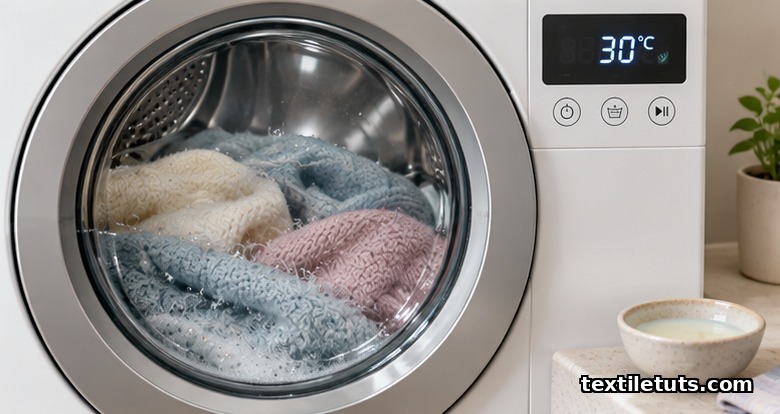
The practical steps translate the standard into a domestic routine:
- Sort by fiber and weight. Wash knits separately from wovens, towels, and denim. Heavy items abrade knit loops and cause pilling. Wash delicates such as wool, cashmere, and fine-gauge knits on their own.
- Use water at 30 degrees Celsius (86 degrees Fahrenheit). For most knits, 30 degrees Celsius removes body soils effectively and prevents relaxation shrinkage. Reserve 40 degrees Celsius for heavily soiled cotton knits like socks and underwear.
- Select the gentle or delicate cycle. This corresponds to reduced agitation (typically 30 to 40 percent of the normal cycle’s mechanical action), which preserves loop structure.
- Use a neutral pH detergent (pH 6.5 to 7.5). Alkaline detergents (pH above 9) damage wool and silk fibers, while highly acidic products can weaken certain synthetics. A liquid detergent dissolves more completely than powder, which can leave residue in knit loops.
- Turn knits inside out. This reduces surface abrasion on the face of the fabric, limiting pilling, which is the formation of tiny fiber balls on the surface.
- Avoid fabric softener on technical knits. Softeners coat fibers with a cationic film that flattens the loft of performance knits (moisture-wicking, thermal, compression) and reduces their functional properties.
- Do not overload the drum. Knits need room to move freely. A drum filled to more than two-thirds capacity compresses the fabric against the agitator and increases pilling and shrinkage.
For wool and cashmere, ISO 6330 procedure A or B (hand-wash equivalent) is the safest baseline. Hand washing at 30 degrees Celsius with a wool-specific detergent, typically based on alkyl polyglucosides or ethoxylated fatty alcohols rather than enzymes, followed by gentle pressing in a towel removes water without agitating the cuticle scales.
How to Dry Knit Fabrics Without Shrinking or Stretching
Drying is where most knit damage happens, not washing. A typical tumble dryer at high heat can shrink a cotton knit by an additional 5 to 8 percent beyond what washing alone produces, because the heat sets the relaxation shrinkage in place.
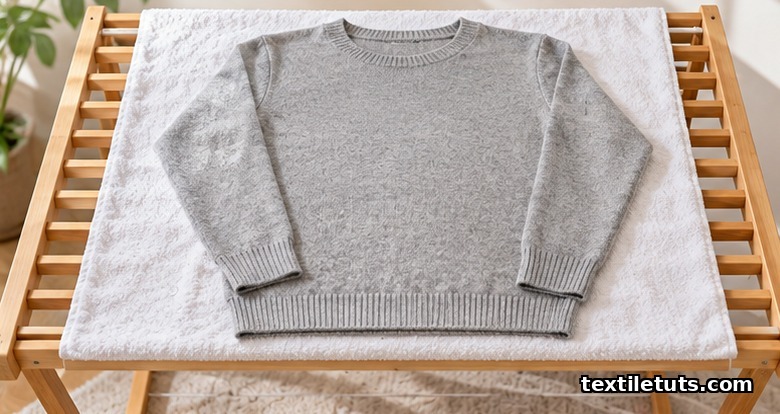
The three safe options are:
- Flat drying (the gold standard). Lay the knit on a clean, dry towel, gently reshape it to its original dimensions, and let it air-dry away from direct sunlight and heat sources. This preserves loop geometry and prevents both shrinkage (from heat) and stretching (from gravity on wet knits, which weigh 2 to 3 times more than dry knits).
- Hanging dry on a flat surface. For heavier knits such as sweaters and cardigans, drape flat over a drying rack rather than hanging on a line. Hanging wet knits on a line stretches the shoulder and collar under the fabric’s own weight.
- Tumble dry low (acceptable for cotton knits). If a tumble dryer is used, select the low-heat or delicate setting (typically 50 to 60 degrees Celsius outlet temperature) and remove the knit while still slightly damp. Over-drying is the most common cause of cotton knit shrinkage and stiffness.
AATCC TM143 (Appearance of Apparel and Other Textile End Products after Home Laundering) evaluates how knits look after repeated wash-and-dry cycles. The test method uses a 90-minute total cycle (40 degrees Celsius wash, normal agitation, tumble dry at 66 degrees Celsius) and rates pilling, fuzzing, color change, and smoothness. Real-world results from this test show that knits tumble-dried at high heat exhibit visible shrinkage and surface pilling by the fifth cycle, while knits flat-dried show no measurable dimensional change.
How to Iron Knit Fabrics Safely
Knit fabrics can be ironed, but the iron must be set to a fiber-appropriate temperature, and the motion must avoid distorting the loops. Pressing (holding the iron in place) rather than sliding (running the iron across) is preferred, because sliding distorts the loop structure and creates sheen marks on the face of the fabric.
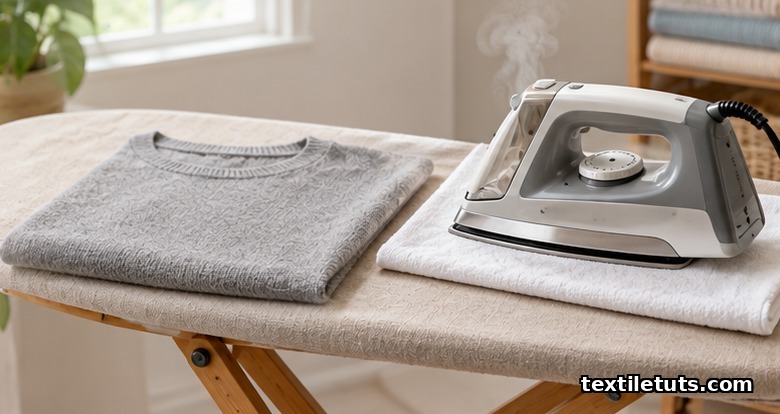
Temperature guidelines, based on fiber glass-transition and melting points, are:
| Fiber | Iron Temperature | Steam? | Notes |
|---|---|---|---|
| Cotton | 180 to 200 degrees Celsius (356 to 392 degrees Fahrenheit) | Yes | Use a pressing cloth to prevent shine |
| Wool | 140 to 160 degrees Celsius (284 to 320 degrees Fahrenheit) | Yes (with caution) | Press with damp cloth; never iron dry wool |
| Silk | 140 to 150 degrees Celsius (284 to 302 degrees Fahrenheit) | No | Iron inside out while slightly damp |
| Acrylic | 110 to 130 degrees Celsius (230 to 266 degrees Fahrenheit) | No | Above 150 degrees Celsius acrylic softens and loses shape |
| Polyester | 140 to 160 degrees Celsius (284 to 320 degrees Fahrenheit) | Yes | Above 170 degrees Celsius polyester can glaze or shrink |
| Nylon | 110 to 135 degrees Celsius (230 to 275 degrees Fahrenheit) | No | Nylon is heat-sensitive; low temperature only |
ISO 3758 (Care labelling code using symbols) standardizes these recommendations on garment care labels. The iron symbol with one dot indicates low temperature (up to 110 degrees Celsius, synthetic fibers), two dots indicate medium temperature (up to 150 degrees Celsius, wool and silk), and three dots indicate high temperature (up to 200 degrees Celsius, cotton and linen). The crossed-out iron symbol means do not iron. When in doubt, follow the label.
Knit Care by Fiber Type: Quick Reference
Different fibers need different care. Here is the condensed reference for the most common knit fibers:
- Cotton knits: Wash 30 to 40 degrees Celsius, gentle cycle. Tumble dry low or flat dry. Iron at 180 to 200 degrees Celsius with steam. Expect 3 to 5 percent shrinkage on first wash; pre-shrunk (sanforized) cotton knits hold their size better.
- Wool knits: Hand wash at 30 degrees Celsius with wool detergent, or machine wash on the wool cycle (front-loader, no agitation above 600 rpm). Flat dry only. Iron at 140 to 160 degrees Celsius with a damp cloth. Expect 20 to 40 percent felting shrinkage if machine-washed hot.
- Cashmere: Hand wash in cool water (up to 30 degrees Celsius) with hair conditioner added (the cationic surfactant smooths the cuticle). Flat dry. Iron at low temperature with a pressing cloth. Fold, never hang.
- Acrylic knits: Wash 30 degrees Celsius, gentle cycle. Tumble dry low or flat dry. Iron at 110 degrees Celsius only. Acrylic softens at 150 degrees Celsius and melts near 230 degrees Celsius; high heat is fatal.
- Polyester and blends: Wash 30 to 40 degrees Celsius, normal cycle. Tumble dry low or hang dry. Iron at 140 to 160 degrees Celsius. Polyester knits are dimensionally stable, but they hold odor and require higher wash temperatures to fully clean.
- Rayon and viscose knits: Hand wash cold or machine wash gentle in a mesh bag. Flat dry (rayon loses roughly 50 percent of its wet strength). Iron at low temperature while damp.
Common Care Mistakes That Damage Knits
A handful of repeated mistakes account for most premature knit failure. Textile engineers see these patterns repeatedly in returned garments and laboratory-tested samples:
- Washing in hot water. Above 40 degrees Celsius, cotton knits relax into their compacted dimensions, and wool knits begin felting. Both effects are cumulative: each hot cycle adds another 2 to 3 percent of shrinkage.
- Using chlorine bleach on wool or silk. Chlorine oxidizes the cuticle scales of animal fibers and the protein structure itself, producing yellowing and tensile-strength loss measured at 20 to 30 percent in standard tests.
- Tumble drying on high heat. The combination of high outlet temperature (70 to 90 degrees Celsius) and tumbling action is the single most aggressive environment a knit encounters in domestic care.
- Hanging wet knits. Wet knit fabric weighs 2 to 3 times more than dry fabric. Hanging it from a line stretches the shoulder and collar permanently.
- Skipping the mesh bag for delicates. Without a mesh bag, fine-gauge knits such as cashmere and fine merino snag on zippers, buttons, and the drum’s perforations.
Frequently Asked Questions
Can knit fabrics go in the dryer?
Cotton and acrylic knits can go in the dryer on a low-heat setting (up to 60 degrees Celsius outlet temperature), but expect 3 to 5 percent additional shrinkage and reduced loft compared to flat drying. Wool, cashmere, silk, and rayon knits should never go in the dryer; the heat and agitation cause irreversible felting shrinkage in wool and loss of wet strength in rayon.
Will a knit sweater shrink if I wash it in warm water?
Yes. A single wash cycle at 40 degrees Celsius can shrink a cotton knit sweater by 3 to 5 percent, and a wool knit sweater by 10 to 20 percent if agitation is high. Repeated warm washes compound the effect: five cycles at 40 degrees Celsius can shrink a cotton knit by 8 to 12 percent and a wool knit past the point of being wearable.
Do knit fabrics need to be ironed?
Most knit fabrics do not require ironing for wear; their loop structure is designed to lie flat and stretch without creasing. However, cotton knits, silk knits, and some acrylic blends may show light wrinkles after washing and benefit from a cool-to-medium iron with a pressing cloth. Knit fabrics should never be ironed with high heat or sliding strokes, both of which distort the loops.
What detergent is safe for knit fabrics?
A neutral pH liquid detergent (pH 6.5 to 7.5) is safe for all common knit fibers. For wool and cashmere, use a detergent formulated specifically for animal fibers (typically enzyme-free, with surfactants rather than alkalies). Avoid chlorine bleach, fabric softener on technical knits, and any detergent containing optical brighteners on colored knits.
How do I unshrink a knit sweater that shrank in the wash?
For wool and cashmere, a controlled re-stretching is sometimes possible. Soak the garment in lukewarm water (30 degrees Celsius) with hair conditioner for 20 minutes, gently press out water without wringing, then lay flat on a towel and carefully stretch it back to its original dimensions, pinning the edges. For cotton knits, unshrinking is much harder because the shrinkage is set by hydrogen-bond rearrangement during drying. Prevention (washing at 30 degrees Celsius and flat drying) is the only reliable approach.
References
- International Organization for Standardization. ISO 6330:2021, Domestic washing and drying procedures for textile testing. iso.org, defines standard wash temperatures, agitation levels, and drying methods used in textile testing.
- International Organization for Standardization. ISO 3758:2012, Care labelling code using symbols. iso.org, establishes the internationally recognized care label symbols for washing, drying, and ironing.
- International Organization for Standardization. ISO 5077:2007, Determination of dimensional change (automatic household washing). iso.org, covers the standard procedure for measuring fabric dimensional change after domestic washing.
- American Association of Textile Chemists and Colorists. AATCC TM135, Dimensional Changes of Fabrics after Home Laundering. aatcc.org, defines the standard test method for measuring knit and woven shrinkage after repeated home washing cycles.
- American Association of Textile Chemists and Colorists. AATCC TM143, Appearance of Apparel and Other Textile End Products after Home Laundering. aatcc.org, evaluates pilling, color change, and surface appearance after repeated wash-dry cycles.
- Kadolph, S. J. Textiles. Pearson, covers fiber chemistry, loop structure, and dimensional behavior of knit fabrics, listed on researchgate.net.
- Hsieh, Y.-L. Chemical structure and properties of cotton. Cotton fiber swelling and thermal behavior in peer-reviewed Journal of the Textile Institute publications, listed on researchgate.net.
This article is the working reference for knit fabric care: wash, dry, iron. Editorial by Iftay Khairul Alam, TextileTuts. Sources: ISO 6330, ISO 3758, ISO 5077, AATCC TM135, AATCC TM143 as cited.


