
Knit Fabric Brushing: Fleece Production

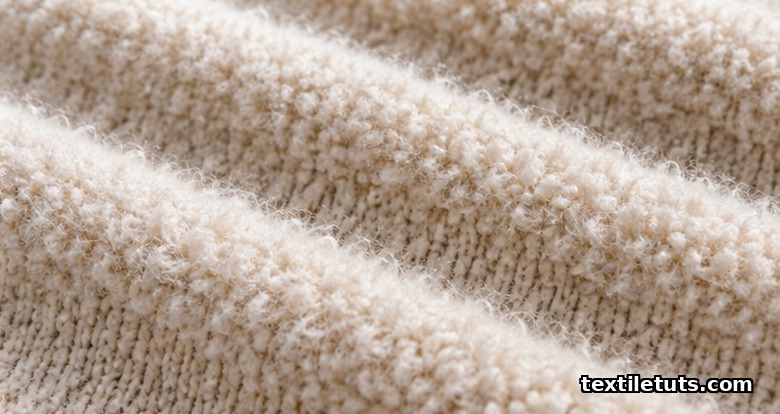
Brushing converts circular-knit jersey into fleece by lifting 5-30% of surface fiber ends out of the yarn structure with rotating card-wire rollers turning at 1000-1500 RPM while the fabric runs at 8-15 m/min, which typically raises finished fabric weight by 12-25% and creates the loft layer that traps still air for thermal insulation in apparel.
The same mechanical process produces interlock fleece, three-end fleece, French terry fleece, and brushed-back jerseys used in hoodies, sweatpants, and base layers. When the parameters are tuned correctly, brushing softens the fabric hand, increases apparent thickness by 0.5-2.0 mm, and improves thermal resistance (clo value) by 30-60% compared to unbrushed knit. When the parameters are wrong, it shreds yarn, drops tensile strength by 15-30%, and pills within a single home laundry cycle.
This article covers how raising machines work, the fabric variables that govern the result, the standards used to grade brushed fleece, and the process windows that consistently produce a pill-resistant hand-feel for production teams and textile students.
What Brushing Does to a Knitted Loop Structure
Brushing (also called raising) is a dry-finishing mechanical process. A set of cylindrical rollers fitted with card-wire raising fillets rotates against the fabric surface in alternating directions. The wire points catch looped fibers that bridge several needles in the knit loop and pull them out as a raised nap. After raising, the fabric carries two surfaces: a clean reverse side and a fiber-covered face that scatters light and traps air.
The raised fibers are not new material. They come from within the yarn itself. A typical ring-spun cotton yarn contains fibers 28-35 mm long, of which roughly half protrude slightly from the yarn surface. Brushing reorients those protruding ends perpendicular to the fabric plane. The number of fibers lifted depends on:
- Yarn twist factor (lower twist lifts more easily but weakens yarn strength)
- Fiber length (longer fibers hold their position better after lift)
- Fabric tightness factor (looser stitches expose more fiber)
- Number of raising passes (each pass lifts additional fiber)
- Roller speed differential (faster wire against fabric produces more aggressive lift)
ISO 1833 chemical-analysis methods are commonly used after brushing to confirm fiber composition, since a knit-blend fleece with 20% broken fibers behaves very differently from a 95/5 cotton-elastane fleece during wear and wash.
From Greige Fabric to Brushed Fleece: The Production Sequence
Brushing is one step in a six-stage sequence. Skipping any stage or reordering them produces unstable fleece that flattens, pills, or shrinks unevenly after a few home laundries.
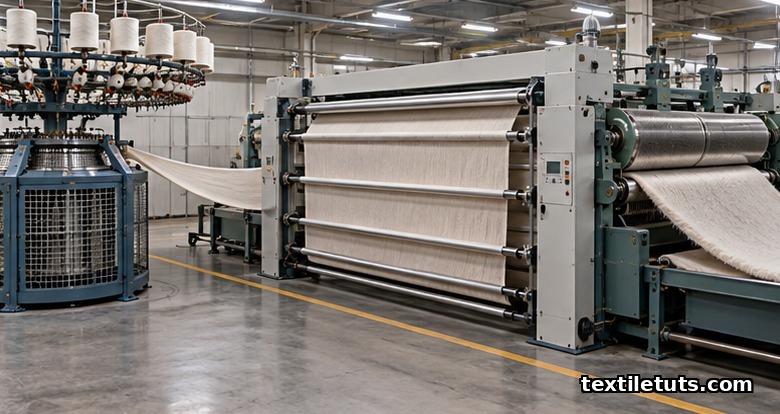
- Knitting: circular knit (jersey, interlock, or three-end fleece with a tie-in yarn) on an 18-32 gauge machine. Tightness factor typically 12-15 for a stable base that resists distortion during raising.
- Pre-treatment: scouring at 95 °C with anionic-nonionic surfactant, bleaching with hydrogen peroxide at pH 10.5-11.0, then neutralization to pH 6.5-7.5 (verified with ISO 3071).
- Drying on a stenter or tensionless dryer: over-drying hardens the loops and reduces brushing efficiency, so residual moisture is held at 8-12% before the brush line.
- Brushing (raising): the focus of this article, covered in the next sections.
- Stabilizing/compacting: compressive shrinking at 0-5% overfeed locks raised fibers into the loop stems and recovers pile height after wash.
- Final dyeing or bleaching: depending on whether the fabric was pre-treated white or piece-dyed.
A typical cotton-rich brushed fleece comes off the knitting machine at 220-260 GSM and exits the brush-and-compact line at 260-340 GSM. The 15-30% weight gain is mostly air trapped between raised fibers, not additional fiber mass.
Raising Machines and Roller Setup
Modern raising lines use 24-36 rollers in series, split between card-wire raising rollers and polishing rollers. Each roller can be set to one of three directions relative to fabric travel, and the sequence of those directions determines whether the machine lifts aggressively or smooths the nap.
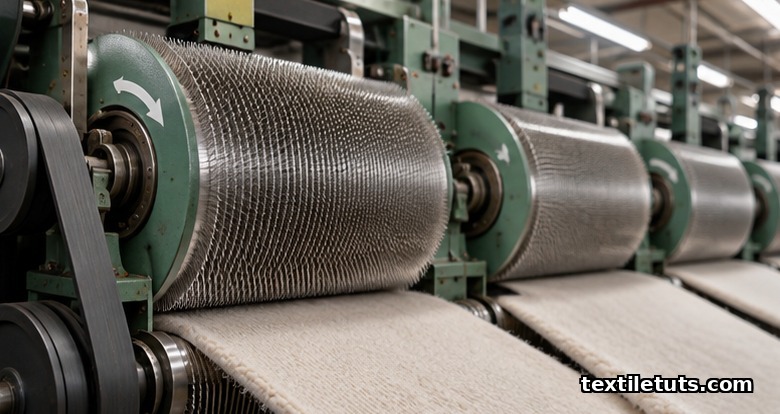
| Roller Type | Wire Orientation | Function |
|---|---|---|
| Card-wire raising (steel) | Against fabric travel | Primary lifting, aggressive on fiber ends |
| Card-wire raising (with direction) | With fabric travel | Smoothes raised nap, evens fiber length |
| Polishing roller (felt or soft rubber) | With fabric travel | Aligns raised fibers, adds soft hand |
Raising intensity is governed by five operating parameters:
- Wire count and angle: 30-44 wires per cm²; 0 degree angle (radial) for the raise, slightly tilted (5-10 degrees) for the polish pass.
- Roller surface speed: 8-15 m/min for fabric, 1000-1500 RPM for rollers (50-90 m/min peripheral). Speed differential equals fiber aggressiveness.
- Fabric tension: 0.5-1.5 N/cm. Higher tension means a cleaner raise but more yarn breakage.
- Number of passes: 1-4 passes depending on fabric weight. More passes on heavier fleeces (300+ GSM).
- Fabric moisture: 8-12% moisture gives the best lift. Over-dry fabric (under 5%) creates dust and static, while over-wet (over 18%) flattens the raise.
Production case studies on cotton-rich fleece note that roller speeds above 1200 RPM with under-tensioned fabric drop yarn tenacity by 18-25% compared to the unbrushed control, which is why roller speed, fabric tension, and pass count are tuned together, not in isolation.
Process Variables That Control the Raise
Five variables account for roughly 80% of pile-height variation in production runs. Treating them as factors, not constants, is the difference between a stable fleece and a defective one.
1. Yarn twist factor (alpha). A fleece yarn at alpha 4.0 lifts cleanly and produces a dense pile. Alpha 3.6 produces a fluffier pile but the tension-tested tensile strength drops 10-15% on the face side. An alpha of 3.8-4.0 is the common compromise between lift and strength.
2. Knit loop length. Longer loops give more fiber to lift. A loop length below 2.8 mm produces a tight, low-pile face. Above 3.4 mm produces a high pile but a slack hand and a visible loop pattern visible through the raised fibers.
3. Pre-treatment uniformity. Residual warp sizing, knitting oil, or peroxide residues stiffen fibers and break rather than lift them. Scouring and bleaching must reach 95-99% absorbency on the drop test before the brush line.
4. Roller age and wire condition. Card-wire raising rollers lose aggressiveness linearly with hours run. Poly-cotton lines average 800-1500 hours of service before re-surfacing. Cotton-rich lines run 400-700 hours. Worn wires leave unraised stripes that show as visible bands in piece-dyed fabric.
5. Compaction after brushing. Compressive shrinking at 0-5% overfeed stabilizes the raised nap. Fleece without compaction recovers only 35-50% of original pile height after 5 home laundries per AATCC TM 135. Fleece with compaction recovers 70-85% over the same wash cycles.
Standards Used to Grade Brushed Fleece
Fleece performance is judged on three axes: dimensional stability, surface durability, and chemical safety. The relevant standards are:
| Property | Standard | Method Summary |
|---|---|---|
| Dimensional change after home laundering | AATCC TM 135 / ISO 5077 | 5 wash cycles at 40 °C, tumble dry, measure warp and weft shrinkage |
| Pilling resistance (Martindale) | ASTM D4970 / ISO 12945-2 | 125-2000 cycles on Martindale, rated 1-5 |
| Abrasion resistance | ASTM D4964 / ISO 13937 | Inflated diaphragm or rotary platform |
| Fabric pH | ISO 3071 / AATCC TM 81 | Extract with water, measure pH; target 4.0-7.5 |
| Formaldehyde (if finish added) | ISO 14184-1 | Free and released formaldehyde, target under 75 ppm |
| Fiber composition | ISO 1833 | Quantitative chemical separation, e.g., cotton/polyester ratio |
A well-tuned fleece typically scores 4-5 (no pilling) on ASTM D4970 after 2000 cycles and shrinks 3-5% in warp, 1-3% in weft after AATCC TM 135 five-wash cycles.
Cotton, Polyester, and Cotton-Polyester Brushed Fleece Compared
| Property | 100% Cotton | 100% Polyester | 80/20 Cotton-Poly |
|---|---|---|---|
| Pre-brush GSM (typical) | 220-260 | 180-220 | 200-240 |
| Post-brush GSM lift | +15-20% | +8-12% | +12-18% |
| Thermal resistance change (clo) | +0.15-0.20 | +0.10-0.15 | +0.13-0.18 |
| Pilling (ASTM D4970, 2000 cycles) | 3-4 | 4-5 | 4 |
| Shrinkage after 5 home washes (AATCC TM 135) | 5-8% | 1-2% | 3-5% |
| Hand after brushing | Soft, natural | Slick, synthetic | Soft with stability |
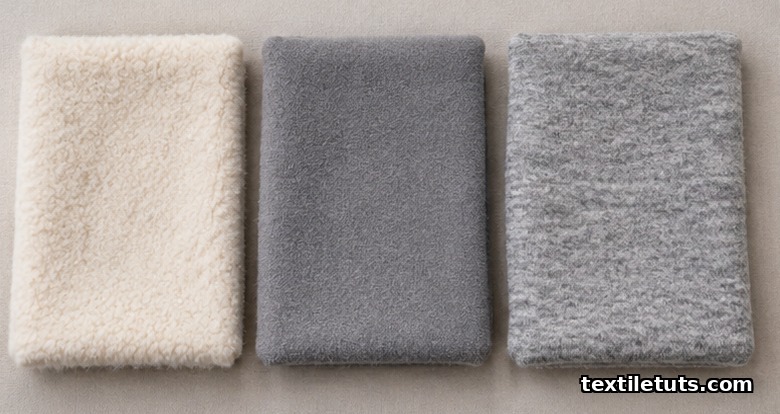
Cotton-only fleece breathes well and absorbs moisture but pills faster and shrinks more. Polyester-only fleece is dimensionally stable and quick-drying but does not absorb sweat and tends to develop static at low humidity. The 80/20 cotton-poly blend balances the two, which is why it dominates the hooded-sweatshirt and athleisure markets.
Frequently Asked Questions
What is the difference between brushing and raising?
In textile finishing, brushing and raising refer to the same mechanical process: using card-wire rollers to lift fiber ends out of the yarn surface. The terms are used interchangeably in ISO and AATCC documents. Some mills distinguish “brushing” as a lighter pass (1-2 roller turns, mostly polish) and “raising” as the deeper lift (multi-pass with steel wire), but the equipment and the underlying action are the same.
Does brushed fleece shrink?
Yes, cotton-rich brushed fleece shrinks 3-8% in warp and 2-5% in weft after five home laundries per AATCC TM 135 (40 °C wash, tumble dry). Compacting after brushing reduces this by 40-60%, which is why production lines always pair a raising unit with a compressive shrinker such as a Sanforizing range. 100% polyester fleece barely shrinks (under 2%) because polyester heat-set fibers resist relaxation, but it can stretch back out under body heat during wear.
Why does brushed fleece pill so quickly sometimes?
Pilling is loose raised fibers that broke free instead of staying anchored in the yarn. The most common cause is worn or under-rotated raising wire, which tears fibers instead of pulling them out cleanly. A second common cause is over-brushing: too many passes (over 4 on a 280 GSM substrate) at too high a roller speed (over 1500 RPM) weakens the fibers and creates surface pills visible within the first wash. A control run with ASTM D4970 checked at 125, 500, 1000, and 2000 cycles catches the problem before shipment.
Can polyester fleece be brushed?
Yes, but polyester requires higher roller speeds (1100-1500 RPM) and lower fabric tension (0.3-0.8 N/cm) than cotton because polyester filaments are smooth and do not lift easily. Specialized raising fillets with finer wires (44+ wires/cm²) and tilted angle settings raise a usable pile on polyester. The lift percentage is lower than cotton: typically 8-12% on polyester versus 15-20% on cotton at the same tension.
Is brushed fleece safe for sensitive skin?
Untreated cotton fleece is generally safe. Once a fabric is finished with crease-resin (DMDHEU) or other crosslinking agents, free and released formaldehyde can exceed 75 ppm unless monitored. ISO 14184-1 caps formaldehyde content for next-to-skin garments. The brushed process itself does not add formaldehyde, but mills that brush dyed fabrics with pigment prints or wrinkle-free finishes should run regular ISO 14184-1 checks and verify pH with ISO 3071 stays in the 4.0-7.5 safe-to-wear window.
References
- ISO. (2019). ISO 1833: Textiles, Quantitative chemical analysis. International Organization for Standardization. https://www.iso.org/standard/66824.html
- ISO. (2007). ISO 5077: Textiles, Determination of dimensional change. International Organization for Standardization. https://www.iso.org/standard/39321.html
- ISO. (2020). ISO 3071: Textiles, Determination of pH of the aqueous extract. International Organization for Standardization. https://www.iso.org/standard/77317.html
- AATCC. (2018). TM 135: Dimensional Changes of Fabrics After Home Laundering. American Association of Textile Chemists and Colorists. https://www.aatcc.org/aatcc-test-methods/
- ASTM International. (2022). ASTM D4970: Standard Test Method for Pilling Resistance and Other Related Surface Changes of Textile Fabrics (Martindale). ASTM International. https://www.astm.org/d4970_d4970m-22.html
- ISO. (2020). ISO 14184-1: Textiles, Determination of formaldehyde. International Organization for Standardization. https://www.iso.org/standard/76440.html
This article is the working reference for knit fabric brushing and fleece production. Editorial by Shahrukh Islam, TextileTuts. Sources: ISO 1833, ISO 5077, ISO 3071, AATCC TM 135, ASTM D4970, and ISO 14184-1 as cited.


