
Knit Fabric Air Permeability Test

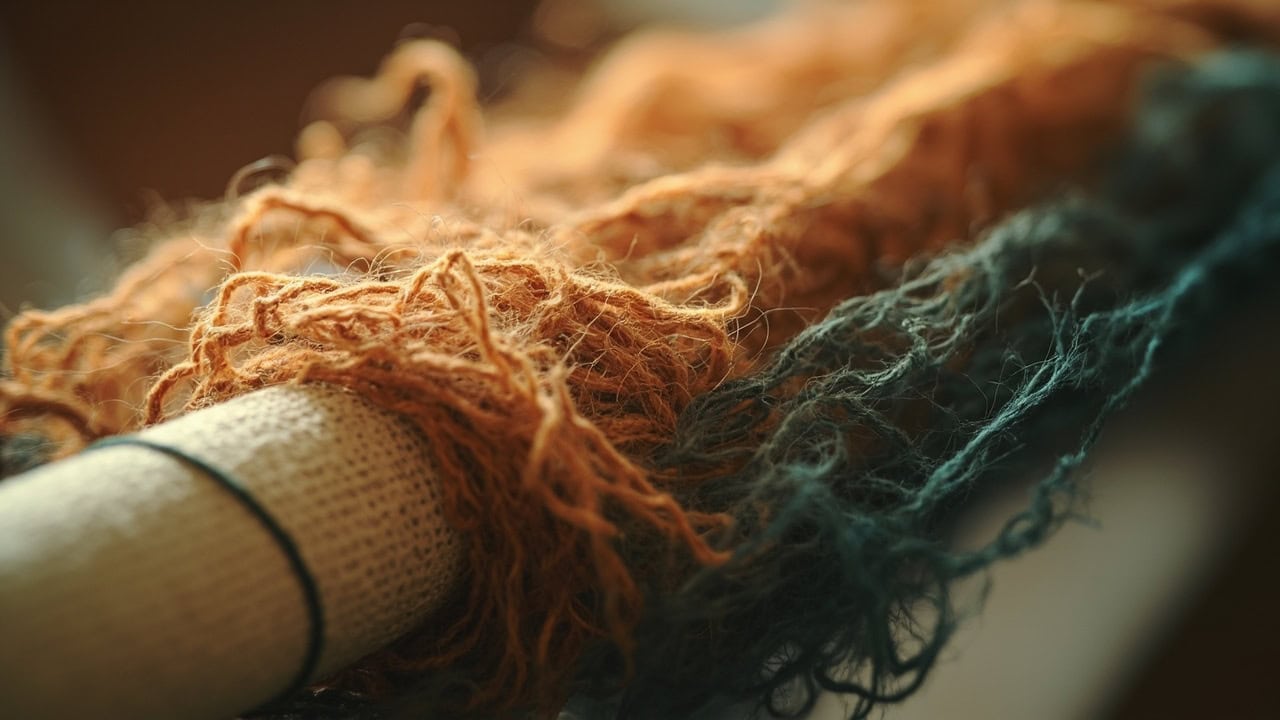
Knit fabric air permeability is measured at 1,000-2,500 cm³/cm²/s for a 150-200 GSM single-jersey cotton tested under a 100 Pa pressure differential per ISO 9237, with 1×1 rib and interlock constructions dropping to 400-900 cm³/cm²/s and open-mesh raschel nets exceeding 5,000 cm³/cm²/s.
The number tells a textile engineer how freely air moves through the loop structure, which governs breathability for sportswear, thermal comfort for base layers, wind resistance for outerwear shells, and filtration efficiency for technical knit filters.
This article walks through the ISO 9237 and ASTM D737 test methods, the apparatus and conditioning that decide a final reading, the construction variables in weft and warp knits that shift a value by an order of magnitude, and how to interpret a test certificate without misreading the units.
What Air Permeability Measures in a Knitted Fabric
Air permeability is the volumetric flow rate of air passing perpendicularly through a fabric under a specified pressure differential, normalised by the test area. The SI unit used by ISO 9237 and most accredited labs is cubic centimetres per square centimetre per second (cm³/cm²/s) at a defined pressure drop in pascals (Pa). The imperial equivalent used by ASTM D737 is cubic feet per square foot per minute (ft³/ft²/min), with 1 ft³/ft²/min ≈ 5.08 cm³/cm²/s.
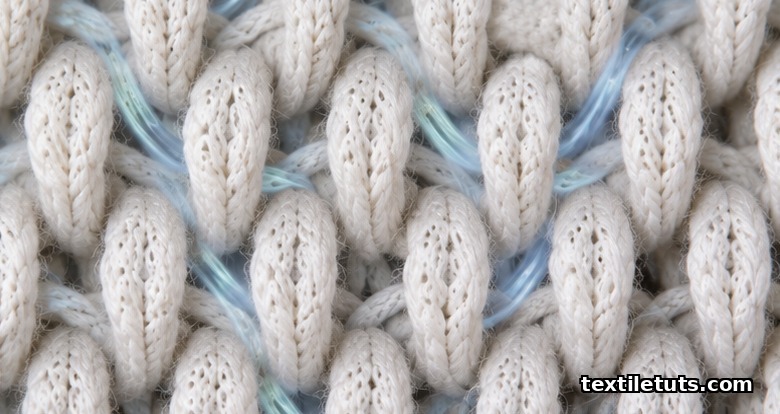
For knit fabrics, the measurement reflects the porosity of the loop structure: the inter-yarn channels between courses and wales, and the intra-yarn gaps between fibres inside each loop. A loose, open knit lets air move freely and raises the reading. A tight, compact knit restricts flow and lowers it. The reading is sensitive enough to detect finishing-induced compaction (compacting, calendaring, compressive shrinkage) and to flag accidental over-stretching during knitting or heat-setting.
Two practical properties follow directly: thermal resistance and moisture-vapour transport. Higher air permeability usually correlates with better breathability and faster drying; lower permeability correlates with windproofing and better particulate capture. Neither extreme is universally good, which is why knit spec sheets specify a target window, not a single optimum.
Test Methods: ISO 9237 vs ASTM D737
Two standards dominate the field. ISO 9237:1995, “Textiles, Determination of permeability of fabrics to air,” prescribes a fixed test pressure of 100 Pa (10 mm water column) across a 5, 20, 50, or 100 cm² circular test head, with results expressed in cm³/cm²/s at 100 Pa. ASTM D737, “Standard Test Method for Air Permeability of Textile Fabrics,” uses a fixed pressure of 125 Pa (0.5 in water column) on a 38.3 cm² (5.94 in²) head, with results reported in ft³/ft²/min.
Because the pressure differentials are close (100 Pa vs 125 Pa), the readings can be cross-compared after unit conversion with little error from the pressure term itself. What cannot be ignored is the head area: ISO results from a 100 cm² head run about 4-8% higher than the same fabric on a 20 cm² head on knit fabrics, because the larger area smooths out local stitch-density variations.
For routine quality control on knit fabrics, ISO 9237 with a 20 cm² head at 100 Pa is the most common combination. For technical-textile certification and US military or medical contracts, ASTM D737 with a 38.3 cm² head at 125 Pa is the default. Always run a calibration check with the manufacturer’s reference plate before reporting numbers on a new fabric or a new instrument.
Apparatus, Conditioning, and Test Procedure
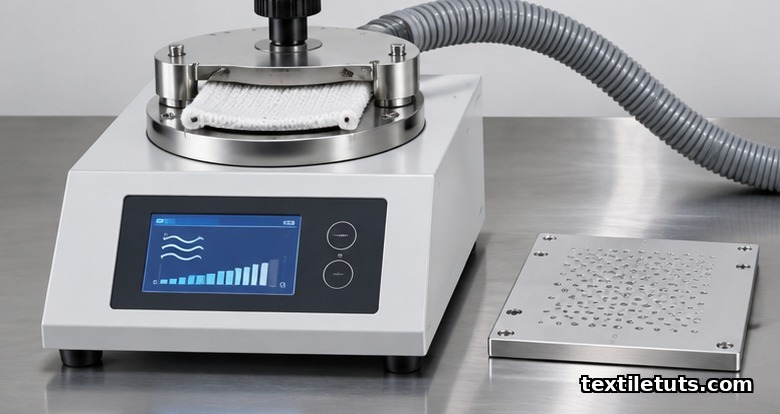
The instrument is an air-permeability tester (for example, the SDL Atlas M021A, the TEXTEST FX 3300, or the TESTEX TO 451). Inside, a suction pump draws air through the clamped specimen, an inline flowmeter measures the volumetric flow that produces the target pressure differential across the fabric, and a digital readout displays the result directly in the chosen unit.
Conditioning comes first. Specimens are pre-conditioned, then conditioned for 24 hours at 20 ± 2 °C and 65 ± 4% relative humidity per ISO 139, because hygroscopic fibres like cotton, wool, and viscose swell with humidity and shrink the air channels. Air permeability on a cotton single jersey drops 8-15% when relative humidity rises from 40% to 90%. The standard atmosphere matters more for knit fabrics than for tightly woven ones, where yarn crimp dominates the geometry.
Five specimens per sample is the minimum per ISO 9237; ten is preferred for knits because stitch spacing creates local variation. Specimens are clamped flat without face distortion that would stretch the loops and falsely raise the reading. The reading is taken once steady-state flow is reached, typically within 30-60 seconds of pump start, and recorded with the test head area, test pressure, and which fabric side faced the flow.
Knit Construction Variables That Shift the Reading
Five construction variables dominate the air-permeability reading on a knit fabric, listed in order of impact.
Stitch density (courses × wales per cm). Holding yarn count and loop length constant, doubling stitch density roughly halves air permeability because the inter-loop channels narrow. A 24-gauge single jersey at 18 courses/cm reads near 1,800 cm³/cm²/s; the same yarn knitted at 24 courses/cm reads near 950 cm³/cm²/s.
Loop length. Longer loops open up the structure and raise permeability. Every 1% increase in loop length raises air permeability by roughly 1.5-2% in cotton single jersey, because the loop arch flattens and exposes the inter-yarn channel.
Yarn count and hairiness. Finer yarns leave larger inter-yarn gaps and raise permeability; hairy spun yarns trap air in the protruding fibres and lower it. A 30 Ne combed-cotton single jersey reads 10-20% higher than a 30 Ne carded-cotton jersey at the same stitch density, because combing removes short fibres that would otherwise bridge the channels.
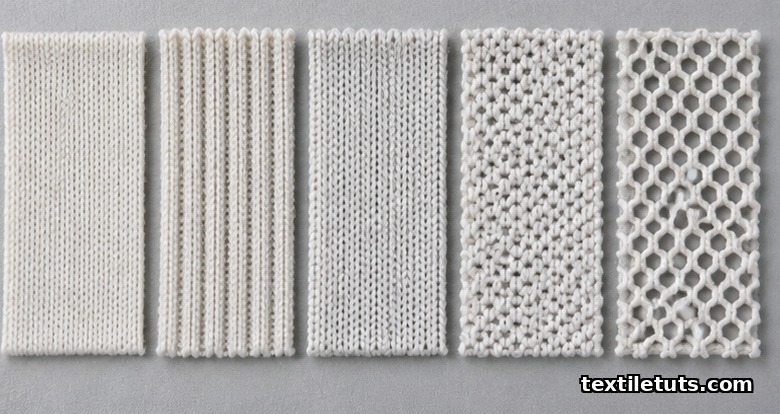
Knit structure. Plain jersey, rib 1×1, interlock, and piqué sit at progressively lower permeability. Plain jersey exposes both faces fully and reads highest; 1×1 rib alternates face and back loops and reduces flow; interlock layers two jersey faces back-to-back and drops flow by 30-45%; piqué adds tuck floats and reads lowest among the common weft knits. Warp-knit meshes (tricot, raschel, net) span a much wider range, from 200 cm³/cm²/s for tight raschel curtain netting to 8,000+ cm³/cm²/s for open agricultural nets.
Finishing and compaction. Compacting and calendaring physically collapse the loops, dropping air permeability by 20-40%. Singeing removes surface hair, which can raise the reading slightly. Softener application can lower it if the softener film bridges the inter-yarn channels.
Typical Air-Permeability Ranges for Common Knits
| Knit structure | Fibre / count | GSM | Air permeability (cm³/cm²/s at 100 Pa, 20 cm² head) |
|---|---|---|---|
| Single jersey | Cotton 30 Ne combed | 150-180 | 1,400-2,200 |
| Single jersey | Cotton 30 Ne carded | 160-190 | 1,100-1,700 |
| Single jersey | Polyester 150 den filament | 120-150 | 1,800-2,800 |
| 1×1 rib | Cotton 30 Ne | 180-220 | 800-1,200 |
| Interlock | Cotton 40 Ne | 200-240 | 450-800 |
| Piqué (Lacoste) | Cotton 30 Ne | 200-240 | 350-650 |
| French terry (loop back) | Cotton 30 Ne | 280-340 | 300-550 |
| Fleece (brushed back) | Polyester/cotton 50/50 | 280-340 | 150-350 |
| Raschel warp-knit net | Polyester 75 den | 60-90 | 5,000-9,000 |
| Tricot (locknit) | Polyester 50 den | 80-120 | 1,500-2,500 |
Use these ranges as a sanity check on incoming goods. A single jersey that reads below 800 cm³/cm²/s almost certainly has unexpected compaction or a heavier yarn than the spec sheet claims; a fleece that reads above 600 cm³/cm²/s has probably missed the brushing step.
Calculating Air Permeability From Raw Flow Data
ISO 9237 reports the result directly in cm³/cm²/s from the instrument readout. When running a manual calculation, the formula is:
R = qv / (A × 0.167 × Δp)
where R is the air permeability in metres per second, qv is the measured volumetric flow rate in cm³/s, A is the test area in cm², Δp is the pressure differential in Pa, and 0.167 is the kinematic viscosity of air at 20 °C in cm²/s. To convert R to the more familiar cm³/cm²/s at 100 Pa, multiply R by 100 (Pa) and divide by 0.167. Most accredited labs report the instrument’s direct readout and skip this arithmetic, but the formula is useful when troubleshooting a non-standard pressure setting.
ASTM D737 uses the same physical principle but fixes Δp at 125 Pa, so the formula simplifies to R (ft³/ft²/min) = qv / A × 0.0254, where the constant absorbs the area unit conversion and the 125 Pa reference pressure.
Frequently Asked Questions
What is a good air-permeability value for a sportswear single jersey?
For running shirts and base layers, a target of 1,200-2,000 cm³/cm²/s at 100 Pa balances breathability and modesty coverage. Below 800 cm³/cm²/s the fabric tends to feel clammy in warm conditions; above 3,000 cm³/cm²/s the knit is usually too transparent for a single-layer top and shows the skin underneath when stretched.
Does higher GSM always mean lower air permeability?
No. GSM and air permeability correlate loosely within a single construction at a fixed yarn count, but the relationship breaks down across constructions and finishes. A 280 GSM brushed fleece at 200 cm³/cm²/s and a 160 GSM single jersey at 1,800 cm³/cm²/s illustrate the spread: GSM measures mass per area, while air permeability measures open-channel geometry. A compacted 140 GSM jersey can read lower than an uncombed 200 GSM jersey of the same yarn.
Can I compare ISO 9237 and ASTM D737 numbers directly?
Yes, after a unit conversion. ISO 9237 reports cm³/cm²/s at 100 Pa, and ASTM D737 reports ft³/ft²/min at 125 Pa. The pressure differentials are within 25% of each other, so unit conversion is the dominant adjustment. Multiply ISO cm³/cm²/s by 0.197 to get ft³/ft²/min, or multiply ASTM ft³/ft²/min by 5.08 to get cm³/cm²/s. For an apples-to-apples audit, re-test the same fabric on both instruments under their respective standards and confirm agreement within 8-10%.
Why do my results drop in summer and rise in winter?
Laboratory relative humidity is the usual culprit, not the season itself. ISO 139 fixes the test atmosphere at 65 ± 4% RH, but uncontrolled lab conditions can swing from 45% RH in winter to 80% RH in summer. Cotton, wool, and viscose swell at higher RH and the inter-loop channels narrow, dropping the reading by 8-15%. Always record the lab’s humidity log with the test report; if the lab cannot hold 65 ± 4% RH, note the deviation on the certificate so downstream buyers know the comparison conditions.
Does yarn twist direction affect air permeability?
Twist direction (Z vs S) has a small effect on knit permeability because it changes how the loops settle into the structure, but the effect is usually under 5% in commercial knit fabrics and is dwarfed by stitch density, loop length, and finishing. Twist level (turns per metre) matters more: low-twist yarns sit flatter, expose more inter-yarn channel, and raise the reading by 5-10% relative to high-twist yarns of the same count.
References
- International Organization for Standardization. ISO 9237:1995, Textiles, Determination of permeability of fabrics to air. iso.org. Primary international test method; fixes test pressure at 100 Pa and head area at 5, 20, 50, or 100 cm².
- ASTM International. ASTM D737-18, Standard Test Method for Air Permeability of Textile Fabrics. astm.org. US equivalent; fixes test pressure at 125 Pa, head area at 38.3 cm², and reports in ft³/ft²/min.
- International Organization for Standardization. ISO 139:2005/Amd 1:2011, Textiles, Standard atmospheres for conditioning and testing. iso.org. Specifies 20 °C and 65% RH conditioning that governs ISO 9237 specimen preparation.
- Bivainyté, A., and Mikučioniené, D. “Influence of shrinkage on air permeability of knitted fabrics.” Materials Science (Medziagotyra). Peer-reviewed study on how wet relaxation and finishing shifts air-permeability readings on cotton weft knits.
- Čiukas, R., Abramavičiūté, J., and Kerpauskas, P. “Investigation of the air permeability of knitted fabrics.” Materials Science (Medziagotyra). Peer-reviewed study correlating stitch density, yarn count, and knitting parameters with air-permeability results.
- Ogulata, R. T. “Air permeability of woven and knitted fabrics.” Fibres & Textiles in Eastern Europe (and related peer-reviewed sources). Comparative study covering test conditions and structure-property relationships.
- ScienceDirect topic collection. “Air permeability of textile fabrics” (multiple peer-reviewed papers). Research database of textile-engineering papers on test methods, structure-property relationships, and finishing effects.
Editorial by Iftay Khairul Alam, TextileTuts. Sources: ISO 9237:1995, ASTM D737-18, ISO 139:2005, and peer-reviewed studies in Materials Science (Medziagotyra), Fibres & Textiles in Eastern Europe, and ScienceDirect as cited.


