
Organic Cotton Spinning Process

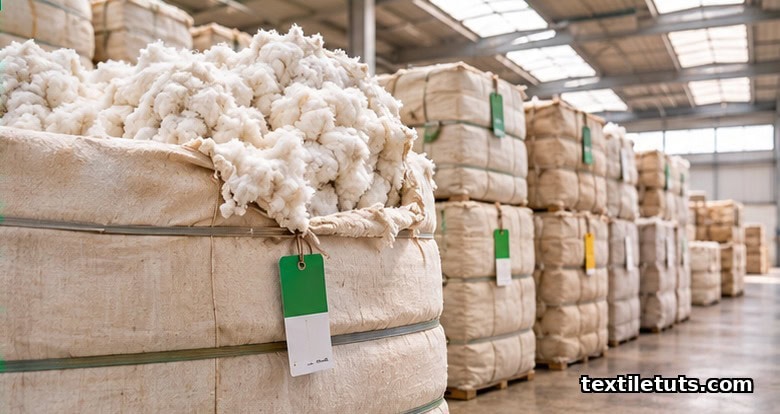
Organic cotton spinning is the yarn formation process that converts GOTS-certified organic cotton fibers (typically 22-32 mm in length) into finished yarn using dedicated equipment lines that prevent contamination from conventional cotton, synthetic fibers, and prohibited chemical auxiliaries.
The defining feature of the process is mandatory physical and temporal separation at every production stage, from bale opening through winding, because GOTS Section 4.2.1 requires that organic cotton be processed in units clearly separated in time or space from conventional cotton processing.
This article explains how organic cotton spinning differs from conventional spinning, the equipment cleaning protocols mills must follow, contamination prevention checkpoints, fiber length considerations, and the processing adjustments that protect yarn quality without losing organic certification status.
How Organic Cotton Spinning Differs From Conventional Cotton Spinning
The structural difference between organic and conventional cotton spinning is not the mechanical principle (ring, rotor, and compact frames still draw, twist, and wind fiber the same way) but the surrounding compliance envelope. Conventional mills can run cotton, polyester, and viscose blends back-to-back on the same line with a quick blow-down. Organic mills must run organic cotton on a dedicated or time-segregated line, log every batch, and avoid any contact with prohibited substances listed in the GOTS Positive List.
Three differences show up in the daily routine:
- No synthetic chemical contact. Spinning oils, antistatic agents, and coning oils must come from the GOTS-approved chemical input list. Conventional mills commonly use mineral oil-based spin finishes (0.4-1.0% add-on); organic mills use vegetable-oil-based or GOTS-listed alternatives.
- Mandatory separation. Organic cotton bales are stored in a clearly marked zone, processed on equipment that has been cleaned to a documented protocol, and run as a distinct batch with traceable records (GOTS 4.2.1).
- Contamination testing. Yarn or fiber samples may be tested for GMO content, pesticide residues (against the GOTS residue tolerance table), and heavy metals before the finished yarn carries the GOTS label.
None of these requirements change the drafting or twisting mechanics, but they reshape the workflow around the machine, adding time, documentation, and cleaning cost that conventional spinning does not incur.
Equipment Cleaning Protocols Before Organic Processing
Cleaning is the first physical step in organic cotton spinning and the most-cited cause of audit failures. The GOTS Implementation Manual requires that processing equipment be free of conventional cotton residues, prohibited spin finishes, and any carry-over contaminants from previous runs.
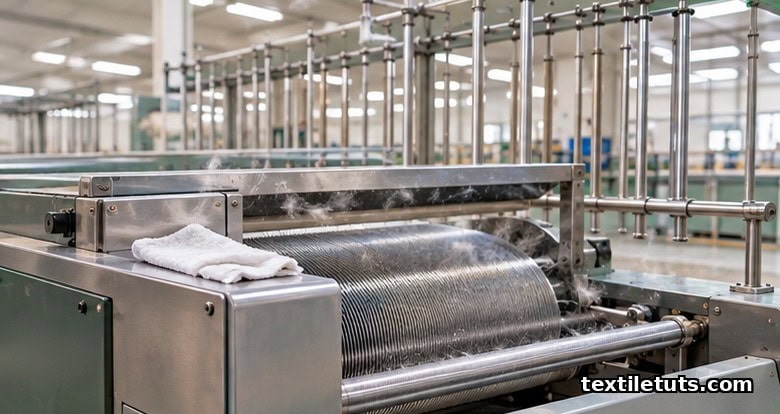
Standard cleaning protocols on organic-certified lines include:
- Blow-down of the entire line. Bale opener, hopper, chute, cards, draw frames, roving frame, ring/rotor frame, and winder are run empty for 20-30 minutes to purge loose fly and fiber.
- Surface wipe-down with permitted cleaners. Machine panels, creel rails, and conveyor surfaces are wiped using GOTS-approved cleaning agents (typically water-based, non-quaternary ammonium formulations).
- Traveler and ring inspection. On ring frames, travelers and rings are inspected for conventional cotton fiber accumulation, since lint trapped under travelers is a frequent contamination vector.
- First-batch purge run. The first 50-100 kg of organic cotton through the line is typically downgraded or run into a transition batch, because trace residues from previous production may still be present in the ducting.
- Verification sampling. Many mills pull a fiber sample from the first card sliver and submit it for residue testing before declaring the line cleared.
For time-segregated processing (where the same line runs conventional during the day and organic at night), cleaning is the dividing line between batches and the operation most likely to determine whether organic status survives the audit.
Contamination Prevention: Separation, Storage, and Identification
Contamination prevention extends beyond cleaning into bale handling, storage, packaging, and labeling. GOTS 4.2.2 requires that organic cotton be clearly identified at all stages of processing, from field to finished yarn.
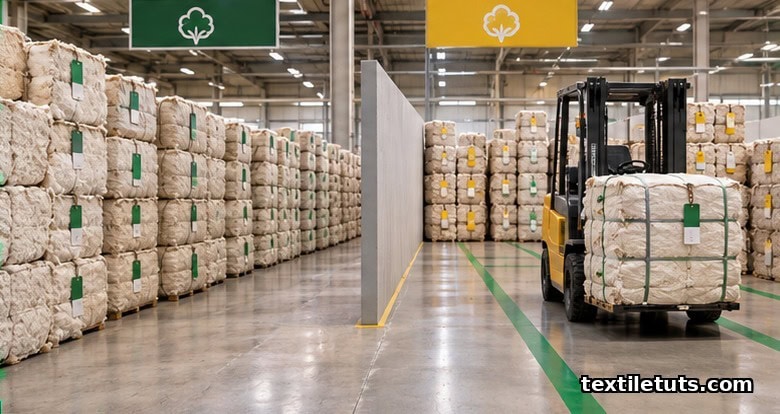
Common contamination vectors and their controls:
- Bale-to-bale mixing. Organic and conventional bales stored in the same yard are at risk of being picked up by the wrong forklift. Control: dedicated storage zones, color-coded bale tags, and physical barriers (separate bays or warehouse wings).
- Polypropylene (PP) bag fragments. Conventional cotton commonly arrives in PP woven bags. PP fiber fragments can lodge in cards and contaminate the sliver. Control: organic cotton is unpacked in a separate area and PP bags are removed before bales enter the opening line.
- Synthetic fiber carry-over. If the line also processes polyester or viscose, static-attached synthetic fibers from previous runs can transfer into organic yarn. Control: dedicated or thoroughly purged lines, antistatic equipment checks, and humidity control (55-65% RH at the cards and draw frames).
- Jute and hemp fragments. Bales sometimes arrive with jute or sisal ties. Fragments break off and end up in the card web. Control: removal of natural-fiber ties before opening, with bales re-tied using cotton twine or PP-free alternatives.
- Worker handling. Personnel moving between conventional and organic areas can transfer fiber on clothing, gloves, and footwear. Control: dedicated uniforms, color-coded PPE, and changing rooms at the zone boundary.
Effective contamination prevention is procedural as much as mechanical. ISO/IEC 17065-compliant certification bodies routinely trace contamination claims back to a single missed step in the segregation chain.
Fiber Length and Quality Characteristics of Organic Cotton
Organic cotton fibers are not chemically different from conventional cotton at the cellular level (they are still Gossypium hirsutum or Gossypium barbadense cellulose), but they are often shorter, more variable, and contain more neps because the cultivation practices that exclude synthetic pesticides and defoliants change the way the plant matures and is picked.
Key fiber property benchmarks for organic cotton spinning:
- Upper Half Mean Length (UHML): typically 22-28 mm for Upland organic (G. hirsutum), versus 26-32 mm for conventional Upland; Pima organic (G. barbadense) reaches 30-36 mm.
- Uniformity Index: often 78-83%, slightly lower than the 80-85% typical of conventional cotton, because hand-picking and the absence of chemical defoliants produce a wider maturity range.
- Micronaire: 3.8-4.5, comparable to conventional, indicating similar fineness and maturity.
- Strength (g/tex): 24-30 g/tex, generally 1-3 g/tex below conventional because the absence of stress-resistant chemical treatments reduces fiber bundle strength.
- Trash and nep count: typically 1.5-2x higher than conventional because leaf and bract fragments enter the gin without chemical defoliation. This raises the cleaning load on the cards.
These properties drive specific processing adjustments at the card and draw frame to preserve yarn strength and uniformity despite shorter, less uniform fiber.
Processing Adjustments for Organic Cotton on the Spinning Line
Because organic cotton has shorter fiber and higher trash content, mills typically tune the spinning line to compensate. Adjustments are made at the card (the highest-impact machine) and carried forward to draw frames and the ring frame.
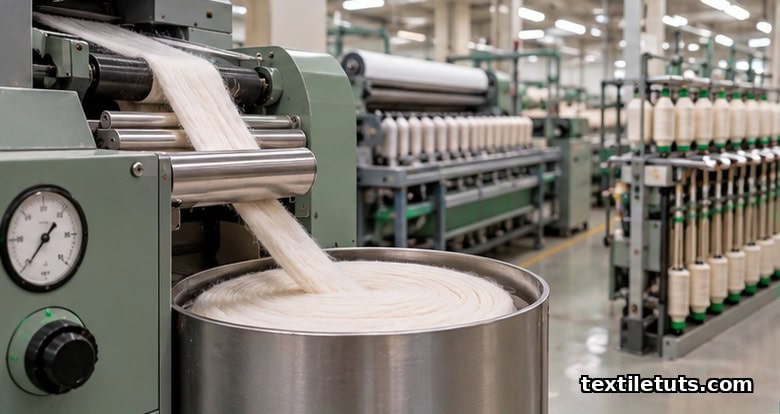
Typical processing adjustments:
- Card production rate reduced. Conventional cards run at 80-120 kg/hour; organic cotton cards are slowed to 50-70 kg/hour to give the clothing and flats more opportunity to remove trash and neps without aggressive fiber breakage.
- Pre-cleaning at the bale opener. Additional coarse cleaning steps (serrated or needle-type cleaners) are used at the hopper to remove larger trash before the fine cleaning at the card.
- Draw frame draft increased slightly. A total draft of 8-10x across breaker and finisher draw frames (versus 6-8x for conventional) compensates for the shorter fiber by producing a more aligned sliver.
- Roving and ring frame settings adjusted. Lower spindle speeds (typically 12,000-15,000 RPM versus 18,000-22,000 RPM on conventional ring frames) reduce end-breakages caused by weaker organic fiber.
- Twist multiplier adjusted upward. A twist multiplier (TM) of 4.0-4.5 (versus 3.8-4.2 for conventional) compensates for shorter fiber by increasing yarn cohesion.
These adjustments come from standard short-staple spinning practice for Indian and Turkish organic cotton, and they are documented in spinning textbooks such as Klein’s “Practical Guide to Ring Spinning” and the Cotton Incorporated Engineered Fiber Selection literature.
Organic vs Conventional Cotton Spinning: Comparison Table
| Property | Organic Cotton Spinning | Conventional Cotton Spinning |
|---|---|---|
| Certification required | GOTS, OCS, or equivalent third-party audit | No fiber-origin certification required |
| Equipment separation | Dedicated line OR time-segregated with full cleaning protocol | Shared line, no separation needed |
| Spinning oils / finishes | GOTS-approved vegetable-oil-based or listed auxiliaries | Mineral oil, ester-based, or any commercial spin finish |
| Storage | Color-coded, dedicated bale zones with traceable records | General bale yard, no segregation required |
| Typical fiber UHML | 22-28 mm (Upland); 30-36 mm (Pima) | 26-32 mm (Upland); 32-38 mm (Pima) |
| Trash and nep count | 1.5-2x higher than conventional | Lower (chemical defoliation reduces trash at harvest) |
| Card production rate | 50-70 kg/hour | 80-120 kg/hour |
| Ring frame spindle speed | 12,000-15,000 RPM | 18,000-22,000 RPM |
| Twist multiplier | 4.0-4.5 | 3.8-4.2 |
| Residue testing | Required (pesticides, GMO, heavy metals) | Not required for unprocessed fiber |
| Documentation | Batch records, cleaning logs, input chemical approvals | Standard production records only |
| Processing cost premium | 15-30% above conventional | Baseline |
Frequently Asked Questions
Q1: Can organic cotton be spun on the same ring frame as conventional cotton?
Yes, under GOTS Section 4.2.1 the same equipment can be used if the line is clearly separated in time, with full cleaning between runs and batch records documenting the changeover. Many smaller mills choose time-segregation because dedicated lines are economically out of reach. The cleaning protocol between the conventional run and the organic run must be documented, and the first organic batch may be downgraded to a transition product.
Q2: What spin finish or coning oil is allowed on organic cotton yarn?
Only spin finishes and coning oils listed on the GOTS-approved chemical input register, or formulations whose individual components are all on the positive list. Conventional mineral-oil-based finishes are prohibited. Vegetable-oil-based or specific synthetic formulations that have been screened for aquatic toxicity, biodegradability, and restricted-substance compliance can be used.
Q3: Does organic cotton produce weaker yarn than conventional cotton?
Single yarn tenacity from organic cotton typically runs 10-20% below conventional cotton spun at the same count, mainly because organic fiber is 1-3 g/tex weaker and slightly shorter. Combed organic yarn narrows the gap to 5-10%. Yarn strength loss is partially offset by raising the twist multiplier, but knitters and weavers using organic yarn should plan for slightly lower tensile performance and adjust fabric construction accordingly.
Q4: How do mills prevent polypropylene contamination from bale bags?
Organic cotton bales arrive in PP woven bags that can shed fiber fragments during opening. Mills remove the PP outer bag in a dedicated unpacking zone before the bale enters the opening line. Some operations use cotton or jute reusable bags for internal transfer, but the initial unpacking is the highest-risk step and must be done away from the carding area to keep PP fragments out of the card web.
Q5: Is rotor spinning suitable for organic cotton?
Rotor (open-end) spinning is acceptable for organic cotton when the rotor and rotor groove are clean and dedicated or properly purged. Rotor spinning tolerates shorter fiber well, which suits the shorter UHML of organic cotton. However, rotor yarn is bulkier and slightly weaker per tex than ring-spun yarn at the same count, so the end-use must accept rotor yarn characteristics (denim, towel yarn, coarse knitwear).
References
- Global Organic Textile Standard (GOTS). Standard Version 7.0 — Section 4.2: Processing of Fibres. global-standard.org — defines separation, equipment cleaning, and chemical input requirements for organic fiber processing.
- International Organization for Standardization. ISO 2061:2015 Textiles — Determination of twist in yarns: Direct counting method. iso.org — reference method for the twist multiplier and yarn-twist testing cited in this article.
- International Organization for Standardization. ISO 2403:2014 Textiles — Cotton fibres — Determination of micronaire value. iso.org — reference method for micronaire readings cited in the fiber property section.
- Textile Exchange. Organic Cotton Market Report 2023. textileexchange.org — public market and processing data on organic cotton fiber length, trash, and processing premiums (the report itself, not the commercial arm).
- Klein, W. A Practical Guide to Ring Spinning (Short-Staple). — Textile Institute professional publication covering draft, twist, and processing adjustments for short-staple cotton including low-quality and short-fiber cottons.
- Organic Research Centre / FAO. Organic Cotton Production and Processing. fao.org — peer-reviewed production and processing data on organic cotton agronomy and fiber quality characteristics.
- Better Cotton Initiative peer-reviewed cotton literature. Sustainability and fiber quality in cotton production: a meta-analysis. sciencedirect.com — peer-reviewed comparative data on organic versus conventional cotton fiber length, strength, and trash content.
This article is the working reference for organic cotton spinning. Editorial by Iftay Khairul Alam, TextileTuts. Sources: GOTS Standard v7.0, ISO 2061, ISO 2403, Textile Exchange Organic Cotton Market Report, the Textile Institute’s short-staple spinning literature, FAO organic cotton production data, and peer-reviewed comparative cotton fiber studies as cited.


