
Bamboo Yarn Spinning: Fiber Types, Properties, and Ring Frame Settings

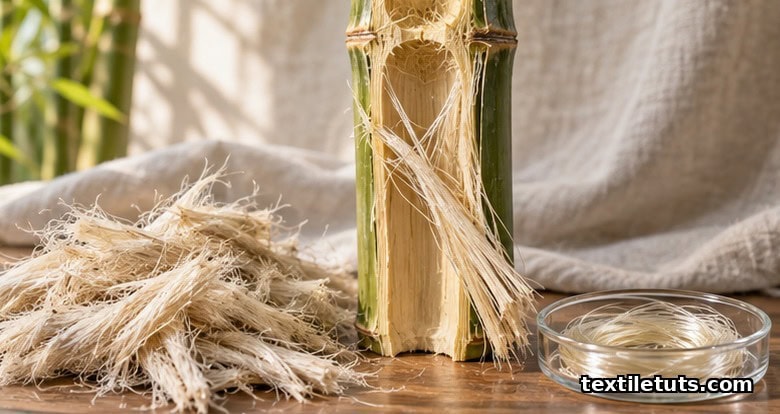
Regenerated bamboo viscose filament measures 1.4-2.2 dtex with a tenacity of 2.0-2.5 cN/dtex, while mechanically extracted natural bamboo fiber bundles run 5-15 dtex at 550-650 MPa tensile strength and roughly 73.8% cellulose content, and that single split between fine regenerated cellulose and coarse lignified bundles is what decides every drafting setting downstream.
Bamboo spinning is two parallel processes built on different raw materials: a regenerated cellulose route that behaves like viscose rayon, and a natural fiber route that behaves like a stiff, coarse bast. Spindle speed, twist multiplier, and break draft depend entirely on which bamboo is on the card, and confusing the two is the most common cause of hairy, weak, or slubby bamboo yarn.
Bamboo Fiber: Two Different Starting Materials
Bamboo yields two textile-grade fibers that share a botanical origin but share almost nothing at the spinning machine. The first is a regenerated cellulose filament made by dissolving bamboo pulp in alkali and carbon disulfide and re-extruding it through a spinneret, the same viscose route used for rayon. The second is a natural bast fiber bundle stripped from the bamboo culm, with most of the original lignin still inside the cell wall.
Which one is on the fiber line is the first decision, because each needs different card clothing, drafting profile, and twist level. Regenerated viscose spins on a cotton system with minor setting changes; natural bamboo behaves closer to stiff flax or hemp tow and usually needs a worsted system or a blend.
Bamboo Fiber Properties That Drive Spinning Behavior
The numbers in the table below are the ones that actually change drafting settings. Mechanical bamboo retains its lignin matrix, which stiffens the fiber and limits how thin you can draft it. Regenerated bamboo is pure cellulose II, with no lignin and a uniform round cross-section, so it drafts like cotton but with longer fibers and lower crimp.
| Property | Natural (mechanical) bamboo fiber bundle | Regenerated (chemical/viscose) bamboo filament |
|---|---|---|
| Linear density | 5-15 dtex (coarse bundle) | 1.4-2.2 dtex (fine filament) |
| Tensile strength | 550-650 MPa (bundle); up to 1.5-2.5 GPa single-fiber | 2.0-2.5 cN/dtex (regenerated cellulose) |
| Cellulose content | ~73.8% | >99% (cellulose II) |
| Lignin content | ~10.1% (residual) | <1% (dissolved in process) |
| Hemicellulose | ~12.5% | trace |
| Length | 30-50 mm (mechanical); up to 250 mm (steam-exploded) | 38-42 mm (cut staple) or continuous filament |
| Moisture regain | ~11% | ~13% (typical for regenerated cellulose) |
| Surface character | Smooth, stiff, low crimp, low cohesion | Smooth, round, uniform, slightly higher cohesion |
The lignified natural fiber is what gives bamboo its hard-to-spin reputation. Sawangbunditkun et al. (2025) showed that bundle tensile strength falls as lignin content rises and extraction breakage increases, the same failure mode drafters see when bundles snap under roller pressure. Sun et al. (2025) measured a 36.8% tensile strength reduction in raw bamboo fibers after water exposure, meaning humid rooms soften bundles but raise nep count.
Spinning Preparation: From Bamboo Culm to Spinnable Sliver
Natural bamboo reaches the card as a stiff, coarse bundle with low cohesion. Li (2020) describes the chemo-mechanical route as selecting, arranging, spreading, slivering, pre-drawing, and combing, with chemical pretreatment plus mechanical refining to separate fibers without shattering them.
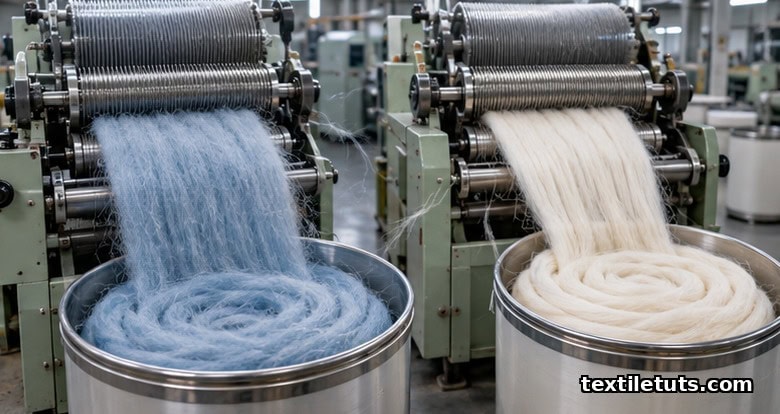
For regenerated bamboo, the route is identical to viscose staple: pulp sheet, alkali steeping (18-20% NaOH), aging, xanthation, dissolution, wet spinning into a sulfuric acid-sodium sulfate bath, cutting into 38-42 mm staple, and drying. The fiber behaves as a standard rayon staple on a cotton card with 30-40 wires/cm^2 worker density.
Three preparation rules apply to both: humidify the bale to 11-13% regain before opening (dry bamboo generates static that wrecks card web uniformity), run the lickerin slower than cotton (600-800 rpm vs 1000+ rpm) to limit fiber breakage, and blend before carding when more than 30% bamboo is in the mix (bamboo fibers segregate from cotton or wool if blended too late).
Draft Distribution: Why Bamboo Stiffness Breaks the Draft
Bamboo fiber stiffness, especially in the natural bundle case, produces three drafting failures: floating fibers running uncaptured between roller nips, hooked fiber accumulation at the front rollers, and periodic thick places from bundles that escape the aprons.
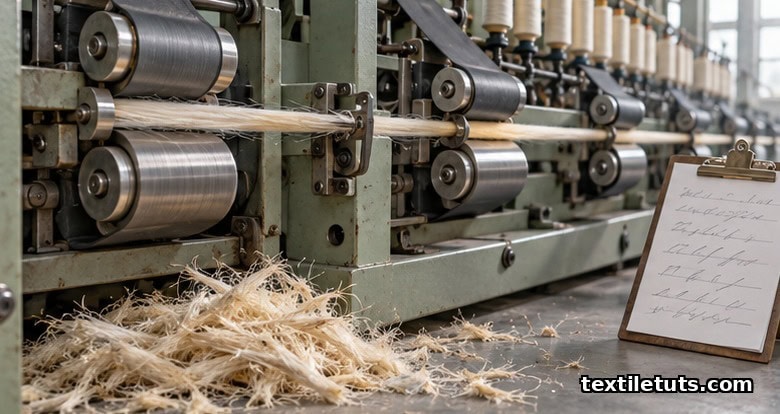
The standard cotton draft of 30-40 total with a break draft of 1.3-1.5 is too aggressive for bamboo. Research on bamboo-cotton blends (MDPI Polymers, 2017) found break draft must rise to 1.6-1.9 to keep stiff bundles under control, with total draft held at 20-28 to limit fiber breakage. Apron pressure is raised 10-15% over cotton settings, with a heavier top apron at 65-70 Shore A.
For natural bamboo on a worsted system, short forward draw with a 1.25-1.4 break draft and a 5-7 total draft works better than long draw. Asmare et al. (2025) found pure natural bamboo fibers showed inadequate cohesion both among themselves and with cotton fibers, the symptom of a draft too aggressive for the fiber length. Blending 50-70% bamboo with cotton or wool is the usual industrial fix, and the reason almost every commercial “bamboo yarn” on the market is in fact a blend.
For regenerated bamboo viscose, drafting is closer to cotton or modal, but with one trap: very low crimp (3-4 crimps/cm vs 8-10 for cotton) packs fibers tightly and resists opening. A light drawing frame re-pass at 1.3-1.5 draft restores uniformity.
Recommended Ring Frame Settings for Bamboo Yarn
The settings below are a working baseline for a 30 Ne (20 tex) bamboo-blended yarn on a cotton-system ring frame. Adjust toward finer counts by reducing spindle speed, and toward coarser counts by raising the draft.
- Spindle speed: 12,000-14,000 rpm (viscose); 9,000-11,000 rpm (natural blend).
- Twist multiplier: 3.8-4.2 (viscose); 4.2-4.6 (natural blend).
- Total draft: 20-28 (viscose); 15-22 (natural blend).
- Break draft: 1.6-1.9 for both fiber types.
- Apron pressure: 10-15% above cotton; top apron hardness 65-70 Shore A.
- Spacer size: 42-44 mm at front rollers for 38 mm cut staple.
- Yarn conditioning: 35-40% RH, 25-28 deg C; 55-60% RH for natural bamboo to soften lignin.
- Traveler weight: one number heavier than cotton equivalent.
MDPI Polymers (2021) confirmed optimum quality for bamboo viscose sits at moderate spindle speed (around 13,000 rpm) with a TM around 4.0. Push spindle speed past 15,000 rpm with regenerated bamboo and you trade strength for hairiness, which most knitting and weaving customers reject.
End Uses of Bamboo Yarn
Regenerated bamboo viscose sits in a niche where moisture management and a soft hand matter more than strength. Working end uses include summer knit T-shirts and tank tops (11-13% moisture regain gives cooling), underwear and sock linings (smooth surface, though wash durability is lower than cotton), bath towels and washcloths (high absorbency), and bedding sheets (smooth, cool hand).
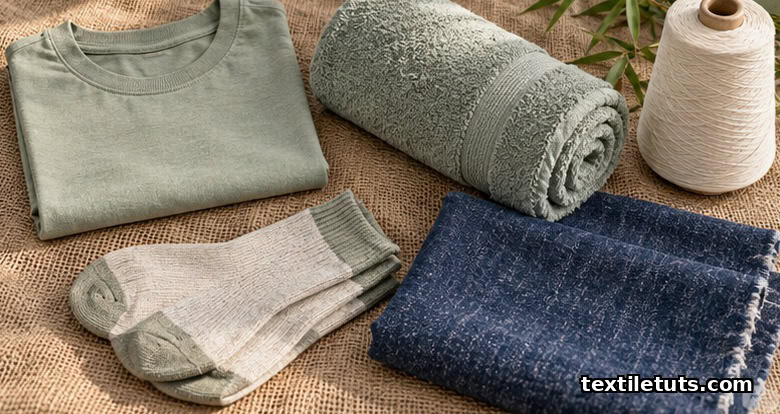
Natural bamboo blends are used more in denim, canvas, and home furnishings where stiffness and texture are part of the look. A 30/70 bamboo/cotton denim has a slightly hairy, dry hand some buyers prefer over 100% cotton. Industrial uses include nonwoven geotextile and filtration media where natural fiber stiffness helps web formation.
Pure 100% bamboo yarn exists but is rare and expensive, and difficult to spin to fine counts without drafting compromise, which is why most commercial “bamboo” labels on a yarn cone are actually a 50/50 or 70/30 bamboo blend with cotton, modal, or wool.
Frequently Asked Questions
Q1: Is bamboo yarn the same as bamboo viscose or rayon?
Most yarn sold as “bamboo” is regenerated cellulose, chemically identical to viscose rayon, made by dissolving bamboo pulp in alkali and carbon disulfide and re-extruding it. Natural mechanically extracted bamboo fiber exists but is coarse (5-15 dtex), stiff, and almost always blended with cotton or wool. If the label just says “100% bamboo,” assume it is regenerated cellulose unless stated otherwise.
Q2: What draft multiplier should I use for bamboo-cotton blends?
For a 50/50 bamboo/cotton blend on a cotton ring frame, hold total draft at 20-26, raise break draft to 1.6-1.9, and run spindle speed at 12,000-13,000 rpm. For coarser natural bamboo blends drop total draft to 15-20 and spindle speed to 9,000-11,000 rpm. Aggressive drafts above these ranges increase breakage and slub frequency.
Q3: Can bamboo yarn be spun on a cotton spinning system?
Regenerated bamboo viscose staple (38-42 mm cut) spins on a standard cotton system with settings adjusted for low crimp and high stiffness: higher break draft, heavier apron pressure, lower spindle speed. Natural mechanically extracted bamboo cannot be spun cleanly on a cotton system in 100% form because of stiffness and low cohesion; it needs a worsted system or a blend of at least 50% cotton.
Q4: Does bamboo yarn shrink, and how should it be finished?
Regenerated bamboo viscose shrinks 8-12% in length after wet finishing from fiber swelling, so fabric should be pre-shrunk before cutting. Natural bamboo blends shrink less, typically 4-7%, because residual lignin restrains fiber movement. Both should be finished at pH 5-7 and below 60 deg C to avoid yellowing; bleaching requires hydrogen peroxide, not chlorine, which degrades the cellulose chain.
References
- Sawangbunditkun, P., et al. (2025). Influence of cellulose content, lignin content, and fiber breakage on the tensile strength of fiber bundles extracted for different bamboo stem regions. ScienceDirect / Industrial Crops and Products. https://www.sciencedirect.com/science/article/pii/S2590123025040459 , peer-reviewed quantification of how lignin content and extraction breakage lower bamboo bundle tensile strength.
- Sun, Y., et al. (2025). Study on the Tensile Properties and Waterproofing of Bamboo Fibers. PMC (NCBI). https://pmc.ncbi.nlm.nih.gov/articles/PMC12693770/ , peer-reviewed tensile strength range (550-650 MPa) and 36.8% wet-strength reduction in raw bamboo fibers.
- Chen, H., et al. (2015). Tensile properties of bamboo in different sizes. Springer Journal of Wood Science. https://link.springer.com/article/10.1007/s10086-015-1511-x , peer-reviewed comparison of bamboo fiber, bundle, and strip tensile behavior.
- Nasri, K., et al. (2023). Effect of cellulose and lignin content on the mechanical properties of natural fiber polypropylene composites. SAGE Journal of Composite Materials. https://journals.sagepub.com/doi/full/10.1177/00219983231186208 , peer-reviewed evidence on how cellulose/lignin ratio drives fiber stiffness.
- Asmare, A., et al. (2025). Production and properties of natural bamboo-cotton blended yarn. ScienceDirect. https://www.sciencedirect.com/science/article/pii/S277313912500031X , peer-reviewed study documenting bamboo fiber stiffness and drafting problems in cotton blends.
- Li, Y. (2020). Preparation and Characterization of Natural Bamboo Fiber. SciOpen. https://www.sciopen.com/article/10.12103/j.issn.2096-2355.2020.02.004 , peer-reviewed chemo-mechanical bamboo preparation route.
- MDPI Polymers (2021). Effect of Spinning Parameters on Bamboo Viscose Yarn Properties. https://www.mdpi.com/2073-4360/13/23/4156 , peer-reviewed optimum twist multiplier (~4.0) and spindle speed (~13,000 rpm) for regenerated bamboo yarn.
Editorial by Iftay Khairul Alam, TextileTuts. Sources: Sawangbunditkun et al. 2025; Sun et al. 2025; Chen et al. 2015; Nasri et al. 2023; Asmare et al. 2025; Li 2020; MDPI Polymers 2021, as cited.


