
ISO 2859 Sampling Plans

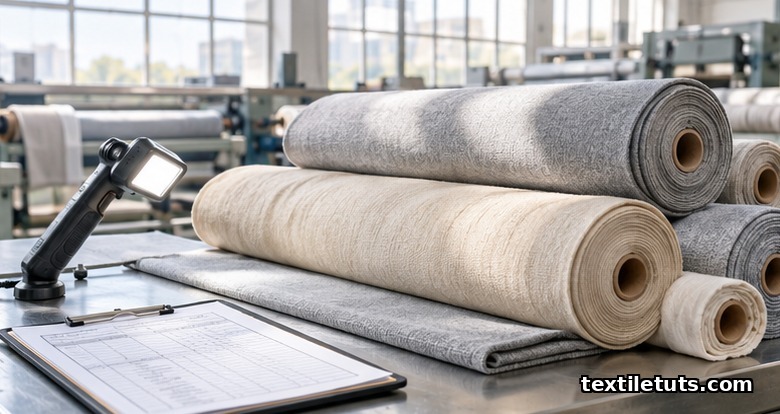
ISO 2859-1 defines attribute-by-attribute sampling plans indexed by Acceptable Quality Limit (AQL), inspecting lots of 26 to 500,000 units against seven inspection levels (S-1 through S-4 and I, II, III) and AQL values from 0.065 to 1,000 defects per 100 items.
For textile mills shipping fabric rolls, garment bundles, or finished trims, the standard turns a subjective “looks acceptable” call into a numerical decision rule with a defined producer and consumer risk.
This guide walks through the mechanics of ISO 2859-1, the inspection levels, the switching rules between normal, tightened, and reduced inspection, and how textile quality teams apply the published AQL tables in day-to-day lot decisions.
What ISO 2859-1 Is, and Why Textile QA Teams Adopt It
ISO 2859-1, titled “Sampling procedures for inspection by attributes — Part 1: Sampling schemes indexed by acceptance quality limit (AQL) for lot-by-lot inspection,” is the international counterpart of ANSI/ASQ Z1.4. The third edition was published in 2022, harmonizing the procedural text with the underlying U.S. standard for global users. The standard covers lot-by-lot inspection, meaning each incoming or outgoing batch is judged on its own sample, with rules that adapt the sampling stringency based on the lot’s recent quality history.
For textile mills, ISO 2859-1 is most often applied to finished fabric rolls, garment bundles, trims, and accessories that arrive in defined batches. Instead of 100% inspection, the standard lets QA teams select a defined number of units, count the defectives, and accept or reject the lot against a published numerical rule. The output is a single decision per lot: accept (move forward), reject (return, sort, or scrap), or continue inspection under a tightened rule.
The standard is widely accepted in Bangladesh’s knit and woven sectors, where suppliers and buyers routinely agree on an AQL and inspection level in the purchase order before shipment. Using a published rule prevents the repeated negotiation that 100% inspection causes when buyer and supplier disagree on what counts as a “minor” or “major” defect.
How ISO 2859-1 Works: AQL, Sample Size, and Accept/Reject Numbers
Three parameters drive every ISO 2859-1 decision: the lot size, the inspection level, and the chosen AQL. The tables inside the standard translate those three inputs into four outputs: sample size n, acceptance number Ac, rejection number Re, and the type of inspection currently in force (normal, tightened, or reduced).
Acceptable Quality Limit (AQL) is the maximum percentage of defective items that, for the purposes of sampling inspection, can be considered acceptable as a process average. It is not the average quality level of the process, but the worst tolerable long-run proportion of defectives. Common AQL values in textile buying are 1.0, 2.5, and 4.0 defects per 100 items for major defects, and 2.5 to 6.5 for minor defects, although the specific numbers depend on the buyer’s product category.
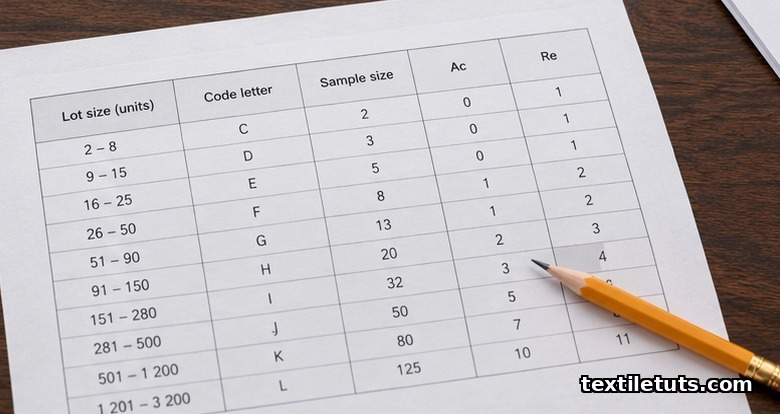
Sample size n is read directly from Table 1 of ISO 2859-1, indexed by lot size and inspection level. For a lot of 281 to 500 units at general inspection level II, the sample size code letter is F, and the sample size is 50. The same lot at level I drops to code letter E (32 units), while level III raises it to code letter G (80 units).
Acceptance number Ac and rejection number Re come from Table 2-A (or 2-B for double sampling). If the lot is inspected at AQL 2.5 and sample size code F (50 units), the acceptance number is 5 and the rejection number is 6. Finding 5 or fewer defectives accepts the lot; finding 6 or more rejects it.
Inspection Levels I, II, III and the Special Levels S-1 to S-4
ISO 2859-1 offers seven inspection levels. Three are “general” (I, II, III) and four are “special” (S-1, S-2, S-3, S-4). General Level II is the default whenever the buyer and supplier do not specify otherwise. Level I requires about 40% of the sample size of Level II, and Level III roughly 1.6 times Level II. Higher levels are used when the cost of a wrong accept decision is high, for example, when downstream rejection costs dwarf the cost of inspecting more samples.
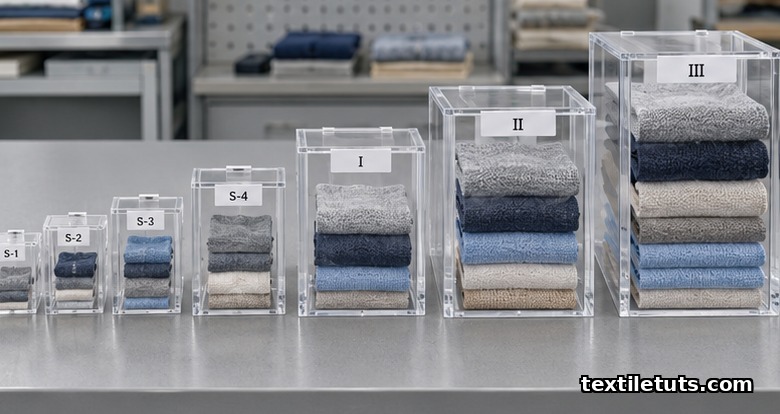
Special levels S-1 to S-4 use very small samples (between 2 and 32 units depending on lot size). They are intended for destructive testing or for very expensive inspections where most defectives will be caught by another method. In textiles, special levels are occasionally applied to destructive tests such as tensile strength, colorfastness to light, or abrasion resistance, where the unit cost of testing is high and only a few specimens can be cut from a sample.
Switching Rules: Normal, Tightened, and Reduced Inspection
ISO 2859-1 is not a static table; it is a rules engine that shifts the inspection stringency based on the lot’s recent history. This is the most under-used section of the standard in informal practice, and it is also the part most likely to be cited in a supplier audit.
- Normal inspection is the starting state. Use the AQL table at the chosen level and AQL.
- Tightened inspection is triggered when 2 out of 5 (or fewer, per the rules) consecutive lots are rejected on normal inspection. Tightened sample sizes are typically the next code letter up, with lower acceptance numbers.
- Reduced inspection is triggered after a run of accepted lots on normal inspection (typically 10 consecutive accepted lots), provided the lot size, AQL, and other criteria allow. Reduced inspection samples are roughly 40% of the normal sample at the same AQL.
- Inspection returns to normal after a tightened lot is accepted, or after 5 consecutive accepted lots on reduced inspection.
In practice, this means a textile supplier that ships ten clean lots in a row can expect the buyer’s QA team to sample less harshly on lot eleven, while a supplier whose last two lots were rejected can expect the next lot to be inspected under tighter rules. The switching rules are designed so that the long-run average fraction defectives stays close to the AQL regardless of incoming quality.
Operating Characteristic Curves and Producer/Consumer Risk
Every sampling plan has two error rates. The producer’s risk (alpha) is the probability that a lot of acceptable quality (at or below the AQL) is rejected by sampling. The consumer’s risk (beta) is the probability that a lot of unacceptable quality is accepted. ISO 2859-1 is calibrated so that, for most single-sampling plans at the default AQL, alpha is approximately 5% and beta at the “Limiting Quality” LQ is approximately 10%.
Operating Characteristic (OC) curves plot the probability of acceptance against the true fraction defective in the lot. A “steep” OC curve (where the curve falls from near 100% acceptance to near 0% acceptance over a narrow quality band) means the plan discriminates well between good and bad lots. A “flat” OC curve means the plan accepts most lots regardless of quality, which is usually unacceptable.
OC curves are most often cited when a buyer asks a supplier to defend a relaxed sampling plan. In those conversations, the relevant number is the Limiting Quality (LQ), which is the incoming quality level that has only a 10% chance of acceptance under the chosen plan.
A Practical Textile Example
The example below shows the normal inspection sample size and acceptance numbers for selected lot sizes at General Level II, AQL 2.5, drawn directly from Table 2-A of ISO 2859-1.
| Lot Size (units) | Code Letter | Sample Size (n) | Ac (Accept) | Re (Reject) |
|---|---|---|---|---|
| 26 to 50 | C | 5 | 0 | 1 |
| 51 to 90 | C | 5 | 0 | 1 |
| 91 to 150 | D | 8 | 0 | 1 |
| 151 to 280 | E | 13 | 1 | 2 |
| 281 to 500 | F | 20 | 1 | 2 |
| 501 to 1,200 | G | 32 | 2 | 3 |
| 1,201 to 3,200 | J | 50 | 3 | 4 |
| 3,201 to 10,000 | K | 80 | 5 | 6 |
| 10,001 to 35,000 | L | 125 | 7 | 8 |
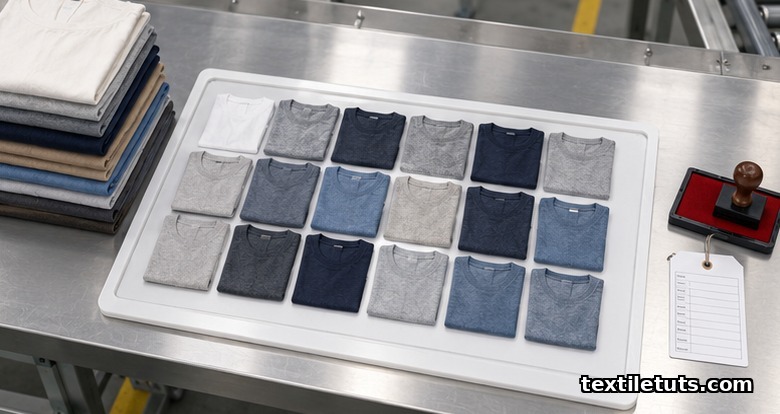
Reading the table: a shipment of 600 finished T-shirts inspected at Level II, AQL 2.5, requires a 32-unit sample (code letter G). Finding 2 or fewer defective T-shirts accepts the lot; finding 3 or more rejects it. The same lot at AQL 1.0 (a tighter plan) uses the same 32-unit sample but with Ac = 1, Re = 2.
Common AQL Choices in Textile Buying
AQL values are not arbitrary; they are negotiated between buyer and supplier based on the cost of downstream defectives and the seller’s process capability. In the woven and knit garment industry, the most common assignments are:
- AQL 1.0 (major) / 2.5 (minor): higher-priced apparel, technical outerwear, and safety-relevant garments where visible major defects trigger returns.
- AQL 2.5 (major) / 4.0 (minor): the most common default for everyday knitwear, casualwear, and home textiles.
- AQL 4.0 (major) / 6.5 (minor): promotional products, low-cost basics, and accessories where buyer rejection cost is high relative to unit price.
For destructive tests such as GSM verification, bursting strength, or colorfastness to washing, textile buyers more often reference ISO 139, ISO 13934-1, or AATCC Test Method 61 alongside ISO 2859-1, with a separate sample-size table for the destructive specimen count.
Frequently Asked Questions
Q1: What is the difference between AQL 1.0, 2.5, and 4.0 in textile inspection?
AQL 1.0 means the buyer’s tolerance is at most 1.0% defective units in the long run, used for critical defects such as broken stitching on a load-bearing seam or fabric holes that are visible on the garment front. AQL 2.5 is the typical default for major visual defects such as stains or shade variation. AQL 4.0 is common for minor defects such as loose threads, slight puckering, or trimming marks that do not affect function or selling appearance.
Q2: Can the same supplier’s lots be inspected under both normal and tightened rules?
Yes, and this is what the switching rules in ISO 2859-1 are designed for. After 2 out of 5 consecutive lots are rejected on normal inspection, the next lot moves to tightened inspection automatically. The supplier does not need to be informed; the buyer’s QA documentation should record the transition and the date it took effect.
Q3: Does ISO 2859-1 require 100% inspection for very small lots?
No. The standard explicitly excludes lots smaller than 26 units from Table 2-A. For lots under 26, ISO 2859-1 directs the user to alternative parts of the ISO 2859 family or to a different inspection strategy, since a sampling plan on 2 to 5 units would have too little statistical power to discriminate.
Q4: Is ISO 2859-1 the same as MIL-STD-105E?
Functionally, yes. MIL-STD-105E was the U.S. military version that ANSI/ASQ Z1.4 was built on, and ISO 2859-1 mirrors both. MIL-STD-105E was officially canceled in 2008 and superseded by ANSI/ASQ Z1.4. Most contemporary purchase contracts reference ISO 2859-1 or ANSI/ASQ Z1.4 directly, both of which carry the same code letters and acceptance numbers.
Q5: What happens if the supplier uses one AQL and the buyer uses another?
The lot can pass on one set of tables and fail on the other. This is why purchase orders must specify the standard, inspection level, and AQL values for each defect class before shipment. In textile buying, the common practice is to write “ISO 2859-1, General Level II, AQL 2.5 major / 4.0 minor, normal inspection” directly into the QA clause of the order.
References
- International Organization for Standardization. ISO 2859-1:2022 — Sampling procedures for inspection by attributes — Part 1: Sampling schemes indexed by acceptance quality limit (AQL) for lot-by-lot inspection. https://www.iso.org/standard/78886.html — the canonical sampling standard with sample size code letters and Ac/Re tables.
- ASTM International. ASTM E2234-22 — Standard Practice for Sampling a Stream of Product by Attributes Indexed by AQL. https://www.astm.org/e2234-22.html — the continuous-stream counterpart to ISO 2859-1, useful for in-line inspection during a shift.
- American Society for Quality. ANSI/ASQ Z1.4 — Sampling Procedures and Tables for Inspection by Attributes. https://www.asq.org/quality-resources/ansi-asq-z1-4 — the U.S. national standard harmonized with ISO 2859-1.
- Montgomery, D. C. Introduction to Statistical Quality Control. Wiley, 8th edition. https://www.wiley.com/en-us/Introduction+to+Statistical+Quality+Control%2C+8th+Edition-p-9781119399308 — textile engineers’ standard reference for OC curves, producer and consumer risk, and switching rules.
- Schilling, E. G., and Neubauer, D. V. Acceptance Sampling in Quality Control. CRC Press. https://www.routledge.com/Acceptance-Sampling-in-Quality-Control/Schilling-Neubauer/p/book/9780367570483 — practitioner reference for AQL-based attribute plans across process industries.
- Khalid, M., et al. Acceptance Sampling Plans in the Textile Industry: A Review. ResearchGate. https://www.researchgate.net/ — review of AQL practices specific to fabric and garment inspection.
This article is the working reference for ISO 2859 attribute sampling plans in textile quality control. Editorial by Sabbir Ahmed, TextileTuts. Sources: ISO 2859-1:2022, ASTM E2234-22, ANSI/ASQ Z1.4, Montgomery (Wiley), Schilling and Neubauer (CRC Press), as cited.


