
4-Point Fabric Inspection System

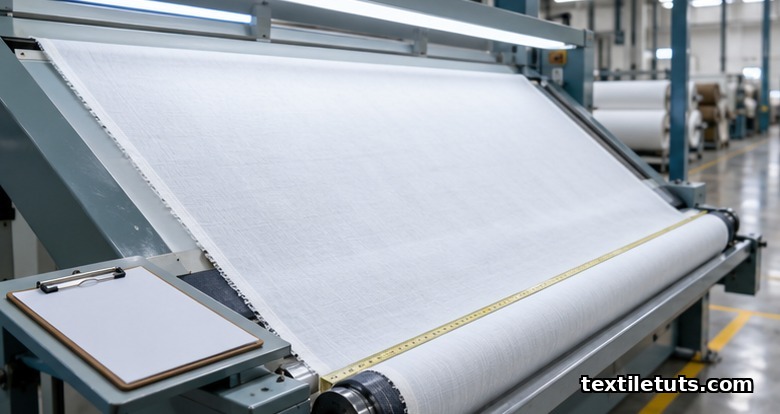
The 4-point fabric inspection system assigns 1, 2, 3, or 4 penalty points to each visible defect based on length (1 point for defects up to 3 in / 7.5 cm, 2 points for 3 to 6 in / 7.5 to 15 cm, 3 points for 6 to 9 in / 15 to 22.5 cm, and 4 points for any defect longer than 9 in or any major flaw such as a hole, broken pick across the full width, or missing warp end), then totals the points per 100 linear yards and compares the result to a buyer-supplied specification that typically allows 20 to 25 points per 100 yards for first-quality woven apparel fabric.
It is the most widely used defect-grading method in cut-and-sew apparel supply chains because it is fast, requires no equipment beyond an inspection frame and a tally sheet, and produces a single number the merchandiser, the mill, and the buying house can all sign off on.
This article explains where the system came from, how each penalty grade is assigned, how inspectors count points in practice, what an acceptance threshold looks like on a real contract, the common defects it catches on woven and knit fabric, and how the inspection itself is run on the frame.
Where the 4-Point System Came From
American cut-and-sew apparel suppliers adopted the 4-point system in the mid-twentieth century as a way to convert a subjective visual judgement into a number that could be written into a purchase order. Before the system existed, fabric was graded “A,” “B,” or “C” by feel, and the buyer had no easy way to dispute a shipment or to compare two mills against each other on the same order.
The Textile Institute and US weaving mills worked with apparel brands on a points-per-length scale that was eventually codified in ASTM D5430 and ASTM D5426. The method survived because it tracks three properties of a defect at once: its presence (it exists), its severity (its size), and its frequency (how many appear per unit length).
ASTM D5430 is the umbrella standard for visual grading, and ASTM D5426 covers the practical inspection setup, including lighting, fabric speed, and viewing distance. Both standards describe the 4-point scale as the default grading rule for woven and knit piece goods in North America. Most major retailers, including those that source from Bangladesh, Vietnam, and India, write the 4-point method directly into their purchase orders, which is why it has become the de facto world standard for cut-and-sew fabric inspection.
How the 1, 2, 3, 4 Scale Is Assigned
The scale is purely a function of defect size and severity. The official rule, repeated in ASTM D5430 and in supplier training manuals, is:
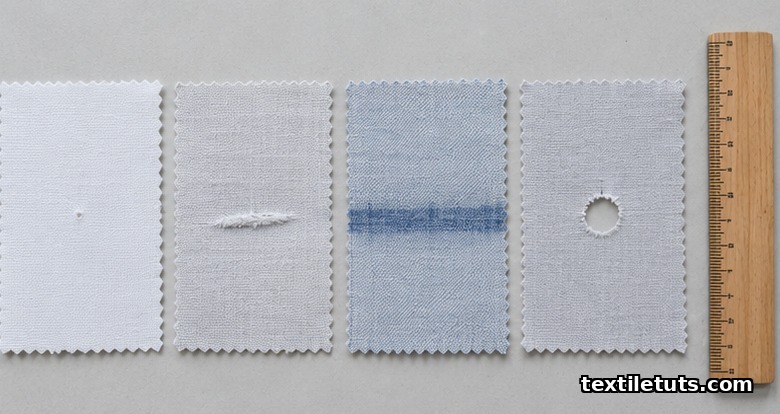
- 1 point: defect up to 3 in (7.5 cm) in length, or a single small flaw such as a missed end, a slub, a fly yarn, or a small dye spot.
- 2 points: defect 3 to 6 in (7.5 to 15 cm) in length, or a small cluster of similar minor flaws inside a 1 in (2.5 cm) window.
- 3 points: defect 6 to 9 in (15 to 22.5 cm) in length, or a major slub, dye streak, or misprint running across several inches of fabric.
- 4 points: defect longer than 9 in (22.5 cm), or a major flaw such as a hole, a missing warp end running the full fabric width, a broken pick across the full width, or any defect the buyer has specifically listed as a “4-point call-out” in the contract.
Two special rules tighten the system so it cannot be gamed. First, defects within 1 in (2.5 cm) of each other are graded as a single defect at the highest severity in the cluster, not as separate defects. This stops a long run of small spots from being scored as many 1-point defects when the real problem is one continuous fault in the fabric.
Second, no fabric roll is deducted more than 4 points for any one defect. A 30 in oil stain is still 4 points, not 8 or 12. The maximum-per-defect rule keeps one catastrophic defect from sinking an otherwise clean roll and lets the merchandiser discuss it separately as a formal claim.
Counting Points per 100 Linear Yards
Once each defect is graded, the inspector tallies the points on a per-roll sheet and divides by the roll length in yards. The number is then multiplied by 100 to give points per 100 linear yards (points/100 yd), the universal reporting unit used on roll tickets, shipping documents, and claim letters.
A worked example: a roll of 250 yd is inspected and the inspector records 14 defects: eight 1-point defects, four 2-point defects, one 3-point defect, and one 4-point defect. Total points = (8 × 1) + (4 × 2) + (1 × 3) + (1 × 4) = 23 points. Points per 100 yd = 23 × (100 / 250) = 9.2 points/100 yd. The roll would pass any contract allowance up to 9 points/100 yd.
Inspectors record the points on a four-column sheet (1 / 2 / 3 / 4) so the merchandiser can see not just the total but the distribution. A roll with 40 points all in the “1” column (many small slubs) is treated differently from a roll with 10 points concentrated in the “4” column (a few big flaws), even when both fail at the same total. A buyer will usually accept the first roll at a discount and reject the second outright.
The 100-yard denominator is not arbitrary. It was chosen because most US apparel fabric in the mid-twentieth century was shipped in 100 yd bolts, so the unit aligned with how the fabric was packed. Modern fabric ships in 50, 60, 80, or 100 m rolls, but suppliers still convert back to points/100 yd for the buyer’s contract.
Reading the Acceptance Criteria on a Contract
Most US and European apparel contracts write the 4-point allowance directly into the purchase order. The allowance is set by fabric type, end use, and price band. Typical figures used in commercial woven and knit fabric:
- First quality, general apparel woven: 20 to 25 points per 100 linear yards for basic cotton, poly/cotton, and viscose wovens used in casual shirts, trousers, and light outerwear.
- First quality, premium shirting: 10 to 15 points per 100 yd for yarn-dyed, end-and-end, oxford, and poplin shirtings where small slubs are highly visible against a plain weave.
- First quality, circular knit: 15 to 20 points per 100 yd for single jersey, fleece, interlock, and rib knit used in T-shirts, sweatshirts, and leggings.
- First quality, denim: 25 to 35 points per 100 yd for indigo denim, where slubs and weave variation are partly accepted as part of the look.
- Seconds / B-quality: 40 to 60 points per 100 yd, sold at discount to garment makers who can work around defects in cutting and spreading.
Anything worse than the contract figure triggers a claim. The buyer can accept the roll at a discount, return it for re-inspection, or reject it for replacement. Most suppliers negotiate a small “claim allowance” of one to two percent of invoice value to absorb minor overruns without a formal dispute on every roll.
The unit on the contract matters. The same roll measured in meters shows roughly 30 percent fewer points because the same number of defects is divided by a longer length. A 10 points/100 yd result is about 6.8 points/100 m, not the same thing. Always check which unit the buyer’s contract uses before comparing a mill’s report to the spec.
Common Defects Caught by the 4-Point System
The scale was designed for woven piece goods first and then extended to knits and nonwovens. The defects that account for the largest share of points on a typical woven cotton or poly/cotton roll include:
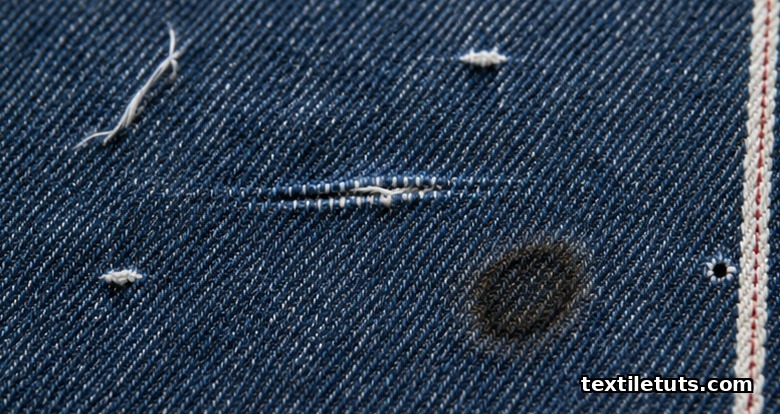
- Slubs and fly waste: loose or thick places in the yarn, usually 1 to 2 points each.
- Mispicks and broken picks: missing or broken weft yarns, typically 2 to 4 points depending on length.
- Broken ends: missing warp yarns, almost always scored as 4 points because they run the full width of the fabric.
- Oil stains and size spots: small spots score 1 point; large stains score 3 or 4.
- Weaving bars: width-wise streaks from a faulty loom, often 4 points because they cross the full fabric width.
- Dye streaks and shade variation: graded by length and visibility, mostly 2 to 4 points.
- Holes and cuts: automatic 4 points, often the trigger for a separate “hole claim” with a fixed penalty per hole.
On knit fabric the defect list shifts: barré (side-to-side yarn count or tension variation), needle lines, drop stitches, laddering, and dye streaks dominate. Each is graded by the same length rule, so a 4 in barré is 2 points and a 12 in barré is 4 points whether it sits on a woven or a knit.
On finished denim and piece-dyed wovens, the dye house is usually the source of the biggest deductions. Shade variation across a roll, listing to one selvedge, and centre-to-selvedge shade difference are graded on the same 1 to 4 scale and often account for most of the points on an otherwise well-woven fabric.
How Inspection Is Run on the Frame
Inspection happens on a horizontal fabric inspection frame, typically 4 to 6 ft wide, where the roll is unrolled under controlled tension at 15 to 20 yd/min. ASTM D5426 specifies the viewing distance, the lighting (a minimum of 100 foot-candles at the fabric surface), and the angle at which the fabric is presented to the inspector. Most mills run fabric face-up so slubs, knots, and surface stains are easier to see, and run a back-up pass for major weave faults that show through to the back.
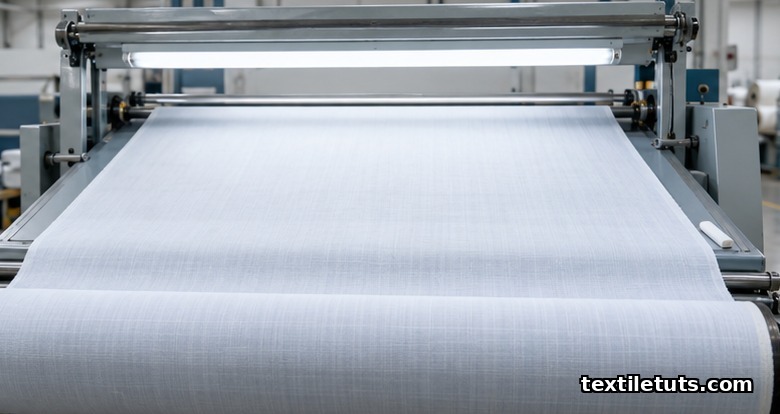
Each defect is marked with a colored chalk or sticker as the fabric passes, and the inspector calls the grade (“one,” “two,” “three,” “four”) to a recorder who writes it on the tally sheet. A second pass is run at the end of the roll to verify the count and to catch any defects the first pass missed. The two results are reconciled, and the final number is written on the roll ticket and on the inspection report that goes to the buyer.
Many mills now use computer-vision inspection tables alongside the human inspector. The camera flags candidate defects in real time, and the human inspector confirms and assigns the grade. Peer-reviewed work on these systems is well documented in the textile-engineering literature; Ngan, Pang, and Yung review the algorithms used to detect and classify fabric defects on automated inspection frames, and Kumar reviews the earlier computer-vision methods used in textile mills.
Whichever method is used, the output is the same: a four-column tally and a points-per-100-yd figure that goes onto the roll ticket, the packing list, and the shipping documents. That single number is what gets compared against the contract and what triggers any claim.
Frequently Asked Questions
What is the difference between the 4-point system and the 10-point system?
The 10-point system is older and is still used in some European and Asian mills. It assigns up to 10 penalty points per defect on a finer scale, but most contracts have moved to the 4-point method because it is easier to train inspectors on, faster to record on a tally sheet, and produces a smaller, more reliable number. ASTM D5430 describes both but recommends the 4-point scale for general piece-goods inspection.
How many points per 100 yards is acceptable for first quality cotton shirting?
Most apparel buyers write 20 points per 100 yd as the maximum for first-quality woven cotton and poly/cotton shirting. Premium shirtings (yarn-dyed, end-and-end, oxford) often run tighter at 10 to 15 points per 100 yd because small slubs are very visible against a plain weave. Knit jersey for T-shirts is usually allowed 15 to 20 points per 100 yd.
Who decides what counts as a 4-point defect?
The contract does. ASTM D5430 defines the size cutoffs (over 9 in or a hole), but the buyer’s purchase order can call out specific defects as automatic 4-point events regardless of size, such as any hole, any oil stain larger than a coin, any foreign yarn, or any needle line longer than 6 in. The supplier’s merchandiser should review the call-out list before the inspection starts so the grader and the buyer agree on the rules.
Can the same roll be inspected twice?
Yes. Most contracts allow a re-inspection if the first result is contested, and ASTM D5426 describes the procedure. The second inspection typically uses the same frame, the same number of inspectors, and the same grading sheet, and the lower of the two results is taken as the binding number. Repeated re-inspection is not allowed because each pass disturbs the fabric and any chalk marks can hide small defects.
Does the 4-point system apply to finished garments?
No. The 4-point system grades fabric on the roll. Finished garments are graded on the AQL (Acceptable Quality Level) system defined in ISO 2859-1, which uses a sampling plan and counts defects per hundred garments, not points per hundred yards. The two systems are complementary: the 4-point system catches fabric defects at the mill, and AQL catches sewing and finishing defects at the garment factory. A claim on a finished garment for a fabric fault should be backed by the original 4-point inspection report.
References
- ASTM International. ASTM D5430-13, Standard Test Methods for Visually Inspecting and Grading Fabrics. ASTM International, West Conshohocken, PA, 2013.
- ASTM International. ASTM D5426-12, Standard Practices for Visual Inspection and Grading of Fabrics. ASTM International, West Conshohocken, PA, 2012.
- International Organization for Standardization. ISO 2859-1:1999, Sampling procedures for inspection by attributes, Part 1: Sampling schemes indexed by acceptance quality limit (AQL) for lot-by-lot inspection. ISO, Geneva, 1999.
- Kumar, A. (2008). Computer-vision-based fabric defect detection: a survey. IEEE Transactions on Industrial Electronics, 55(1), 348 to 363.
- Ngan, H. Y. T., Pang, G. K. H., and Yung, N. H. C. (2011). Automated fabric defect detection, a review. Image and Vision Computing, 29(7), 442 to 458. Elsevier, ScienceDirect.
- AATCC. AATCC Technical Manual, latest edition. American Association of Textile Chemists and Colorists, Research Triangle Park, NC.
This article is the working reference for the 4-point fabric inspection system used in cut-and-sew apparel sourcing. Editorial by Sabbir Ahmed, TextileTuts. Sources: ASTM D5430 and ASTM D5426 (ASTM International), ISO 2859-1 (International Organization for Standardization), Ngan et al. (Image and Vision Computing, Elsevier), and the AATCC Technical Manual, as cited.


