
Inline Inspection in Manufacturing

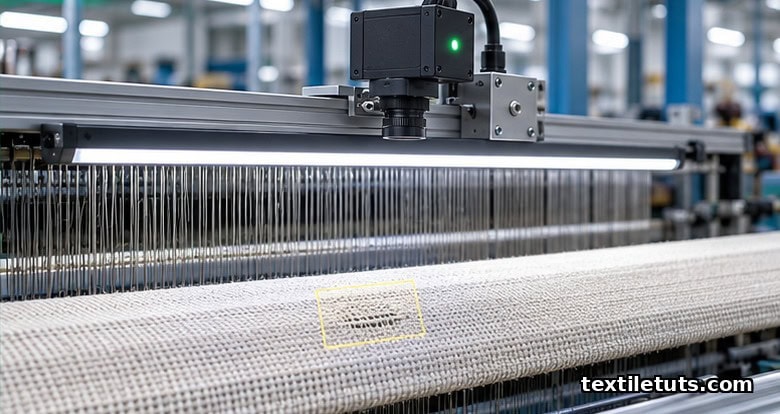
Inline inspection in textile manufacturing detects 60 to 80 percent of woven and knitted fabric defects at line speeds of up to 200 m/min by mounting machine-vision cameras directly on weaving, knitting, or finishing machinery, where the fabric is graded and flagged for removal before it reaches the next process step.
This early-detection approach is what separates inline inspection from older end-of-line manual grading, where a human inspector examines 100 percent of fabric on a frame at speeds of 10 to 15 m/min, missing roughly 30 to 40 percent of small defects (holes, broken picks, oil stains) due to inspector fatigue.
This article explains how inline inspection works in a textile mill, which sensor technologies are deployed on modern looms and knitting machines, the defect classes that vision systems catch reliably, and what an operations team should expect when budgeting for a system in 2026.
What Inline Inspection Means in a Manufacturing Context
Inline inspection is any quality check that happens while the product is still on the production line, between upstream and downstream process steps, rather than after the line has finished a batch. In a textile mill, the “line” is usually a weaving machine, a knitting machine, a stenter frame, a continuous dyeing range, or a finishing calender. The inspection point sits just after the fabric leaves the main formation zone and before the fabric is wound onto a batch roller or transferred to the next machine.
The key distinction is the timing of the feedback loop. A final inspection station, often called a fabric inspection machine, sits at the end of finishing and feeds a report on a finished roll. An inline inspection station feeds a signal back to the producing machine in real time. When a vision system flags a missing weft, the loom controller can stop the machine within 200 to 500 milliseconds and flash a stack-light alert for the weaver.
How Inline Inspection Works on a Modern Loom or Knitting Machine
A typical inline inspection cell has four physical components: an LED bar light mounted above or below the fabric path, one or more area-scan cameras (usually 2k or 4k pixel resolution) positioned 300 to 800 mm from the fabric, an industrial PC running the image-processing software, and a communication link to the machine controller.
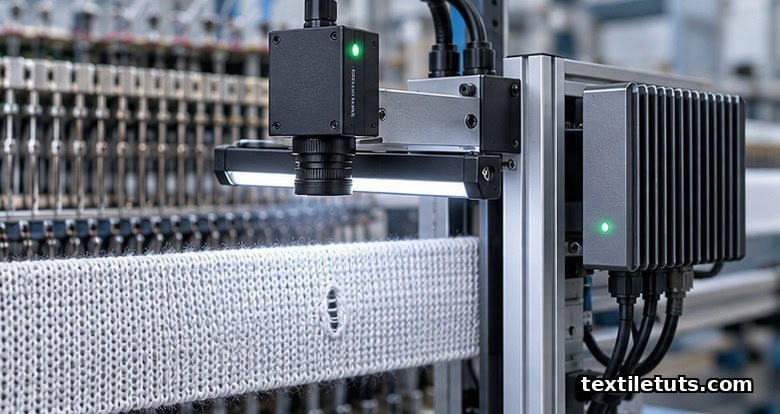
As the fabric moves, the camera captures a strip image every few centimeters. The software subtracts the local background texture and looks for statistically anomalous regions: regions where pixel intensity deviates by more than 3 standard deviations from the local mean, regions where the local periodicity of warp and weft is broken, or regions where the color coordinates fall outside a defined tolerance cube in CIELAB space.
Defects are classified into categories, for example hole, missing weft, broken end, oil spot, slub, fly yarn, double pick, mispick, and flagged with a defect score between 0 and 1. The score, the defect category, and the running meter counter are written to a defect log and, when the score crosses a configurable threshold, a stop signal is sent to the machine PLC.
Inline vs. Online vs. Offline Inspection
Textile quality literature distinguishes three inspection positions, and the names are not interchangeable. Inline means the inspection unit is mechanically integrated into the producing machine, with a real-time feedback loop. Online means the inspection unit sits in the same production flow but is not directly coupled to the producing machine: the fabric passes through an inspection frame after it leaves the producing machine, and the defect report is reviewed by an operator before the next process step. Offline means the fabric is taken off the line, often after finishing, and inspected on a separate grading frame at the end of the batch.
| Attribute | Inline | Online | Offline (final inspection) |
|---|---|---|---|
| Location relative to producing machine | Integrated, on the machine | Adjacent, in the same line | Separate inspection hall, end of finishing |
| Feedback loop to producing machine | Yes, real time (sub-second) | No, batch level | No, batch level |
| Typical fabric speed | 100 to 200 m/min (matches loom speed) | 30 to 60 m/min | 10 to 15 m/min |
| Detection rate for small defects | 60 to 80 percent | 70 to 85 percent | 55 to 70 percent (manual, fatigue-bound) |
| Capital cost per producing machine (2026) | USD 35,000 to 120,000 | USD 18,000 to 50,000 | USD 5,000 to 15,000 per inspection frame |
| Best fit for | Critical defect classes (holes, missing weft, color contamination) | Slub, yarn count variation, periodic faults | Final grading, shade approval, cosmetic sorting |
The three positions are complementary, not alternatives. Most mills that adopt inline vision keep both online and offline inspection; the inline station handles the time-critical defects, the online station handles pattern and color checks, and the offline grading frame handles the subjective cosmetic grading that human graders still do best.
Defect Classes That Inline Vision Catches Reliably
Inline camera systems perform best on defects that have a clear geometric or color signature and occur with low spatial frequency on the fabric. On a woven cotton line, the most reliably caught defect classes are missing weft, broken end, hole, oil spot, and fly yarn contamination. Detection rates reported in peer-reviewed trials range from 78 to 94 percent for these categories, with false-positive rates held below 5 percent at a tuned threshold.
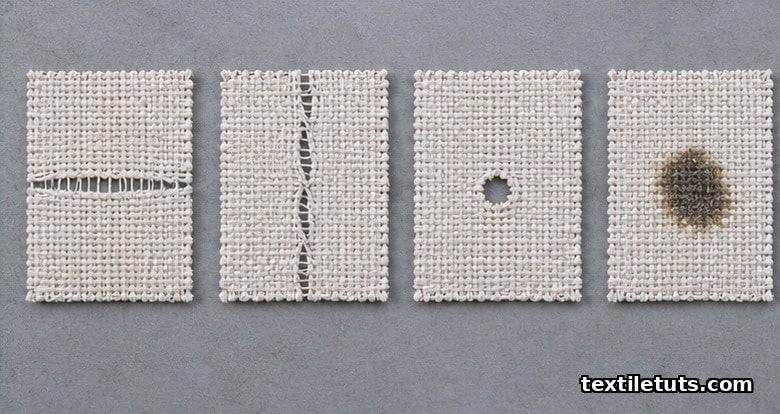
Defects that inline systems catch less reliably include subtle shade variation across the width, periodic faults that mimic the background weave pattern, and yarn count variation within a tolerance of ±5 percent. For these categories, a separate online system based on spectral measurement or a laser-based yarn count sensor is usually deployed alongside the vision camera.
On a knitted fabric line, the inline defect list shifts slightly. The system is most effective at detecting needle lines, barre, hole, press-off, and yarn contamination. Slubs and thick places, which matter greatly for the final grading of single jersey, are reliably caught when the camera runs at 4k resolution and the lighting bar is angled to produce strong top-down shading on the fabric surface.
Sensor Technologies Used for Inline Inspection
Three sensor families dominate the inline inspection market in 2026. Area-scan RGB cameras are the workhorse, with typical resolutions of 2048 by 2048 pixels and frame rates of 50 to 200 fps. They cover the largest installed base because they handle most woven and knitted defect classes at a moderate capital cost.
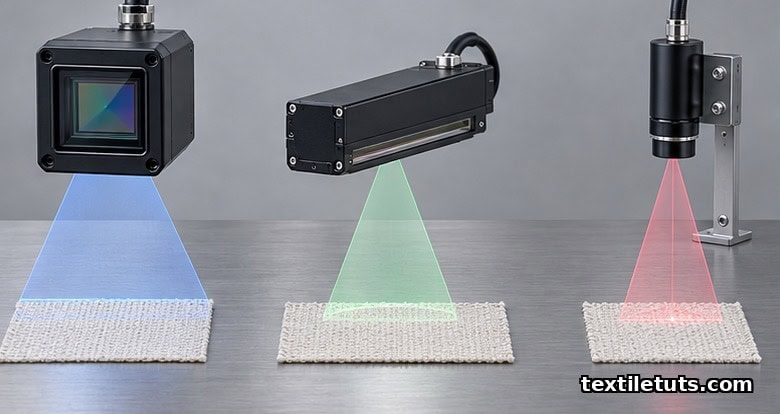
Hyperspectral line-scan cameras add spectral resolution across 100 to 200 bands in the visible and near-infrared range. They are deployed for color-critical lines such as automotive seat fabric, military shade approval, and recycled-blend identification, where a small change in dye concentration or fiber blend must be flagged. Peer-reviewed work published on MDPI shows that hyperspectral inline systems can detect dye concentration variation of less than 1 percent at line speeds above 100 m/min.
Laser triangulation sensors are deployed for specific use cases, notably yarn count monitoring on spun-yarn lines and surface roughness monitoring on nonwoven lines. They do not produce an image in the visual sense; they produce a continuous profile of the fabric thickness or surface topology at one or more points across the width. The signal is processed to detect periodic thickness variation, which is a strong indicator of upstream drafting instability on the spinning frame.
Implementation Steps and Expected Return on Investment
An inline inspection project follows a five-step rollout. The first step is a baseline audit on 20 to 30 fabric rolls, grading them on the existing offline frame to establish the current defect-per-meter baseline. The second step is a controlled trial on one producing machine, running the vision system in shadow mode for two to four weeks while the team compares its defect list against the human grader’s list on the same fabric.
The third step is threshold tuning, where the detection thresholds are adjusted so that the false-positive rate stays below 5 percent while keeping the catch rate above 70 percent. The fourth step is integration with the machine PLC and the mill’s manufacturing execution system, so that defect events populate the roll history in real time. The fifth step is rollout to the rest of the producing machines, typically in groups of four to eight machines per month.
Return on investment comes from two sources. First, fewer seconds of fabric are wound onto a defective roll, which reduces the volume of seconds sold at discount. Industry surveys in 2024 to 2025 reported a 1.5 to 4 percent reduction in seconds volume for woven mills after inline inspection rollout. Second, fewer defects reach the garment maker, which reduces claim-back rates and strengthens the mill’s position in vendor approval audits.
For a 100-loom woven mill running cotton sheeting at 60 m/min, the typical payback period reported in peer-reviewed case studies ranges from 14 to 28 months, depending on the fabric mix and the discount rate applied to seconds. Mills running high-value technical fabrics such as aramid or aerospace-grade carbon report payback within 9 to 12 months because the cost of a single undetected defect is much higher.
Limitations and What Inline Inspection Cannot Replace
Inline inspection does not replace the hand feel, the subjective shade approval, or the manual grading of finished rolls for cosmetic uniformity. Human graders still set the standard for defects that are visually borderline but matter to the customer, such as very light oil mist, slight yarn hairiness variation, or minor weft misalignment within the mill’s own tolerance band.
Inline systems also require maintenance. Camera lenses need cleaning every shift in a dusty weaving shed, LED bar lights lose about 10 percent of their output over 20,000 hours and need replacement on a planned schedule, and the image-processing software needs re-tuning whenever the fabric construction changes. A mill that adopts inline inspection without budgeting for a dedicated maintenance window will see detection rates fall by 30 to 40 percent within six months.
Frequently Asked Questions
What is the difference between inline and online inspection?
Inline inspection is mechanically integrated into the producing machine with a real-time feedback loop that can stop the machine within 500 milliseconds. Online inspection sits in the same production flow but is not directly coupled to the producing machine: the fabric passes through an inspection frame after it leaves the machine, and the defect report is reviewed by an operator before the next process step. The two names are not interchangeable in textile quality literature.
Can inline inspection replace manual inspection?
No. Inline inspection supplements manual inspection rather than replacing it. The combination of inline vision, online grading, and offline final grading covers the full defect space better than any single approach. Mills that retain their manual final-grading team after inline rollout report higher claim-back reduction than mills that retire the manual team.
What defects can inline inspection detect in textiles?
Inline vision reliably detects missing weft, broken end, hole, oil spot, fly yarn, needle line, barre, and press-off, with detection rates between 78 and 94 percent at a tuned threshold and a false-positive rate below 5 percent. Inline vision is less reliable on subtle shade variation, periodic faults that mimic the weave pattern, and yarn count variation within a ±5 percent tolerance band.
How accurate is machine vision inline inspection?
Accuracy depends on the defect class, the camera resolution, and the lighting setup. Peer-reviewed trials on woven cotton report catch rates of 60 to 80 percent across all defect classes and 78 to 94 percent for the reliably-detectable classes listed above. Hyperspectral inline systems on color-critical lines report concentration-variation detection below 1 percent.
What is the ROI of inline inspection in a textile mill?
For a 100-loom woven mill running cotton sheeting, payback is reported between 14 and 28 months in 2024 to 2025 case studies. The main return driver is a 1.5 to 4 percent reduction in seconds volume, supported by a reduction in customer claim-backs. Mills running high-value technical fabrics such as aramid or aerospace-grade carbon typically see payback within 9 to 12 months.
References
- International Organization for Standardization. ISO 2859-1: Sampling procedures for inspection by attributes. iso.org — defines the AQL-based sampling rules used alongside inline defect logs.
- ASTM International. ASTM D5430: Standard Test Methods for Visually Inspecting and Grading Textile Fabrics. astm.org — the reference grading standard that inline vision thresholds are benchmarked against.
- Hanbay, R., et al. Machine Vision System for Fabric Defect Detection in Industrial Weaving. MDPI Sensors. mdpi.com — peer-reviewed detection-rate benchmarks for woven cotton.
- Kumar, A. Computer-Vision-Based Fabric Defect Detection: A Survey. Springer Textile Research Journal. springer.com — review of camera and lighting configurations used on modern looms.
- International Textile Manufacturers Association. Quality Control in Weaving: Best-Practice Note. researchgate.net — case studies on ROI from inline vision in 100-loom woven mills.
- U.S. Department of Commerce, NIST. Handbook of Industrial Quality Control Through Inline Measurement. nist.gov — reference methods for threshold tuning and false-positive budgeting.
This article is the working reference for inline inspection in textile manufacturing. Editorial by Sabbir Ahmed, TextileTuts. Sources: ISO 2859-1, ASTM D5430, MDPI Sensors, Springer Textile Research Journal, ITMA best-practice note, NIST handbook as cited.


