
Final Random Inspection (FRI)

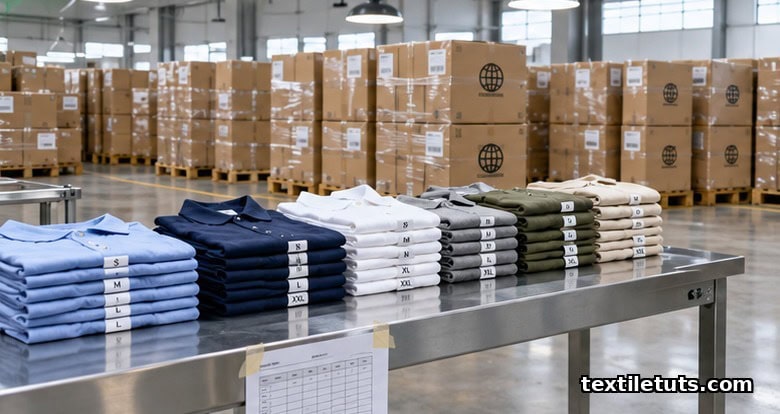
Final Random Inspection (FRI) is a pre-shipment quality-control check that uses AQL (Acceptable Quality Level) sampling under ISO 2859-1, with most buyers specifying 1.0 for critical defects, 2.5 for major defects, and 4.0 for minor defects on a lot of 2,001 to 8,000 garments at General Inspection Level II.
Conducted when at least 80% of the finished lot is packed for export, FRI decides whether a finished-goods lot ships, gets reworked, or is rejected outright.
The rest of this article walks through how FRI is set up, how defects are classified, how the AQL tables are read, and how the result feeds back into the production line.
What Final Random Inspection Actually Checks
FRI is the last guard before a buyer’s container is sealed. By the time the inspector arrives, the factory should have 80% or more of the order packed into cartons, with the remaining 20% either finished or in the final stages. The sample is drawn randomly from these packed cartons so the result is statistically valid for the shipment, not for the few pieces the line workers chose to display.
A standard FRI covers five categories:
- Quantity verification: counting cartons per style, per color, per size against the packing list.
- Workmanship: stitching density (spi), seam allowance, broken stitches, open seams, needle marks, puckering, snags, and overall appearance.
- Measurement: dimensional checks against the buyer’s approved size spec, typically on 13 to 20 garments per style.
- Functionality: zippers, snaps, buttons, drawcords, velcro pull-strength, and any other mechanical feature the buyer specified.
- Packaging and labeling: polybag warnings, barcodes, care labels, country-of-origin marks, hangtags, and master carton markings.
How AQL Sampling Works Under ISO 2859-1
AQL is the worst defect rate, expressed as a percentage of defective units, that a buyer will accept on average across many lots. ISO 2859-1 (the civilian successor to MIL-STD-105E) is the document that translates the AQL into a sample size and an acceptance number.
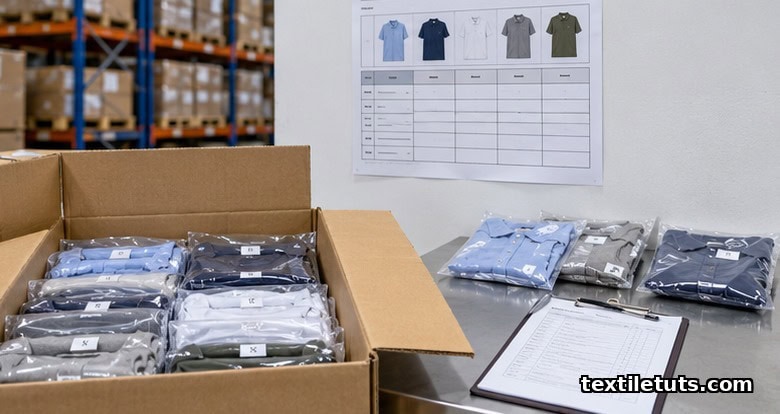
Three inputs drive the table lookup:
- Lot size: the number of units in the shipment (cartons multiplied by pieces per carton).
- Inspection level: General Levels I, II, and III cover most apparel; Special Levels S-1 to S-4 are used for destructive or expensive tests. Level II is the default unless the buyer says otherwise.
- AQL value: set per defect class. Critical defects (safety, legal, functional) are usually AQL 0 or 1.0. Major defects (visible, performance-affecting) are commonly AQL 2.5. Minor defects (cosmetic, not affecting sale) are usually AQL 4.0.
For a lot of 3,000 pieces at Level II and AQL 2.5, the table calls for a sample of 125 units. The lot passes if no more than 7 of those 125 units are defective. The lot fails if 8 or more are defective.
Critical, Major, and Minor: The Defect Classification
Classification is what makes an AQL table meaningful. Most buyers publish a defect code list before production starts. A typical split:
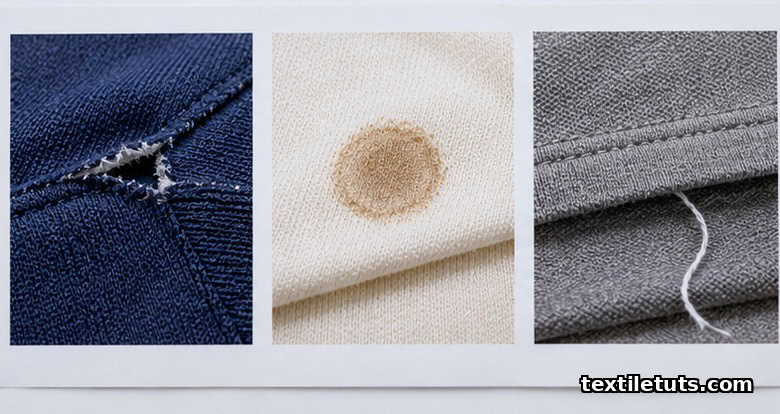
- Critical: sharp metal parts, broken needles left in the garment, flammable trims that fail the buyer’s standard, incorrect country-of-origin. Any one critical defect in the sample rejects the lot.
- Major: broken stitches, seam slippage above the buyer’s tolerance, missing buttons, visible stains, GSM off-spec by more than ±5%, measurement off-tolerance on a major dimension.
- Minor: loose thread not trimmed, mild puckering, slight shade variation within tolerance, minor print misalignment that the buyer defines as cosmetic.
The classification matters because ISO 2859-1 uses three separate AQL budgets. A lot that fails AQL 1.0 for critical but passes AQL 2.5 for major can still be rejected.
Reading the Sample Result
After inspection, the inspector records the number of defective units per class, plus the total. The single-sampling plan compares each total to its acceptance (Ac) and rejection (Re) numbers. If the number of defects is at or below Ac, the lot passes. If it equals or exceeds Re, the lot fails. Results between Ac and Re do not happen in single sampling because Ac and Re are consecutive integers (for example, Ac=7 and Re=8 at lot size 2,801 to 5,000, AQL 2.5, Level II).
Some buyers use double sampling, where a first sample is drawn and, if the result is borderline, a second sample is drawn. ISO 2859-1 has full tables for both plans, plus reduced and tightened inspection. Switching to tightened inspection after a first rejection is a common protocol that protects the buyer without forcing rework on borderline lots.
Common Measurement and Workmanship Standards Buyers Reference
Most apparel buyers cite the same international methods, so an inspector can compare the live measurement to a published rule rather than guess:
- ISO 2859-1: sampling procedures for inspection by attributes (the AQL tables themselves).
- ASTM D3774: mass per unit area (weight) of woven and knitted fabrics.
- ASTM D3776: mass per unit area of fabric by cut-and-weigh method, used by inspectors in the field.
- AATCC TM135: dimensional changes of fabrics after home laundering, used to set shrinkage tolerance on the size spec.
- ASTM D1683: failure in sewn seams of woven fabrics, used to set seam-strength pass/fail.
- AATCC TM130: stain removal, occasionally listed when a buyer includes stain resistance under workmanship.
What Happens When the Lot Fails
A failed FRI does not automatically mean the buyer cancels the order. Most buying agreements have a defined rework loop:
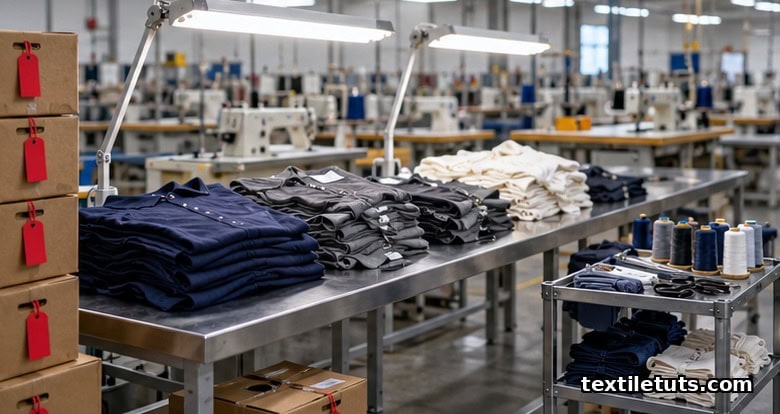
- 100% inspection of the lot at the factory’s cost, with all defectives reworked or replaced.
- Second FRI on the reworked lot, charged back to the factory in some contracts.
- Pre-shipment re-inspection if the second FRI fails. Continued failure can trigger shipment hold, chargeback, or in the worst case order cancellation.
The cost of a failed FRI is rarely the inspection fee. It is the cost of holding the container, missing the ship date, paying air freight to recover the program, and the discount a buyer demands on the next order to compensate for the disruption.
FRI vs. Other Pre-Shipment Inspections
FRI is one of several checkpoints. Knowing the difference prevents confusion when a buyer names more than one inspection:
- DUPRO (During Production): conducted when 20-40% of the lot is complete. Used to catch systemic issues while there is still time to re-train the line.
- IPC (Initial Production Check): the first 20-50 pieces off the line, used to confirm the factory understands the spec.
- PSI (Pre-Shipment Inspection): same scope as FRI in many buying programs; the two terms are often interchangeable.
- Pre-Production Meeting (PPM): a paperwork-only event, not an inspection.
Frequently Asked Questions
What does AQL stand for in garment inspection?
AQL stands for Acceptable Quality Level. It is the maximum percentage of defective units that a buyer will accept on average over many lots. ISO 2859-1 converts an AQL into a sample size and an acceptance number for any lot size and inspection level.
What AQL is most common for apparel?
Most apparel buyers specify AQL 1.0 for critical defects, 2.5 for major defects, and 4.0 for minor defects. Buyers with stricter programs (premium sportswear, children’s wear) often drop critical to 0 and major to 1.5. Discount programs sometimes raise minor to 6.5 to ease pressure on lower-cost factories.
How many garments are inspected in a typical FRI?
For a lot of 2,001 to 8,000 pieces at General Inspection Level II (the default), ISO 2859-1 calls for a 125-piece sample. Smaller lots use smaller samples (51 for 91 to 150 pieces; 13 for 26 to 50). Larger lots up to 500,000 pieces still draw 315 pieces at Level II, which is why container-size lots are inspected at the same rate as 8,000-piece lots.
Can a buyer reject a lot on a single critical defect?
Yes. Most buyers set the critical AQL at 0 or 1.0. Under AQL 0, any single critical defect in the sample rejects the lot. Under AQL 1.0 for a 125-piece sample, the lot rejects at 3 or more critical defects. A broken needle left in a garment is treated as a single-unit critical defect for this purpose.
What is the difference between FRI and PSI?
There is usually no difference in scope. Both are pre-shipment inspections done when 80% or more of the lot is packed. The buyer’s contract or quality manual decides which term is used. Some buyers reserve FRI for finished-goods shipments and PSI for shipments that include hanging garments or flat-packed home textiles.
References
- International Organization for Standardization. ISO 2859-1:1999 Sampling procedures for inspection by attributes, Part 1: Sampling schemes indexed by acceptance quality limit (AQL) for lot-by-lot inspection. iso.org. The AQL sampling tables used for garment FRI.
- ASTM International. ASTM D3774/D3774M-24 Standard Test Methods for Mass Per Unit Area (Weight) of Woven or Knitted Fabrics. astm.org. Mass measurement method referenced in FRI checks.
- ASTM International. ASTM D3776/D3776M-20 Standard Test Methods for Mass Per Unit Area (Weight) of Fabric by the Cut-and-Weigh Method. astm.org. Field method inspectors use for fabric weight checks.
- ASTM International. ASTM D1683/D1683M-17 Standard Test Method for Failure in Sewn Seams of Woven Apparel Fabrics. astm.org. Seam-strength pass/fail referenced during FRI.
- AATCC. AATCC TM135-2018 Dimensional Changes of Fabrics after Home Laundering. aatcc.org. Shrinkage tolerance basis used in FRI size-spec checks.
- American Society for Quality. Acceptance Sampling Resources: AQL, OC, and Producer’s Risk Curves. asq.org. Overview of AQL application in textile and apparel inspection.
This article is the working reference for Final Random Inspection. Editorial by Sabbir Ahmed, TextileTuts. Sources: ISO 2859-1, ASTM D3774, ASTM D3776, ASTM D1683, AATCC TM135 as cited.


