
Carbon Fiber Spinning

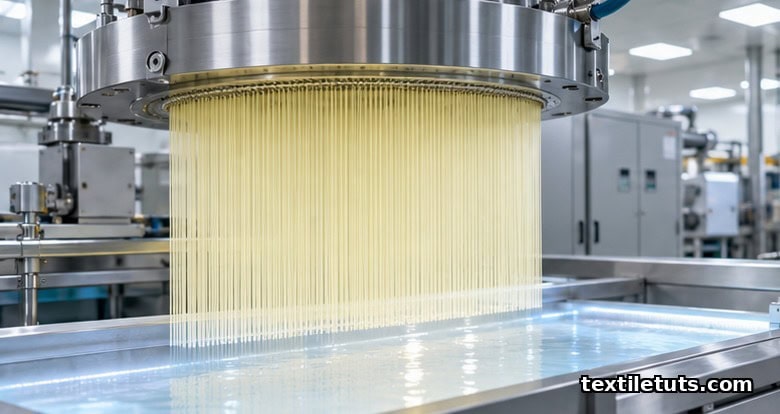
Carbon fiber spinning produces filaments with diameters of 5-10 micrometers from a polyacrylonitrile (PAN) precursor containing at least 95% acrylonitrile repeat units, which are subsequently carbonized at 1,000-1,500 °C in an inert atmosphere to reach tensile strengths of 3.5-7.0 GPa.
This precursor route accounts for roughly 90% of global commercial carbon fiber production, with mesophase petroleum pitch supplying most of the remaining 10%.
Below we walk through the chemistry and mechanics that turn a thermoplastic polymer solution into aerospace-grade structural fiber, then flag the precision parameters that distinguish commodity carbon fiber from high-modulus grades.
What Carbon Fiber Spinning Actually Means
In textile manufacturing, “spinning” can refer either to the short-staple fiber-to-yarn process used for cotton and wool, or to the extrusion of continuous filaments from a polymer solution or melt. Carbon fiber spinning belongs to the second category: it is the extrusion of a carbon-rich precursor polymer into continuous filaments that are later converted into nearly pure carbon through controlled pyrolysis.
The filaments produced at this stage are not yet carbon. They are off-white or pale yellow precursor fibers, typically polyacrylonitrile (PAN), that are subsequently heated through stabilization, carbonization, and (for high-modulus grades) graphitization to yield the final black carbon fiber. The spinning step itself only governs filament geometry, internal morphology, and the level of molecular orientation that survives into the final fiber.
This distinction matters in practice. A spinneret for carbon fiber precursor may carry 1,000-50,000 holes, compared with 50-200 holes for textile filament extrusion, because carbon fiber is always handled as a multifilament tow. After thermal conversion, each filament shrinks roughly 20-30% in diameter and 40-50% in linear density, so the precursor must already be drawn to within ±2% of the target precursor diameter.
Why PAN Precursor Dominates Commercial Production
Carbon fiber can be derived from three precursor families: PAN, mesophase pitch, and rayon (regenerated cellulose). PAN commands roughly 90% of commercial output because its linear, carbon-rich molecular backbone yields 50-55% carbon yield after pyrolysis, compared with 20-25% for pitch and 10-15% for rayon. Higher carbon yield translates directly into lower precursor mass per kilogram of finished carbon fiber, which is the single largest variable cost in the supply chain.
Commercial PAN precursor for carbon fiber must contain at least 95% acrylonitrile repeat units, with the balance drawn from neutral comonomers such as methyl acrylate, methyl methacrylate, itaconic acid, or acrylamide. These comonomers serve two functions: they disrupt PAN’s tendency to cyclize too violently during stabilization, and they introduce dye sites and oxygen-bearing groups that lower the exotherm peak that otherwise degrades filament uniformity.
The exact comonomer recipe is proprietary to each manufacturer (Toray, Toho Tenax, Mitsubishi Chemical, SGL, DowAksa, Formosa Plastics, Hyosung). Comonomer content typically sits between 0.5 and 4 mol%.
Pitch-based carbon fiber is its own niche. Mesophase pitch, a discotic liquid-crystalline form of petroleum or coal-tar pitch, is melt-spun at 300-400 °C and yields fibers with very high thermal conductivity and modulus (up to 900 GPa after graphitization), at the cost of lower tensile strength (2.0-3.5 GPa) and reduced elongation. Pitch-based fiber is the standard choice for satellite structures and heat-spreader applications; aerospace primary structures almost exclusively use PAN-based fiber.
The Wet Spinning and Dry-Jet Wet Spinning Process
PAN precursor is most commonly produced by wet spinning or dry-jet wet spinning. In the wet-spinning variant, a PAN solution (typically 18-22% solids) in dimethylformamide (DMF), dimethyl sulfoxide (DMSO), or dimethylacetamide (DMAc) is extruded at 50-80 °C through a spinneret with 1,000-50,000 holes into a coagulation bath of the same solvent diluted with water, held at 0-30 °C.
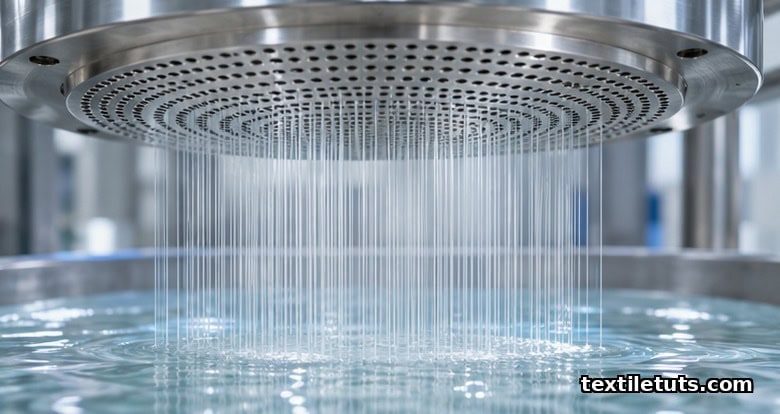
Solvent diffuses out of the nascent filament while water diffuses in, locking in a finger-void cross-section that collapses during subsequent drawing. Key parameters that drive the resulting fiber’s final tensile properties are:
- Spinneret hole diameter, typically 50-100 µm for a target final diameter of 5-10 µm after draw.
- Coagulation bath temperature (lower temperatures slow solvent diffusion and yield denser skin).
- Jet stretch ratio, usually 1.5-4×, set by the speed difference between extrusion and first godet.
- Residual solvent in the gel fiber, controlled below 30 wt% before drying.
Dry-jet wet spinning is the more common industrial variant: the spinneret sits 5-50 mm above the coagulation bath, allowing the solution stream to cool and partially align before contacting the non-solvent. This configuration supports higher polymer solids (up to 25%) and finer filaments without spinneret fouling.
Stretching, Washing, and Drawing
The coagulated gel fiber leaves the bath at a draw ratio of roughly 1:1 to 1:3 and must be drawn to total ratios between 6:1 and 14:1 to develop the molecular orientation that survives carbonization. Drawing happens in three zones:
- Plasticizing draw in a hot water or steam bath at 90-100 °C, where residual solvent acts as a plasticizer.
- Hot-air or hot-plate draw at 130-180 °C, which aligns the polymer chains without plasticizer.
- Final draw on heated godets at 180-220 °C, where the fiber develops crystallinity.
Between zones, the fiber is washed in countercurrent water to bring residual solvent below 0.5 wt%. Insufficient washing leaves DMF or DMSO in the fiber, which causes voids during carbonization and reduces tensile strength by 10-30%.
The finished PAN precursor fiber has a density of 1.16-1.19 g/cm³, a tenacity of 4-7 cN/dtex, and an elongation at break of 8-14%. Crucially, it must be free of contamination and surface defects, because every particle or skin defect becomes a stress concentrator after carbonization, often halving tensile strength at the local scale.
From Precursor to Carbon Fiber: Pyrolysis Stages
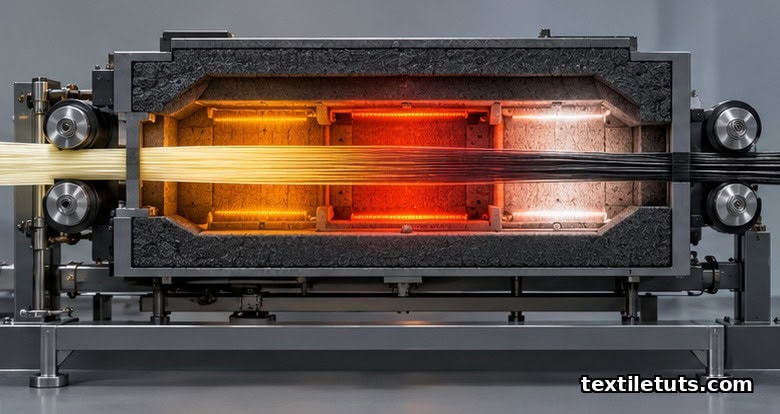
Spinning produces a precursor; thermal processing converts that precursor into carbon fiber. The conversion runs in three sequential stages:
| Stage | Temperature | Atmosphere | Outcome |
|---|---|---|---|
| Stabilization | 200-300 °C | Air | Cyclization of nitrile groups to a ladder polymer; filament picks up 8-12% oxygen. |
| Carbonization | 1,000-1,500 °C | Nitrogen or argon | Non-carbon atoms evolve as H₂O, CO₂, NH₃, HCN; residual carbon forms a turbostratic graphitic structure. |
| Graphitization (optional) | 2,000-3,000 °C | Inert gas, tension maintained | Graphene planes align along the fiber axis; modulus rises from ~230 GPa to 400-700 GPa. |
Stabilization is the rate-limiting step. Cyclization of the nitrile groups is strongly exothermic, and the heat must leave the filament faster than the reaction generates it, otherwise the filament melts and the tow is lost. Industrial lines apply tension of 0.5-5 mg/denier during stabilization to keep filaments straight.
Carbonization becomes endothermic once volatile evolution ends; filament residence times run 30-90 seconds at peak temperature, with tow speeds of 5-15 m/min for standard-modulus fiber.
Properties of Finished Carbon Fiber
Standard-modulus PAN-based carbon fiber (Toray T700, T800; Toho Tenax IMS65 equivalents) reaches a tensile strength of 4.0-5.5 GPa and a tensile modulus of 230-290 GPa. High-modulus grades (Toray M55J, M65J; Mitsubishi HR40) trade elongation for stiffness, with tensile modulus of 400-640 GPa and tensile strength dropping to 3.5-4.5 GPa.
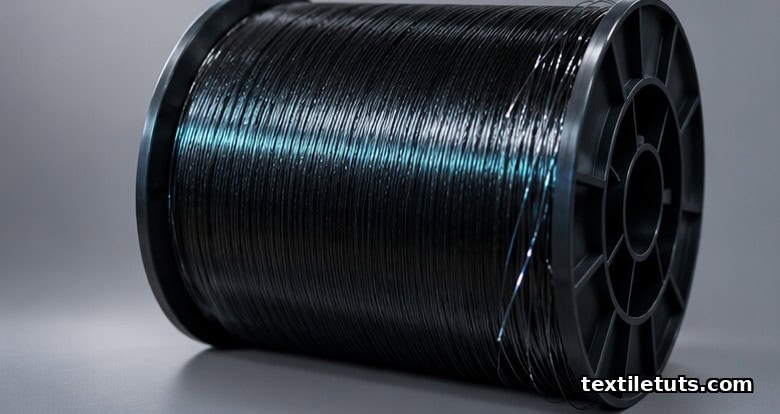
Filament diameter is the single most visible outcome of the spinning step. Most aerospace-grade tows are 6-7 µm per filament. Larger-diameter fiber (10-12 µm) is cheaper but more prone to internal defect propagation.
Density of finished PAN-based carbon fiber sits at 1.75-1.93 g/cm³, against 7.85 g/cm³ for steel. Specific strength (tensile strength divided by density) is therefore 3-5× that of high-strength steel and roughly 2× that of E-glass fiber, which is the main reason carbon fiber dominates aerospace primary structures.
Quality Control and Testing
Carbon fiber tow is tested at three points: after spinning (precursor), after carbonization (finished fiber), and after surface treatment and sizing. Tensile testing follows ASTM D4018 for tow properties and ASTM D3822 for single-filament properties. Filament diameter follows ISO 13029, and density follows ISO 10119 (gradient column or gas pycnometry).
Defect-driven tensile failure is statistically modeled using a Weibull distribution, with a Weibull modulus of 5-8 for high-quality PAN-based fiber. A low Weibull modulus signals a broad defect-size distribution and predicts lower design allowables for composite laminates.
Process lines also monitor linear density (denier or tex per filament), surface oxygen content (X-ray photoelectron spectroscopy), and sizing type (epoxy-compatible, polyester-compatible, polyurethane-compatible) so that downstream weavers and prepreggers receive a consistent product.
Frequently Asked Questions
How many filaments are in a typical carbon fiber tow?
A standard “12K” tow contains 12,000 filaments; “3K” and “6K” are the most common small-tow grades for sporting goods and aerospace fabrics; “24K” and “50K” are large-tow industrial grades. The filament count is set by the spinneret hole count in the precursor spinning step.
Can carbon fiber be spun from a melt rather than a solution?
Conventional PAN decomposes below its melting point and cannot be melt-spun. Melt-processable PAN copolymers and pitch precursors can be melt-spun, but commercial PAN-based carbon fiber is almost exclusively solution-spun. Pitch-based carbon fiber from mesophase pitch is itself melt-spun at 300-400 °C before oxidation and carbonization.
What is the carbon yield from PAN precursor?
PAN precursor yields roughly 50-55% carbon by mass after carbonization, meaning 2 kg of precursor produces approximately 1 kg of finished carbon fiber. Pitch-based precursor yields 20-25%, and rayon yields 10-15%, which is why PAN dominates commercial production.
Is wet spinning or dry-jet wet spinning more common for carbon fiber precursor?
Dry-jet wet spinning is the dominant industrial method today because the air gap allows higher polymer solids (up to 25% versus 18-22% for immersion wet spinning) and finer filament diameters without spinneret fouling. Pure immersion wet spinning survives in a small share of plants producing coarse textile-grade PAN.
How do spinning defects affect final carbon fiber properties?
Surface particles, skin voids, and uneven coagulation carry into the carbonized fiber as internal flaws that act as stress concentrators. Tensile strength is governed by the Weibull weakest-link statistic, so a single 5-µm void can halve the strength of the affected filament section. This is why precursor plants run ISO 14644-7 cleanroom conditions for the dope preparation and spin hall.
References
- ISO 10119:2020. Carbon fibre — Determination of density. International Organization for Standardization. Method for density of finished carbon fibre.
- ISO 13029:2020. Carbon fibre — Determination of the filament diameter and cross-sectional area. International Organization for Standardization.
- ASTM D4018-17. Standard Test Methods for Properties of Continuous Filament Carbon and Graphite Fiber Tows. ASTM International. Tensile strength, modulus, and elongation methods for carbon fiber tows.
- Morgan, P. (2005). Carbon Fibers and Their Composites. CRC Press. Reference on PAN precursor chemistry, spinning, and conversion.
- Edie, D. D. (1998). “The effect of processing on the structure and properties of carbon fibers.” Carbon, 36(4), 345-362. ScienceDirect. Pitch and PAN precursor spinning relationships to fiber structure.
- Huang, X. (2009). “Fabrication and properties of carbon fibers.” Materials, 2(4), 2369-2403. MDPI. Open-access review of PAN-based carbon fiber manufacture.
- Park, S.-J., editor (2015). Carbon Fibers, Springer Series in Materials Science. Springer. Spinning, stabilization, and carbonization processes.
Editorial by Iftay Khairul Alam, TextileTuts. Sources: ISO 10119, ISO 13029, ASTM D4018, Morgan (2005), Edie (1998), Huang (2009), Park (2015) as cited.


