
Industrial Fabric Weaving: Conveyor Belts

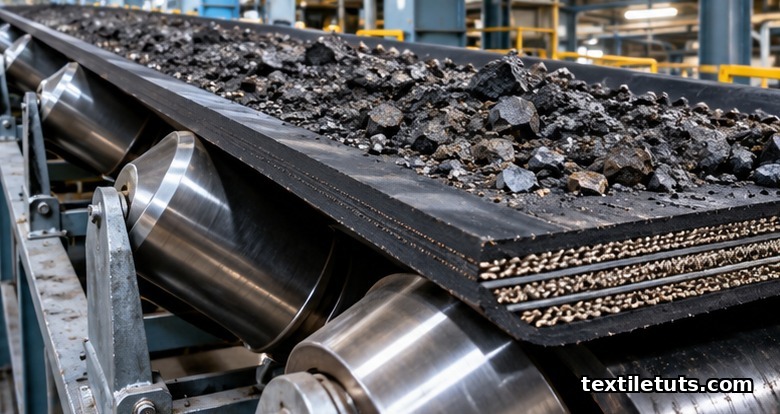
Industrial conveyor belts are woven from synthetic fabrics, most commonly polyester-nylon (EP) or nylon-nylon (NN) in 2 to 6 plies, and deliver tensile strengths of 100 to 3500 N/mm at carcass widths up to 2400 mm as classified by ISO 14890. Operating temperatures range from −40 °C to +200 °C depending on the polymer system, and the same carcass can carry coal, cement clinker, iron ore, or grain at belt speeds between 0.5 and 10 m/s.
This guide walks through how the woven carcass is engineered, which weave structures carry which loads, and how standards from ISO and DIN specify the textile construction. You will learn the exact role each layer plays, the difference between a fabric carcass and a steel-cord belt, and how to read a conveyor-belt code on a product data sheet.
What Is the Carcass in a Conveyor Belt?
The carcass is the load-bearing textile skeleton inside every fabric conveyor belt. It is built by weaving high-tenacity synthetic yarns into flat strips, stacking those strips into multiple plies, and laminating them with a polymer skim coat before covering the top and bottom with rubber or PVC.
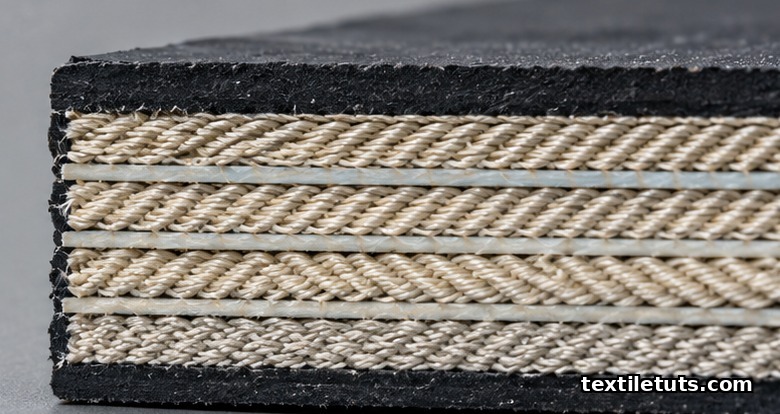
Three carcass constructions dominate the industry. EP (polyester warp, nylon weft) gives high modulus, low elongation, and good impact resistance, which is why EP belts hold roughly 70 percent of the global fabric-belt market for mining and bulk handling. NN (nylon warp, nylon weft) has higher elongation at break (around 25 percent versus EP’s 1.5 to 2 percent) and absorbs shock better, so it is preferred for long-distance overland conveyors with rocky or lump ore. Steel-cord belts use brass-coated steel cables instead of fabric and are excluded from ISO 14890, which is the standard for fabric-reinforced belts only.
Yarn Materials Used in Industrial Conveyor Belt Weaving
The textile engineer chooses warp and weft yarns based on tensile modulus, elongation, heat resistance, and adhesion to the rubber skim. The four commercial choices below cover almost every fabric carcass shipped today.
| Yarn | Type | Tensile strength (cN/tex) | Elongation at break | Heat resistance (continuous) | Typical use |
|---|---|---|---|---|---|
| Polyester (PET) | Warp | 60–80 | 1.5–2% | −40 to +150 °C | EP belts, long-haul conveyors |
| Nylon 6 / 6.6 (PA) | Warp or weft | 55–80 | 20–25% | −40 to +120 °C | NN belts, impact zones |
| Aramid (PPTA) | Warp | 190–220 | 3–4% | −40 to +200 °C | High-temperature, low-stretch belts |
| Cotton / viscose | Weft | 20–35 | 8–12% | Up to +90 °C | Light-duty, food-grade belts |
Polyester and nylon are by far the most common pair. Polyester supplies the modulus that keeps the belt from stretching under load, while nylon supplies the transverse toughness needed to absorb impact when lump material drops onto the belt. Aramid is reserved for high-temperature duty and for very long conveyors where even small elongation accumulates into significant take-up travel. Cotton and viscose appear only in light-duty and food-contact belts where rubber adhesion requirements rule out synthetics.
Weave Structures and Ply Construction
The weave structure controls how the warp and weft interlock, and that interlock controls tear resistance, flex life, and fastener-holding ability. Three weave families cover almost all fabric carcasses:
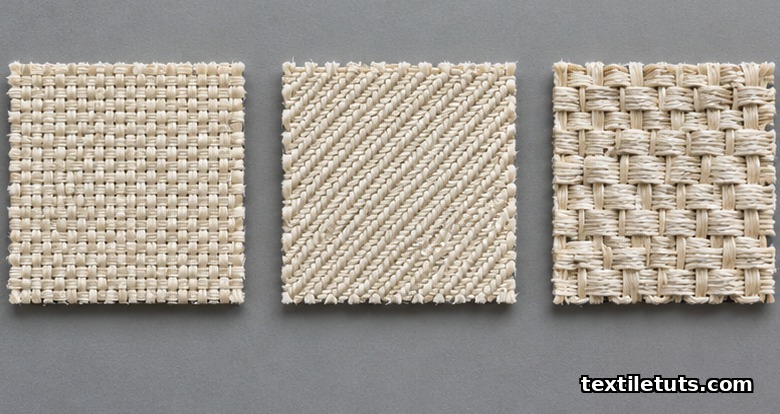
- Plain weave (1/1): every warp crosses over and under every weft in alternation. This gives the most stable fabric and the best fastener-holding for mechanical belt splicing, but lower tear strength than other weaves at the same weight.
- Twill weave (2/1, 2/2, 3/1): warp floats over two or three wefts before going under. Twill improves tear strength by 20 to 40 percent versus plain weave at equal fabric weight and is the default for EP and NN mining belts.
- Broken twill / multi-layer (3+ layers): used in solid-woven carcass belts where warp and weft interlock across the full thickness, eliminating the skim-rubber layer. These carcasses run thinner and are common in underground coal mining where low profile and flame resistance matter.
A standard conveyor carcass is built from 2 to 6 plies, with each ply a separate woven fabric. The plies are stacked so warp directions align, then bonded with a thin calendered rubber skim (typically 0.4 to 0.8 mm per ply) that locks the plies together and gives the rubber cover something to anchor to. The number of plies drives the tensile rating: a 4-ply EP belt at 315 N/mm designation (per ISO 14890) carries four times the working load of a single-ply 315 N/mm fabric when stretched.
Key Mechanical Properties Specified by Standards
ISO 14890 is the umbrella standard for fabric-reinforced conveyor belts. It defines belt types by tensile strength (ST 100, ST 125, ST 160, ST 200, ST 250, ST 315, ST 350, ST 400, ST 450, ST 500, ST 630, ST 800, ST 1000, ST 1250, ST 1600, ST 2000, ST 2500, ST 3150, ST 3500) and by cover-grade selection based on the material being conveyed. The suffix numbers after “ST” refer to the nominal longitudinal tensile strength in newtons per millimeter of belt width.
Three additional ISO standards govern the textile behavior of the carcass itself. ISO 583 covers tensile properties of the belt and uses a 1:100 pulley-diameter-to-belt-thickness ratio for the test. ISO 284 sets the maximum electrical resistance at 300 megohms for belts used in flammable atmospheres. ISO 340 covers flame-retardant covers used in underground coal mining and rates self-extinguishing behavior after a controlled flame exposure. A complete belt data sheet normally references all four standards plus a national adoption such as DIN 22102 in Germany, AS 1334 in Australia, or JIS K 6322 in Japan.
How a Woven Carcass Becomes a Finished Belt
Fabric conveyor-belt manufacture is a continuous calendering and laminating process. The textile stages are run on dedicated industrial weaving machines that look similar to a wide loom but produce rolls of fabric up to 2400 mm wide with selvedges treated for rubber bonding.
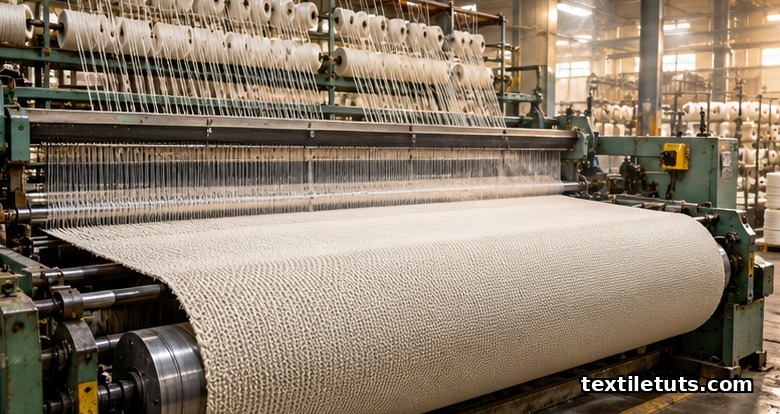
- Yarn preparation: high-tenacity polyester and nylon filaments are twisted, plied, and sized to give a warp sheet with uniform tension. A typical EP warp sheet contains 80 to 160 ends per 100 mm depending on the target tensile rating.
- Weaving: the warp is woven on a wide loom (Sulzer, Picanol, or Toyota shuttleless machines are common) using a twill or multi-layer pattern. Weft is inserted by projectile, rapier, or air-jet at picks of 30 to 60 per 100 mm.
- Skim calendering: each ply is run through a calender that presses a thin rubber skim into the fabric. The skim is a friction compound with RFL (resorcinol-formaldehyde-latex) adhesion promoter that bonds to polyester and nylon.
- Building: plies are stacked in the correct warp direction, with cover rubber calendered on the top and bottom faces. Cover thickness ranges from 2 mm (light-duty service) to 10 mm or more (abrasive ore service).
- Vulcanization: the assembled belt is cured in a continuous vulcanizing press at 140 to 160 °C for 15 to 45 minutes, depending on belt thickness and cover compound. This step locks the textile and rubber together permanently.
Typical Specifications by Application
The same textile carcass is built differently depending on what it carries. The table below captures the most common duty classes and the carcass construction that handles them.
| Application | Belt type | Ply count | Tensile rating (N/mm) | Cover thickness (top / bottom) | Reference standard |
|---|---|---|---|---|---|
| Light package handling | EP 100–200 | 2 | 100–200 | 2 / 1 mm | ISO 14890 |
| Sand and aggregate | EP 400–630 | 3 | 400–630 | 4 / 2 mm | ISO 14890, DIN 22102 |
| Hard coal preparation | EP 630–1000 | 3–4 | 630–1000 | 6 / 3 mm | ISO 14890, ISO 340 |
| Iron ore lump transport | EP 1000–1600 | 4–5 | 1000–1600 | 8 / 5 mm | ISO 14890 |
| Cement clinker | EP 1250–2000 | 4–6 | 1250–2000 | 10 / 6 mm | ISO 14890 |
| Underground coal (flame resistant) | Solid-woven PVC or rubber | Solid | 400–1000 | Integrated | ISO 340, MSHA |
| High-temperature sintering | Aramid carcass | 2–3 | 800–1600 | 6 / 4 mm (silicone cover) | ISO 14890 |
Frequently Asked Questions
What is the difference between EP and NN conveyor belts?
EP belts use polyester in the warp direction and nylon in the weft, giving low elongation (1.5 to 2 percent) and high modulus, which keeps long conveyors stable under load. NN belts use nylon in both directions, with elongation at break of about 25 percent, which absorbs impact from falling lump material far better. EP dominates general bulk handling; NN is chosen where rocks hit the belt hard and where troughing idlers place shock loads on the carcass.
How thick is a typical conveyor belt carcass?
A 4-ply EP belt with a 6 mm top cover and 3 mm bottom cover has a total belt thickness of roughly 12 to 14 mm, of which the woven fabric plies plus skim account for 3 to 4 mm. Heavier 6-ply steel-mill belts can run 22 to 25 mm overall. Solid-woven PVC belts are thinner, often 6 to 9 mm for the same tensile rating, because the warp and weft interlock through the full thickness.
Can a fabric conveyor belt carry hot material?
Yes, but only if the cover compound and the carcass yarns are rated for the temperature. Standard rubber covers with EP or NN carcass handle material up to about 80 °C in continuous service, with short peaks to 120 °C. Above that, the cover is upgraded to heat-resistant EPDM or silicone and the carcass may be aramid, which is rated to 200 °C continuous. Cement clinker and sinter plants routinely run aramid-carcass belts with silicone cover at 150 to 180 °C.
What is the average service life of a fabric conveyor belt?
Service life depends on material abrasiveness, belt speed, idler spacing, and cover grade rather than on the carcass itself. In well-designed aggregate and sand service, fabric belts commonly last 6 to 10 years and carry 30,000 to 100,000 hours of operation. In heavy iron-ore duty with 8 mm cover, expect 4 to 6 years. The woven carcass almost always outlasts the cover; when the carcass finally fails, it is usually at a splice or after foreign-material damage, not from textile fatigue.
Are conveyor belt fabrics recyclable?
The textile plies can be reclaimed by cryogenic grinding, which separates the rubber from the polyester-nylon fabric, and the recovered fabric is reused as reinforcement in lower-grade rubber products or as filler in molded goods. The rubber cover is reprocessed into crumb rubber for road surfaces, athletic tracks, and playground surfacing. End-of-life recycling rates for used conveyor belts in Europe exceed 90 percent by mass under extended-producer-responsibility schemes.
References
- International Organization for Standardization. ISO 14890:2013 — Conveyor belts — Specification for rubber- or plastics-covered conveyor belts of textile construction for general use. iso.org — defines belt types by tensile strength (ST series) and cover-grade selection.
- International Organization for Standardization. ISO 583:2007 — Conveyor belts with a textile carcass — Total belt thickness and thickness of constitutive elements. iso.org — sets the 1:100 pulley-diameter-to-thickness test ratio and thickness tolerances.
- International Organization for Standardization. ISO 284:2012 — Conveyor belts — Electrical conductivity — Specification and test method. iso.org — caps resistance at 300 MΩ for flammable-atmosphere service.
- International Organization for Standardization. ISO 340:2013 — Conveyor belts — Laboratory scale flammability characteristics — Requirements and test method. iso.org — covers flame-retardant covers used in underground coal mining.
- DIN (German Institute for Standardisation). DIN 22102:2023 — Textile conveyor belts for general purpose; dimensions, requirements. din.de — German national standard referenced alongside ISO 14890.
- Deutsches Institut für Normung. DIN 22101:2011 — Continuous conveyors — Belt conveyors for loose bulk materials; basis for calculation and design. din.de — covers belt selection for bulk handling systems.
- ResearchGate / Springer. Conveyor belt technology: a review of carcass materials and weave structures. researchgate.net — peer-reviewed review of polyester, nylon, and aramid carcass engineering.
This article is the working reference for industrial fabric weaving in conveyor belts. Editorial by Mohammad Yousuf (Anik), TextileTuts. Sources: ISO 14890, ISO 583, ISO 284, ISO 340, DIN 22102, DIN 22101, and the Springer / ResearchGate review of carcass materials, as cited.


