
Colorfastness to Water: ISO 105 E01

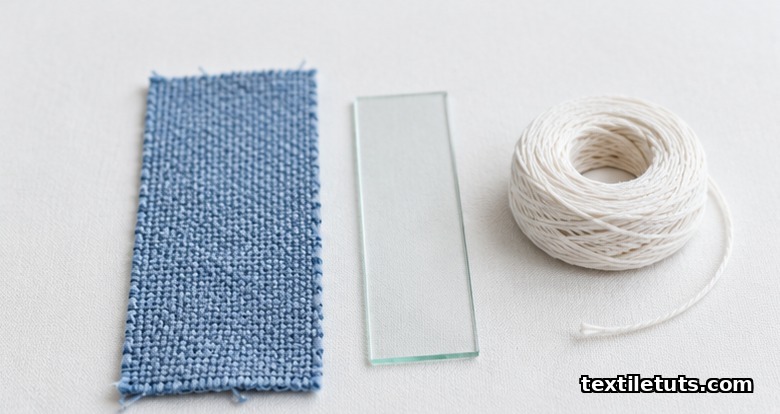
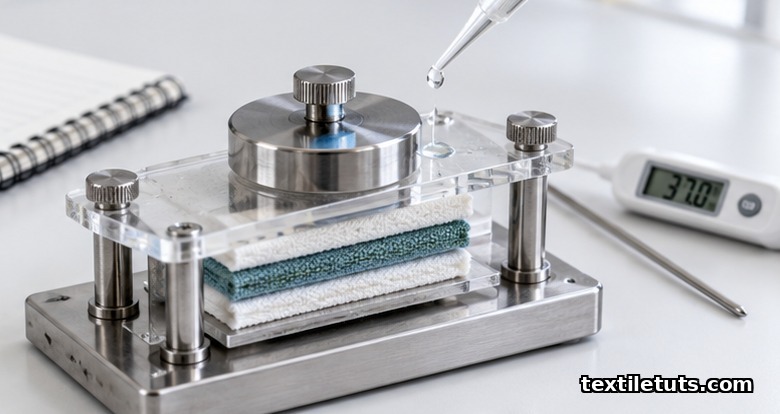
ISO 105 E01 tests colorfastness to water by sandwiching a 40 mm × 100 mm specimen between two TV multifiber adjacent strips, pressing the assembly under 12.5 kPa in a perspirometer, and holding it for 4 hours at 37±2°C; the specimen is then rated for shade change and the adjacent fabric for staining on separate 1-5 grey scales.
A rating of 5 means the dye did not bleed onto any of the six multifiber components and the specimen’s colour did not shift; a rating of 1 means heavy staining across every adjacent fiber and a strong visible shade change on the test fabric itself.
This guide walks through what ISO 105 E01 measures, how the four-hour test actually runs in a textile lab, why the TV multifiber strip matters, how the grey scales work, and how E01 differs from the closely related E02 (sea water), E03 (chlorinated water), and E04 (perspiration) tests.
What ISO 105 E01 Actually Measures
ISO 105 Part E covers “tests for adjacent and handling” – the family of short, single-cycle wet-contact tests that simulate real liquid exposure without going through a full wash cycle. Within that family, ISO 105 E01 is the colourfastness-to-water test: it asks one specific question – if a finished textile stays in contact with neutral water for an extended period, will dye transfer to adjacent material, and will the textile itself visibly shift in shade?
The standard was first published in 1987 and re-confirmed in 2013 as ISO 105-E01:2013 under ISO/TC 38/SC 1, the technical committee responsible for textile colourfastness tests. It pairs with the grey-scale standards ISO 105-A02 (shade change) and ISO 105-A03 (staining), and it specifies the same TV multifiber adjacent fabric defined in ISO 105-F10.
E01 does not measure detergent or mechanical action – those belong to ISO 105-C06 and C08, the domestic-wash fastness series. It is purely a static water-contact test at body temperature, which is why it is the closest lab proxy for dye behaviour during rain, sweat, or accidental soak-and-sit events.
Step-by-Step Test Procedure
The full procedure takes one working day in a textile lab, and the steps are prescribed down to the gram and the minute.
- Prepare the specimen. Cut a 40 mm × 100 mm strip from the fabric to be tested. If the fabric is yarn, knit or weave a 40 mm × 100 mm strip; if loose fibre, comb it into a parallel bundle of equivalent dimensions.
- Sandwich the specimen. Place the test specimen between two pieces of TV multifiber adjacent fabric (40 mm × 100 mm), one piece face-to-face with the test surface and one with the back, so any dye migration into either face can be detected.
- Mount the assembly. Slide the three-layer sandwich into an acrylic-plate perspirometer and load it with a calibrated weight so the contact pressure equals 12.5 kPa, the prescribed frame load for the perspirometer.
- Add water. Fill the perspirometer reservoir with distilled or deionised water at pH 7 ± 0.5 so the specimen is fully wetted but not flooded.
- Incubate. Place the loaded perspirometer in an oven or water bath at 37 ± 2 °C for 4 hours. Body temperature is used because most end-use wet contact (sweat, rain absorbed into skin, towel use) happens near 37 °C, not at room temperature.
- Dry. Remove the assembly, separate the specimen from the adjacent fabric, and hang each piece to dry at room temperature (air at or below 60 °C, no direct sun). Hanging-dry is mandated because tumble drying would add mechanical action not part of the test.
- Condition. Bring the dried pieces to standard atmosphere (20 ± 2 °C, 65 ± 4 % RH, ISO 139) for at least 4 hours before evaluation.
- Evaluate. Rate shade change of the specimen against ISO 105-A02 grey scale; rate staining of each of the six multifiber components against ISO 105-A03 grey scale. Ratings can be whole numbers (1 to 5) or half steps (1-2, 2-3, 3-4, 4-5) depending on the analyst’s confidence.
The TV Multifiber Adjacent Fabric (ISO 105-F10)
The TV strip is a 100 mm-wide ribbon woven from six narrow warp stripes in this fixed order: diacetate (cellulose acetate), bleached cotton, polyamide (nylon 6.6), polyester, acrylic, and wool. Each strip runs the full length of the ribbon so the whole ribbon fits a 100 mm-wide specimen edge.
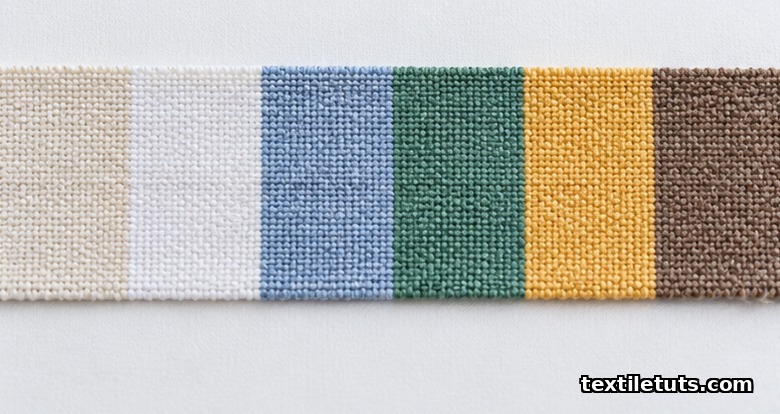
Why these six? They cover the full commercial dye-affinity range. Acetate and acrylic are the most bleed-prone under wet contact, cotton is the standard cellulose reference, nylon 6.6 is the standard protein-fibre substitute for silk, polyester is the standard hydrophobic synthetic, and wool is the most sensitive natural protein. If a dye stains acetate heavily but leaves wool clean, the chemist reading the report immediately knows the dye class is disperse or basic; if cotton is the worst, the dye is probably direct or reactive with incomplete wash-off.
ISO 105-F10 specifies that the multifiber fabric must be scoured once before use to remove spin finishes, and the strips must run parallel to the warp so the orientation relative to the test specimen stays reproducible between labs.
Grey Scale Evaluation (A02 and A03)
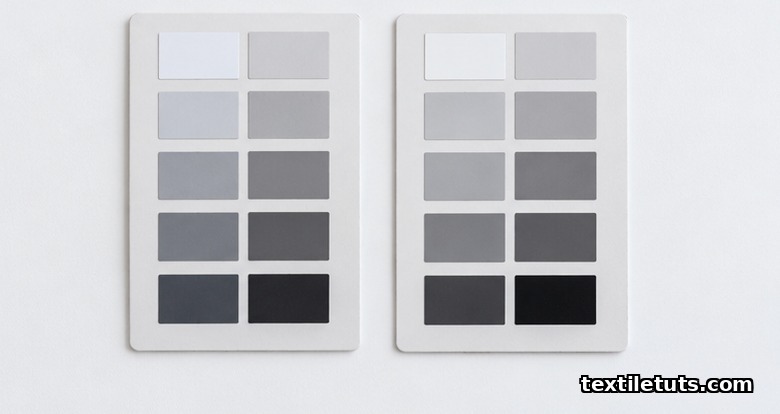
The two grey scales used to translate visual difference into a number have been the backbone of ISO 105 grading for decades. Each is a card with five pairs of chips ranging from no contrast (rating 5) to maximum contrast (rating 1).
| Grey scale | Standard | What it grades | 5 | 3 | 1 |
|---|---|---|---|---|---|
| Shade change | ISO 105-A02 | Test specimen vs. untreated reference | No change | Noticeable shift | Large shift |
| Staining | ISO 105-A03 | Multifiber strip vs. unused strip | No stain | Moderate stain | Severe stain |
Under controlled D65 daylight, the analyst holds the grey-scale chips next to the sample and chooses the pair whose contrast matches what they see. A typical buyer-side specification reads “shade change ≥ 4, staining ≥ 3-4” – meaning the dyed fabric must barely shift and may bleed only mildly onto the worst-case adjacent fiber.
For deeper analysis, ISO 105-J01 spectrophotometric method can replace the visual grey scale, producing a numerical ΔE value that lab-to-lab grading tools convert back into the 1-5 scores.
How E01 Compares to E02, E03, and E04
Part E has four closely related tests, each simulating a different liquid hazard. The procedure – specimen size, perspirometer, 37 °C / 4-hour cycle, drying, evaluation – is identical. The only change is the bath liquid.
| ISO standard | Liquid simulated | Typical bath | Why it matters |
|---|---|---|---|
| E01 | Fresh water | Distilled water, pH 7 ± 0.5 | Rain, soak, condensation |
| E02 | Sea water | 30 g/L NaCl synthetic sea salt | Marine wear, coastal swim |
| E03 | Chlorinated water | 50 mg/L available chlorine | Swimwear, hotel pool towels |
| E04 | Perspiration | Acid buffer (pH 5.5) and alkaline buffer (pH 8) – run twice | Underarm, neckline, lining contact |
Most dye houses run E01 and E04 as a routine pair. A reactive dye with a rating of 5 on E01 will often drop to 3-4 on E04 because the alkaline-perspiration buffer accelerates the hydrolysis that releases unfixed dye. A disperse dye on polyester, by contrast, usually scores 5 on both because the dye is locked inside the fibre matrix.
Real-World Implications for Buyers and Makers
For a fashion buyer writing a tech-pack, the practical questions E01 answers are these:
- Will a white shirt stay white when a dark scarf drips on it in the rain?
- Will a navy lining stain the inside of a beige coat during a humid commute?
- Will a tie bleed onto the front of a wedding shirt when the wearer sweats?
Most retailers in the EU and US specify a minimum E01 rating of 4 (shade change) and 3-4 (staining) for next-to-skin apparel. Performance and outdoor brands typically demand 4-5 across both, and luxury silk houses expect 5/5 because the dyes used (acid dyes on silk) are intrinsically wetfast.
For makers and dyers, E01 is also a quality-control check during process development. A new reactive-dye recipe that scores 3 on E01 should be reworked with an extra soap-off step; a vat dye on cotton that scores 2 on E01 signals incomplete oxidation and must be re-soaped before the next batch leaves the floor.
Limitations of the Test
ISO 105 E01 has known boundaries. It is a static, single-cycle contact test; it does not predict dye behaviour after 50 household washes (that is ISO 105-C06 or C08), it does not simulate detergent chemistry, and it ignores mechanical agitation entirely. A fabric rated 5/5 on E01 can still bleed in a hot machine wash because the wash combines heat, alkali, and mechanical action that the test deliberately excludes.
It is also a visual test at heart. Even when J01 spectrophotometry is used, the underlying scoring rubric was built on human-eye contrast under D65, so a ΔE of 0.5 still maps to a 5 rating and a ΔE of 13 maps to 1. Buyers who need sub-grade precision should request the raw ΔE values alongside the rating.
Frequently Asked Questions
Is ISO 105 E01 the same as colorfastness to washing?
No. ISO 105 E01 tests static water contact at 37 °C for 4 hours with no detergent and no mechanical action. Colorfastness to domestic or commercial washing is tested under ISO 105-C06 or ISO 105-C08, which use a wash liquor, steel balls or a rotating drum, and temperatures up to 95 °C. A fabric rated 5 on E01 can still bleed in a real machine wash.
What is the difference between the shade-change rating and the staining rating?
The shade-change rating (ISO 105-A02) measures how much the test specimen itself changed colour compared with an untreated reference. The staining rating (ISO 105-A03) measures how much colour transferred from the test specimen onto each of the six fibers in the TV multifiber strip. A fabric can have perfect shade-change stability (5) and still stain heavily (1) if it bleeds a lot of unfixed dye, or it can show noticeable shade change while transferring almost no dye.
Why does the test use 37 °C?
Body temperature is the realistic maximum for most wet-contact end uses – sweat, rain absorbed into skin, hot wash water cooled to skin temperature, or towel use. Using 37 °C also keeps the test comparable with ISO 105-E04 (perspiration) and ISO 105-E02 (sea water), which share the same 37 °C / 4-hour cycle so results can be cross-compared.
How long does an ISO 105 E01 test take from sample to report?
From cutting the specimen to a final signed report, the test takes about one working day: 30 minutes for cutting and sandwiching, 4 hours of incubation, 1-2 hours of hanging-dry, 4 hours of conditioning, and 30-60 minutes for grey-scale evaluation and report writing. Most commercial labs quote a 3-5 working-day turnaround because the test usually sits in a queue with other colourfastness tests on the same batch.
What rating do I need for a next-to-skin garment?
For adult apparel that touches skin directly, most retailers specify a minimum shade-change rating of 4 and a staining rating of 3-4. Children’s wear, swimwear, and luxury silk products typically require 4-5 across both shade change and staining. Anything below 3 is usually rejected at the QC stage regardless of price point, because a fabric that visibly bleeds in plain water will fail consumer expectations within the first wear.
References
- International Organization for Standardization. ISO 105-E01:2013 – Textiles – Tests for colour fastness – Part E01: Colour fastness to water. iso.org – specifies the perspirometer method, the 37 °C / 4-hour cycle, and the TV multifiber adjacent fabric.
- International Organization for Standardization. ISO 105-A02 – Textiles – Tests for colour fastness – Part A02: Grey scale for assessing change in colour. iso.org – the contrast pair used to rate shade change after E01.
- International Organization for Standardization. ISO 105-A03 – Textiles – Tests for colour fastness – Part A03: Grey scale for assessing staining. iso.org – the contrast pair used to rate staining of the multifiber strip.
- International Organization for Standardization. ISO 105-F10 – Textiles – Tests for colour fastness – Part F10: Specification for adjacent fabric: Multifibre. iso.org – defines the six-fibre TV strip composition and order.
- American Association of Textile Chemists and Colorists. AATCC TM 107 – Colorfastness to Water. aatcc.org – the North-American equivalent of ISO 105-E01, with a comparable procedure.
- ResearchGate. Colorfastness of natural dyes on cotton: a comparative study of water, perspiration, and wash fastness. researchgate.net – peer-reviewed data on how reactive, vat, and natural dyes rate on E01, E02, and E04.
This article is the working reference for ISO 105 E01 colorfastness to water testing. Editorial by Iftay Khairul Alam, TextileTuts. Sources: ISO 105-E01:2013, ISO 105-A02, ISO 105-A03, ISO 105-F10, AATCC TM 107, and the ResearchGate comparative-dye study as cited.


