
What Twist Multiplier Is


Twist multiplier is the single number a spinning technician uses to communicate yarn twist without worrying about the count system. Where “turns per inch” or “turns per meter” changes meaning as yarn count changes, twist multiplier stays constant for a given fiber blend and end use. The TM concept is what allows a yarn spec to be portable across mills that use different count systems, cotton, worsted, metric tex, or linen, and is the de facto industry shorthand for yarn twist. This article covers the formula, the calculation, the typical TM ranges by yarn type, and how to choose the right TM for a given end use.
What Twist Multiplier Is
Twist multiplier (also called α-m, alpha-m, or twist factor) is a dimensionless number that relates the turns per unit length of yarn to the yarn count. It expresses the helix angle of fibers in the yarn in a way that does not depend on whether the yarn is fine or coarse. Two yarns with the same TM but very different counts will have the same fiber helix angle and similar feel, even though their turns-per-inch numbers differ widely.
The concept was introduced in the early 20th century and has been the standard way of specifying twist in cotton and worsted yarn for nearly a century. Modern standards including ISO 2061 (Textiles, Determination of twist in yarns) recognize twist multiplier as the correct way to compare twist across different count systems.
The Twist Multiplier Formula
For yarns expressed in the English cotton count system (Ne), the formula is:
TM = T / √Ne
where T is turns per inch (tpi) and Ne is the English cotton count. For worsted or woolen yarns, the same formula uses the worsted count (Ne_w) and turns per inch. For yarns expressed in tex (the SI linear-density system), the formula is:
TM = T_m / √tex
where T_m is turns per meter and tex is the linear density in grams per 1000 meters. The metric tex version of twist multiplier is sometimes called the metric twist factor or alpha-tex.
The reason for the square-root relationship comes from the geometry of a twisted fiber bundle: the helix angle of fibers in the yarn depends on the circumference of the yarn, which scales with the square root of the cross-section area, hence the square root of count.
Calculating Twist Multiplier: Worked Examples
Cotton ring-spun example
Consider a 30 Ne cotton ring yarn with 24 turns per inch. The twist multiplier is:
TM = 24 / √30 = 24 / 5.477 = 4.38
This is a typical TM for a carded cotton woven weft yarn. The same yarn expressed in metric terms is 19.7 tex, and if it has 945 turns per meter, the metric twist factor is:
TM = 945 / √19.7 = 945 / 4.438 = 4.26
The slight difference between 4.38 (English) and 4.26 (metric) reflects the different relationships between tex and Ne, and is well within the normal tolerance band used in mills. Most mills work in one system and convert only at the customer interface.
Worsted example
A 1/48 Nm worsted yarn (48 metric count, single) at 850 turns per meter has TM = 850 / √48 = 850 / 6.928 = 12.27. This is a typical TM for a worsted weaving yarn in the 1/48 to 1/60 Nm range.
Knitting yarn example
A 24 Ne cotton knit yarn at 18 turns per inch has TM = 18 / √24 = 18 / 4.899 = 3.67. This is in the lower TM range typical for knit weft yarn, where softness is more important than strength.
These examples show how TM allows a yarn spec to be portable: a TM of 4.0 in cotton means a “normal” woven weft yarn regardless of whether it is 10 Ne, 30 Ne, or 50 Ne.
Typical Twist Multiplier Ranges by Yarn Type
TM values in cotton ring spinning typically fall in these ranges, expressed in the English cotton count convention:
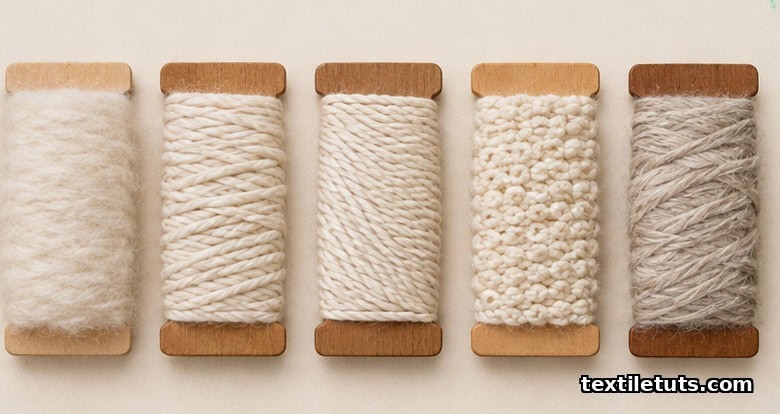
- Cotton warp, woven: TM 4.0 to 4.8 (higher TM for fine counts, lower for coarse)
- Cotton weft, woven: TM 3.5 to 4.2
- Cotton hosiery / knitting: TM 3.0 to 3.8
- Cotton sewing thread (plied): TM 4.5 to 5.5
- Cotton crepe yarn: TM 5.5 to 7.0 (very high, gives the characteristic crepe surface texture)
- Polyester-cotton blend warp: TM 4.2 to 4.8
- Modal or viscose ring yarn: TM 3.6 to 4.2
For worsted yarns (wool and wool blends), TM ranges are higher because worsted fibers are longer and the yarn structure tolerates more twist without becoming harsh:
- Worsted weaving warp: TM 11 to 14 (in 1/Ne metric count convention)
- Worsted weaving weft: TM 10 to 12
- Worsted hosiery: TM 8 to 10
- Worsted crepe: TM 13 to 16
These are practical working ranges observed in mills. The actual TM chosen for a specific yarn depends on the fiber length, the end-use requirements, and the customer’s hand-feel specification.
How Twist Multiplier Affects Yarn Properties
Increasing TM increases yarn tenacity up to a point. Below the optimum, more twist adds fiber-to-fiber friction and binds the yarn together more effectively. Above the optimum, the helix angle of fibers becomes too steep and fibers start to align along the yarn axis at an angle, reducing axial load contribution. The result is a curve: tenacity rises with TM to a maximum, then falls.
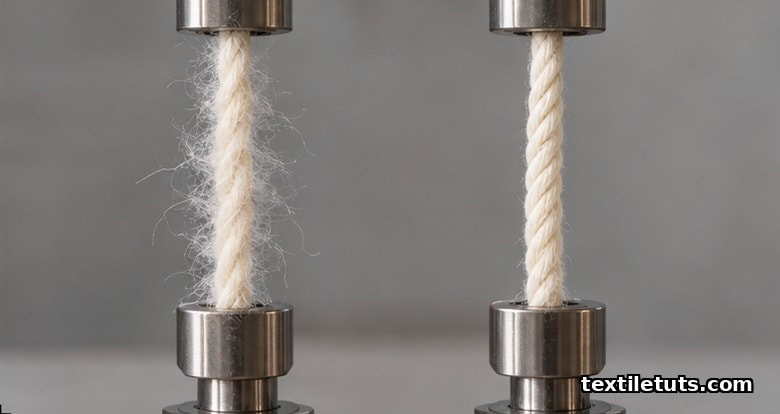
For cotton yarn, the optimum TM for maximum tenacity is typically around 4.5 to 5.0 in the English count system. For worsted, it is around 12 to 14 in the worsted count system. Above these optima, additional twist gives lower tenacity but higher abrasion resistance, which is why some warp yarns are spun at TMs above the tenacity optimum for weaving durability.
TM also affects yarn hand, luster, hairiness, and downstream behavior. Higher TM means a harder, more compact yarn with less hairiness and a crisper feel. Lower TM means a softer, hairier, more extensible yarn. Knitting yarns are at the low end because softness sells; crepe yarns are at the high end because the very high twist gives a characteristic lively, pebbled fabric surface.
Choosing the Right Twist Multiplier
The TM choice is a balance of competing requirements. The optimization sequence in a mill typically runs:
- Define the end use: warp, weft, knit, sewing thread, crepe, etc. Each has a target TM band.
- Account for fiber length: longer fibers tolerate higher TM without becoming harsh. A 32 mm cotton can take a TM 0.2 to 0.4 higher than a 26 mm cotton for the same hand-feel.
- Account for the count: finer counts generally need slightly higher TM to develop adequate tenacity; coarser counts can run lower.
- Account for downstream processing: warp yarns that will be sized and loom-tensioned can run higher TM for durability; knit yarns that must pass through needles need lower TM to avoid needle damage and skipped stitches.
- Validate on the fabric: lab or pilot-knit the yarn and measure hand, pilling, abrasion, and shrinkage. Adjust TM up or down by 0.1 to 0.3 increments until the spec is met.
Many mills run a tiered TM program: a “standard” TM for everyday warp and weft, a “soft” TM for premium knitting, and a “tight” TM for technical warp that will be heavily sized. The yarn’s TM is recorded on the package label and in the lot documentation, allowing traceability if downstream complaints arise.
Twist Multiplier in Open-End and Wrapped Yarns
The twist multiplier concept applies most cleanly to ring-spun yarn, where twist is inserted uniformly along the fiber strand. For rotor (open-end) and air-jet/vortex wrapped yarns, the structure is different and TM does not describe the helix angle in the same way. Rotor and vortex yarn are usually specified by twist level (tpm or tpi) rather than by TM, because their “twist” includes both core helix and wrapper fiber formation that do not scale with the square root of count.
That said, the practical guideline for rotor yarn is that the required twist level is typically 10 to 20 percent lower than a comparable ring yarn because rotor yarn has higher fiber cohesion from the wrapper structure. A 20 Ne rotor weft yarn that would run 18 tpi (TM 4.02) as ring yarn might run 14 to 15 tpi as rotor yarn without losing fabric performance. This is captured in mill recipes rather than in a single TM number.
Standardized Test Methods and Documentation
Twist measurement follows ISO 2061 (untwist-retwist method) or ASTM D1422. The yarn count measurement that goes into the TM calculation follows ISO 2060 (skein method) or ASTM D1907. Together these standards provide the test data needed to back-calculate the TM and confirm that the spun yarn matches the TM specification.
In modern mill quality systems, TM is recorded in the yarn quality database alongside count, fiber composition, and lot number. Statistical process control charts on TM (typically ±0.15 around the target) are standard tools for catching drift in spinning frame settings before it shows up as customer complaints.
Frequently Asked Questions
What is the twist multiplier formula?
In the English cotton count system, TM = T / √Ne, where T is turns per inch and Ne is the English cotton count. In the metric tex system, TM = T_m / √tex, where T_m is turns per meter and tex is the linear density in grams per 1000 m. Both forms are equivalent and in common use.
What is a typical TM for cotton warp yarn?
Cotton ring-spun warp yarn typically runs TM 4.0 to 4.8 in the English count system. Finer counts run at the higher end (4.5 to 4.8); coarser counts at the lower end (4.0 to 4.3). The actual value depends on the fiber length, the loom tension, and the sizing system.
What TM is used for knitting yarn?
Cotton knitting yarn typically runs TM 3.0 to 3.8, lower than woven warp or weft. Lower TM gives a softer, more extensible yarn that knits cleanly and feels comfortable against the skin. Worsted hosiery runs TM 8 to 10 in the metric count system.
Does higher TM always mean stronger yarn?
No. Tenacity rises with TM to an optimum and then falls. For cotton, the optimum is around TM 4.5 to 5.0. Above the optimum, additional twist gives lower tenacity but higher abrasion resistance. Most warp and sewing-thread yarns are run close to or slightly above the tenacity optimum to balance strength and durability.
Does twist multiplier apply to rotor or air-jet yarn?
Twist multiplier is most meaningful for ring-spun yarn, where the fiber helix angle is the dominant structural parameter. Rotor and air-jet/vortex wrapped yarns have a different structure (core plus wrapper) and are usually specified by raw twist level (tpm or tpi), with mill recipes providing the rotor-specific twist targets.
References
- ISO 2061:2015. Textiles, Determination of twist in yarns, Untwist/retwist method. International Organization for Standardization, Geneva.
- ISO 2060:1994. Textiles, Yarn from packages, Determination of linear density by the skein method. International Organization for Standardization, Geneva.
- ASTM D1422 / D1422M-20. Standard Test Method for Twist in Single Spun Yarns by the Untwist-Retwist Method. ASTM International, West Conshohocken, PA.
- ASTM D1907 / D1907M-19. Standard Test Method for Linear Density of Yarn (Yarn Number) by the Skein Method. ASTM International, West Conshohocken, PA.
- Lawrence, C.A. (2003). Fundamentals of Spun Yarn Technology. CRC Press, Boca Raton. ISBN 978-1566768138.
- Morton, W.E., and Hearle, J.W.S. (2008). Physical Properties of Textile Fibres, 4th Edition. Woodhead Publishing, Cambridge. ISBN 978-1845692209.
- Textile Institute (2009). Textile Terms and Definitions, 11th Edition. The Textile Institute, Manchester.
Editorial by Iftay Khairul Alam, TextileTuts


