
How to Store Wool Sweaters Without Moth Damage


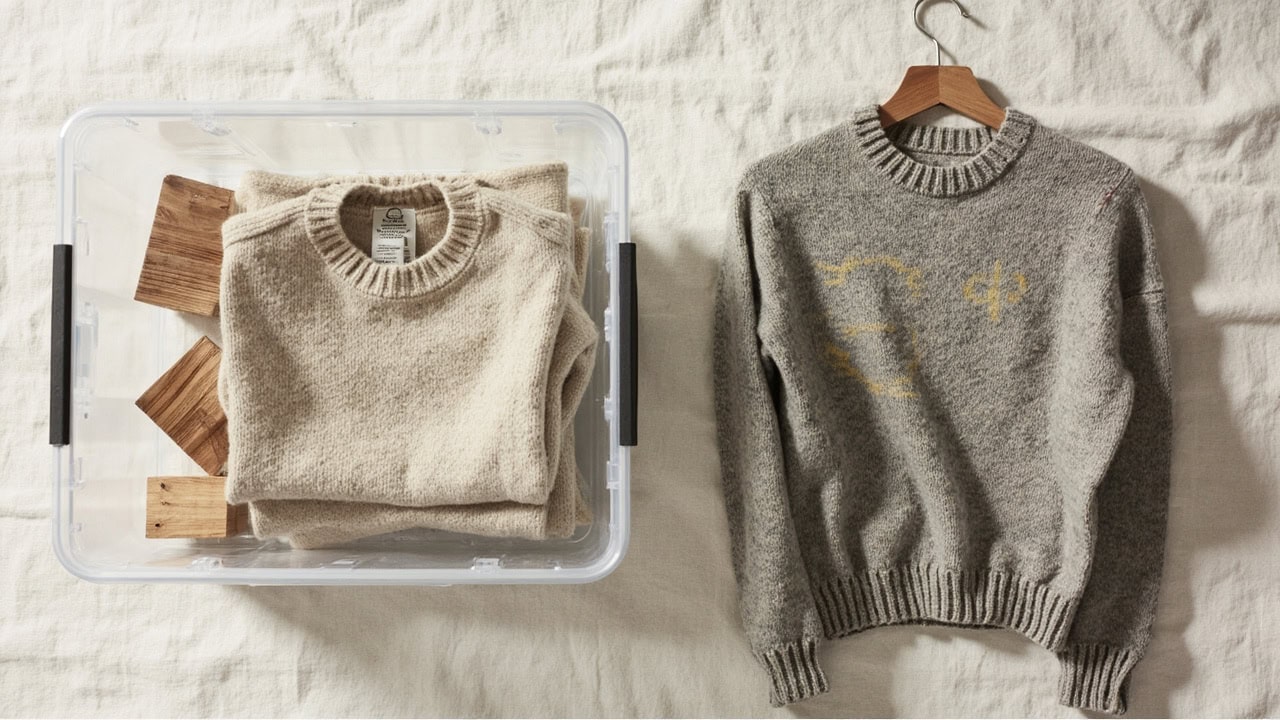
Wool sweaters must be stored clean and folded in airtight containers with natural moth deterrents (cedar or lavender)—hanging causes irreversible shoulder stretching because wool lacks the tensile strength to support its own weight over time. Moths are attracted to keratin in wool fibers, and residual body oils in unworn sweaters provide the food source that hatching larvae need to destroy your garments.
Wool is an animal fiber consisting primarily of keratin protein—the same structural protein found in hair, fur, and silk—which makes it uniquely appealing to clothes moth larvae. Unlike synthetic fibers, wool can absorb up to 30% of its own weight in moisture without feeling damp, and its natural fiber crimp gives it elasticity that, while useful for fit and comfort, cannot withstand the sustained downward pull of hanger-mounted storage.
Fold vs. Hang: Why Folding Is Non-Negotiable for Wool Sweaters
Wool fibers are elastic but have low tensile strength—a property that makes them comfortable against the skin but catastrophically unsuitable for hanging storage. When hung, wool fibers stretch downward under their own weight over a period of weeks, permanently conforming to the shape of the hanger. Shoulder dimpling and stretched necklines are irreversible because wool lacks the dimensional stability to spring back once the load is removed.
Heavy knit wool sweaters—cable knit, Icelandic wool, and chunky pullovers—are especially prone to hanger stretch. These constructions add significant mass without adding tensile resilience, accelerating the distortion process. A cable knit stored on a standard wooden hanger for just three to four weeks will show visible shoulder deformation that no amount of steaming or reshaping can correct.
Folded storage distributes weight evenly across the garment surface, maintaining sweater shape indefinitely. The exception to the no-hang rule is temporary: store only on padded or velvet hangers if hanging is unavoidable for less than one week—the wider, cushioned surface distributes weight enough to prevent immediate damage during short-term staging.
Optimal Storage Conditions for Wool Sweaters
Wool sweaters require specific environmental conditions to survive long-term storage without fiber degradation. The target range is 60–70°F (15–21°C) at 40–50% relative humidity. These cool, consistent conditions slow fiber degradation and deny moths the warmth they need to complete their life cycles.
Wool absorbs moisture readily and can mildew if stored in high-humidity environments—basements and ground-floor closets in humid climates are particularly risky. Conversely, extremely dry conditions (below 30% relative humidity) can make wool fibers brittle over very long storage periods. Light exposure is equally critical: ultraviolet light breaks down wool proteins through a process called photodegradation, causing fiber brittleness and color fading that accumulates irreversibly over months of exposure.
Airflow should be limited but not completely sealed during off-season storage. Completely airtight environments trap residual moisture, while breathable cotton bags allow slow air exchange that moderates humidity without permitting moth access. The ideal storage location is a interior closet away from exterior walls, pipes, and heat sources.
Avoid three categories of storage spaces entirely:
- Attics—Extreme temperature swings accelerate fiber degradation; summer heat can exceed 120°F (49°C), well above wool’s safe storage threshold.
- Basements—Moisture levels often exceed 60% relative humidity, creating ideal conditions for mildew and mold growth on wool fibers.
- Garages—Temperature swings of 40°F or more within 24 hours cause condensation inside storage containers, and less secured structures invite pest access.
Storage Containers and Materials: What to Use and What to Avoid
Clear airtight plastic bins with gasket seals (such as Keen印象 or Iris brands) are the gold standard for wool sweater storage. The clear walls allow visual identification without unpacking, the gasket seal prevents moth entry, and the rigid structure protects fibers from crushing pressure. Cotton storage bags and muslin wraps serve as breathable alternatives for medium-term storage where air exchange is desirable.
Cedar chests require caution: the wood itself provides some moth-repellent benefit, but without active cedar oil replenishment, an older cedar chest may offer false security. The natural oils dissipate over years, and once dried out, the wood becomes merely a cellulose structure that moths can penetrate. If using a cedar chest, apply fresh cedar oil to the interior surfaces annually.
Three storage materials must be categorically avoided:
- Cardboard boxes—Moths can and do penetrate cardboard seams; the corrugated structure provides harborage for eggs and larvae.
- Vacuum bags—Compression flattens wool’s loft permanently. The fiber crimp that gives wool its softness and insulation properties cannot be restored once crushed.
- Mothballs—Contain naphthalene or p-dichlorobenzene, both toxic compounds classified as possible human carcinogens by the U.S. Consumer Product Safety Commission. These chemicals vaporize and absorb into wool fibers, creating a health hazard during wear and potentially damaging the fibers themselves over time.
Cedar blocks and sachets are effective when fresh. Cedar oil (scientifically known as sarethone in certain formulations) disrupts moth larvae development and repels adult moths by interfering with their chitin formation. However, cedar loses efficacy as it dries—sand the surface of solid cedar blocks semi-annually to expose fresh oils, or replenish liquid cedar oil every six months. Lavender sachets provide complementary deterrence through linalool, a natural compound moths avoid; rehydrate dried buds annually to maintain volatile emissions.
Moth and Pest Protection for Wool Sweaters
Understanding the enemy is essential to defeating it. Moths target keratin—the structural protein in wool fibers—not the fabric itself. Adult clothes moths (Tineola bisselliella) are harmless; they do not eat fabric and cannot digest wool. It is their eggs and larvae that cause destruction. A single mated female can lay 50–100 eggs in the hidden crevices of a stored sweater, and the hatching larvae will consume wool continuously for two to three months before pupating.
The freeze method is the most reliable pre-storage kill step. Seal the clean, dry sweater in an airtight plastic bag, removing as much air as possible, and place in a freezer at 0°F (-18°C) for 72 hours. This temperature is cold enough to kill eggs, larvae, and adult moths at all life stages. Thaw in the sealed bag to prevent condensation from forming on the wool, then proceed with storage. This treatment does not prevent future infestation—it merely ensures no existing pests accompany the sweater into storage.
Natural deterrents beyond cedar and lavender include dried rosemary (Rosmarinus officinalis) and thyme (Thymus vulgaris), both of which contain volatile compounds (camphor and thymol, respectively) that repel clothes moths. PlaceHerb sachets containing equal parts dried rosemary, thyme, and lavender alongside stored sweaters for layered protection.
Pyrethrin-based sprays are a chemical alternative only when natural methods fail. Pyrethrin is a natural insecticide derived from chrysanthemum flowers thatknocks down and kills moths on contact. However, it degrades rapidly under ultraviolet light and loses efficacy within hours of application. If used, spray the affected area and allow thorough airing for a minimum of 24 hours before wearing the treated garment.
Inspect stored sweaters every three to four months, even during off-season storage. Look for adult moths resting near the storage area (they prefer dark, undisturbed spaces), for silky webbing or cocoons in garment folds, and for fecal pellets (tiny dark spheres) that indicate active feeding. Early detection limits damage to a single garment rather than an entire closet.
Before-Storage Preparation: The Cleaning Requirement
Cleaning before storage is non-negotiable. Body oils, sweat, skin cells, and environmental residues accumulate on wool sweaters during wear, and these organic compounds are precisely what moth larvae require for survival. Washing wool sweaters removes this food source and forces out the moisture that mildew needs to establish.
Hand washing is the preferred method for most wool sweaters. Use cold water (below 86°F / 30°C—hot water triggers felting shrinkage in wool through uncontrolled fiberScale interlock) and a wool-specific detergent such as Woolite or Eucalan. Agitate minimally; excessive mechanical action encourages fiber felting. Soak for 15–20 minutes, rinse thoroughly in water at the same temperature to prevent thermal shock, and press water out gently without wringing.
Dry cleaning is preferable for structured or multi-layered knits—cable knits, Fair Isle patterns, and any sweater with elaborate construction where hand-washing agitation could miss spots or distort seams. Professional dry cleaning also applies finishing steam that relaxes fibers to their original dimensions.
Dry completely flat on a clean, absorbent towel before storing. Place the sweater on the towel in its desired shape, reshape the shoulders and body gently, and allow 24–48 hours for drying depending on ambient humidity. Never hang wet wool—gravity will stretch fibers irreversibly during the critical drying period. Once dry, add a clean sheet of acid-free tissue paper between folded layers to prevent color transfer on multi-colored or dyed sweaters.
How to Fold a Wool Sweater Correctly
Proper folding maintains the sweater’s shape, maximizes storage density, and minimizes wrinkles. Follow this sequence for consistent results:
- Button or zip any closures to keep the sweater’s shape intact during storage.
- Lay the sweater flat, front side down, with sleeves extended outward at roughly 45-degree angles.
- Fold the left side inward so the left sleeve lies along the left side seam of the body.
- Fold the right side inward using the same technique.
- Fold both sleeves back over the folded body of the sweater, creating a compact rectangular shape.
- Fold the bottom hem upward to approximately one-third of the sweater’s length.
- Fold once more to achieve the desired storage height—typically 8–10 inches for most sweaters.
Store folded sweaters vertically in the bin, like books on a shelf. This orientation allows you to see and retrieve any sweater without disturbing the others—unpiling folded sweaters to reach one at the bottom is the primary cause of storage wrinkles and fiber stress.
Frequently Asked Questions
Q: Can you store wool sweaters in vacuum bags?
A: Vacuum bags compress wool fibers and can cause permanent flattening of the loft and structure. If space is critical, use breathable cotton storage bags instead—the compression damage to wool is irreversible.
Q: How do I know if my wool sweater has moth damage?
A: Moth damage appears as small irregular holes or eaten patches, usually starting in hidden areas like under armpits, inside cuffs, or near seams. Adult moths visible near your closet indicate an infestation; check all nearby wool items immediately.
Q: Do cedar blocks actually repel moths?
A: Cedar oil (sarethone) disrupts moth larvae development and repels adult moths, but only when the cedar is fresh and aromatic. Old dried cedar provides minimal protection—sand the surface to refresh the oils or replenish with cedar oil every 6 months.
Q: Should I store wool sweaters in the freezer?
A: Freezing is an effective moth egg and larvae kill step before long-term storage—seal the sweater in an airtight plastic bag and freeze at 0°F (-18°C) for 72 hours. Do not use freezing as ongoing storage; it does not prevent moth damage during storage.
References
- International Wool Textile Organisation (IWTO). “Wool Properties and Benefits.” https://www.iwto.org/resources/wool-properties
- U.S. Environmental Protection Agency. “Cedarwood Oil Classification; Product Properties and Uses.” https://www.epa.gov
- Canfield, D.R. & Olsen, J.W. “Clothes Moth Biology and Integrated Pest Management.” Textile Research Journal, vol. 70, no. 4, 2000, pp. 315–320.
- Simpson, W.S. & Crawshaw, G.H. Wool: Science and Technology. Woodhead Publishing, 2002.
- U.S. Consumer Product Safety Commission. “ Mothball Safety.” https://www.cpsc.gov
- Post, R. “Natural Insect Repellents: Chemistry and Efficacy.” Journal of Agricultural and Food Chemistry, vol. 58, no. 11, 2010, pp. 6536–6543.


