
How to Remove Stains from Polyester

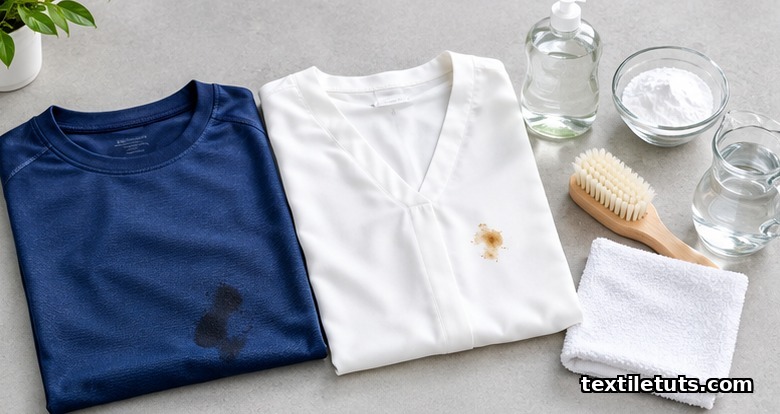
Polyester is naturally more stain-resistant than natural fibers because its smooth, tightly packed synthetic surface gives stain molecules fewer access points. However, oil-based stains are the exception — polyester’s oleophilic (oil-attracting) surface chemistry actually attracts and holds oil stains, which is why activewear and polyester clothing often develops a greasy residue or persistent odor over time that standard washing doesn’t resolve.
Polyester’s Stain Behavior: Stain-Resistant but Oil-Prone
Polyester (PET — polyethylene terephthalate) is a hydrophobic synthetic fiber with a moisture regain of approximately 0.4% under standard conditions (ASTM D1776-16 for conditioning textiless for testing). Water beads off its smooth surface rather than soaking in, which means water-based stains like coffee, tea, and juice penetrate less readily than they would on cotton or linen. This is why polyester is widely used in performance apparel and outdoor gear.
But polyester’s chemical structure creates a significant vulnerability: the ester bonds in its polymer chain make it oleophilic — chemically attracted to oils and greases. When cooking oil, sunscreen, bike chain grease, or skin oils contact polyester, the fiber absorbs and holds the oil molecules with more affinity than natural fibers would. The result is that oil-based stains on polyester are noticeably more stubborn than on cotton, wool, or silk.
A secondary issue with polyester is odor retention. Polyester’s hydrophobic surface also traps bacterial metabolic compounds from sweat inside the fiber weave. Standard laundry detergent — formulated for general soil removal — lacks the specific enzymes needed to fully break down these compounds. Studies on synthetic fabric odor have shown that bacteria colonize polyester more readily than natural fibers, creating persistent “swamp smell” that builds up over repeated wear and washing cycles. Sports-specific detergents (such as Tide Sport or Nikwax Sport Wash) contain enzyme blends specifically formulated to address this.
Quick Reference: Polyester Stain Treatment
| Stain Type | Treatment | Key Notes |
|---|---|---|
| Coffee / tea | Cold water flush + enzyme detergent | Easier to remove than on natural fibers |
| Grease / oil | Dish soap pre-treatment, then warm wash at 30–40°C | Critical — never skip the pre-treatment step |
| Blood | Cold water flush → enzyme soak 15–30 min | Never use hot water — heat proteins bond to fiber |
| Sweat / odor | Sports detergent; baking soda pre-soak | Not a visible stain but fully addressable |
| Grass | Enzyme detergent; OxiClean (oxygen bleach) | Safe for polyester; effective on organic stains |
| Ink | Rubbing alcohol (70%+ isopropyl); test first | Most polyester tolerates it — test on hidden seam |
Treating Oil-Based Stains on Polyester
Oil-based stains are the most challenging stain type on polyester. Because the fiber’s surface chemistry actively attracts oil molecules, simply running the garment through a normal wash cycle with detergent is not enough — the oil bonds to the fiber and builds up over time, creating a visible discoloration and a characteristic greasy feel.
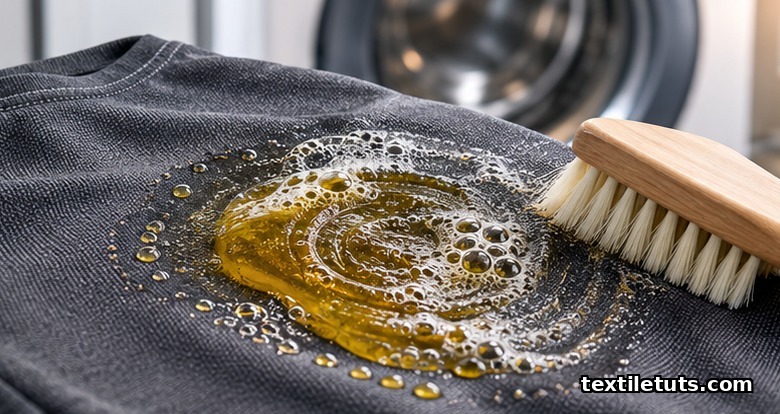
The solution is a dedicated pre-treatment step using dish soap, which is formulated with surfactants designed to emulsify and suspend oils in water. Follow this sequence for best results:
- Apply undiluted dish soap — Place 1–2 teaspoons of full-strength dish soap directly onto the stain. Use your fingertips or a soft-bristled brush to work it gently into the fabric in a circular motion. Do not scrub aggressively, which can damage the fiber surface or push the stain deeper.
- Let it dwell 15–20 minutes — Allow the surfactants time to surround and lift the oil molecules away from the fiber. Keep the fabric damp during this period. Do not let the soap dry completely on the fabric.
- For persistent dried stains, apply WD-40 first — If the stain is old and dried, re-liquefy it by applying a small amount of WD-40 to the affected area. Wait 5–10 minutes, then blot excess, and apply dish soap before washing. This two-step approach breaks through the heat-set oil bond that forms over time.
- Machine wash in warm water at 30–40°C — Set your washing machine to the warm cycle (30–40°C / 86–104°F). Warmer water is significantly more effective than cold at releasing oil from polyester. The AATCC LP1 standard for home laundering specifies 50 mL of detergent per 1.8-kg load for proper soil removal. Use an enzyme laundry detergent as your base detergent.
- Check before drying — this is the critical step — Before transferring the garment to the dryer, inspect the stain under bright lighting. If any discoloration remains, treat it again and re-wash. Once heat-set in a dryer, oil stains become permanent. If you cannot remove the stain, air-dry the garment and seek professional cleaning.
The most common failure in polyester stain removal is skipping the pre-treatment step and relying solely on detergent in the wash cycle. Standard laundry surfactants are diluted in a full wash load — they cannot generate the concentration needed to break the oil-fiber bond on heavily soiled areas. Pre-treatment with undiluted dish soap delivers a full-strength dose directly where it is needed.
Treating Odor Build-Up in Polyester Activewear
If your polyester garments smell even after washing, the issue is bacterial colonization and retention of sweat metabolites inside the fiber — not a detergent failure. Standard detergents remove soil but do not fully eliminate the odorous compounds produced by bacteria that live in warm, moist environments like worn gym clothes.
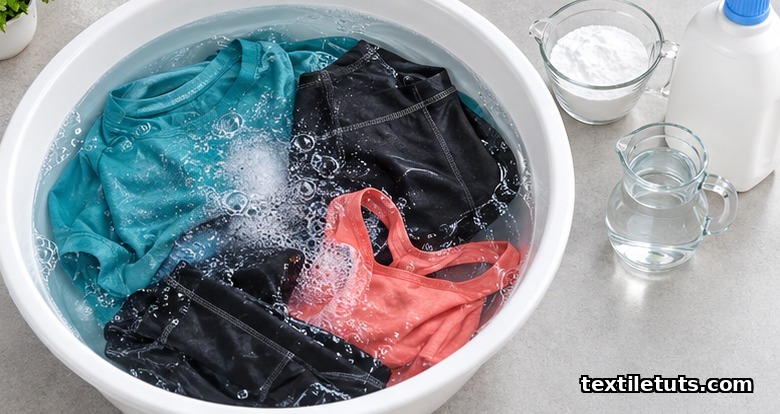
Sports-specific laundry detergents are formulated with enzyme systems (primarily proteases and lipases) that break down the protein and fat components of sweat that bacteria feed on. For heavy odor build-up, the following approach restores freshness:
- Add 1/2 cup of baking soda to the wash water before adding the garment — this raises the pH and helps release odor compounds from the fiber
- Run a long soak cycle (30 minutes minimum) with a sports-specific detergent formulated for synthetic fabrics
- In the rinse cycle, add 1/4 cup of white distilled vinegar — this neutralizes residual bacterial compounds and deodorizes without damaging polyester
- Never use fabric softener or dryer sheets — they deposit a waxy coating on the polyester fiber surface that traps odor molecules inside the fabric, making the problem worse over time
For garments with severe, long-standing odor, repeating this treatment across 2–3 wash cycles is typically necessary. Each wash cycle removes a portion of the accumulated bacterial compounds; total removal requires sustained enzyme exposure.
What Never to Do on Polyester Stains
Polyester has specific vulnerabilities that, if ignored, create permanent damage. These are the actions that ruin polyester garments most often:
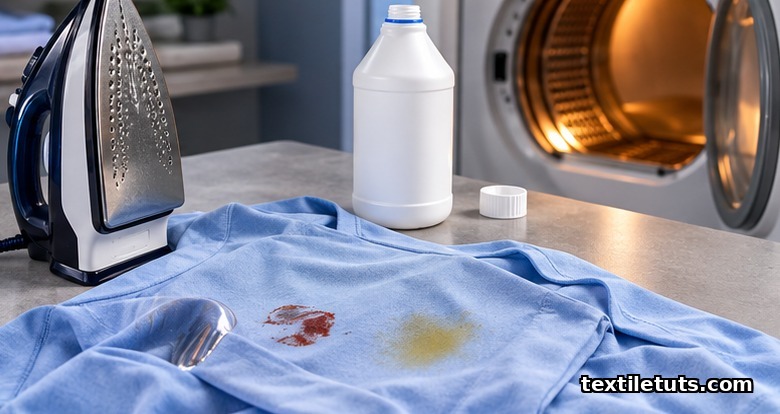
- Never put a stained garment in the dryer before the stain is confirmed removed — The heat in a dryer (typically 60–80°C) permanently thermosets oil stains to polyester. Once heat-set, the stain becomes part of the fiber and cannot be reversed. Always air-dry or tumble-dry on low heat until stain removal is confirmed.
- Never use chlorine bleach (sodium hypochlorite) on polyester — Chlorine bleach attacks the ester bonds in the polyester polymer chain, causing fiber degradation, fabric weakening, and color loss. Even on white polyester, chlorine bleach can cause yellowing and fiber brittleness. If a bleach alternative is needed, use oxygen bleach (OxiClean) instead — it is safe for all fabric types including polyester.
- Never iron over a visible stain — Like dryer heat, direct iron heat (often 150–200°C for synthetic fabrics) instantly sets protein-based stains (blood, egg, sweat) and oil stains to polyester. If you must iron a garment, always ensure the stain side is facing up and fully visible, and never iron over a stain.
- Never use hot water on blood or protein stains — Hot water denatures and coagulates blood proteins, causing them to bond more tightly to the fiber. Always use cold water (below 20°C) for initial flushing of blood stains, then follow with an enzyme soak.
Frequently Asked Questions
Q: Are polyester fabrics stain-resistant?
A: Polyester resists water-based stains better than natural fibers but is vulnerable to oil-based stains. Its surface chemistry attracts oils (oleophilic property), making grease, cooking oil, and skin oil stains particularly stubborn. Water-based stains like coffee or juice bead on polyester’s hydrophobic surface and are easier to flush out than on absorbent natural fibers.
Q: Why do polyester clothes smell after washing?
A: Polyester’s smooth hydrophobic surface traps bacterial metabolic compounds from sweat inside the fiber weave. Standard detergent does not contain the specific enzymes needed to fully break down these compounds. Sports detergent with protease and lipase enzymes, combined with a baking soda pre-soak and vinegar rinse, addresses this more effectively than standard laundry products.
Q: Does OxiClean work on polyester stains?
A: Yes — OxiClean (oxygen bleach / sodium percarbonate) is safe for polyester and effective on organic stains such as grass, blood, and food residue. It does not work on oil-based stains because oxygen bleach breaks down pigmented organic compounds, not oils. Use undiluted dish soap for oil-based stains and reserve OxiClean for non-greasy organic stains.
Q: Can I use hot water to wash polyester to remove oil stains?
A: Warm water at 30–40°C (86–104°F) is optimal for removing oil from polyester. Temperatures above 40°C risk damaging the fiber and may set certain stain types. Check the garment care label — many polyester blends have a maximum wash temperature of 40°C. Hot water alone is not a stain remover; pre-treatment with dish soap is always necessary for oil stains.
Q: How do I remove old, set-in oil stains from polyester?
A: For old, dried oil stains that have bonded to polyester, first apply WD-40 to re-liquefy the old grease. Blot excess after 5–10 minutes, then apply undiluted dish soap, work in gently, and let sit 15–20 minutes. Wash in warm water at 30–40°C with an enzyme detergent. Repeat if necessary. If the stain persists after two treatment cycles, the garment should be taken to a professional cleaner.
References
- ASTM International. (2016). ASTM D1776/D1776M-16: Standard Practice for Conditioning and Testing Textiles. ASTM International. https://www.astm.org
- AATCC. (n.d.). AATCC LP1: Home Laundering — Machine Washing. American Association of Textile Chemists and Colorists. https://www.aatcc.org/laundering/
- Britannica. (n.d.). Polyester. Encyclopædia Britannica. https://www.britannica.com/science/polyester
- Elsevier ScienceDirect. (n.d.). Polyester — Materials Science Topic. https://www.sciencedirect.com/topics/materials-science/polyester


