
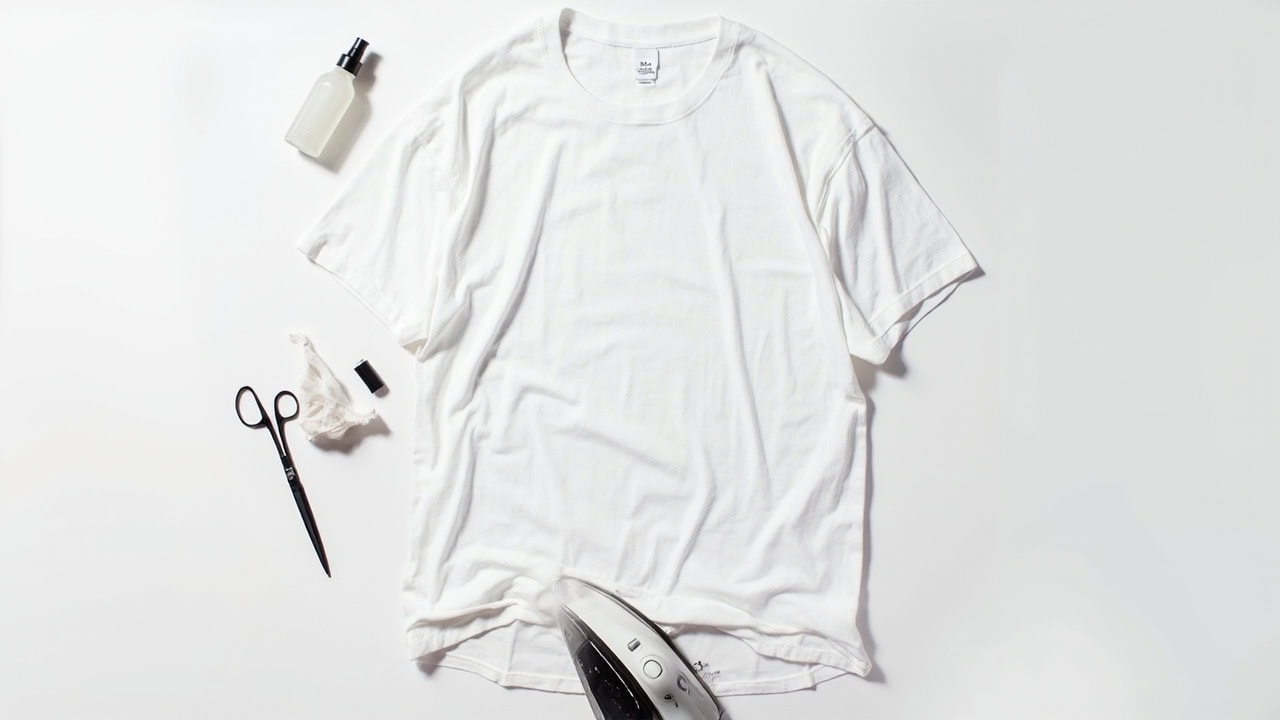
How to Resize a T-Shirt Without Sewing: Heat and Cut Methods

How to Resize a T-Shirt Without Sewing
You can resize a t-shirt smaller without sewing using either heat application (iron on high cotton setting with steam and pressure) or fabric cutting techniques (side slits, knotting, or hem bonding with fabric glue). The heat shrinkage method shrinks cotton fibers permanently by activating residual shrinkage tension still present in pre-shrunk fabric, while the cut-and-knot method physically removes excess material and secures edges with knots or adhesive — neither method requires a needle, thread, or sewing machine.
Whether you bought a size up by mistake, received a boxy oversized tee as a gift, or want to refit a vintage find, you do not need a sewing machine or tailor skills to achieve a better fit. Two categories of no-sew alteration work at home: controlled heat shrinkage (for cotton fabrics) and mechanical alteration via cutting and bonding (for any knit). Both have been used in domestic textile care for decades, with documented results backed by AATCC and ISO laundering standards.
No-Sew Resizing: When Heat Application and Cutting Methods Work Best
No-sew resizing is a practical skill because it requires no equipment beyond a household iron, scissors, and either a spray bottle or fabric adhesive. It suits specific situations where a sewing machine is unavailable, impractical, or simply overkill for the degree of adjustment needed. The jersey knit fabric responds particularly well to these methods, as do most cotton-based textiles.
The conditions that make no-sew resizing worthwhile include:
- No sewing machine or needle-and-thread skills required — if you can use an iron or scissors, you can resize
- Ideal for jersey knit and cotton t-shirts that tolerate heat application — these fabrics respond predictably to controlled thermal exposure
- Quick turnaround — most methods take 15–30 minutes of active work, not counting cure time for adhesives
- Reversibility where applicable — heat shrinkage is permanent, but cut methods can be undone by untying knots or peeling back bonded hems
- Best results on 100% cotton or high-cotton blends — residual shrinkage in pre-shrunk cotton retains measurable dimensional change potential that heat can reactivate [AATCC Test Method 135]
Do not apply heat to polyester-heavy fabrics. Polyester is a thermoplastic fiber — it begins to deform at 80–85°C and can melt or scorch at temperatures above 180°C. An iron set to the cotton setting (150–180°C) will damage polyester-dominant blends, causing shiny spots, holes, or permanent fabric distortion. For polyester-blend t-shirts, use cut-and-knot or cut-and-bond methods instead.
Understanding why heat shrinks cotton helps you apply the technique more precisely. Cotton fibers are primarily cellulose, and the weaving or knitting process introduces tension into the fabric. During initial manufacturing, fabric is often pre-shrunk using controlled washing and heat, but residual tension remains — a phenomenon textile scientists call residual shrinkage. According to AATCC Test Method 135 and ISO 6330, even properly finished cotton fabrics can retain 2–5% additional dimensional change potential after their initial care cycle. Applying heat and moisture reactivates this residual tension, causing fibers to contract and the fabric to shrink measurably.
Method 1: Heat Shrinkage (Best for 100% Cotton T-Shirts)
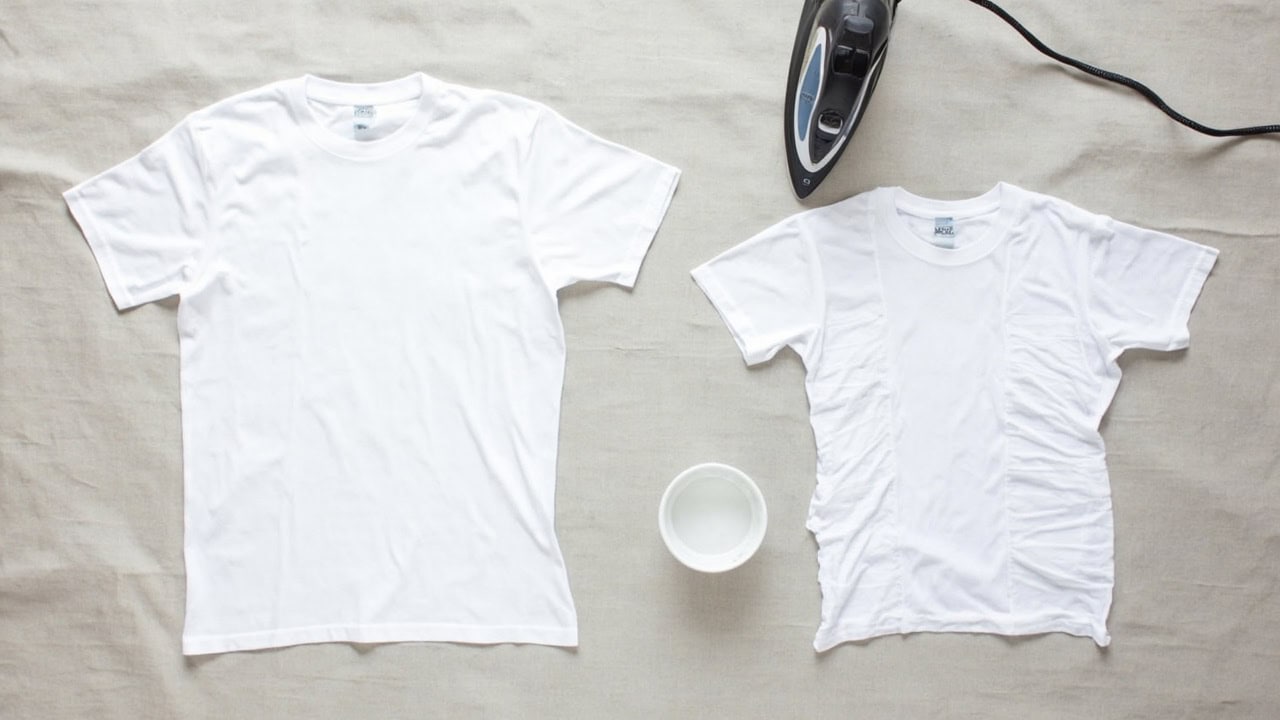
Heat shrinkage is the most uniform no-sew method for cotton t-shirts because it shrinks the entire fabric evenly rather than removing material or creating focal stress points. The mechanism is straightforward: controlled heat and steam relax and contract the cotton fibers within their remaining shrinkage potential. Pre-shrunk cotton retains approximately 2–5% residual shrinkage that heat can reactivate, producing dimensional reduction of up to 5–7% of the original measurement in any given direction [AATCC Test Method 135].
Before beginning, wash the t-shirt in warm water to remove any fabric finishing coatings (such as softeners, soil-release agents, or sizing) that could act as a barrier to heat and moisture penetration. Damp fabric responds more effectively to heat shrinkage because water molecules act as a plasticizer, allowing the fiber to relax and reform more readily.
Set your iron to the cotton setting, which typically corresponds to 150–180°C (302–356°F). See the iron temperature guide for fabric-specific settings. Enable the steam function — steam transfers heat more efficiently than dry air and keeps the fabric evenly moistened during application. Have a spray bottle handy for spot-dampening if you need to target specific areas more aggressively.
Follow these steps for heat shrinkage:
Heat Shrinkage Steps
- Dampen the target area — Using a spray bottle, lightly moisten the section of fabric you want to shrink. Focus on the area needing most reduction: sleeves for bicep tightening, sides for waist taper, or hem for length shortening.
- Place a pressing cloth over the fabric — A thin cotton muslin or clean handkerchief prevents direct iron contact that causes shine marks or scorching. This is especially important on dark or tightly woven cotton.
- Apply iron with firm pressure — Press the iron down firmly on each section for 30–45 seconds. Do not slide the iron — hold it in place to concentrate heat on the target area.
- Focus on target areas systematically — Sleeves require ironing the entire sleeve circumference; sides need attention along the torso taper; the hem needs length reduction along its full width.
- Allow to cool completely before checking — Shrinkage sets as the fabric dries. Check dimensions only after the fabric has fully cooled to room temperature, typically 10–15 minutes after ironing.
- Repeat if additional shrinkage is needed — If the first application did not achieve the desired reduction, repeat the process. The maximum achievable shrinkage on pre-shrunk cotton is approximately 5–7% of the original dimension in the treated direction.
Heat Shrinkage Warnings
Warning: Do not apply this method to polyester blends or any fabric with a synthetic fiber content above 50%. Polyester begins to deform at 80–85°C and will melt or develop holes at iron temperatures above 180°C. If you are unsure of the fabric composition, perform a patch test on an inside seam first.
Expected Results
Heat shrinkage on pre-shrunk cotton yields approximately 5–7% dimensional reduction — roughly 1 inch on a sleeve or 1.5 inches on a torso circumference. The cotton-polyester blend responds less predictably because the polyester component does not shrink and can create uneven tension as the cotton contracts around it.
Method 2: Cut and Knot Method (Works on Any Knit Fabric)
The cut-and-knot method is a purely mechanical alteration that requires no heat and works on any knit fabric, including cotton, cotton-polyester blends, rayon, and modal. Instead of shrinking the fabric, the cut-and-knot method removes excess material and gathers the remaining fabric along the cut line to create a fitted silhouette. This method is the most reversible of all no-sew techniques.
The look is distinctive — knotted side seams — and has been a visible fashion detail in its own right since the 1980s, when distressed and cut-and-knotted tees became mainstream. The gathered effect creates a subtle texture along the side that many find aesthetically preferable to a flat seam.
Follow these steps for the cut-and-knot method:
Cut and Knot Steps
- Lay the t-shirt flat — Place the tee on a clean, flat surface. Smooth out wrinkles so the side seam is clearly visible. Use chalk or a fabric marking pen to draw the new desired seam line on both sides.
- Cut from hem toward armpit — Using sharp scissors, cut straight up from the hem along your marked line. Stop 2–3 inches (5–7.5 cm) below the armpit to keep the lower hem intact — this preserves the original hem structure and prevents the knot from sitting at an awkward height.
- Make a second parallel cut inward — Cut a second line 1 inch (2.5 cm) inward from the first cut, running the same length. This creates a strip of fabric that will be removed entirely.
- Tie a secure knot at the base — Pull the two cut edges (the original seam line and the new inner cut line) together and tie a firm overhand knot at the bottom, just above the intact hem. The knot should be tight enough that it will not slip during wear or washing.
- Continue tying knots up the side — Space knots at 1–2 inch (2.5–5 cm) intervals up the cut section for a regularly gathered effect. Tighter spacing creates more reduction; wider spacing is more subtle.
- Trim excess fabric from knots — Cut away any long fabric tails from the knots so they lie flat against the garment. On jersey knit fabric, fray is minimal due to the interlocking loop structure of the knit. If the fabric is a woven cotton, seal cut edges with a thin line of fabric glue to prevent unraveling.
Cut and Knot Results
This method reduces width by 1–3 inches (2.5–7.5 cm) per side seam depending on how aggressively you gather. For a moderate taper on a medium-sized tee, two to three knots per side typically achieve a visible but not extreme fit improvement. You can undo the knots to return to the original width, though small cut marks (3–5 mm in width) will remain at the seam line.
If a cleaner finish is desired, apply a small amount of fabric adhesive inside each knot before wearing — products like Tear-mender fabric glue or E6000 craft adhesive hold the knot interior firmly and prevent it from loosening over washes.
Method 3: Cut and Hem Bonding (Clean Finish Without Sewing)
Cut-and-hem bonding uses fabric adhesive or hemming tape instead of stitching to create a clean, professional-looking hem without any visible sewing. This method is the most discreet of the three no-sew techniques — when done correctly, the finished hem is nearly indistinguishable from a sewn hem on casual inspection.
The technique works for both length adjustments (shortening the torso or sleeves) and width reductions along the side seams. The limitation is durability: adhesive bonds degrade over wash cycles and are not as strong as stitched hems. Most bonded hems last 10–20 wash cycles before the bond begins to weaken, depending on the adhesive used and the wash temperature.
Recommended products include:
- Tear-mender fabric glue — A latex-based adhesive designed specifically for fabric-to-fabric bonding. It remains flexible after curing and tolerates machine washing. Cure time is typically 2–4 hours under light pressure, with full bond strength reached at 24 hours.
- Hemingford hemming tape — A heat-activated web tape placed between two fabric layers and activated with an iron. Cleaner than liquid adhesive because it does not squeeze out from the seam. Requires precise placement before activation.
- E6000 craft adhesive — An industrial-strength craft glue that bonds fabric to itself and to other materials. Stronger than Tear-mender but less flexible when cured, which can make it more visible through thin fabric. Use in well-ventilated areas due to solvent fumes.
Follow these steps for cut-and-hem bonding:
Cut and Hem Bonding Steps
- Turn the t-shirt inside out — Working on the inside of the garment gives you better control over the fold and keeps adhesive off the outer fabric surface.
- Fold hem to desired length — Fold the original hem up to the new desired length. For a torso length adjustment, a typical fold is 1–2 inches (2.5–5 cm). For sleeves, fold from the cuff edge toward the sleeve head.
- Apply fabric glue or hemming tape along the fold — For liquid adhesive, apply a thin, even bead along the fold line on the inside of the hem. For hemming tape, insert the tape strip between the folded fabric and the garment body before pressing.
- Press firmly and hold for 30–60 seconds — Apply consistent pressure along each section of the hem. Use clips or binder clips to hold sections in place while the adhesive cures if the hem is long.
- Allow adhesive to cure for 24 hours before wearing or washing — This is the most critical step. Premature wearing or washing breaks the bond before it reaches full strength. Place the garment flat while curing.
- For sleeves: fold and bond in the same manner — Follow the same process on each sleeve, matching the fold depth on both sides for symmetry.
Cut and Hem Bonding Durability
Do not expect a bonded hem to last as long as a sewn one. Domestic adhesive technology, even professional-grade products, does not match the mechanical strength of thread. Re-apply adhesive when the bond weakens — typically every 10–20 washes, depending on the detergent used and wash temperature.
Heat vs. Cut Method Comparison
Each no-sew resizing method has distinct characteristics suited to different fabric types and desired outcomes. The table below summarizes the key differences to help you select the appropriate technique for your t-shirt and goals.
| Method | Best Fabric | Shrinkage Amount | Difficulty | Durability | Time Required |
|---|---|---|---|---|---|
| Heat shrinkage | 100% cotton | Up to 5–7% per dimension | Easy | Permanent | 20–30 minutes |
| Cut and knot | Any knit or jersey | 1–3 inches per side | Easy | Moderate (reversible) | 15–20 minutes |
| Cut and bond | Any woven or knit | Varies by fold depth | Moderate | 10–20 washes | 30 min + 24hr cure |
Fabric Compatibility Guide for Resizing Without Sewing
Not all fabrics respond the same way to heat or cutting methods. Fabric fiber composition determines which techniques are safe and effective. Use this guide before beginning any no-sew resize project.
100% cotton jersey: All three methods work. Heat shrinkage gives the most uniform results because it shrinks the entire fabric evenly without removing material or creating focal stress points. Cut methods are also effective, with the knot method creating a textured side detail and the bond method producing a clean hem.
Cotton-polyester blend (under 50% polyester): Use cut methods preferentially. If applying heat, perform a patch test on an inside seam first and keep the iron at the lowest effective temperature. Blended fabrics respond less predictably to heat shrinkage than pure cotton because the polyester component does not shrink and can create uneven tension as the cotton contracts around it.
Polyester or polyester-dominant blends: Do not use the heat method. Polyester is a thermoplastic fiber — it softens and begins to deform at 80–85°C and will melt, scorch, or develop shiny holes at temperatures above 180°C. An iron set to the cotton setting (150–180°C) will damage polyester-dominant fabrics. Use cut-and-knot or cut-and-bond only.
Rayon and viscose: Use cut methods only. Rayon is a semi-synthetic fiber with good moisture absorption but poor heat tolerance — it can shrink excessively and become damaged when exposed to high iron temperatures. The cut-and-knot method is the safest alteration approach for rayon tees.
Linen: The heat method works well. Linen tolerates high temperatures without melting or scorching, and its relatively open weave structure responds well to steam and pressure. Linen does not retain residual shrinkage as predictably as cotton, so results vary. Cut methods also work but linen is prone to fraying at cut edges — seal cut edges with fabric adhesive.
Modal: Use cut methods only. Modal is a type of viscose (beech tree cellulose fiber) that is more dimensionally stable than standard rayon but still heat-sensitive. Cut-and-knot or cut-and-bond will not damage modal fibers, while heat application can cause irregular shrinkage.
Frequently Asked Questions
References
- AATCC. (2020). AATCC Test Method 135 — Dimensional Change of Fabrics After Home Laundering. American Association of Textile Chemists and Colorists.
- ISO. (2021). ISO 6330 — Textiles — Domestic washing and drying procedures for textile testing. International Organization for Standardization.
- Cotton Incorporated. (2023). Cotton Fabric Care and Performance. Cotton Incorporated technical resources
- Wikipedia. (2025). Dimensional change in textiles. en.wikipedia.org/wiki/Shrinkage_(fabric)
- Wikipedia. (2025). Polyester. en.wikipedia.org/wiki/Polyester
- Wikipedia. (2025). Heat setting. en.wikipedia.org/wiki/Heat_setting


