
Jacquard Weaving: How Complex Patterns Are Created on a Loom

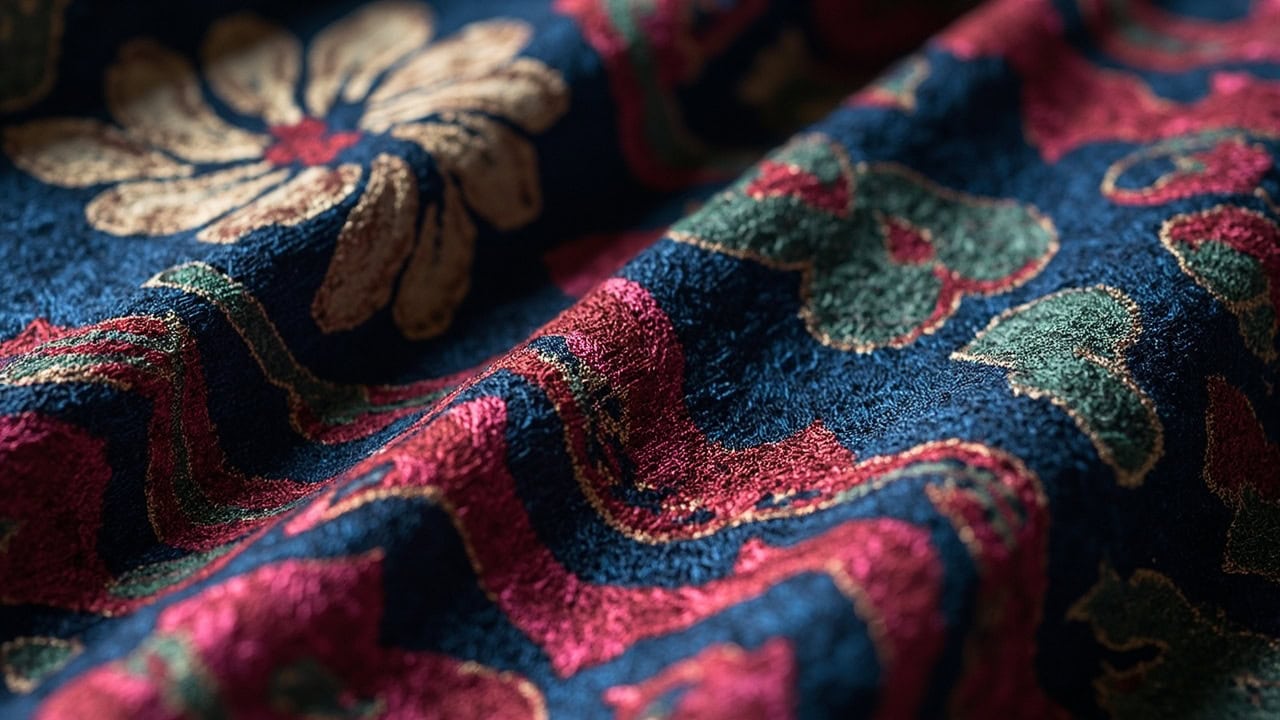
Jacquard weaving is a method of creating intricate, multi-colored patterns directly during the weaving process by individually controlling each warp thread via a punched card system — unlike dobby weaving which groups threads into sheds, jacquard can manipulate thousands of warp threads independently to produce brocade, damask, and tapestry fabrics with photographic detail and seamless pattern integration.
What Is Jacquard Weaving? Definition and Origins
Named after Joseph Marie Jacquard (French weaver, 1752–1834), the jacquard loom mechanism was patented in 1804, revolutionizing textile production by automating complex pattern weaving that had previously been done entirely by hand. Jacquard’s invention built upon earlier work by Basile Bouchon (1725), Jean Baptiste Falcon (1728), and Jacques Vaucanson (1740), who each contributed incremental advances toward the punched-card concept. The concept of using perforated material to control pattern threads traces back even further — to a 15th-century Italian weaver known as “Jean le Calabrais.”
The jacquard loom uses a system of punched cards to control warp thread elevation, where each hole in a card corresponds to one warp thread being raised. This seemingly simple mechanism was profound: it was the first industrial use of programmable machinery, making jacquard weaving a direct ancestor of modern computer programming. When Charles Babbage designed his Analytical Engine in the 1830s, he explicitly referenced jacquard punch cards as the model for how to store programs — meaning the technology you use to read this article has roots in a textile machine from 1804.
How Jacquard Weaving Works: The Mechanism Explained
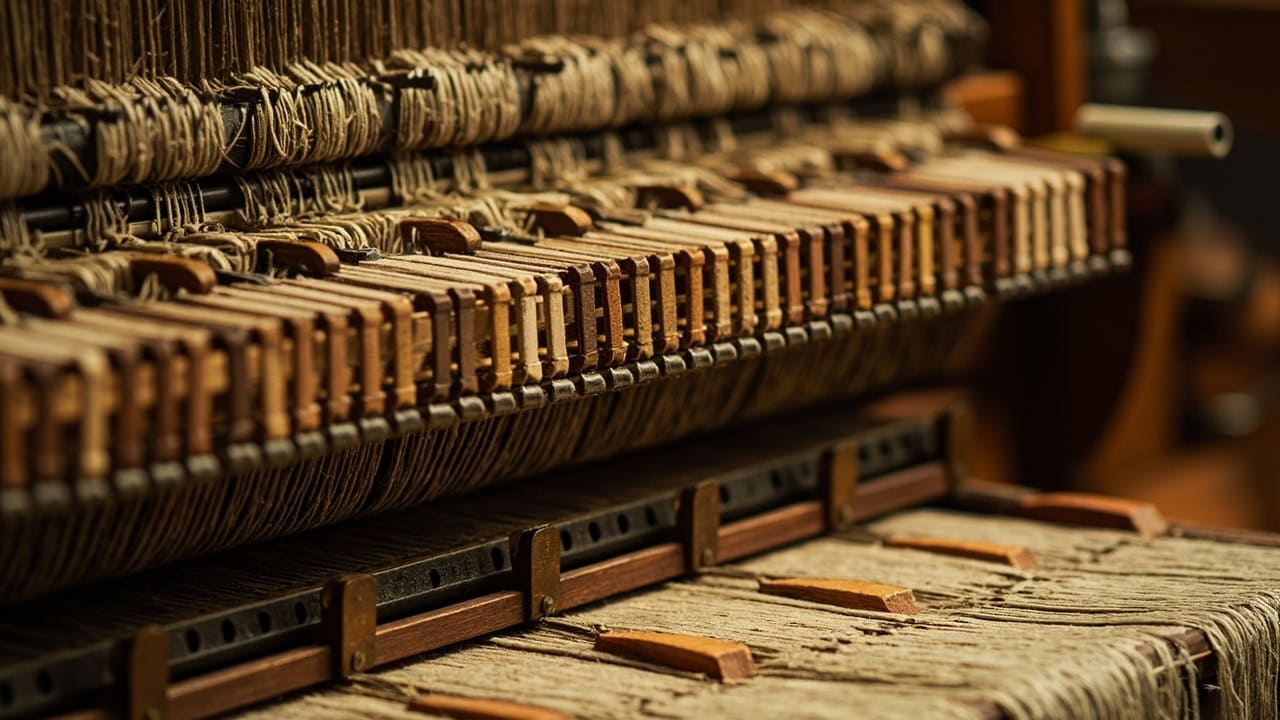
The jacquard mechanism controls each warp (vertical) thread individually through a harness cord connected to a hook. Punch cards — one per weft row — contain holes that determine which hooks are raised at any given moment. When a hook is raised, its connected warp thread rises, creating an opening (the shed) through which the weft passes. A loom with a 400-hook head typically runs four threads per hook, producing fabric up to 1,600 warp ends wide.
The cards are fastened into a continuous chain passing over a square box. Each quarter rotation presents a new card representing one row (one pick of the shuttle). Where holes exist in the card, rods pass through unmoved; where no hole exists, rods push left, which movement is transferred to the hooks and heddles. Unlike dobby weaving, which raises groups of warp threads together within limited shaft configurations (typically 20–50 shafts), the jacquard system can control thousands of threads simultaneously and independently. Modern electronic jacquard systems, which began replacing mechanical punch-card systems in 1983 with Bonas Textile Machinery’s first successful electronic jacquard at ITMA Milan, can now extend to more than 10,000 warp ends, eliminating repeat patterns entirely.
Multiple colors are achieved by using a different colored weft yarn for each shot — the shuttle carries one color per pass, and the pattern emerges from which warp threads are raised at each moment, determining which weft color appears on the fabric surface. This creates the multi-hued, complex designs that define jacquard-woven fabrics.
Key Properties of Jacquard Fabrics
| Property | Description |
|---|---|
| Pattern depth | 3D effect — pattern appears woven into fabric, not printed on surface. The weave structure itself creates relief. |
| Durability | Extremely durable; pattern is integral to the fabric structure and cannot wear off or fade away with washing. |
| Weight range | From lightweight chiffon jacquard to heavy upholstery-weight constructions exceeding 400 g/m². |
| Breathability | Varies by fiber content; generally good with natural fibers like cotton, linen, and silk. |
| Moisture sensitivity | Depends heavily on fiber — silk jacquard is sensitive to moisture, while cotton jacquard tolerates washing. |
| Color fastness | Generally excellent; dyes are applied during weaving and penetrate the fibers throughout the fabric structure. |
Types of Jacquard Fabrics
Jacquard weaving produces several distinct fabric types, each with its own characteristics:
- Brocade: Features a rich, raised pattern visible against a background weave. Supplemental weft threads float across pattern areas, creating the characteristic raised effect. Non-reversible — the back shows long float threads.
- Damask: A reversible flat pattern fabric where satin and sateen weave structures create contrast between the pattern and ground. Fully reversible — both sides show the design in negative.
- Tapestry: Creates pictorial woven images using many colored weft yarns — essentially a pixel image in thread. Used for wall hangings and art pieces as well as decorative textiles.
- Matelassé: Has a quilted or padded appearance achieved through double cloth construction with hidden filler yarns between two woven layers.
- Single-layer jacquard: Lightweight construction with one fabric layer. Used for scarves, linings, and sheer apparel.
- Double-layer jacquard: Two separate fabrics woven simultaneously face-to-face, creating two-faced designs with independent patterns on each side.
Common Uses and Applications
The versatility of jacquard construction means it is used across virtually every textile category. The ability to work with any fiber — cotton, silk, wool, linen, synthetic blends, or modern microfibers — means jacquard fabrics appear everywhere from haute couture to heavy-duty upholstery.
- Home textiles: Upholstery fabric, drapery, table linens, bedding — matelassé coverlets are a particularly common application in bedroom textiles.
- Apparel: Dresses, suits, ties, scarves, church vestments, and formalwear where the pattern’s depth and permanence add luxury appeal.
- Accessories: Handbags, wallets, belts, shoe overlays, and small leather goods that benefit from the pattern’s durability.
- Decorative: Wall hangings, tapestries, and art pieces where the jacquard’s ability to render pictorial images is fully exploited.
Jacquard vs. Dobby: Understanding the Difference
Understanding the distinction between jacquard and dobby weaving is essential for anyone working with woven fabrics, purchasing textiles, or specifying fabrics for manufacturing.
| Feature | Jacquard | Dobby |
|---|---|---|
| Thread control | Individual warp threads controlled independently | Groups of warp threads raised together in shaft configurations |
| Pattern complexity | Very high — supports thousands of hooks and independent warp control | Limited — typically 20–50 shafts restricting pattern scope |
| Cost | Higher due to more complex machinery and slower production | Lower — simpler mechanism, faster weaving speed |
| Typical patterns | Florals, medallions, portraits, photographic imagery, complex isolated motifs | Geometric repeats, simple stripe or dot patterns, small-scale motifs |
| Machine width | Wide — modern jacquards exceed 350 cm | Narrower — dobby looms typically produce narrower fabrics |
| Origin | 1804 (Joseph Marie Jacquard) | Earlier, simpler mechanism predating the jacquard |
The practical test for identification: if a pattern features isolated, complex shapes — a single rose, a human portrait, a naturalistic landscape — it is almost certainly jacquard-woven. Dobby patterns are inherently limited to repeating geometric motifs and small-scale textures because the mechanism groups threads rather than controlling them individually.
Pros and Cons of Jacquard Fabrics
| Pros | Cons |
|---|---|
| Intricate, complex patterns possible — photographic detail achievable | Higher cost than printed or dobby-woven fabrics |
| Pattern is permanent — woven into structure, cannot wear off | Slower production speed than dobby looms |
| Wide variety of fiber options — cotton, silk, wool, synthetics | Limited stretch in many jacquard constructions |
| Many types are fully reversible (damask) | Can be heavier than equivalent printed fabrics |
| High perceived value and luxury aesthetic | Some jacquards require dry cleaning (especially silk blends) |
Care Summary for Jacquard Fabrics
Care for jacquard fabric is determined by the fiber content, not the weave structure itself. Always check the care label, but general guidelines by fiber type apply:
- Silk jacquard: Dry clean only. Avoid water, heat, and direct sunlight. Store folded in breathable fabric bags.
- Cotton jacquard: Machine wash cold on gentle cycle. Tumble dry on low heat. Press with a medium-hot iron while slightly damp.
- Wool jacquard: Dry clean recommended. May tolerate gentle hand wash in cool water with wool-specific detergent. Lay flat to dry to preserve shape.
- Synthetic jacquard (polyester, nylon blends): Machine wash warm. Tumble dry on low heat. Iron as needed on synthetic setting — generally low temperature.
Jacquard fabrics generally hold dye better than printed fabrics because the color is woven in rather than applied to the surface. However, heavy exposure to sunlight can cause fading in any dyed fabric over time, regardless of the weave mechanism.
Frequently Asked Questions
Q: What is the difference between jacquard and brocade?
A: Brocade is a type of jacquard fabric — specifically, brocade features a raised pattern (supplemental weft threads) visible against a background weave. All brocades are jacquard-woven, but not all jacquards are brocades. Damask, matelassé, and tapestry are other jacquard fabric types.
Q: Is jacquard weaving only for patterned fabrics?
A: Yes — jacquard is specifically a pattern-creating mechanism. The entire purpose of the jacquard system is to produce multi-colored, complex designs during weaving. Plain weaves (solid color, no pattern) use simpler mechanisms like plain looms or dobby looms.
Q: Can jacquard fabric be used for upholstery?
A: Absolutely — jacquard is one of the most popular upholstery fabrics due to its durability and pattern permanence. Heavy-weight cotton, cotton-polyester, and even silk-blend jacquards are commonly used for furniture. Upholstery jacquards typically feature higher thread counts and more durable fiber blends than apparel jacquards.
Q: How do you identify jacquard fabric?
A: Look for: (1) The pattern is woven into both sides (reversible) — damask is fully reversible; brocade may be nearly so; (2) Individual threads are visible at pattern edges, not a printed surface; (3) Complex isolated motifs (single flowers, medallions) rather than simple repeating geometric patterns; (4) A slightly raised or three-dimensional pattern texture compared to flat printed fabric.
References
- Collier, B.J. and Tortora, P.G. (2015). Understanding Textiles (8th ed.). Pearson.
- International Fabricare Bulletin. (2018). Care and Labelling of Textile Articles. International Fabricare Association.
- Joseph Marie Jacquard. (2024). Jacquard Weaving — Wikipedia. Wikimedia Foundation.
- Tortora, P.G. and Johnson, I. (2014). The Fairchild Books Dictionary of Textiles (8th ed.). Fairchild Books.


