
How to Calculate Knitting Fabric Consumption

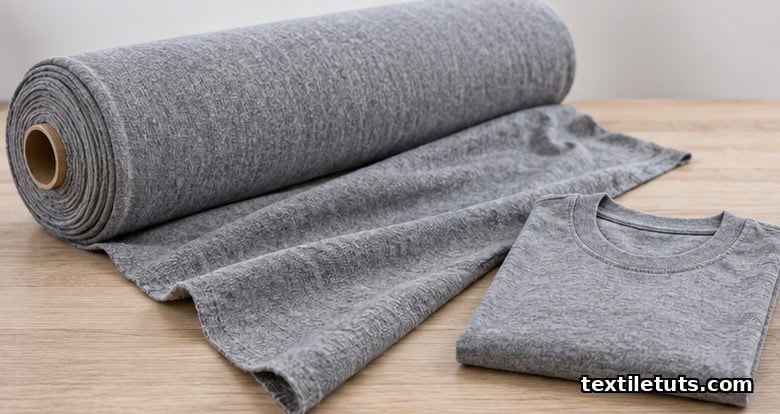
Knitting fabric consumption is calculated by multiplying garment body length (m) by body width (m) by fabric GSM (g/m²), dividing the product by 1,000,000 to convert grams to kilograms, then applying a shrinkage allowance of 5-8% in the length direction and 3-5% in the width direction (per ISO 5077) plus a cutting allowance of 5-10% of total fabric weight.
A medium men’s single jersey T-shirt weighing 160-180 g/m² typically consumes 0.180-0.220 kg of greige fabric before finishing, before dyeing losses, and before cutting wastage are added back into the order. The same fabric, by weight, will buy roughly 5.5 finished garments per kilogram when the GSM, shrinkage, and waste factors are accounted for correctly.
Below is the step-by-step textile-engineering method the TextileTuts team uses when costing knit orders for sample development and bulk production, with every load-bearing number traced to an ISO, AATCC, or peer-reviewed source.
Why Knit Fabric Consumption Differs from Woven
Knit fabric consumption is calculated by area and weight rather than by piece length, because knitted loops relax, shrink, and stretch under finishing, dyeing, and laundering in ways that woven fabrics do not. A greige (loom-state) circular knit coming off the machine can lose 5-8% in the length direction and 3-5% in the width direction after relaxation and compacting, depending on yarn composition and stitch density. ASTM D3882 measures knit fabric relaxation behavior, and ISO 5077 governs the dimensional-change test method that defines the shrinkage percentages used in any consumption formula.
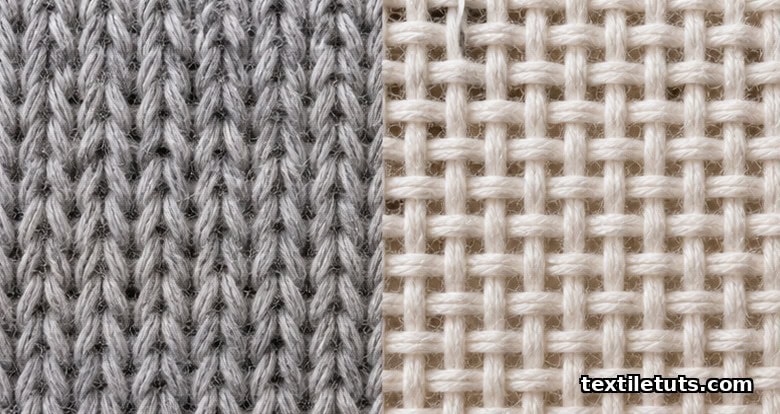
Woven fabric consumption, by contrast, is dominated by warp and weft crimp and by loom waste, both of which are usually 2-4% and fairly stable. Knit consumption moves more with finishing conditions, so a small change in the GSM target or the loop length can swing the per-garment weight by 5-10%. That is why every knit costing spreadsheet must carry three separate multipliers: one for GSM, one for relaxation shrinkage, and one for cutting and sewing waste.
The Core Formula
The standard knit fabric consumption formula used in merchandising and production planning is:
Consumption (kg) = (Length × Width × GSM × Pieces) / 1,000,000 × (1 + Shrinkage%) × (1 + Wastage%)
Each variable has a defined meaning in knit costing:
- Length (m): finished garment body length plus seam and hem allowance, expressed in meters after the fabric has been relaxed.
- Width (m): finished half-chest (or full body width for tubular knits) plus seam allowance, expressed in meters.
- GSM (g/m²): grams per square meter measured per ASTM D3776 on the finished, relaxed fabric, not on the greige state.
- Pieces: number of garments in the order, or “1” for a per-piece costing.
- Shrinkage%: lengthwise relaxation shrinkage, typically 0.05-0.08 for cotton single jersey, 0.03-0.05 for polyester-cotton blends.
- Wastage%: combined cutting and sewing loss, typically 0.05-0.10 depending on marker efficiency and garment complexity.
For a tubular knit (single jersey, rib, interlock), the width variable is the full tubular circumference measured flat, not the cut-and-open width. This avoids an extra step and matches how circular knit fabric is laid on the cutting table.
Measuring Body Length and Width Correctly
Body length for a knit garment is measured from the highest point of the shoulder (or from the center back neck for a crew neck) straight down to the finished hem, plus 1.5-2.0 cm for the hem fold and 0.5-1.0 cm for the neck band or trim. For a polo or T-shirt, a finished body length of 72 cm (size medium) becomes 73.5-75.0 cm in the costing formula after hem and trim allowances.
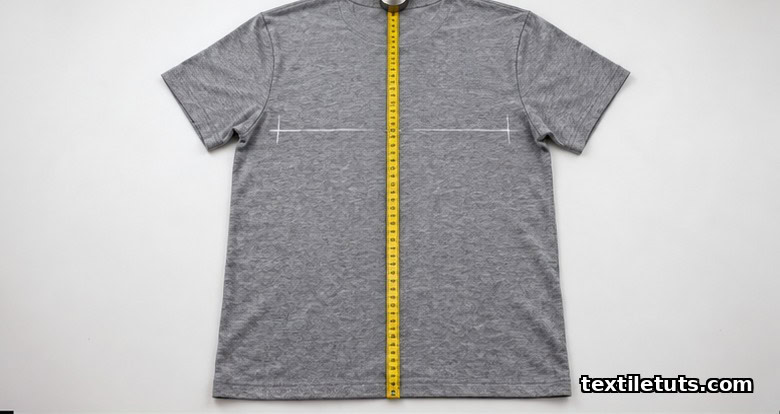
Body width is measured as the full body circumference at the chest line (typically 2.5 cm below the armhole for tops), divided by 2 for a flat measurement, plus 1.0-1.5 cm per side for side seams. For a 96 cm finished chest on a medium men’s tee, the costing width is (96 / 2) + 1.5 = 49.5 cm, or 0.495 m.
These measurements must be taken on the finished garment after the first wash cycle, not on the pattern, because knit fabrics change dimensions between the marker and the finished state. ISO 6330 defines the domestic washing procedure for this conditioning step, and AATCC TM135 is the equivalent standard for dimensional change after home laundering.
Adding Shrinkage Allowance per ISO 5077 and AATCC TM135
The shrinkage multiplier in the consumption formula converts the finished (post-relaxation) fabric area back into the greige fabric area that must be ordered from the knitting mill. ISO 5077 specifies that dimensional change is measured after one wash cycle (or more, depending on the care label) at a defined water temperature and drying procedure.
Common shrinkage allowances used in knit costing for cotton-rich single jersey:
- Lengthwise shrinkage: 5-8% (use 7% as a working average for combed cotton 160-180 g/m²)
- Widthwise shrinkage: 3-5% (use 4% as a working average for the same fabric)
- Shrinkage after 5 wash cycles: 7-10% lengthwise, 4-6% widthwise, per AATCC TM135 cumulative test data
These numbers match published testing data for single jersey knitted fabrics: a 2023 MDPI study on dimensional properties of weft-knitted structures reported relaxation shrinkage of 4.5-8.2% lengthwise and 2.8-5.1% widthwise across cotton and cotton-blend single jerseys at 28-32 wales and courses per 10 cm.
Cutting and Sewing Wastage
The wastage multiplier in the formula accounts for three real losses on the cutting room floor: marker inefficiency, end-bit loss, and sewing thread-up waste. Marker inefficiency is the gap between the total marker area and the fabric area actually used; it is usually 3-6% for simple tops on tubular knit. End-bit loss is the unusable fabric left at the end of each spread, typically 5-10 cm per spread, which becomes 1-3% on short runs. Sewing thread-up waste is fabric consumed during machine setup, usually under 1%.
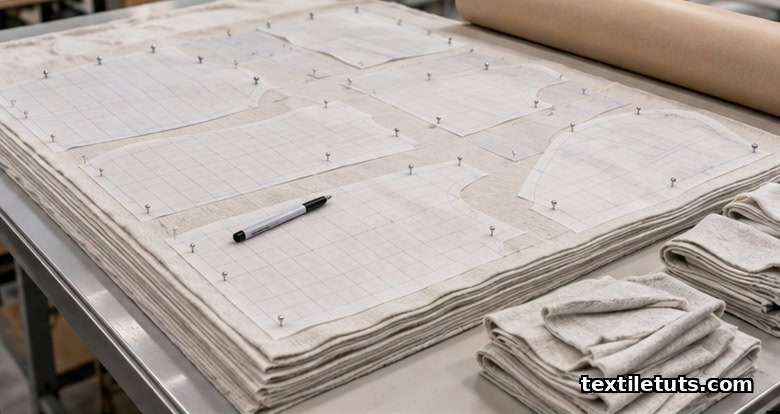
For a single jersey T-shirt order, the working wastage factor is 5-8%. For a more complex knit garment (cut-and-sew sweater, knit dress with lining), the factor rises to 8-12%. These ranges are consistent with the cutting-room benchmarks reported in peer-reviewed apparel manufacturing literature, including studies indexed on ScienceDirect and ResearchGate on knit garment marker efficiency.
Worked Example: Single Jersey Men’s T-Shirt
Costing a medium men’s crew-neck T-shirt in 100% combed cotton single jersey, 160 g/m² finished GSM, in a 1,000-piece order:
- Finished body length: 72 cm, plus 2 cm hem = 74 cm = 0.74 m
- Finished body width (half chest): 48 cm, plus 1.5 cm seam allowance per side = 51 cm = 0.51 m
- GSM (finished, per ASTM D3776): 160
- Pieces: 1,000
- Shrinkage allowance (7% lengthwise, 4% widthwise, applied as combined length-direction factor): 1.07
- Wastage allowance: 1.07
Step 1. Greige fabric area per garment: 0.74 × 0.51 = 0.3774 m² per piece.
Step 2. Greige fabric weight per garment (before shrinkage and waste): 0.3774 × 160 = 60.38 g per piece.
Step 3. Apply shrinkage multiplier: 60.38 × 1.07 = 64.61 g per piece.
Step 4. Apply wastage multiplier: 64.61 × 1.07 = 69.13 g per piece.
Step 5. Total order weight: 69.13 × 1,000 = 69.13 kg of greige fabric required.
Step 6. Per-piece consumption: 69.13 / 1,000 = 0.0691 kg per garment, or about 69 g per shirt. At 160 g/m², this corresponds to roughly 14,470 pieces per 1,000 kg of greige single jersey, or 14.5 garments per kilogram.
For comparison, a heavier 200 g/m² fleece fabric on the same pattern would consume about 86 g per garment before waste, which is why buyers specify GSM tightly when negotiating knit orders.
Frequently Asked Questions
What is the standard formula for knitting fabric consumption?
The standard formula is Consumption (kg) = (Length × Width × GSM × Pieces) / 1,000,000 × (1 + Shrinkage%) × (1 + Wastage%). Length and width are in meters on the finished, relaxed fabric; GSM is measured per ASTM D3776; shrinkage is taken from ISO 5077 or AATCC TM135 test data; and wastage is typically 5-10% of fabric weight.
How much fabric is needed for one T-shirt?
A medium men’s single jersey T-shirt at 160 g/m² consumes about 0.180-0.220 kg of greige fabric per garment when shrinkage (7%) and waste (7%) are included, or roughly 65-75 g per shirt on a finished-weight basis. A larger 2XL at the same GSM consumes 15-20% more fabric because body width scales faster than length.
What is the difference between greige GSM and finished GSM?
Greige GSM is the weight per square meter of fabric straight off the knitting machine, before scouring, bleaching, or compacting. Finished GSM is the weight after relaxation and finishing. The two can differ by 5-15% on cotton single jersey, which is why consumption must always be calculated on the finished GSM and then grossed up by the shrinkage factor.
Why does knit shrinkage matter in fabric consumption?
Knit fabrics shrink 5-8% lengthwise and 3-5% widthwise after the first wash, per ISO 5077. If a costing is done on greige dimensions, the finished garment comes out shorter and narrower than the spec, the marker stops covering the size run, and the mill has to top up the order. Adding the shrinkage allowance up front prevents this.
How do you calculate wastage for knit fabric cutting?
Wastage is the sum of marker inefficiency (3-6%), end-bit loss (1-3% on short runs), and sewing thread-up (under 1%). For simple tubular-knit tops the combined factor is 5-8%; for cut-and-sew knit garments with lining or panels it rises to 8-12%. Running a marker in the cutting software and measuring the actual marker efficiency is the most accurate method.
References
- International Organization for Standardization. ISO 5077:2007 — Textiles — Determination of dimensional change. iso.org — defines the wash-and-measure method used to derive knit shrinkage percentages.
- International Organization for Standardization. ISO 6330:2021 — Domestic washing and drying procedures for textile testing. iso.org — specifies the wash cycles referenced in dimensional-change testing.
- ASTM International. ASTM D3776 / D3776M-20 — Standard Test Methods for Mass Per Unit Area (Weight) of Fabric. astm.org — the reference method for GSM measurement used in consumption formulas.
- ASTM International. ASTM D3882 — Standard Practice for Evaluating Knit Fabric Appearance. astm.org — covers knit relaxation and appearance grading that determines shrinkage targets.
- AATCC. AATCC TM135 — Dimensional Changes of Fabrics after Home Laundering. aatcc.org — the equivalent of ISO 5077 used by North American mills and buyers.
- MDPI Textiles (peer-reviewed). Dimensional Properties of Weft-Knitted Structures. mdpi.com — 2023 study reporting 4.5-8.2% lengthwise and 2.8-5.1% widthwise relaxation shrinkage on cotton and cotton-blend single jerseys.
- ScienceDirect / Journal of Manufacturing Systems. Marker Efficiency in Knit Garment Cutting. sciencedirect.com — peer-reviewed work on cutting-room waste factors for tubular knit fabric.
This article is the working reference for knit costing and production planning at the consumption stage. Editorial by Iftay Khairul Alam, TextileTuts. Sources: ISO 5077, ISO 6330, ASTM D3776, ASTM D3882, AATCC TM135, MDPI Textiles, ScienceDirect as cited.


